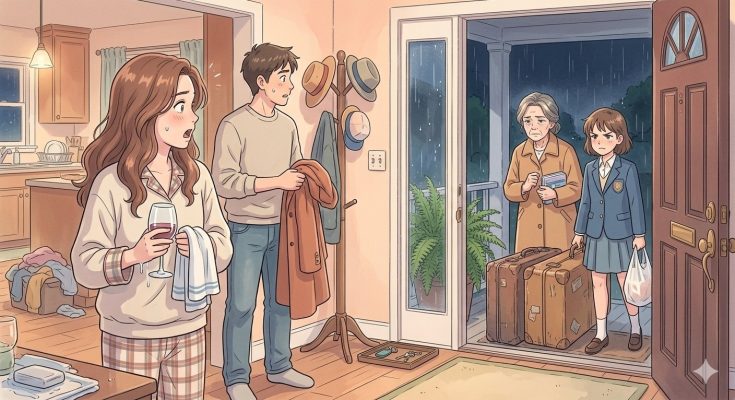
Daniel’s older brother, Thomas, showed up two evenings later.
Without calling.
Apparently surprise visits were genetic.
When I opened the door, he stood there with his hands in his coat pockets and the expression of a man who had already heard enough to be angry but was reluctantly willing to gather evidence.
I looked past him toward the driveway.
“No suitcases?”
He almost smiled.
“Can I come in?”
“Depends. Did you bring house rules?”
That got the smile.
Barely.
Then it vanished.
Thomas looked enough like Daniel that strangers sometimes assumed they were twins despite the age difference. Same gray-blue eyes. Same shoulders. Same habit of rubbing their jaw when annoyed.
But Thomas had never inherited Daniel’s ability to hide from conflict.
He walked into the kitchen.
Daniel was at the table with several printed apartment listings spread in front of him.
Thomas noticed.
“So it’s true.”
Daniel leaned back.
“Which part?”
“You put Mom in a hotel.”
“I booked her an extended-stay suite.”
“You know what I mean.”
I took a pitcher of iced tea from the refrigerator. Years of marriage had trained hospitality into me so thoroughly that apparently I would offer beverages during my own prosecution.
Thomas sat down.
“Mom says Elaine let her stay one night, then threw her out before breakfast.”
I set the pitcher down harder than necessary.
Daniel answered first.
“Elaine didn’t throw anybody out. I did.”
Thomas stared at him.
“You?”
“Yes.”
That clearly wasn’t in the story he’d heard.
“Why?”
“Because Mom moved into our house without permission.”
“She said you knew.”
“I knew she was thinking about selling.”
“She said you told her she could stay here.”
“I never said that.”
Thomas leaned forward.
“Did you tell her she couldn’t?”
Silence.
I looked at Daniel.
He looked at the table.
Thomas sat back.
“Well, there you go.”
Daniel’s head came up.
“No. I was an idiot for not saying no. That still doesn’t turn it into yes.”
I looked at him.
That might have been the first time in twenty-four years I heard Daniel admit fault without explaining how circumstances technically made it someone else’s problem.
Thomas rubbed his forehead.
“Why couldn’t she stay a few weeks while she found somewhere?”
“She didn’t come for a few weeks,” I said.
Thomas turned toward me.
“How do you know?”
“She brought a fern.”
He stared.
“The plant?”
“The plant, three suitcases, her medication case, and Rebecca.”
Thomas frowned.
“Rebecca was moving in too?”
Daniel and I exchanged a look.
“You didn’t know?” I asked.
“No. Mom said Rebecca was helping her settle.”
I laughed.
“She settled pretty quickly.”
Thomas looked confused.
“What exactly happened?”
The house rules were still tucked beneath a stack of mail on the counter.
I almost reached for them.
Then stopped.
I had spent years explaining myself in this family.
Why I didn’t like Marjorie rearranging my kitchen drawers.
Why I wanted Christmas morning with Daniel and our kids before the extended family arrived.
Why I disliked hearing comments about how much I paid for groceries in a house Marjorie didn’t fund.
Every boundary apparently required a closing argument.
I pulled my hand away.
“I’m not presenting evidence for the right to sleep in my own bedroom.”
Thomas stared at me.
Daniel pointed toward the paper.
“They planned to take our room. Rebecca planned to take Elaine’s office.”
Thomas reached for the sheet himself.
He read the first lines.
His eyebrows rose.
“Breakfast at six?”
“Apparently I was hired without an interview.”
He kept reading.
“This is insane.”
“Thank you.”
Thomas turned toward Daniel.
“You didn’t tell me this.”
“You didn’t ask. You called yesterday and told me you were ashamed of me.”
“I said Mom was ashamed of you.”
“Much better.”
Thomas put the paper down.
“I thought all this had been arranged.”
Daniel frowned.
“What do you mean?”
“Mom’s been telling people since spring she’d probably be moving in here.”
The room changed.
Daniel stared at him.
“She told people that?”
“Aunt Janet knew. I think Debbie did too.”
“What exactly did she say?”
Thomas hesitated.
“That you two had plenty of room and you told her you’d figure something out.”
Daniel went pale.
I knew that phrase.
He had almost certainly used those exact words.
Daniel’s version of avoiding a fight.
Marjorie’s version of approval.
Thomas continued.
“Honestly, I thought selling the condo was partly because of Rebecca.”
“What about Rebecca?” I asked.
Thomas looked uncomfortable.
“You really don’t know?”
There are few sentences less comforting in a family conversation.
He explained that Marjorie had used some of the money from the condo sale to pay off several of Rebecca’s credit cards.
He didn’t know the exact amount.
Only that Marjorie had complained about Rebecca’s finances after her divorce.
I slowly sat down.
“So Marjorie sold her home, paid Rebecca’s debts, and then both of them arrived here.”
Thomas lifted a hand.
“I’m not saying Rebecca stole anything.”
“I didn’t say she did.”
And I didn’t believe she had.
That would almost have been simpler.
Marjorie had chosen to rescue her.
Again.
Rebecca had been divorced for several years. She worked at a dental office most weekdays, yet somehow every financial emergency still ended with Marjorie opening her checkbook.
Daniel looked at the apartment listings.
“Mom can’t keep doing this.”
Thomas gave him a tired look.
“She has been doing it.”
That sentence followed me for the rest of the night.
Because after Thomas left, Daniel sat quietly at the kitchen table while I loaded the dishwasher.
Finally he said, “Maybe Mom could stay here.”
I stopped.
He immediately added, “Without Rebecca. Temporarily.”
I turned.
“Until we find her an apartment.”
My first instinct was no.
Absolutely no.
Instead, I asked the question that mattered.
“What happens when Rebecca needs somewhere to stay?”
Daniel looked away.
And in that silence, I realized the house rules hadn’t been the real problem.
They were just the first time someone had bothered to print the family pattern on paper.
### Part 4
The following morning Daniel called Marjorie.
She ignored the first call.
She answered the second.
Eventually he persuaded her to tour a senior apartment community about ten minutes from our house.
Elevator.
Small balcony.
Grocery store nearby.
Close enough for Daniel to help her without turning our home into an annex of hers.
The tour was scheduled for the end of the week.
For the first time since Sunday night, I thought maybe we had found a solution.
Then my phone rang at work.
It was Daniel.
His voice sounded strange.
“Mom fell.”
Every argument disappeared for a second.
“What happened?”
“She slipped getting out of the shower.”
“Is she okay?”
“They think so. Rebecca called for help. I’m heading over now.”
I was already reaching for my purse.
“I’ll meet you there.”
When I arrived, Marjorie was sitting on an exam table in a backless medical gown, her hair flattened against one side of her head.
A dark bruise was spreading across her hip.
For the first time since she had appeared on my porch, I saw her age before I saw her personality.
She didn’t look controlling.
She didn’t look impossible.
She looked seventy-six.
Fragile.
Embarrassed.
Tired.
The scans showed no fracture.
That was the good news.
The bad news was that she had taken a hard fall, and the doctor wanted somebody nearby for the next few days. She could walk carefully with a cane, but he didn’t want her getting in and out of the shower alone or wandering around while half asleep.
Rebecca sat in the corner looking at her phone.
Daniel stood beside his mother.
I already knew what question was coming.
He waited until we reached the parking lot.
“Maybe Mom should stay with us.”
There it was.
“Just until she’s steady.”
I leaned against my car.
A week earlier, I would have answered before he finished.
Now I couldn’t.
That irritated me almost as much as the request.
“She really fell,” he said.
“I know.”
“I’m not talking about permanently.”
“I know.”
The cold wind pushed a strand of hair across my face.
The truth was complicated.
I wanted to help her.
Not because she had earned the right to invade my home.
Because she was hurt.
Those were different things.
Families got into trouble when they pretended helping someone and surrendering to them were the same act.
“I’ll help,” I said. “But bringing her into our house cannot be the only definition of helping.”
Daniel looked toward the building.
“What else do we do?”
So we figured it out.
Nothing dramatic.
Just logistics.
Daniel stayed at the extended-stay place that night.
I bought a nonslip bath mat and a shower chair.
Thomas collected Marjorie’s prescriptions.
The hotel moved her to an accessible suite.
Daniel arranged a short visit from a home health aide using the information from her discharge papers.
And Rebecca, who was already staying in the second bedroom, was supposed to handle the hours between everyone else’s visits.
Supposed to turned out to be an important word.
The next afternoon I brought Marjorie chicken noodle soup from a deli she liked.
Rebecca was putting on her coat when I walked in.
“Perfect,” she said. “You’re here.”
I looked behind me.
“For what?”
“I have some things to do.”
Marjorie sat in an armchair with her cane leaning beside her.
“You said you would help me wash my hair.”
“I will later.”
“Rebecca.”
Rebecca exhaled dramatically.
“Mom, I’ve been trapped in this room all day.”
I looked at the clock.
Marjorie did too.
Rebecca noticed.
“Oh, come on. I need a break.”
“What things do you need to do?” I asked.
“Errands.”
“What errands?”
Rebecca stared at me.
“I don’t need permission to leave.”
“No. But apparently your mother needs help.”
Her expression hardened.
“I said I’ll come back.”
Then she left.
The door clicked shut.
Marjorie kept staring at it.
For a moment neither of us spoke.
Finally she said quietly, “She was supposed to be helping me.”
I unpacked the soup.
“Then let her.”
Marjorie looked at me.
I took two bowls from the cabinet.
I didn’t explain.
I didn’t need to.
For years Marjorie had complained that Rebecca relied on her too much while making sure Rebecca never discovered what happened when someone stopped rescuing her.
I wasn’t going to solve that contradiction.
We ate.
Marjorie said very little.
Before leaving, I made sure her cane, phone, water, and medication case were within reach.
As I picked up my purse, she said, “Elaine.”
I turned.
“Thank you.”
Quietly.
Almost reluctantly.
I pretended the words weren’t unusual.
But they were.
Over the next several days, the pattern became impossible to miss.
Rebecca was remarkably available whenever housing or money came up.
She became mysteriously busy whenever Marjorie needed groceries, help dressing, or someone to stay nearby.
Daniel noticed.
Thomas noticed.
And eventually, Marjorie noticed.
But while Rebecca was exposing one family pattern, another one was tearing at Daniel.
One night, standing at our kitchen sink, he finally told me why saying no to his mother had always terrified him.
And suddenly twenty-four years of my marriage made a painful kind of sense.


One Comment on “Part 3”