
Part 1
The doorbell rang late on a Sunday night, right when I had decided the laundry could survive until Monday.
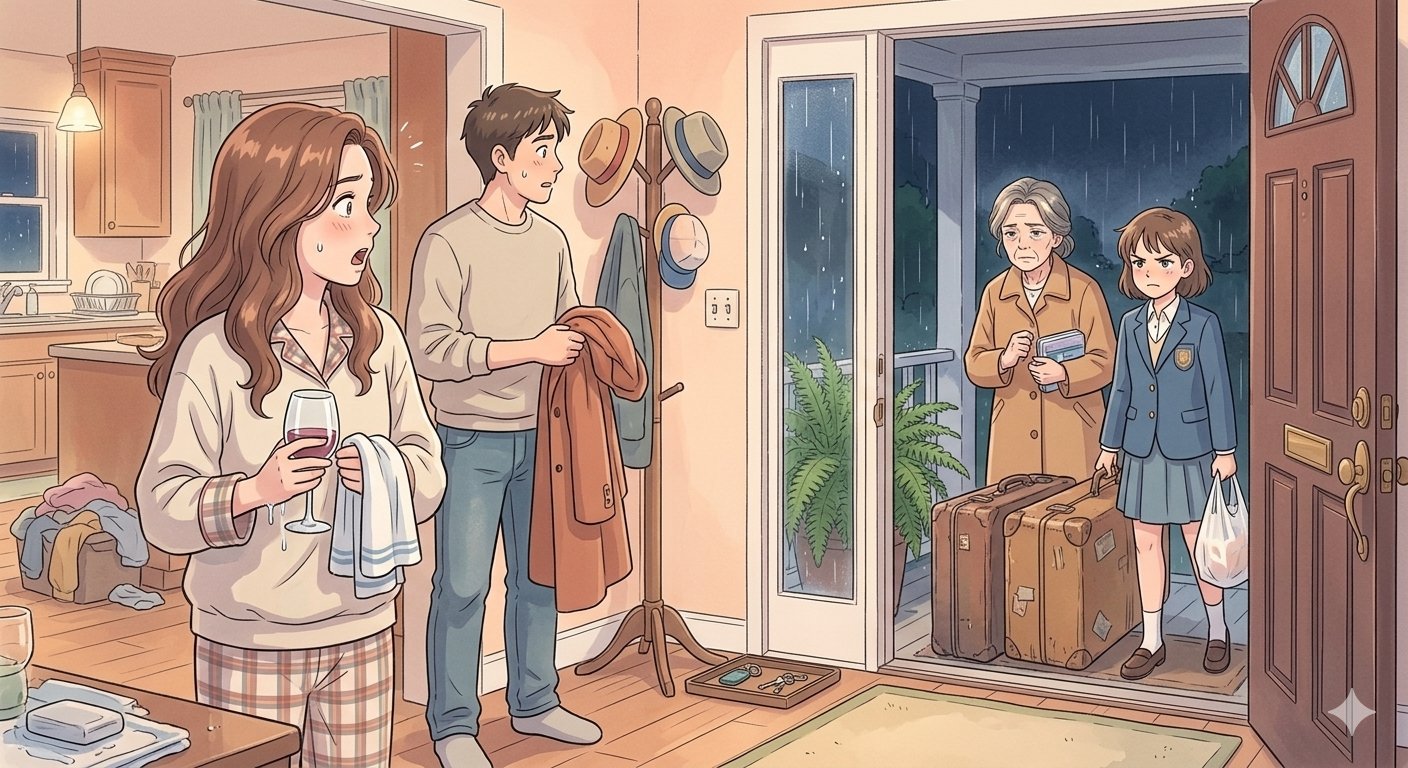
I was standing at the kitchen sink in plaid pajama pants and an old Michigan sweatshirt, rinsing two wine glasses from dinner. The dishwasher hummed beneath the counter, and rain tapped softly against the dark windows.
My husband, Daniel, called from the living room.
“Are you expecting someone?”
“No.”
The bell rang again.
Longer this time.
Whoever was outside had no interest in patience.
Daniel pushed himself out of his recliner. I dried my hands and followed him because curiosity was apparently stronger than common sense after bedtime.
Then I looked through the narrow window beside the front door.
My stomach dropped.
“You have got to be kidding me.”
Daniel stopped with his hand on the lock.
His mother, Marjorie, stood on our porch wearing a camel-colored coat buttoned to her throat. Beside her was Daniel’s younger sister, Rebecca.
And between them sat three enormous rolling suitcases.
Not weekend luggage.
Not “we’re staying through Tuesday” luggage.
These were the kind of suitcases people used when they intended to cross an ocean or disappear under federal protection.
Marjorie had two canvas bags hanging from one arm and a plastic case containing her medications tucked under the other.
Rebecca held another shopping bag.
Behind them, sitting beside the porch railing, was Marjorie’s giant Boston fern.
I stared at it.
I had given her that fern for Christmas years earlier, and she had spent every holiday since telling me I watered plants incorrectly.
People did not bring ferns for overnight visits.
Daniel opened the door.
Cold air swept into the foyer.
Marjorie walked straight past him.
“Well,” she announced, setting down a tote, “we’re finally here.”
Finally?
I looked at Daniel.
Daniel looked at his mother.
Rebecca rolled a suitcase across the threshold so aggressively the wheel almost went over my foot.
“Careful.”
“Oh. Sorry.”
She wasn’t.
I shut the door.
“What happened?”
Marjorie blinked at me.
“What do you mean?”
“Your condo. Did something happen?”
“No.”
“A pipe burst?”
“No.”
“Heat went out?”
“No.”
“Then why do you have three suitcases and a houseplant?”
Rebecca gave a little laugh.
Marjorie removed her coat and handed it to Daniel as if he worked at a hotel.
“We’re living here now.”
My brain rejected the sentence.
I actually smiled.
Not because it was funny.
Because surely I had misunderstood.
“You’re what?”
“Living here.”
She said it casually, like she had told me she preferred tea instead of coffee.
I turned toward my husband.
Daniel looked away.
And that was the moment the suitcases stopped being the problem.
I had been married to that man for twenty-four years.
I knew every version of his face.
Tired Daniel.
Irritated Daniel.
Daniel pretending he hadn’t eaten the cookies I had hidden behind the flour.
And guilty Daniel.
This was guilty Daniel.
“How much did you know?”
Marjorie sighed.
“Oh, Elaine, don’t turn this into some interrogation.”
I didn’t look at her.
“Daniel?”
He rubbed the back of his neck.
“Mom mentioned staying with us for a while after she sold the condo.”
I stared at him.
“After she what?”
Marjorie frowned.
“You didn’t tell her?”
Daniel closed his eyes briefly.
Marjorie continued.
“I closed on Friday.”
Rebecca smiled.
“The movers came yesterday.”
I looked from the suitcases to the fern.
Then to my husband.
“You knew she was selling.”
“I knew she was considering it.”
“And you never thought to mention that she was considering moving into our house?”
“She kept talking about it like it was an idea.”
I laughed once.
“Apparently she was packing while you were calling it an idea.”
Marjorie’s mouth tightened.
“We’re family. I didn’t think I needed to submit an application.”
“You didn’t need an application. You needed permission.”
Rebecca reached into her handbag.
“Actually, I made something that might help.”
Something about the way she said it should have warned me.
She unfolded a sheet of printer paper.
At the top were two large words.
HOUSE RULES.
Rebecca handed it to me with a smile.
“I thought establishing expectations early would make the adjustment easier.”
I read the first three lines.
Breakfast at six.
Laundry every day.
Marjorie gets downstairs primary bedroom.
I read them again.
Then I looked up.
“Whose house are these rules for?”
Marjorie gave me the patient expression she usually reserved for explaining why my Thanksgiving gravy needed more salt.
“My knees are bad. Your bedroom is downstairs.”
“Our bedroom.”
“Exactly.”
Rebecca pointed toward the hallway.
“You and Daniel can move upstairs. I’ll use your office since it’s next to Mom.”
“My office?”
“It makes the most sense.”
I looked at Daniel.
He had taken the page from me.
He read it silently.
Every line.
I waited for him to laugh.
Or object.
Or simply say, “Absolutely not.”
He said nothing.
And somehow his silence hurt worse than the paper in my hand.
Because Marjorie being controlling wasn’t new.
Rebecca acting entitled wasn’t new.
But my husband standing in our foyer while two people assigned me a breakfast schedule and relocated me from my own bedroom?
That was different.
Or maybe it wasn’t.
Maybe I had simply run out of ways to pretend it was normal.
I took the paper back.
“Nobody is taking my bedroom tonight.”
Marjorie stiffened.
“I never said tonight.”
Rebecca looked at her.
“You did, actually.”
Interesting.
Even dictators had public relations problems.
I grabbed one suitcase and rolled it toward the guest room.
“You can stay tonight. Tomorrow, we figure out where you’re actually going.”
Marjorie stared at me.
“Going?”
“Yes. Because moving into my home permanently is not something you decide without me.”
Daniel finally spoke.
“Let’s deal with everything in the morning.”
I looked at him.
For years, that sentence had meant one thing.
Everybody else got comfortable while I became the unreasonable woman who was somehow still upset the next day.
This time, I didn’t argue.
I simply handed him the house rules.
“Fine.”
But as I walked upstairs, I already knew morning was going to be different.
I just didn’t know Daniel was about to make a decision neither his mother nor I thought he was capable of making.
Part 2
By eleven, Rebecca was in the guest room.
Marjorie was furious about sleeping on the pullout couch in the den, but I had refused to surrender our bedroom.
Daniel and I lay beside each other without speaking.
The house felt wrong.
Every little sound seemed louder than usual—the furnace clicking on, the refrigerator motor, the occasional squeak from the den when Marjorie shifted on the mattress.
I waited for Daniel to explain himself.
He didn’t.
Eventually I turned toward the wall.
Sometime in the middle of the night, I woke and reached across the bed.
His side was empty.
A thin strip of light showed beneath the door of the small upstairs room where Daniel kept bills, tax records, and the printer he constantly complained about.
I almost got up.
Instead I rolled over.
If he had something to say, he could come say it.
A few hours later, I woke to a different sound.
Wheels rolling over hardwood.
Then another set.
Then a man’s voice downstairs.
“That the last one?”
I sat up.
Daniel’s side of the bed was still empty.
I pulled on my robe and stepped into the hallway.
All three suitcases were lined beside the front door.
For a moment, I simply stood at the top of the stairs.
Daniel was already dressed in jeans and a gray sweatshirt. Keys were in one hand and a travel mug in the other.
Marjorie sat rigidly in the den.
Rebecca stood beside the coffee table with her arms folded.
No one looked happy.
That was promising.
“What’s happening?”
Marjorie looked at me.
“Ask your husband.”
Her voice could have frozen a lake.
I looked at Daniel.
“I booked them somewhere.”
I blinked.
“Somewhere?”
“Extended-stay place about fifteen minutes from here. Two bedrooms, kitchenette. I paid for the first week.”
Rebecca’s jaw dropped.
“You say that like we agreed.”
Daniel lifted one of the suitcase handles.
“You didn’t.”
Marjorie stood.
“Daniel.”
She had always been able to fit forty years of guilt into his name.
I had watched it work countless times.
Daniel stopped.
Marjorie stepped closer.
“What exactly do you think you’re doing?”
“Helping you move.”
“We already moved.”
Daniel met her eyes.
“Not here.”
I should have felt victorious.
Instead I felt stunned.
This was a man who had once driven twenty minutes back to a restaurant because his mother decided, after getting home, that she should have ordered a different salad dressing.
Daniel did not tell Marjorie no.
He negotiated until no became maybe, and maybe became whatever kept her from being angry.
Rebecca turned toward me.
“Oh, wow.”
“What?”
“This is unbelievable.”
“What part?”
She pointed toward Daniel.
“You got to him.”
I laughed.
“Rebecca, I was asleep.”
“Sure.”
Daniel cut in.
“Elaine didn’t book anything. I did.”
Rebecca actually went silent.
For approximately three seconds.
Marjorie looked at her son as if he had betrayed something sacred.
“You made this decision overnight?”
“Yes.”
“Without discussing it with me?”
I almost admired the nerve of that question.
Daniel apparently did too.
He glanced at me before answering.
“You sold your condo without discussing moving into our house with Elaine.”
“That is completely different.”
“How?”
“I’m your mother.”
There it was.
Not a reason.
A title.
Marjorie had used those three words for decades like diplomatic immunity.
Daniel looked down at his keys.
“I know you’re my mother.”
“Do you?”
His shoulders tightened.
“When your father left, who stayed?”
Daniel said nothing.
“I worked two jobs.”
“I know.”
“I made sure you had a home.”
“I know, Mom.”
“I never told you there wasn’t room for you.”
And there it was—the old trapdoor.
The opening Daniel always fell through.
For one horrible moment, I watched his face change.
He wasn’t the fifty-four-year-old man standing in our foyer anymore.
He was the kid whose father left and whose mother reminded him exactly what she had sacrificed to keep everything together.
Marjorie saw it too.
Her face softened.
Daniel swallowed.
“I love you for what you did.”
She waited.
Then he said, “But this is Elaine’s home too.”
Marjorie went perfectly still.
The sentence should not have been revolutionary.
Apparently it was.
Rebecca shook her head.
“This is exactly what I’ve been saying. Ever since Elaine—”
“Stop.”
Daniel didn’t shout.
That made it stronger.
Rebecca blinked.
“I’m driving both of you over. We’ll figure out what happens next after everyone cools down.”
Marjorie gave a bitter laugh.
“What happens next? Like I’m some problem you need to solve?”
“No. Like you need somewhere to live.”
“I had somewhere to live.”
Daniel looked around our foyer.
“No. You decided you had somewhere to live.”
That landed.
Even Rebecca had nothing ready.
Daniel went into the kitchen to refill his coffee.
I followed.
“How long?”
He stopped.
“How long did you know she was talking about moving here?”
He stared at the counter.
“A couple months.”
My chest tightened.
“A couple months?”
“She kept bringing it up. I kept telling her we’d see.”
“That is not the same as telling her no.”
“I know.”
“You keep calling that neutral, Daniel. It isn’t neutral when I’m the one people walk over.”
He nodded once.
No excuse.
No defense.
Just a nod.
It didn’t erase anything.
But I noticed.
From the den, Marjorie called, “Are we leaving, or are we at least being allowed breakfast?”
I glanced at the kitchen clock.
“According to her rules, somebody is already behind schedule.”
For half a second, the corner of Daniel’s mouth twitched.
Then it disappeared.
Soon the luggage was back in his truck.
Marjorie paused beside him before getting into the passenger seat.
“I don’t recognize you right now.”
Daniel’s face tightened.
She climbed inside.
He closed the door.
I watched him stand there with one hand on the roof of the truck.
She had aimed exactly where she knew it would hurt.
When he finally drove away, my house became silent.
And for the first time since the doorbell had rung, I could breathe.
But peace lasted only a few hours.
By afternoon, Daniel’s phone started ringing.
His brother.
His aunt.
Then a cousin we barely saw.
By dinner, the family version of events had already been written.
And according to it, I was the woman who had thrown a seventy-six-year-old widow into the street before breakfast.