The thud came first—wood cracking against bone like a wet branch snapping in a storm.
I didn’t scream. The air left my lungs in a rush that tasted like copper and dust. Grandma’s braided rug pressed against my cheek. It still smelled faintly of her lilac lotion, even after all these months.
“You think that uniform makes you untouchable?”
Dad’s voice cut through the ringing in my ears. His work boots planted themselves inches from my face. The same boots that used to kick a soccer ball in the backyard. The same man who taught me to ride a bike without training wheels.
— Sell the house, Naomi. Your sister is drowning. You can live on base. You don’t need this place.
I tried to push up. Pain lanced through my left side like someone twisting a knife between my ribs. I collapsed back onto the floor, gasping.
— Please don’t do this.
Mom’s voice fluttered from somewhere near the kitchen doorway. I could barely see her through the blur of tears. She was wringing her hands the way she always did during arguments—helpless, caught between us.
— She’s being selfish, Mom. Grandma would want the family taken care of. Not some Navy brat hoarding a house she visits twice a year.
That was my sister. Always the victim. Always the one who needed saving.
The bat scraped against the hardwood as Dad shifted his grip. Through the cracked window behind him, I could hear Mrs. Patterson’s wind chimes from next door—bright, cheerful notes that made the violence in this room feel surreal.
— I’m not selling, I managed to whisper.
The words came out thin. Pathetic. But they were mine.
Dad’s knuckles whitened around the handle.
— Then I’ll make you.
He raised the bat above his head.
I squeezed my eyes shut.
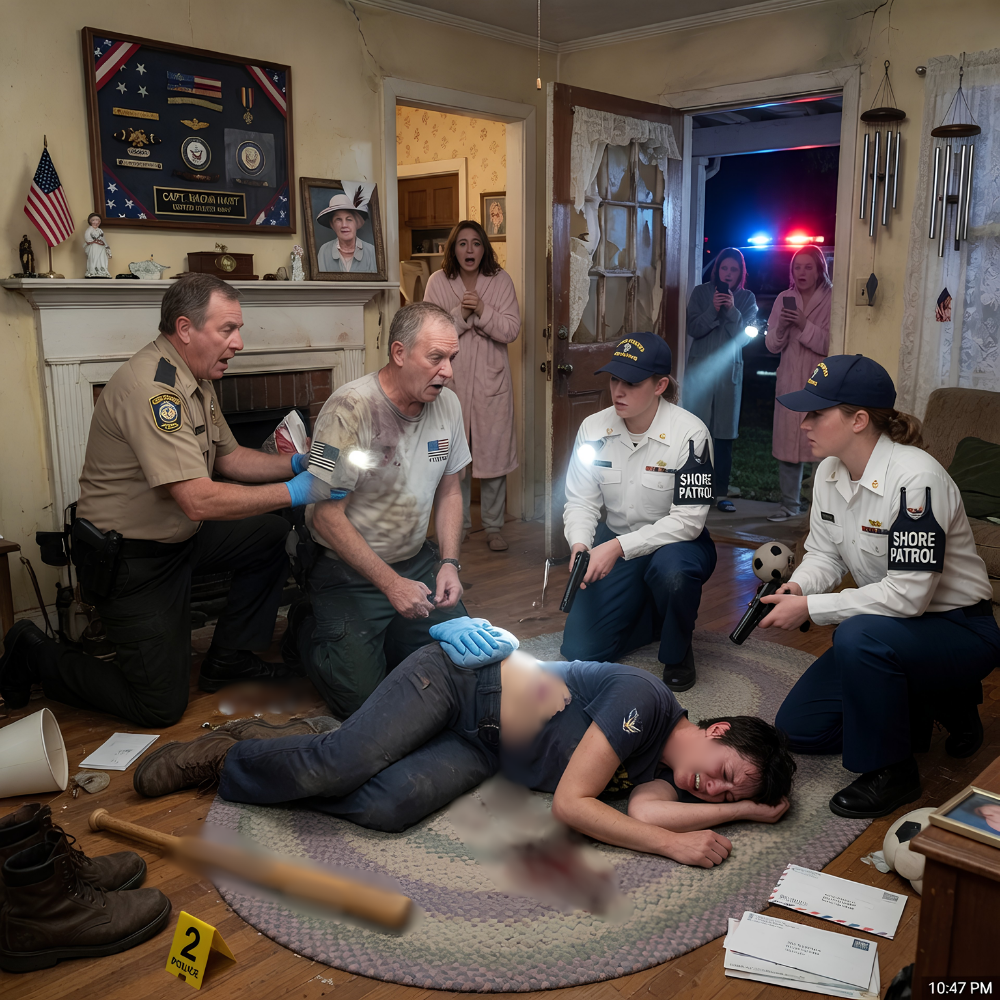
And that’s when the front door exploded inward.
— POLICE! DROP THE WEAPON! DROP IT NOW!
Three uniforms filled the frame—one county deputy and two sailors in crisp shore patrol dress. Their weapons were drawn. Their faces were stone.
The bat clattered to the floor. Dad’s hands shot up.
— She’s my daughter! This is family business!
The deputy ignored him. He was already cuffing Dad’s wrists, reading rights in a monotone voice that bounced off the walls like a radio broadcast.
But one of the sailors—young, maybe twenty-three, with freckles across his nose—he looked past my father. He squinted at me through the dim lamplight.
His posture changed instantly. Shoulders back. Spine straight.
— Captain Hart. Ma’am, are you injured?
The room went silent.
Mom’s hand flew to her mouth. My sister’s jaw dropped. Dad stopped struggling against the cuffs and stared at the sailor, then at me, then at the shadow box above Grandma’s mantle—the one with my ribbons and insignia pinned neatly inside.
— Captain? Dad’s voice cracked. What the h*ll is he talking about?
The sailor—Ellison, his nametag read—ignored him completely. He crouched beside me, careful not to touch my ribs.
— Ma’am, an ambulance is three minutes out. Try not to move.
I wanted to answer. I wanted to stand up and show them I was fine. But when I tried, the left side of my body lit up with white-hot agony, and all I could do was press my forehead back against Grandma’s rug and breathe through clenched teeth.
— She’s a captain? My sister’s voice was small now. Since when?
— Nine years, Ellison answered flatly. United States Navy. Commissioned officer. And you just committed aggravated assault against her.
Dad’s face drained of color. He looked old suddenly—older than I’d ever seen him. The anger that had burned behind his eyes moments ago flickered and died, replaced by something I couldn’t name.
Confusion. Shame. Fear.
Maybe all three.
The paramedics arrived in a blur of gloves and gurney straps. Someone cut my shirt open. Someone else pressed ice against my ribs. They asked my name three times, and each time I said “Captain Naomi Hart” like it was a shield I’d forgotten I was carrying.
As they wheeled me past the mantle, I caught Grandma’s photograph in her Sunday hat—the one with the little feather tucked in the band. Her eyes were soft, amused, like she knew exactly how this night would end before it even began.
— Naomi.
Dad’s voice stopped me at the doorway.
He was standing in cuffs now, the deputy guiding him toward the porch. His eyes were wet. His hands were trembling.
— I didn’t know.
The paramedic pushed the gurney forward. Cold night air hit my face. Neighbors stood frozen on their lawns, phones raised like tiny witnesses.
I didn’t answer him.
What was there to say?
He didn’t know because he’d never bothered to ask. Nine years of silence. Nine years of choosing pride over curiosity. Nine years of assuming I was still the rebellious teenager who’d walked out his door with a duffel bag and a grudge.
The ambulance doors closed.
The sirens started.
And somewhere behind me, in the house Grandma left me to keep safe, the wind chimes kept singing their bright, oblivious song.
Part 2: The ambulance rocked gently as we pulled away from Maple Lane. Through the small rear window, I watched my childhood home shrink into a blur of red and blue lights, the porch where Grandma used to shell peas now crawling with deputies and crime scene tape.
“Ma’am, I need you to stay still.”
The paramedic—a young woman with tired eyes and a name badge that read “Martinez”—pressed an ice pack against my ribs. The cold bit through the shock, sharp and clarifying.
“Can you tell me your full name again?”
“Naomi Hart,” I said through clenched teeth. “Captain. United States Navy.”
She nodded, scribbling notes while her partner adjusted the IV line snaking into my arm.
“You’re doing great, Captain. We’re about eight minutes from County General.”
Eight minutes. I counted them in my head like I used to count down drills on the bridge. One Mississippi. Two Mississippi. Each breath came with a price—a stabbing reminder that the man who’d taught me to swing a bat had just used one to break me.
The siren wailed above us, a sound I’d heard a hundred times from the other side of the world. In Djibouti, in the South China Sea, in ports where danger wore different faces. But never like this. Never in the house where I’d learned to walk.
Martinez’s partner—older, grayer, name tag reading “Daniels”—leaned over me.
“Any allergies, Captain?”
“Penicillin.”
“Noted. Any prior rib fractures?”
“No.”
“First time’s the charm,” he said, not unkindly. “You’re gonna feel like you got kicked by a horse for about six weeks. Then it gets better.”
Six weeks. I could do six weeks. I’d done six-month deployments with less warning.
But the ache behind my ribs wasn’t just bone-deep. It was the kind of hurt that no ice pack could reach.
The emergency room at County General smelled like antiseptic and old coffee. Fluorescent lights hummed overhead as they wheeled me into a curtained bay. Martinez and Daniels transferred me to a narrow bed with practiced efficiency, rattling off vitals to a waiting nurse.
“Thirty-four-year-old female, blunt force trauma to left lateral thorax, possible rib fractures, no loss of consciousness, GCS fifteen.”
The nurse—a stocky woman with purple scrubs and kind eyes—appeared at my side.
“Captain Hart? I’m Rachel. We’re gonna take good care of you, honey. X-ray’s on their way.”
“Honey” wasn’t a word I heard often in the Navy. It landed soft, like something Grandma would have said.
“Thank you,” I managed.
She squeezed my hand.
“Family in the waiting room?”
I hesitated. The word “family” felt like a landmine.
“No,” I said. “Just me.”
Rachel’s expression flickered—understanding, maybe pity—then smoothed into professionalism.
“Alright. Let’s get you comfortable.”
She adjusted the bed, dimmed the overhead light, and pulled the curtain closed. The relative darkness was a mercy. I closed my eyes and tried to breathe without thinking about the bat.
The X-ray tech was a young man with a nose ring and gentle hands. He positioned me against the cold plate, apologizing every time I winced.
“Sorry, sorry. Almost done. One more angle.”
I gritted my teeth and held still. Years of standing at attention had taught me how to lock my body down even when everything inside was screaming.
When he left, I stared at the ceiling tiles and counted the perforations. Twenty-four. Twenty-five.
The curtain rustled. A new face appeared—Detective Marcus Row, according to the badge clipped to his belt. He was middle-aged, African American, with a graying goatee and the weary posture of someone who’d seen too many domestic calls.
“Captain Hart,” he said, pulling up a stool. “I’m sorry we’re meeting under these circumstances.”
“Me too.”
He flipped open a small notebook.
“I know you’ve been through a lot tonight, but I need to take your statement while it’s fresh. Can you walk me through what happened?”
I took a breath. The pain had dulled to a manageable throb, thanks to whatever Martinez had pushed through the IV.
“My father showed up at my grandmother’s house around seven-thirty. He was agitated. Demanded I sell the property to help my sister with her debts. When I refused, he picked up a baseball bat from the coat rack and swung it into my ribs.”
Row’s pen scratched across the page.
“Had he threatened you before tonight?”
“Verbally, yes. Over the past few weeks. Letters, phone calls, showing up unannounced. But never physical. Not since I was a teenager.”
“And tonight was different?”
“He’d been drinking. I could smell it on him. And he’d brought my mother along, which he doesn’t usually do for confrontations. I think he wanted witnesses to prove he was in the right.”
Row nodded slowly.
“Your mother—she didn’t intervene?”
I closed my eyes.
“She begged him to stop. But she didn’t call for help. She just… stood there.”
He let the silence stretch.
“Captain, I need to ask you a difficult question.”
“Go ahead.”
“Do you want to press charges? Aggravated assault with a deadly weapon is a felony. Given your status as a commissioned officer, the Navy JAG office will likely open a parallel investigation regardless. But your cooperation would help.”
I opened my eyes and looked at the ceiling again.
“He’s my father, Detective.”
“I understand. But fathers don’t get a free pass to break their daughters’ ribs.”
The words hit harder than the bat had. Because they were true.
“I know,” I said quietly. “I just… I need tonight to think. Can I give you my decision tomorrow?”
Row closed his notebook.
“You can. I’ll check in around noon.” He stood, tucking the stool back against the wall. “One more thing—your neighbor’s Ring camera caught the whole approach. Your father walking up with the bat, your mother behind him. The audio’s not great, but it’s enough to corroborate your account. Whatever you decide, the evidence is there.”
He handed me a card.
“Call if you remember anything else. Or if you just need to talk to someone who’s not wearing scrubs.”
After he left, I lay in the half-dark, listening to the distant beeps and murmurs of the ER. Somewhere down the hall, a child was crying. A phone rang at the nurses’ station. Life continued, indifferent to the fact that my father had tried to beat me into submission in my grandmother’s living room.
The doctor arrived an hour later—Dr. Chen, a petite woman with sharp eyes and a no-nonsense manner. She pulled up my X-rays on a tablet.
“Two fractures,” she said, pointing. “Seventh and eighth ribs, left side. No displacement, which is good. No punctured lung. You’re lucky.”
“Lucky” wasn’t the word I would have chosen.
“We’re going to keep you overnight for observation. Ice, rest, pain management. You’ll need to take it easy for six to eight weeks. No heavy lifting, no strenuous activity. Follow up with your primary care in two weeks.”
“Understood.”
She paused, studying my face.
“Victim services will stop by in the morning. They can connect you with resources—counseling, legal advocacy, safe housing if you need it.”
“I have a house,” I said. “It’s mine.”
“Good,” she said. “Hold onto that.”
After she left, a nurse helped me into a wheelchair and rolled me up to the third floor—a private room with a window overlooking the parking lot. The bed was stiff but clean. The sheets smelled like industrial detergent.
I asked for my phone, which someone had retrieved from the living room floor. The screen was cracked but functional. Seventeen missed calls. Thirty-two text messages.
Mom: Naomi please call me. Dad is so sorry. He didn’t mean it.
Sister (Becca): You pressed charges??? He’s our FATHER. What is wrong with you???
Mom: The police won’t let me see him. Please help.
Becca: You always thought you were better than us. Now you’re proving it.
Mr. Whitaker (neighbor): Saw the lights. Praying for you, Captain.
I deleted Becca’s messages without reading them all. Mom’s I left unread, hovering like a bruise I wasn’t ready to press.
Mr. Whitaker’s I answered: Thank you. I’m okay.
Then I called a number I’d memorized years ago.
It rang three times.
“Commander Reeves.”
“Sir, it’s Hart.”
A pause. “Naomi? It’s almost midnight. What’s wrong?”
I told him. The words came out flat, clinical—like I was delivering a mission brief instead of confessing that my father had tried to cave in my chest.
When I finished, Reeves was silent for a long moment.
“I’m coming down there.”
“Sir, that’s not necessary—”
“Captain Hart.” His voice hardened. “You’re one of mine. You don’t go through this alone. I’ll be at County General by oh-seven-hundred. Do not argue with a superior officer.”
“Yes, sir.”
“Get some rest. That’s an order.”
The line went dead.
I set the phone on the bedside table and stared at the ceiling again. Outside, a helicopter thumped past—probably a med-flight heading for the roof. The sound faded, replaced by the hum of the HVAC and the distant beep of my own heartbeat on the monitor.
I thought about Grandma. About the way she’d hummed while she gardened, off-key and happy. About the letter she’d sent me during my first deployment:
Naomi, I had a dream about you last night. You were standing on a big ship, looking out at the water, and you looked so peaceful. I woke up crying, but they were good tears. You found your place, baby. Don’t let anyone take it from you.
I hadn’t cried yet. Not when the bat hit. Not when the police came. Not when they wheeled me past Dad’s stunned face.
But now, alone in this sterile room with Grandma’s words echoing in my head, the tears finally came. Silent, hot, sliding down my temples and into my hair.
I let them fall.
I woke to gray light filtering through the blinds. For a blissful second, I didn’t remember where I was. Then I tried to shift, and my ribs screamed a reminder.
The clock read 6:42 AM.
I fumbled for the bed controls and raised myself into a sitting position. Every movement was a negotiation with pain.
A knock at the door.
“Come in.”
Commander Reeves stepped inside, holding two cups of coffee. He was tall, silver-haired, with the weathered face of a man who’d spent thirty years at sea. His uniform was pressed sharp, medals gleaming.
“Captain Hart.” He set one cup on my tray table. “You look like hell.”
“Thank you, sir.”
He pulled up a chair and sat, studying me with those pale blue eyes that missed nothing.
“JAG office called me at five. They’re opening a file. Standard procedure when an officer is assaulted.”
“I figured.”
“How are you feeling?”
“Like I got hit with a baseball bat.”
He nodded slowly.
“I’ve been where you are. Not exactly—my father never raised a hand to me. But I know what it’s like to have family turn on you because of the uniform. My brother still won’t speak to me. Says I chose the Navy over him.”
“What did you do?”
“Nothing. I let him be angry. Eventually, he came around. Took fifteen years, but he showed up at my retirement ceremony.” Reeves sipped his coffee. “Point is, Naomi, you can’t control how they feel. You can only control how you respond.”
I looked down at my hands, still scraped from the fall.
“He wants me to drop the charges.”
“What do you want?”
The question hung in the air.
“I want him to understand what he did. I want him to face it. But I don’t want to destroy him. He’s still my father.”
Reeves set down his cup.
“Then tell the prosecutor that. They can work with you. Restraining order, mandatory counseling, restitution. You don’t have to send him to prison to hold him accountable.”
I nodded, the knot in my chest loosening slightly.
“Thank you, sir.”
He stood.
“I’ve arranged for you to take medical leave. Four weeks minimum. Use it. Heal. Figure out what comes next.” He paused at the door. “And Hart? You did nothing wrong. Don’t let anyone—including yourself—tell you otherwise.”
After he left, I drank the coffee slowly, letting the warmth settle in my stomach.
The victim advocate arrived at nine—a soft-spoken woman named Gloria with braids and a calm demeanor. She sat beside my bed and explained my options in a voice that never rushed.
“You can request a protective order. It would prohibit your father from contacting you or coming within a certain distance of your home. Violation is a criminal offense.”
“What about the criminal case?”
“The county prosecutor will decide whether to file charges regardless of your wishes, but your input carries weight. If you’re willing to testify, it strengthens the case. If you’re not, they may still proceed based on the physical evidence and witness statements.”
I thought about testifying. About sitting in a courtroom across from my father, describing in detail how he’d swung a bat at his own daughter.
“Can I think about it?”
“Of course. There’s no deadline on your decision. The prosecutor will likely hold off for a few days given the circumstances.”
She left me a folder of resources—counseling services, support groups, legal aid numbers. I thumbed through it without really seeing the words.
Around noon, Detective Row called.
“Captain Hart. Just checking in. Have you given any more thought to your statement?”
I took a breath.
“I’ll cooperate with the investigation. But I’d like to request that any sentencing focus on treatment rather than incarceration. Counseling. Anger management. Something that might actually help him change.”
Row was quiet for a moment.
“That’s more grace than most people would offer.”
“He’s my father,” I said again. “I can’t forget that. Even if he did.”
“I’ll make a note in the file. The prosecutor will take it under advisement.”
“Thank you, Detective.”
“Get some rest, Captain.”
They discharged me at two in the afternoon. Martinez—the paramedic from the night before—happened to be dropping off a patient and spotted me in the lobby. She walked over, hands in her pockets.
“You need a ride, Captain?”
“I was going to call a cab.”
“I’m off shift. Let me drive you.”
I hesitated, then nodded.
“Thank you.”
Her car was a battered Honda Civic that smelled like vanilla air freshener and dog. She drove carefully, avoiding potholes, glancing over at me every few minutes.
“My dad used to hit my mom,” she said quietly. “When I was a kid. She never pressed charges. Said it would ruin him. He died of a heart attack five years ago, and she still flinches when someone raises their voice.”
I didn’t know what to say.
“You did the right thing,” she continued. “Calling the cops. Letting them take him. It doesn’t feel like it right now, but you did.”
We pulled up to Maple Lane. The crime scene tape was gone. The porch looked normal again, except for the dent in the doorframe where the police had kicked it open.
“Thank you for the ride,” I said.
“Anytime.” She handed me a scrap of paper with a number scrawled on it. “If you ever need to talk to someone who gets it.”
I tucked the paper into my pocket and walked slowly up the porch steps. The house was quiet. Cold. I’d left the window cracked the night before, and the living room smelled like autumn and old lilacs.
The rug where I’d fallen had been vacuumed. Someone—probably Mr. Whitaker—had righted the overturned table and swept up the broken lamp. The bat was gone, taken as evidence.
Grandma’s photo still sat on the mantle, watching.
I lowered myself onto the couch, careful of my ribs, and stared at the dent in the doorframe.
The next few days blurred together. I slept in fits and starts, waking every few hours when the pain crept through the medication. Neighbors stopped by with casseroles and quiet sympathy. Mr. Whitaker fixed the doorframe without being asked. Mrs. Gordon brought a lemon pound cake and didn’t ask any questions.
My phone buzzed constantly. Mom. Becca. Unknown numbers that turned out to be cousins I hadn’t spoken to in years.
I answered none of them.
On the third day, a letter arrived from the county jail.
Dad’s handwriting.
Naomi,
I don’t know how to start this. I’ve written it ten times and thrown it away. But I need you to know—I’m sorry. Not because I got caught. Because I was wrong. I was drunk and angry and I took it out on you. That’s not the man your grandmother raised me to be.
Your mother says you’re not answering calls. I don’t blame you. I wouldn’t answer me either.
They’re letting me out on bond tomorrow. I have to stay away from you. I will. I promise.
I don’t expect you to forgive me. I just wanted you to know that I see it now. What I did. Who I’ve become.
Dad
I read it three times. Then I folded it carefully and placed it in Grandma’s Bible, next to the restitution check I still hadn’t cashed.
Becca showed up on the fifth day.
I was sitting on the porch, wrapped in a blanket despite the afternoon sun, watching the hydrangeas sway in the breeze. Her car pulled up slowly, like she wasn’t sure she was allowed to park.
She got out and stood by the driver’s door, arms crossed.
“Can I come up?”
I nodded.
She climbed the steps and sat in the rocker next to mine. For a long moment, neither of us spoke.
“You look like crap,” she said finally.
“Thanks.”
“I’m serious. You’re pale. You’ve lost weight.”
“Ribs will do that.”
She flinched.
“I didn’t know he was going to do that, Naomi. I swear. When he said he was going to talk to you, I thought he meant… talk.”
“He brought a bat, Becca.”
“I know. I saw the Ring video.” Her voice cracked. “I watched my father swing a baseball bat at my sister. On a doorbell camera. Like it was a TV show.”
Tears spilled down her cheeks. She wiped them angrily.
“Mom won’t stop crying. Dad’s out on bond, staying at the shop. He just sits there in the dark. Won’t eat. Won’t talk. The business is falling apart.”
“What do you want me to do?”
She looked at me, eyes red.
“I don’t know. I don’t know anything anymore. I just… I needed to see you. To make sure you were real.”
“I’m real.”
She laughed—a broken, wet sound.
“Yeah. You always were. Even when we pretended you weren’t.”
I reached over and took her hand. She squeezed back, hard.
“I’m sorry,” she whispered. “For everything. For the debts. For making you the villain. For not standing up to him years ago.”
“I’m sorry too,” I said. “For leaving. For not coming back sooner. For letting the silence grow so big that a baseball bat seemed like the only way to break it.”
We sat there as the sun sank lower, two sisters holding hands on a porch that had witnessed the worst of our family and, maybe, the beginning of something better.
The weeks that followed were slow and strange. My ribs healed in increments—first the sharp pain faded to a dull ache, then to a twinge when I moved wrong. I followed up with Dr. Chen, who pronounced me “on track” and cleared me for light activity.
I used the time to work on the house. Nothing strenuous—just small things. Repainting the porch rail. Planting mums along the walkway. Hanging new curtains in the kitchen. Each task felt like reclaiming territory.
The Navy kept its distance, respecting my medical leave. Commander Reeves checked in weekly by phone, brief and professional. The JAG office sent paperwork I signed without reading closely.
Detective Row called with updates. The prosecutor was moving forward with charges—aggravated assault, reduced from the original felony given my statement requesting leniency. Dad had pled no contest. Sentencing was scheduled for December.
I marked the date on my calendar and tried not to think about it.
In early November, I drove to the cemetery.
Grandma’s grave was tidy, the grass trimmed, a small American flag planted beside her headstone. Someone—Mom, probably—had left fresh flowers. White lilies, Grandma’s favorite.
I sat on the bench nearby and talked to her the way I always did.
“They want me to testify at his sentencing. Tell the judge what he did. I don’t know if I can. Not because I’m afraid. Because I don’t want to be the person who stands up in court and lists her father’s sins for a room full of strangers.”
The wind stirred the lilies.
“But if I don’t, who will? Mom won’t. Becca’s too scared. The prosecutor has the evidence, but evidence doesn’t have a voice. Someone has to say it out loud: This happened. This was wrong. This cannot happen again.”
I watched a robin hop across the grass.
“You always said duty makes you strong, not hard. Maybe this is my duty. Not to punish him. To make sure he understands. To make sure he gets help. To make sure no one else ever has to lie on your rug while the person who’s supposed to protect them raises a weapon.”
The robin flew away.
“I’ll do it,” I said. “I’ll speak. Not for revenge. For you. For the house. For the girl who left nine years ago and the woman who came back.”
I stood, touched the headstone, and walked back to my car.
December arrived with a cold snap that iced over the birdbath and sent the hydrangeas into hibernation. The sentencing hearing was scheduled for the fifteenth—a Tuesday, 9 AM, County Courthouse, Room 4B.
I wore my dress blues. Pressed sharp. Medals gleaming. Hair pulled back tight.
Becca met me in the parking lot. She was wearing a simple black dress, her face pale.
“You sure about this?”
“No,” I said. “But I’m doing it anyway.”
We walked in together.
The courtroom was small, wood-paneled, smelling like old paper and floor wax. Mom sat in the front row, clutching a tissue. Dad was at the defendant’s table with his lawyer, wearing a suit I’d never seen before. He looked smaller than I remembered. Older.
When he saw me, his eyes went wide. He hadn’t expected the uniform.
The judge entered—a woman with silver hair and a stern face. We all rose, then sat.
The prosecutor summarized the case: the Ring video, the medical records, the police reports. He recommended anger management counseling, community service, and two years of probation.
Dad’s lawyer spoke about his clean record, his standing in the community, his remorse. He asked for leniency.
Then the judge looked at me.
“Captain Hart, you requested to make a statement. Please proceed.”
I stood and walked to the podium. My heart was pounding, but my voice came out steady.
“Your Honor, the man who hurt me is my father. He taught me to ride a bike. He came to my softball games. He worked sixty-hour weeks to keep food on our table. I love him. I always will.”
I paused, gathering myself.
“But on September twenty-third, he picked up a baseball bat in my grandmother’s living room and swung it into my ribs. Not because I’d done something wrong. Because I said no to something he wanted. Because he believed his anger gave him the right to hurt me.”
I turned and looked at Dad. He was crying silently, tears tracking down his cheeks.
“I don’t want him in prison. I want him in therapy. I want him to understand why he did what he did, and I want him to do the work so he never does it again. To anyone. Ever.”
I faced the judge again.
“Whatever sentence you impose, I ask that it includes mandatory counseling. Not as punishment. As a chance for him to become the father I used to know.”
I returned to my seat. Becca squeezed my hand.
The judge was quiet for a long moment.
“Mr. Hart, please rise.”
Dad stood, shoulders hunched.
“I’ve reviewed the evidence and heard the testimony. What you did was unacceptable. You broke your daughter’s ribs in a fit of rage. The fact that she is standing here today, asking for mercy rather than maximum penalty, is a testament to her character—not yours.”
Dad’s head dropped lower.
“I am sentencing you to two years of supervised probation, one hundred hours of community service, and fifty-two weeks of anger management counseling. You will have no contact with Captain Hart except through approved mediation. If you violate any of these terms, you will serve eighteen months in county jail. Do you understand?”
“Yes, Your Honor.”
“Then we are adjourned.”
The gavel fell.
Outside the courtroom, the winter sun was blinding. I stood on the steps, breathing in the cold air, feeling something loosen in my chest that had nothing to do with my ribs.
Mom approached slowly.
“Naomi…”
“Not today, Mom.” My voice was gentle but firm. “I need time.”
She nodded, tears streaming.
“Okay. Okay. Whenever you’re ready.”
She walked away, shoulders shaking.
Becca appeared beside me.
“Lunch?”
“I could eat.”
We found a diner three blocks from the courthouse. Red vinyl booths, chrome trim, the smell of bacon and coffee. I ordered a club sandwich. Becca got pancakes.
“That was brave,” she said. “What you said in there.”
“It was honest.”
“Same thing, sometimes.”
She poured syrup in careful spirals.
“Dad’s going to counseling. First session is next week. Mom’s going with him, for support.”
“Good.”
“Do you think it’ll help?”
I thought about the letter in Grandma’s Bible. About the man who taught me to ride a bike and the man who swung a bat, both existing in the same skin.
“I don’t know,” I said. “But he has to try.”
Becca nodded slowly.
“I filed for bankruptcy. Chapter Seven. It’s going to wipe out most of the debt. I’ll have to start over, but… maybe that’s not a bad thing.”
“I’m proud of you.”
She looked up, surprised.
“Yeah?”
“Yeah.”
We ate in comfortable silence, the way we used to when we were kids sharing a bowl of cereal on Saturday mornings. Before the Navy. Before the debts. Before the bat.
Christmas came quietly that year.
I spent it alone at Grandma’s house, by choice. I decorated the porch with white lights, hung a wreath on the door, and baked cookies from her old recipe card—the one with the butter stain in the corner.
On Christmas Eve, I sat by the window with a cup of cocoa, watching snow fall over Maple Lane. The house was warm. Safe. Mine.
My phone buzzed.
Mom: Merry Christmas, Naomi. We miss you. Dad is doing better. Counseling is hard but he’s trying. I love you.
I stared at the message for a long time.
Then I typed back: Merry Christmas, Mom. I’m glad he’s trying. Love you too.
It wasn’t forgiveness. Not yet. But it was a door, left open just enough for light to pass through.
New Year’s Day brought a letter from the JAG office. The Navy had closed its parallel investigation, citing my cooperation with civilian authorities and my statement at sentencing. No further action would be taken.
I filed it away and went back to my life.
Medical leave ended in January. I returned to base, to the familiar rhythms of duty and discipline. My ribs still ached when I pushed too hard, but the pain was fading.
Commander Reeves greeted me with a nod.
“Good to have you back, Captain.”
“Good to be back, sir.”
He handed me a folder.
“New assignment. Desk duty for now, while you finish healing. But there’s a deployment coming up in the spring if you’re interested.”
“I am.”
“Thought you might be.” He paused. “How are things at home?”
“Complicated,” I said. “But improving.”
He nodded.
“Complicated is better than broken. Keep me posted.”
February brought an unexpected visitor.
I was sitting on the porch after work, wrapped in Grandma’s old quilt, when a familiar truck pulled up. Dad got out slowly, hands visible, posture hesitant.
He stopped at the bottom of the steps.
“I know I’m not supposed to be here,” he said. “The order says no contact. But my lawyer said we could do mediation if you agreed. I wanted to ask—would you be willing? To talk? With someone else in the room?”
I studied him. He’d lost weight. His eyes were clearer than I’d seen them in years.
“You’ve been going to counseling.”
“Every week. Twelve sessions so far. It’s… hard. But I’m learning things. About myself. About why I get so angry.” He swallowed. “About what I did to you.”
The wind chimes sang above us.
“I’ll think about it,” I said. “Mediation. Not tonight, but maybe soon.”
He nodded, relief flickering across his face.
“That’s more than I deserve.”
“Probably.”
He almost smiled.
“I’ll go now. I just wanted to ask in person. To show you I’m trying.”
He turned and walked back to his truck.
I watched him drive away, then went inside and called my victim advocate.
“Gloria? It’s Naomi Hart. I need information about mediation services.”
The first mediation session was in March.
We met in a small office downtown—neutral territory, beige walls, a box of tissues on the table. The mediator was a calm woman named Dr. Estrada who specialized in family reconciliation.
Dad sat across from me, hands folded on the table. He looked nervous.
Dr. Estrada explained the ground rules: respectful language, no interruptions, the goal was understanding, not agreement.
“Captain Hart, would you like to begin?”
I took a breath.
“I want you to know what that night felt like. Not the physical pain—the doctors can explain that better than I can. I want you to know what it felt like to lie on Grandma’s rug, looking up at you, and realize that the man who raised me was willing to hurt me to get what he wanted.”
Dad’s face crumpled.
“Naomi…”
“Please let me finish.”
He nodded.
“I’ve spent nine years building a life without you. I made myself into someone Grandma would be proud of. I earned my rank. I earned my house. I earned the right to say no. And you tried to take all of that away with a piece of wood.”
Tears were streaming down his face now.
“I’m sorry,” he whispered. “I’m so sorry.”
“I believe you,” I said. “But sorry isn’t the same as changed. I need to see the change before I can trust you again.”
Dr. Estrada nodded.
“Mr. Hart, your response?”
He wiped his eyes.
“I don’t have words. I just… I see it now. What I did. Who I was. I was so angry—at you, at myself, at the world—and I took it out on the one person who didn’t deserve it.” He looked at me directly. “I’m not asking you to forgive me. I’m asking for a chance to earn it. However long it takes.”
The session lasted two hours. We didn’t resolve everything—couldn’t, in one sitting. But we started something.
Spring came gently to Maple Lane. The hydrangeas bloomed white and blue. I planted a vegetable garden in the back, just like Grandma used to have.
Becca came over most Sundays. We’d sit on the porch and talk about small things—her new job at the library, my upcoming deployment, the stray cat that had taken up residence under the shed.
One afternoon, she handed me a photo.
“What’s this?”
“Found it in Mom’s attic. You and Dad at your first softball game.”
I looked at the image: a younger version of myself, gap-toothed and grinning, holding a bat while Dad knelt beside me, adjusting my grip. His face was soft. Proud.
“I don’t remember this,” I said.
“Me neither. But it’s proof, right? That he wasn’t always…”
She trailed off.
“Yeah,” I said. “Proof.”
I tucked the photo into Grandma’s Bible, next to the letters and the uncashed check.
Deployment came in May.
I shipped out on a destroyer bound for the Pacific. Six months of open water, of watches and drills and the steady hum of engines beneath my feet.
I wrote letters home—to Becca, to Mom, even one to Dad. Short notes. Nothing profound. Just proof that I was still here, still willing to reach across the distance.
He wrote back.
Naomi,
Got your letter. It meant more than you know. Counseling is going okay. Some weeks are harder than others. Last week we talked about my father—your grandpa. How he used to hit me when I was a kid. I never told you that. I thought if I just pushed it down, it would go away. It didn’t. It came out sideways. At you.
I’m not making excuses. Just trying to understand.
Stay safe out there.
Dad
I read the letter on the bridge, the ocean stretching endless around me. And for the first time, I saw my father not as a monster or a victim, but as a man carrying wounds he’d never learned to heal.
It didn’t excuse what he’d done. But it made it comprehensible.
I came home in November, just before Thanksgiving.
Maple Lane was golden with fallen leaves. The house was cold, dusty, waiting. I opened the windows, aired out the rooms, and made a pot of coffee.
Becca called.
“Dinner at Mom’s on Thursday. She asked me to invite you. No pressure.”
I thought about it.
“I’ll come.”
“Really?”
“Really.”
Thursday arrived gray and chilly. I wore civilian clothes—jeans, a sweater, nothing that marked me as anything but a daughter coming home.
Mom’s house smelled like roasting turkey and cinnamon. Becca met me at the door, hugging me tight.
“You came.”
“I said I would.”
Dad was in the kitchen, wearing an apron, basting the bird. He looked up when I walked in.
“Naomi.”
“Dad.”
An awkward pause.
“Can I help with something?”
He blinked, surprised.
“The potatoes need mashing.”
I rolled up my sleeves.
We worked side by side in silence, the way we used to when I was a kid and he’d let me stir the gravy while he carved the turkey. It wasn’t comfortable. But it wasn’t impossible.
Dinner was strange and wonderful.
We sat around the same table where I’d eaten a thousand meals as a child. Mom said grace. Becca’s kids—my niece and nephew—chattered about school and video games. Dad was quiet, but present.
Afterward, he asked if we could talk.
We walked out to the backyard, where the old swing set still stood, rusted but standing.
“I’ve got sixteen counseling sessions left,” he said. “Then I’m supposed to keep going on my own. The therapist says I’ve made progress. I don’t always feel it, but… I trust her.”
“That’s good.”
He looked at me.
“I know I can’t undo what I did. I know trust takes time. I just want you to know—I’m going to keep trying. For as long as it takes. Even if you never fully forgive me.”
I watched a squirrel run along the fence.
“I’m trying too,” I said. “Not for you. For me. Because carrying anger is exhausting. And Grandma wouldn’t want that for either of us.”
He smiled faintly.
“She always liked you best.”
“She liked us all. She just knew I needed extra.”
He laughed—a real laugh, rusty from disuse.
“Yeah. She did.”
We stood there in the cold, two people who’d hurt each other in ways that couldn’t be erased, choosing anyway to stand in the same yard and breathe the same air.
It wasn’t forgiveness. Not yet.
But it was a start.
That night, back at Grandma’s house, I sat on the porch wrapped in her quilt. The stars were out, sharp and clear.
I thought about the journey from that September night to this November evening. The bat. The sirens. The hospital. The courtroom. The letters. The slow, painful work of rebuilding something that might never be whole again.
Grandma’s wind chime sang in the breeze.
I pulled out my phone and typed a message to Dad.
Thank you for today. It was good to be home.
His reply came fast.
Thank you for coming. It meant everything.
I set the phone down and looked up at the stars.
“Okay, Grandma,” I whispered. “I’m trying.”
The wind shifted, warm despite the cold, and I felt something settle in my chest that had been restless for years.
Peace. Fragile, imperfect, hard-won.
But peace.
EPILOGUE
Five years later, I stood on the porch of 23 Maple Lane, watching Becca’s kids chase fireflies across the lawn. The house had a fresh coat of paint—white with blue shutters, just like Grandma always wanted.
I’d finished my Navy career as a Commander, retiring with full honors after twenty-two years of service. The ceremony had been small but meaningful, with Commander Reeves pinning my final medal and Becca crying in the front row.
Mom and Dad came too. They sat together, holding hands, their faces a complicated map of pride and regret. Afterward, Dad shook my hand and said, “Your grandmother would be so proud.” I believed him.
The house on Maple Lane became my permanent home. I turned the spare bedroom into an office, filled the garden with more hydrangeas, and adopted the stray cat from under the shed. She was gray and imperious and I named her Admiral.
Dad and I met for coffee once a month. It wasn’t easy—some conversations still hit old bruises—but we kept showing up. He finished his counseling, then started going voluntarily to a men’s group for anger management. He said it helped him understand himself better. I believed that too.
Becca got married in the backyard under a trellis of white roses. I stood as her maid of honor, my dress blues swapped for a lavender dress she’d picked out. Dad walked her down the aisle, tears streaming, and I thought about how far we’d all come from that night when a baseball bat shattered more than just my ribs.
On quiet evenings, I’d sit on the porch with a glass of sweet tea and watch the sun set over the oaks. Sometimes I’d talk to Grandma’s photo, updating her on the garden, the cat, the slow healing of our fractured family.
And always, the wind chimes would answer—a bright, gentle music that sounded like forgiveness.
Not the easy kind that forgets. The hard kind that remembers and chooses anyway.
The kind Grandma always said would save us, if we let it.
SIDE STORY: THE WEIGHT OF WATER
Becca’s Account
I was fourteen when Naomi left.
Not literally—she was eighteen, a year out of high school, standing in the driveway with a duffel bag that looked too heavy for her skinny shoulders. But in my memory, I’m always fourteen, watching from the upstairs window as Dad stood on the porch with his arms crossed and his jaw locked tight, refusing to say goodbye.
Mom was crying in the kitchen. I could hear her through the floorboards, that hiccupping sob she always tried to muffle with a dish towel. The smell of burned meatloaf hung in the air because she’d forgotten to set the timer, too busy pleading with Dad to go outside and stop Naomi from leaving.
He didn’t stop her. He watched her walk to her car, and when she looked back—just once, over her shoulder, her face raw with something I couldn’t name—he turned around and went inside.
I didn’t go downstairs. I stayed at the window until her taillights disappeared around the corner, then I lay on my bed and stared at the ceiling, counting the glow-in-the-dark stars Naomi had helped me stick up there when I was eight.
That was the first time I understood that love in our family came with conditions.
Naomi and I were never close in the way sisters are supposed to be. She was four years older, which might as well have been a decade when we were kids. She was the serious one, the one who read books about ships and oceans while I watched music videos and dreamed about becoming a dancer. She was Dad’s project—the one he took to softball practice, the one he taught to swing a hammer, the one he expected to take over Hart & Son Plumbing someday.
I was Mom’s. The baby. The one who got coddled and excused and never quite learned how to stand on her own two feet.
I didn’t resent Naomi for being Dad’s favorite. Not at first. It seemed like a burden more than a blessing, the way he pushed her, criticized her, measured her against some invisible standard she could never quite reach. When she announced she was joining the Navy instead of taking over the business, I wasn’t surprised. I was relieved.
If Naomi left, maybe Dad would finally see me.
That’s not how it worked, of course.
The years after Naomi left were a slow-motion disaster I didn’t recognize until I was drowning in it.
Dad threw himself into the business with a fury that scared off employees and customers alike. He expanded too fast, took out loans he couldn’t afford, and refused to admit when things were going wrong. Mom retreated into her garden and her church groups, pretending everything was fine while the bills piled up on the kitchen counter.
And me? I got married at twenty-one to a man named Kyle who played guitar and promised me a life of adventure. The adventure turned out to be three years of bounced checks, late-night arguments, and a baby I wasn’t ready for. When Kyle left—”I can’t do this, Bec, I’m sorry”—I moved back home with a toddler and a mountain of credit card debt I’d accumulated trying to keep us afloat.
Dad didn’t say “I told you so.” He didn’t have to. The disappointment in his eyes was louder than any words.
I started working at the plumbing business because I had nowhere else to go. Dad put me behind the counter, answering phones and scheduling appointments, while Mom watched my daughter, Lily, during the day. It was supposed to be temporary. A bridge to something better.
But bridges collapse when you don’t maintain them.
The debt grew. A car repair here, a medical bill there, a new credit card to pay off the old one. I told myself I was managing, that I’d catch up eventually, that everyone struggled in their twenties. By the time I turned thirty, I owed more than I could ever repay, and I’d gotten very good at hiding it.
Lily was six when I met Danny—a contractor who came in to fix the shop’s HVAC system. He was kind and steady and didn’t seem to mind that I came with baggage. We got married in a small ceremony at the courthouse, and for a while, I thought things might actually turn around.
Then Danny got laid off. Then I got pregnant again. Then the medical bills started piling up on top of everything else.
By the time Naomi came back into our lives—or rather, back into Grandma’s house—I was drowning in over a hundred and fifty thousand dollars of debt, and I couldn’t see a way out that didn’t involve dragging my whole family down with me.
I didn’t know Dad was going to confront Naomi that night.
He’d been drinking more than usual, pacing the living room, muttering about “that house” and “what’s rightfully ours.” Mom kept telling him to calm down, to let it go, that Grandma had made her choice. But Dad couldn’t let anything go. It wasn’t in his nature.
“We’re going to talk to her,” he said, grabbing his keys. “Now.”
Mom looked at me with pleading eyes.
“Becca, come with us. Maybe she’ll listen to you.”
I should have said no. I should have stayed home with my kids and let them handle their own mess. But I was tired and scared and desperate, and somewhere deep down, I resented Naomi for having something I didn’t: a way out.
So I got in the truck.
I didn’t see the bat until we were already on her porch.
Dad had grabbed it from behind the seat—an old Louisville Slugger he kept for “protection,” though I’d never known him to use it. When I saw it in his hand, my stomach dropped.
“Dad, what are you doing with that?”
He didn’t answer. His face was set in that hard expression I’d learned to fear as a child, the one that meant no amount of reasoning would reach him.
Mom was wringing her hands. “Harold, please, just talk to her. Don’t—”
He pounded on the door.
When Naomi opened it, I saw her face change. Surprise, then wariness, then something that looked like exhaustion. She’d been through this before, I realized. Not the bat, but the demands, the pressure, the expectation that she’d fix what the rest of us had broken.
I wanted to tell her I was sorry. I wanted to tell her to just sell the house so this could all be over. I wanted to run back to the truck and drive away and pretend none of this was happening.
I did none of those things.
I stood in the doorway with my arms crossed while my father raised a baseball bat at my sister, and I didn’t say a word.
The sound of the bat hitting her ribs was the worst thing I’ve ever heard.
It wasn’t loud like in the movies. It was a dull, wet crack, like a branch breaking underwater. Naomi dropped to her knees, and I saw the pain flash across her face—not just physical, but something deeper, something that looked like betrayal.
I opened my mouth to scream, but no sound came out.
Mom was crying, begging Dad to stop. He raised the bat again, and I thought, This is it. This is how our family ends. In Grandma’s living room, with a baseball bat and a pile of debt and years of silence that curdled into violence.
Then the door burst open and everything changed.
I didn’t know Naomi was a captain.
I mean, I knew she was in the Navy. I knew she’d been promoted a few times. Mom mentioned it occasionally, reading snippets from Grandma’s letters before she died. But “captain” was just a word to me, like “lieutenant” or “commander”—military ranks that existed in a world I didn’t understand.
When the shore patrol sailor straightened up and said “Captain Hart” like it was a title that commanded respect, I felt the ground shift beneath my feet.
Naomi wasn’t just my older sister who’d walked out nine years ago. She was someone important. Someone who’d built a life without any of us, who’d earned things I couldn’t even imagine.
And Dad had just assaulted her with a deadly weapon.
The days after the arrest were a blur of police stations, lawyers, and whispered conversations that stopped whenever I entered the room.
Mom was inconsolable. She couldn’t understand how things had gone so wrong so fast. She kept saying, “He didn’t mean it, he was just upset, she’s his daughter, how could she press charges against her own father?”
I wanted to scream at her. She’s his daughter and he broke her ribs with a baseball bat. What part of that is okay?
But I didn’t scream. I was too busy trying to keep my own life from falling apart.
Danny found out about the full extent of the debt two days after the arrest. I’d been hiding some of it—the worst of it—because I was ashamed. When he saw the stack of bills and collection notices I’d stashed in the back of the closet, his face went pale.
“Becca. This is… this is more than our house is worth.”
“I know.”
“Why didn’t you tell me?”
“Because I was scared.”
He sat down on the edge of the bed, staring at the papers like they were written in a foreign language.
“We need help,” he said finally. “Professional help. Bankruptcy, maybe. I don’t know.”
“I know.”
He looked up at me, and I braced myself for anger, for blame, for the same disappointment I’d seen in Dad’s eyes my whole life.
Instead, he reached for my hand.
“We’ll figure it out,” he said. “Together.”
I cried for the first time since the arrest. Great, heaving sobs that shook my whole body and left me gasping for air. Danny held me until I was empty, and then he made me a cup of tea and we started making calls.
Visiting Naomi in the hospital was the hardest thing I’ve ever done.
I waited five days, partly because I was scared and partly because I didn’t know what to say. “Sorry” seemed too small. “I didn’t know he was going to do that” sounded like an excuse. “Please don’t hate me” was selfish.
When I finally showed up at her room, she was sitting up in bed, staring out the window. Her face was bruised, her arm wrapped in a sling to keep her ribs immobilized. She looked tired and sad and stronger than I’d ever felt in my life.
“Hey,” I said from the doorway.
She turned. “Hey.”
“Can I come in?”
She nodded.
I sat in the chair beside her bed, the same chair Detective Row had probably used. For a long moment, neither of us spoke.
“I’m sorry,” I said finally. “I know that doesn’t fix anything. But I am.”
Naomi looked at me with those steady eyes that reminded me so much of Grandma’s.
“Did you know he had the bat?”
“No. I swear. I didn’t even see it until we were on your porch. And by then…” I trailed off.
“By then it was too late.”
“I should have stopped him. I should have said something. I just froze.”
Naomi was quiet for a moment.
“Becca, I need to ask you something, and I need you to be honest.”
“Okay.”
“Did you want him to hurt me?”
The question hit me like a physical blow.
“No! God, no. Naomi, I would never—”
“Did you want him to scare me into selling the house?”
I opened my mouth to deny it, then stopped.
The truth was uglier than a simple yes or no. I hadn’t wanted her hurt. But I had wanted her to give in. I had wanted the house sold so the pressure would stop, so Dad would calm down, so maybe—just maybe—someone would finally see how much I was struggling and help me.
“I wanted the problem to go away,” I whispered. “I didn’t think about what that would cost you.”
Naomi nodded slowly, like I’d confirmed something she already knew.
“I understand,” she said. “Better than you think.”
“You do?”
“I’ve spent nine years wanting the problem of our family to go away. Wanting Dad to just… be different. Wanting Mom to stand up for herself. Wanting you to see me as something other than the enemy.” She shifted in the bed, wincing. “It doesn’t work. The wanting. It just makes you tired.”
“So what does work?”
She looked at me, and for the first time since she’d left, I saw my sister—not the Navy captain, not the woman Dad resented, but Naomi, the girl who used to let me sleep in her bed during thunderstorms.
“Doing the hard thing,” she said. “Even when it hurts. Especially when it hurts.”
I filed for bankruptcy three weeks later.
It was the hardest thing I’d ever done—harder than telling Danny about the debt, harder than facing Naomi in the hospital, harder than watching my father get led away in handcuffs. Signing those papers felt like admitting I’d failed at everything I’d ever tried.
But when it was done, something shifted.
The calls from creditors stopped. The letters demanding payment stopped arriving. For the first time in years, I could open the mailbox without my stomach clenching.
Danny and I sat down and made a budget. A real one, with actual numbers and categories and a plan for the future. We cut everything we didn’t need—cable, streaming services, eating out. I got a second job working weekends at the library, shelving books and helping with children’s story hour.
It wasn’t glamorous. But it was honest.
Dad’s sentencing was in December. I wore a black dress and sat in the second row, behind Mom.
When Naomi walked in wearing her dress blues, I saw Dad’s face change. He’d known she was a captain—the arrest report made that clear—but seeing it was different. The medals, the crisp uniform, the way she carried herself like someone who’d earned every inch of respect.
She gave her statement in a steady voice, asking for counseling instead of prison. I watched Dad cry—really cry, not the angry tears I’d seen before, but something broken and genuine.
Afterward, in the parking lot, I caught up to Naomi.
“That was brave,” I said.
She shrugged. “It was honest.”
“Same thing, sometimes.”
She almost smiled.
“Lunch?”
“I could eat.”
We went to a diner three blocks from the courthouse. Red vinyl booths, chrome trim, the smell of bacon and coffee. I ordered pancakes because I needed something soft and sweet. Naomi got a club sandwich.
She asked about the bankruptcy. I told her everything—the debt, the hiding, the shame, the slow climb back toward something resembling stability.
“I’m proud of you,” she said.
I looked up, surprised.
“For filing bankruptcy?”
“For facing it. For not running away.”
I thought about all the times I’d run away—from bad relationships, from hard conversations, from the truth about who I was and what I’d done.
“I learned it from you,” I said. “You ran toward something. Not away.”
Naomi’s eyes softened.
“Grandma used to say that. ‘Don’t run from your problems, Becca. Run toward your solutions.’ I never understood what she meant until now.”
We ate in silence for a while, the comfortable kind that sisters share when words aren’t necessary.
The mediation sessions between Naomi and Dad started in the spring. I wasn’t part of them—they were private, just the two of them and Dr. Estrada—but I saw the effects.
Dad was different afterward. Quieter. Slower to anger. He started going to counseling on his own, and sometimes he’d share things with me that he’d never said before.
“My father used to hit me,” he told me one evening, sitting on the back porch while the kids played in the yard. “When I was a boy. Nothing like what I did to Naomi, but… enough. I thought if I just pushed it down, it would go away. It didn’t.”
I didn’t know what to say.
“I’m not making excuses,” he continued. “What I did was wrong. I know that now. But understanding why helps. It makes it feel less like… like I’m just a monster.”
“You’re not a monster, Dad.”
He looked at me with those tired eyes.
“I was. That night, I was. But I’m trying not to be anymore.”
Lily started asking questions about Aunt Naomi when she was eight.
“Why doesn’t she come to Grandma’s house for Christmas?”
“She does now, sweetie.”
“But she didn’t before. Why?”
I thought about how to explain nine years of silence and one night of violence to a child who still believed in Santa Claus.
“Sometimes grown-ups have fights,” I said carefully. “Big fights that take a long time to fix. But Aunt Naomi and Grandpa are working on it.”
“Like when I was mad at Emma for breaking my crayons?”
“Kind of. But bigger.”
She nodded solemnly.
“I’m glad they’re fixing it.”
“Me too, baby. Me too.”
Naomi came home from her final deployment just before Thanksgiving, five years after the night that changed everything.
She’d sent letters while she was away—short notes about the ocean and the stars and the strange peace of being surrounded by water. I’d written back with updates about the kids, about Dad’s progress in counseling, about the garden I’d started in the backyard.
When she walked into Mom’s house that Thanksgiving, wearing civilian clothes and carrying a pie she’d baked herself, something felt different. Lighter.
Dad was in the kitchen, basting the turkey. He looked up when she came in.
“Naomi.”
“Dad.”
An awkward pause.
“Can I help with something?”
He blinked, surprised.
“The potatoes need mashing.”
She rolled up her sleeves.
I watched them work side by side, not talking much, just existing in the same space without tension. It wasn’t forgiveness—not fully, not yet. But it was something.
After dinner, Naomi and I sat on the back porch while the kids played in the yard. The swing set creaked in the cold air.
“I never thanked you,” I said.
“For what?”
“For not hating me. After everything. The debt, the demands, the way I just… stood there while he…”
She was quiet for a moment.
“I was angry at you for a long time,” she admitted. “Not for the debt. For not seeing me. For treating me like the enemy instead of your sister.”
“I know.”
“But I realized something while I was deployed. You were drowning, Becca. And drowning people don’t think clearly. They just grab for whatever’s closest.”
“You were what was closest.”
“Yeah.”
She looked at me.
“I’m sorry I wasn’t there for you. Before. When you were struggling and didn’t know how to ask for help.”
I felt tears prick my eyes.
“You’re here now.”
“Better late than never?”
“Better late than never.”
The years after Naomi’s retirement were the best our family had ever known.
Not perfect—nothing ever is. Dad still had bad days, moments when the old anger flickered behind his eyes. Mom still struggled to stand up for herself. I still carried shame about the debt and the bankruptcy, even though I’d paid off what I could and rebuilt my credit.
But we were together. Imperfectly, messily, stubbornly together.
Naomi lived in Grandma’s house, tending the garden and hosting Sunday dinners that became a new family tradition. She adopted a gray cat she named Admiral and filled the rooms with books and photographs and the quiet peace of someone who’d finally found her harbor.
I visited every week. Sometimes with the kids, sometimes alone. We’d sit on the porch and talk about nothing and everything, the way sisters do when they’ve finally learned how to be family.
Dad came to some of the Sunday dinners. Not all—it was still hard for him to be in that house, surrounded by memories of what he’d done. But he came more often as time passed, and eventually, he could sit in Grandma’s living room without flinching.
One evening, I found him alone on the porch, staring at the hydrangeas.
“She loved these flowers,” he said quietly.
“Grandma?”
He nodded.
“She planted them the year I was born. Said they reminded her of hope. Of things that bloom even after a hard winter.”
I sat beside him.
“Do you think she’d forgive you? For what you did?”
He was silent for a long time.
“I don’t know,” he said finally. “But I think she’d be proud of Naomi. For standing her ground. For not letting me break her.”
“She’d be proud of you too, Dad. For trying to change.”
He looked at me, eyes glistening.
“You really think so?”
“I know so.”
On the tenth anniversary of Grandma’s death, we gathered at her grave—all of us. Naomi in a simple blue dress, Dad in his best shirt, Mom holding a bouquet of lilies, me with my kids and Danny.
The preacher from Grandma’s old church said a few words about faith and resurrection and the eternal nature of love. Then Naomi stepped forward.
“I want to say something,” she said.
We all fell silent.
“Grandma taught me that duty makes you strong, not hard. I carried those words with me through twenty-two years in the Navy, through deployments and promotions and nights when I thought I couldn’t go on. I carried them through the worst night of my life, when someone I loved tried to break me in the house she left me to protect.”
She looked at Dad. He didn’t look away.
“And I carry them now, standing here with all of you, in this place where she rests. We’re not perfect. We’ve hurt each other in ways that can’t be undone. But we’re still here. Still trying. Still choosing each other, even when it’s hard.”
She knelt and placed a small stone on Grandma’s headstone—a Navy tradition, marking a visit.
“Thank you, Grandma. For everything.”
One by one, we each placed a stone. Dad’s hand trembled when he set his down. Mom was crying quietly. The kids didn’t understand the significance, but they followed our lead, adding their small rocks to the growing pile.
When it was my turn, I knelt beside the grave and whispered, “I’m trying to be better. Like you always said I could.”
The wind picked up, rustling the leaves, and I swear I felt her there—not as a ghost, but as a presence. The same presence I’d felt in her kitchen while she taught me to bake cookies, in her garden while she showed me how to plant seeds, in her living room while she read me stories and told me I was stronger than I knew.
That night, back at Naomi’s house—Grandma’s house, I still thought of it—we gathered for dinner. The table was crowded with food and people and the noisy chaos of family.
Lily, now twelve, asked Naomi about the Navy. My sister’s face lit up as she described the ocean at night, the stars reflected in endless water, the feeling of being part of something bigger than yourself.
“I want to do that someday,” Lily said. “See the ocean.”
“You will,” Naomi promised. “And when you do, you’ll understand why I kept going back.”
After dinner, while the kids watched a movie in the living room and the adults cleaned up, I found Naomi on the porch again.
“You okay?” I asked.
“Yeah. Just thinking.”
“About?”
She smiled faintly.
“About how different things could have been. If I’d stayed. If I’d given in. If Dad had…”
She didn’t finish the sentence.
“But you didn’t,” I said. “You stood your ground.”
“I almost didn’t. That night, when he was standing over me with the bat, part of me wanted to give in. Just to make it stop.”
“What stopped you?”
She looked at the house, at the porch where Grandma used to sit, at the wind chimes that sang in the evening breeze.
“Her,” she said simply. “Grandma. I could hear her voice in my head, telling me to stand steady. So I did.”
I reached over and took her hand.
“I’m glad you did. Even though it hurt. Even though it was hard. I’m glad you didn’t give in.”
She squeezed back.
“Me too.”
EPILOGUE TO THE SIDE STORY
I’m forty-three now. The kids are growing up—Lily’s in high school, talking about college and careers and all the things I never had the courage to pursue. Danny and I are still together, still budgeting, still figuring it out day by day.
The debt is gone. Not overnight—it took years of careful planning and sacrifice—but gone. I have a savings account now, something I never thought I’d have. I’m not rich, but I’m stable. And stability, I’ve learned, is its own kind of wealth.
Dad is seventy-one. He still goes to counseling once a month, not because he has to, but because he wants to. He and Naomi have coffee together every other Tuesday. It’s not always easy—some conversations still drift toward old wounds—but they keep showing up.
Mom is happier than I’ve ever seen her. She joined a book club and started painting again, something she gave up when I was born. The house is filled with her watercolors—landscapes, flowers, portraits of the grandkids.
And Naomi? Naomi is exactly where she’s supposed to be.
She lives in Grandma’s house, tending the garden, hosting Sunday dinners, and serving as a mentor for young women considering military service. She’s at peace in a way I’ve never seen before, as if all those years at sea finally brought her home.
Sometimes, on quiet evenings, I drive over to Maple Lane and sit with her on the porch. We don’t talk much. We just watch the fireflies and listen to the wind chimes and breathe the same air.
It’s enough. More than enough.
Because this—this imperfect, scarred, stubborn family—is what Grandma was trying to build all along. Not a perfect house. Not a flawless legacy.
Just a place where people who’ve hurt each other can sit on a porch together and choose to stay.
I think she’d be proud of us.
I know I am.
End of Side Story