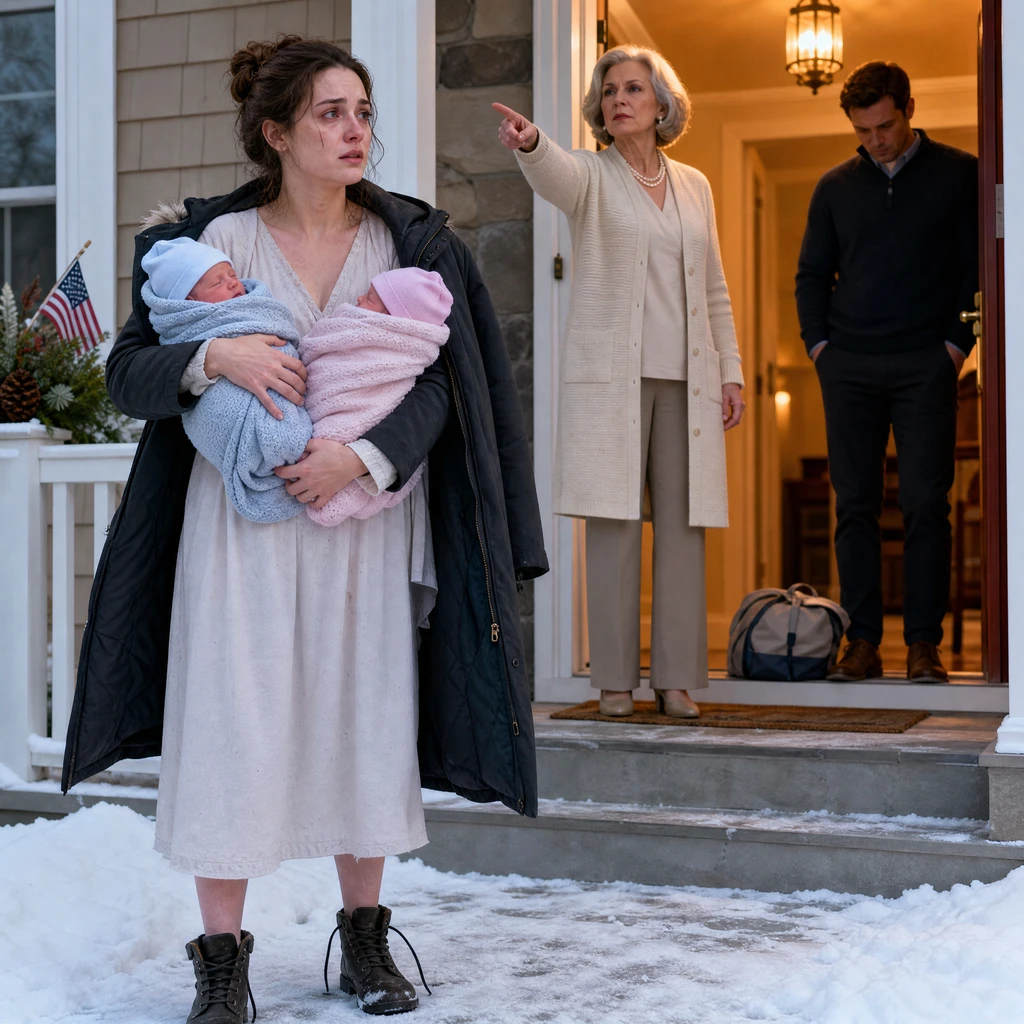
The snow was already past my ankles when Constance Pierce threw my coat at my feet like it was something she had found beside the trash cans.
“Take your babies and get out.”
Her voice cracked through the freezing air so sharply both twins woke in my arms.
Elodie cried first, her tiny face folding into itself beneath the pink knit hat the hospital volunteer had made. Ezra followed a second later, smaller and weaker, his breath coming in thin, frightened bursts against my chest. They were ten days old. Ten days. Their whole world was supposed to be warm blankets, milk-drunk sleep, and the soft humming of the white-noise machine in their nursery.
Instead, they were learning what it sounded like when a door closed.
I bent as fast as my body would allow, which was not fast at all. Ten days after giving birth to twins, every movement still felt borrowed from someone stronger. My stitches pulled. My knees trembled. One baby was strapped against me in a wrap, the other tucked inside the crook of my arm beneath the loose front of my nursing robe. I grabbed the coat with one shaking hand and dragged it over my shoulders without getting one sleeve all the way on.
My boots were still by the entryway, the old brown ones I wore for quick trips to the mailbox. I shoved my feet into them, half-laced, the tongues crooked, snow already spilling over the sides before I could even straighten up.
Dalton stood behind his mother in the doorway.
That is the part I remember most clearly.
Not the cold. Not the snow. Not the bite of the wind cutting straight through my thin cotton gown. It was my husband’s face in the warm gold light of our front hall, blank and tired and almost relieved, as if watching his mother throw me into a January storm with his newborn children was just another unpleasant task he had finally gotten someone else to handle.
“Dalton,” I said.
I did not scream. I did not have the breath for it.
He looked down at the floor.
Constance lifted her chin. She wore pearl earrings and a cream cashmere wrap, because women like Constance Pierce could make cruelty look ready for Sunday brunch.
“This is better for everyone,” she said. “You need time to think.”
I looked at my husband again, waiting for some buried part of the man I married to step forward. Waiting for the father of my children to say that whatever had broken between us, two newborns did not belong outside in a snowstorm.
He did not move.
Then the door closed.
The lock clicked.
And the porch light shone through frosted glass while I stood in the driveway of the house I had helped buy, holding two crying infants against a body that had barely started to heal.
They thought I had nowhere to go.
They thought I was a tired, broke freelance designer who had married into their family and should be grateful for every room they allowed me to stand in. They thought I depended on Dalton for groceries, insurance, the roof over my head, the baby formula stacked in the pantry, the diapers lined up in the nursery closet, the very appearance of stability around me.
That was their first mistake.
Their second was believing quiet meant empty.
My name is Brier Callahan, and ten days before my mother-in-law threw me into the snow, I gave birth in a hospital room where my husband checked his phone forty-three times during eleven hours of labor.
I counted.
That sounds strange unless you have ever been in enough pain that your mind reaches for anything solid. The clock. The nurse’s shoes. The beeping monitor. The little red numbers on the blood pressure machine. The glow of your husband’s phone lighting up his face while your body is splitting itself open to bring his children safely into the world.
Forty-three times.
His screen lit up while a nurse named Patty wiped my forehead. His thumb moved while another contraction bent me around the bed rail. Twice, he stepped into the hallway and murmured that it was work, just work, nothing that could wait.
I wanted to believe him.
I had been believing Dalton Pierce for a long time.
Three years earlier, I met him at a charity gala in Chicago, the kind of event where women wore winter white, men pretended not to check who was watching from across the room, and every table had a silent auction card tucked beside the salad fork.
I was there representing a boutique design firm.
That was what my business card said.
It did not say I owned the firm.
It did not say that Ren Ashford, the name printed beneath glossy magazine photographs of lakefront mansions and restored brownstones, was me.
I had invented Ren Ashford when I was twenty-four years old and scared of being dismissed before I ever entered the room. Back then, I worked from a rented space above a florist in Oak Park, drawing floor plans at a card table while winter air slipped through the window frame. I had no rich father, no architecture-school pedigree, no family friend who golfed with developers. I had taste, discipline, and the kind of hunger that comes from watching your mother count quarters at the grocery store.
My mother cleaned offices at night and did alterations during the day after my father left. I can still see her sitting under the yellow kitchen light, pinning hems for women who spoke to her like she was furniture. She wore the same black coat for seven winters. At the checkout counter, she counted coins quietly, as if poverty were something you could keep private if your hands moved carefully enough.
I promised myself young that nobody would ever look at me that way again.
But promises made from old wounds do not always grow straight.
Ren Ashford became my armor. The name sounded polished, established, difficult to question. Clients trusted Ren before they ever trusted Brier. By the time I met Dalton, Ren Ashford Interiors had twelve employees, an eighteen-month waiting list, and contracts in homes with elevators, heated stone floors, and wine rooms larger than the apartment I grew up in.
But Brier Callahan still drove a seven-year-old Subaru. She still bought blazers from consignment shops. She still felt embarrassed when people talked too loudly about money.
Dalton saw the simple black dress, the practical shoes, the modest handbag, and assumed I was struggling.
I let him.
Not because I wanted to deceive him. Not exactly. It was more foolish than that. Some small, wounded part of me wanted to know whether a man like Dalton Pierce would love me if he believed I had nothing impressive to offer. I wanted to be chosen without my success standing in the room first.
Dalton was good at making a woman feel chosen.
He had dark hair that always looked recently combed, a careful smile, and the soft voice of a man raised around people who considered volume tacky. He asked about my work. He remembered small things. He brought me coffee the way I liked it after I mentioned it once. He walked on the street side of the sidewalk without making a performance of it.
I mistook attentiveness for character.
His mother did not bother pretending.
Constance Pierce disliked me from our first family dinner. It was not loud dislike. That would have been too honest for her. It came wrapped in linen napkins and polite smiles.
“Well,” she said, looking me up and down over the rim of her crystal glass, “Dalton certainly doesn’t choose women for their bank accounts, does he?”
The dining room went still for half a second.
Dalton laughed too quickly.
“Mom.”
“What?” Constance said. “It’s a compliment. I think it’s refreshing.”
I smiled because that is what women are taught to do when insult arrives wearing perfume.
Constance lived in Lake Forest in a brick house with clipped hedges, polished silver, and a front hallway that smelled faintly of lemon oil and old money. The Pierce family was not as wealthy as she wanted the world to believe, but she had mastered the art of making decline look like tradition.
Dalton’s late father had left behind three small boutique inns scattered across Illinois and Wisconsin. Charming places, if you saw them from the right angle. Cracked foundations, if you stood too close. Outdated plumbing. Tired wallpaper. Debt tucked behind every velvet curtain.
Constance ran them like a queen defending a shrinking country.
She loved appearances more than truth. She loved control more than kindness. And she loved Dalton with the consuming pride of a woman who believed her son’s comfort was a family duty.
I was never a daughter-in-law to her.
I was an intruder with a smaller handbag.
For the first year, I tried. I brought flowers to dinners. I remembered birthdays. I showed up to Easter brunch at the country club in a blue dress she later called “sweet, in a modest sort of way.” I stood beside Dalton at weddings, funerals, holiday parties, and office fundraisers while his mother introduced me as “Brier, Dalton’s wife. She does a little design work.”
A little design work.
At the time, I almost found it funny.
Looking back, it was one of many warnings I folded neatly and put away because I wanted my marriage to remain beautiful.
Dalton and I bought the house two years after we met. It sat on a quiet cul-de-sac outside Naperville, with a maple tree in the front yard, an HOA mailbox cluster at the corner, and a sunroom that caught the morning light so beautifully I signed the paperwork before the real estate agent finished talking.
On the deed, the house belonged to both of us.
In the bank records, nearly seventy percent of the down payment came from me.
Dalton knew I had savings.
He never asked how much.
I never volunteered.
People talk about marriage as if secrets are always dramatic things. Affairs. Hidden debts. Double lives. But sometimes a marriage begins to rot from smaller silences. A bank account not explained. A resentment not named. A fear dressed up as privacy until it becomes a wall neither person can see over.
When I found out I was pregnant, I told Dalton in the kitchen before work. The test was still warm in my hand. He stared at it, then at me, and for one bright second I thought I saw joy.
Then his eyes moved to his phone on the counter.
“Wow,” he said. “Okay. Wow.”
At the first ultrasound, there were two heartbeats.
Twins.
Two tiny flickers on a screen while I cried into the paper sheet and Dalton held my hand with fingers that felt cold.
The pregnancy was difficult almost from the beginning. Morning sickness turned into whole-day sickness. My ankles swelled early. My back ached constantly. I learned to sleep sitting up with pillows stacked behind me like sandbags. I ran my company from the sunroom in leggings and compression socks, approving fabric boards between doctor appointments, client calls, and long nights staring at nursery paint samples.
Dalton withdrew slowly enough that I could pretend not to notice.
He came home late. He said work was demanding. He kept his phone face down at dinner. He stopped touching my stomach in bed. He no longer asked about baby names unless I brought them up first.
There was a woman at his firm named Sabrina Voss.
I met her twice. Once at a Christmas party, where she wore red lipstick and laughed too hard at something Dalton said. Once at a summer office picnic, where she handed him a beer without asking what he wanted, as if she already knew.
“This is Sabrina,” Dalton said both times. “She’s on my team.”
Too casual.
Too rehearsed.
But I was pregnant, exhausted, and determined not to become the suspicious wife. I told myself jealousy was ugly. I told myself fatigue made shadows out of nothing. I told myself my husband was scared, not unfaithful.
The twins came early during a snowstorm.
By the time Ezra was born, the hospital windows were white. He arrived first, quiet and serious, blinking beneath the lights as if unimpressed by the entire world. Elodie came four minutes later, furious and loud, fists clenched, her cry filling the room so completely that one nurse laughed.
“That one’s going to run the house,” she said.
For one moment, Dalton cried.
He held them both with trembling hands and tears on his face, and I let myself believe we had found our way back to each other. There are moments in a marriage when hope feels less like a choice and more like a survival instinct. I was too tired not to hope.
It lasted ten days.
Ten days is nothing.
It is barely enough time for newborn skin to stop peeling. Barely enough time for a mother’s body to understand that sleep has become a rumor. Barely enough time for a father to learn which cry means hunger and which means gas.
But apparently, it was enough time for Dalton and Constance to decide what would happen to me.
On the seventh day home, Constance began visiting every afternoon.
She came with soup in glass containers and opinions she did not bother containing at all. The nursery was too warm. The twins were swaddled too tightly. I was nursing too often. I was not nursing enough. The laundry was piling up. Dalton looked exhausted. I looked “fragile.”
“You should rest,” she told me while opening my refrigerator like she was inspecting a tenant’s kitchen. “A woman in your condition should not try to control everything.”
I was standing barefoot near the sink, holding Elodie against one shoulder while Ezra slept in the bassinet by the window. My hair had not been washed in three days. Milk stained the front of my shirt. I remember looking at Constance’s perfect manicure around the refrigerator handle and thinking, not for the first time, that some women called it help when what they really wanted was access.
Dalton seemed relieved when she arrived.
They talked in low voices in the kitchen. Conversations stopped when I entered. Twice, I found Constance watching me with that appraising look people give furniture they plan to move.
On the ninth day, I found the text.
We had a family tablet mounted in the kitchen for grocery lists, pediatric appointments, shared calendars, all the little domestic systems that make a household look organized from the outside. At four in the morning, Elodie was asleep against my chest and Ezra had finally stopped fussing. I went downstairs to warm a bottle and saw the screen glow.
A message had synced from Dalton’s phone.
Sabrina: Almost there. Once she’s out, we can stop hiding.
I stood in the dim kitchen with the bottle warmer humming beside me and read that sentence until the words lost their shape.
Once she’s out.
Out of what?
The marriage? The house? The life I had been trying to hold together while Dalton built another one behind my back?
I should have screamed then. I should have woken him and thrown the tablet at his chest. Instead, I stood there holding my sleeping daughter and felt a coldness spread through me that had nothing to do with winter.
The next morning, I asked him.
Not dramatically. Not in the way movies teach women to confront betrayal. I sat on the edge of the bed with Ezra in my lap, trying to keep my voice steady so I would not startle him.
“Who is Sabrina to you?”
Dalton stopped buttoning his shirt.
For a moment, he looked caught.
Then he looked relieved.
That hurt more.
“Brier,” he said quietly, “this hasn’t been working for a long time.”
It was such a cowardly sentence. So smooth. So practiced. As if our marriage were a broken dishwasher and not a life he had been dismantling while I painted a nursery upstairs.
He admitted the affair almost without resistance. Nearly a year. He had been planning to tell me. He did not want to upset me during the pregnancy. Sabrina understood him in ways I did not. His mother agreed that the tension in the house was unhealthy.
His mother agreed.
Of course she did.
I sat there with our son in my arms while my husband explained, in the calm voice of a man who had rehearsed every line except an apology, that I should consider staying somewhere else for a while.
“Somewhere else?” I repeated.
“Just until things settle.”
“The twins are ten days old.”
“I know.”
“I just gave birth.”
“I know.”
“This is my home.”
He looked away.
That was when I understood the conversation had never been a conversation. It was an announcement delivered late.
Constance arrived at six that evening with a bakery box, a wool coat, and the brisk energy of a woman who had been waiting to enter the scene she helped write. She put the box on the kitchen island and removed her gloves finger by finger.
“We need to be practical,” she said.
I was in the rocking chair near the fireplace, feeding Ezra while Elodie slept in a portable bassinet at my feet. My whole body ached. The room smelled of formula, laundry detergent, and the chicken soup Constance had brought the day before but never actually served.
“Practical about what?” I asked.
“You and Dalton.”
Dalton stood near the counter with his arms crossed.
Constance sat on the sofa without being invited. “This arrangement is no longer sustainable. It isn’t good for the babies to be raised in an atmosphere of resentment.”
I almost laughed. The sound caught somewhere behind my ribs.
“The babies are ten days old. Their atmosphere is milk and sleep.”
“Don’t be difficult, Brier.”
There it was.
The family word for any woman who refused to fold herself neatly enough.
“I’m not leaving my children,” I said.
“No one asked you to leave your children.”
“You’re asking me to leave my home.”
“You need space.”
“I need sleep. I need help. I need a husband who didn’t spend my pregnancy with another woman.”
Dalton flinched.
Constance did not.
Her mouth tightened, but her voice stayed polished. “Dalton made a mistake. That does not mean you get to punish everyone forever.”
The audacity of that sentence settled over the room like ash.
“Forever?” I said. “I found out this morning.”
“And you have been cold to him for months.”
I looked at Dalton then. Really looked at him. The man had let his mother turn my postpartum exhaustion into evidence against me.
“You told her that?”
He said nothing.
Constance leaned forward. “Brier, let us not pretend you came into this family with no agenda. You have always kept your little work life separate. Always had your secrets. Dalton has been under tremendous pressure trying to support everyone while you disappear into that sunroom.”
That sunroom.
The one where I had signed contracts larger than Dalton’s annual salary. The one where I took calls with clients whose names Constance would have recognized from donor walls and society pages. The one that had paid for most of the house she was now trying to push me out of.
For one dangerous second, I considered telling them everything.
Then Elodie stirred in the bassinet, mouth rooting in her sleep, and I swallowed the impulse.
Some truths are wasted on people who only hear them when forced.
The evening stretched into something uglier. Constance spoke in circles. Dalton avoided my eyes. I refused to leave. At some point, I went upstairs to change the twins and cried silently in the nursery while fastening a clean onesie over Ezra’s little kicking legs.
When I came downstairs again, Constance was standing by the front door with my coat in her hands.
My hospital discharge bag sat beside her, half-packed. A sleeve of diapers. A container of formula. One folded blanket. Not enough for a night. Not enough for twins. Not enough for anything except the appearance of mercy.
“I think it’s best you go now,” she said.
I stared at the bag. “You packed my things?”
“Dalton and I need to sort out the practical details.”
“You went through my things?”
“Do not make this harder than it needs to be.”
Dalton opened the front door.
Cold rushed into the hallway.
I remember that gust of wind moving across my bare ankles. I remember Constance’s pearl earring catching the light. I remember the little framed birth announcement on the console table, the one I had ordered before the twins arrived, still empty because we had not taken a family photo yet.
“Dalton,” I said, “close the door.”
He did not.
Constance’s composure finally cracked.
“Take your babies and get out.”
And that was how I ended up in the snow.
For a few seconds after the door locked, I could not move. The driveway sloped toward the street. Snow came down in thick, quiet sheets, covering the tire tracks Dalton had left that morning. Across the cul-de-sac, porch lights glowed behind wreaths no one had taken down after Christmas. Somewhere, a dog barked once and stopped.
Elodie’s cry sharpened.
Ezra made a small sound that terrified me because it was not loud enough.
I pulled the coat around us as best I could and pressed my lips to Elodie’s hat.
“We’re okay,” I whispered. “We’re okay. We’re okay.”
I did not believe it.
But babies do not need truth in a crisis. They need warmth. They need breath. They need the sound of their mother insisting the world is still steady even when it has split open beneath her feet.
I looked back once at the house.
Dalton’s shadow moved behind the frosted glass, then disappeared.
Something inside me went very still.
Not calm. Not numb. Something harder than both.
They thought they had closed a door on me.
They had no idea what they had opened.
I shifted Ezra higher against my chest, freed one hand from beneath the coat, and pulled my phone from the pocket of my robe. My fingers were stiff. Snow melted on the screen. For half a second, I saw my reflection in the black glass: pale face, wet hair, eyes wide but not broken.
Then I called the emergency driver line my company kept for late-night client travel.
“Ren Ashford Interiors,” a dispatcher answered.
“This is Brier Callahan,” I said. My voice shook, but it held. “I need a car at my home address immediately. Heated. Infant-safe. No questions at pickup.”
There was a pause.
Then the woman’s tone changed.
“Yes, Ms. Callahan. Eleven minutes.”
My second call was to Marisol.
Marisol Vega had been my assistant for six years, though assistant was too small a word for what she had become. She knew every calendar, every client preference, every hotel manager in three states, and every version of my voice from calm to catastrophe.
She answered on the first ring.
“Brier?”
“I need a hotel suite,” I said. “Tonight. Somewhere warm. Private entrance if possible. Two bassinets. Formula. Diapers. Bottles. A pediatric concierge if you can find one.”
There was no gasp. No demand for explanation. Just the quick rustle of someone already moving.
“Are the babies with you?”
“Yes.”
“Are you safe?”
I looked at the shut door.
“Not yet.”
“You will be,” she said. “Stay on the line until the car comes.”
Eleven minutes can be an entire lifetime in the cold.
I walked to the end of the driveway because I would not let the driver pull up and see me standing beneath Dalton’s porch like someone waiting to be allowed back inside. Snow soaked through my gown. My boots filled around my ankles. Every step sent pain through my middle, but I kept moving because the streetlight was brighter there, and because I needed one small decision that belonged only to me.
The black SUV arrived with its hazard lights blinking softly through the snow. The driver, a gray-haired man named Owen whom I recognized from airport runs, got out so fast he nearly slipped.
He saw the twins and his face changed.
“My God, Ms. Callahan.”
“Please just open the door.”
He did.
The heat inside the car hit us like mercy.
I climbed in carefully, one baby at a time, shaking so badly Owen had to help fasten the infant carrier Marisol had somehow arranged to keep stocked in the vehicle from our emergency family-travel kit. I had approved that policy two years earlier for employees traveling with children. I never imagined I would be the one using it in a driveway while my husband stayed behind a locked door.
When the SUV pulled away, I did not look back.
By midnight, I was in a corner suite at a hotel downtown with warm towels, two bassinets, a tray of bottles, and a nurse recommended by one of our private family clients on her way for overnight support. The room overlooked the Chicago River, black and glossy beneath the winter lights. My twins slept side by side, their faces peaceful in the way newborns can be peaceful after terrifying you half to death.
I sat on the bed in a hotel robe and finally zipped my coat closed, even though I was indoors.
My hands would not stop shaking.
Marisol arrived just after one with a garment bag, my laptop, a charger, and a face that told me she had chosen rage but placed it carefully behind professionalism.
“I didn’t call anyone else,” she said. “Not yet.”
“Thank you.”
“What do you need first?”
For years, I had lived with two names.
Brier Callahan, Dalton Pierce’s quiet wife.
Ren Ashford, the invisible founder whose work appeared in homes Constance’s friends clipped from magazines.
That night, under a hotel lamp with milk drying on my sleeve and snow still melting from my boots by the door, I understood those two women could not remain separate anymore. One had been trying to protect the other. Instead, she had made her easier to underestimate.
“I need Priya,” I said.
Priya Okafor had been my attorney since my company’s third year, when a client tried to avoid paying a six-figure invoice by claiming the work had been “emotionally unsatisfying.” Priya was sharp, calm, and capable of making silence feel like a weapon.
She answered because Marisol texted her first.
I told her everything.
The affair. The synced message. Constance packing my bag. Dalton opening the door. The snow. The twins. The house. The down payment. The records.
Priya listened without interrupting. I could hear keys clicking faintly on her end.
When I finished, there was a brief silence.
Then she said, “Brier, listen to me very carefully. Do not communicate with Dalton or his mother except in writing. Do not return to the house tonight. Photograph everything you are wearing, the babies’ clothing, the condition of the items she packed, and your boots. I want timestamps. I want the driver’s statement. I want the hotel receipt. I want the pediatric nurse’s notes if she observes any distress.”
My throat tightened.
“Priya.”
“I know,” she said, and her voice softened for one second. “I know. But now we document.”
That sentence became the beginning of everything that followed.
Women are often told to calm down when what they need is a record.
So I made one.
Marisol photographed the wet hem of my gown, the untied boots, the red marks where the cold had bitten my ankles. Owen sent a written statement before dawn. The hotel nurse, who arrived at two-thirty and took one look at me before wrapping me in another blanket, recorded that both infants had been brought in from exposure to severe winter conditions but were stable.
By morning, Priya had filed for emergency relief.
By noon, Dalton had texted me seven times.
Brier, where are you?
Mom says you overreacted.
We need to talk like adults.
You can’t just disappear with my children.
This is exactly what I mean about you making everything dramatic.
I stared at that last message for a long time.
Then I sent one reply.
All communication goes through my attorney.
His answer came less than a minute later.
Attorney? Seriously?
I did not respond.
There are few things more revealing than a man’s surprise when the woman he mistreated begins to protect herself properly.
The emergency hearing happened four days later in a county courtroom that smelled like old carpet, floor wax, and wet wool coats. Snow had turned to gray slush outside. I wore a navy dress Marisol had brought me, flat shoes, and a postpartum belly binder beneath everything because standing upright still hurt. Ezra slept against my chest. Elodie stayed home with the nurse because Priya said one crying newborn in court was enough to remind everyone what this was really about.
Dalton arrived with Constance and a lawyer who looked too young to have learned fear yet.
Constance wore winter white.
I almost admired the commitment.
She saw me across the hallway and started toward me with a face arranged into public concern.
“Brier, this has gone far enough.”
Priya stepped between us so smoothly it felt choreographed.
“Mrs. Pierce, do not speak to my client.”
Constance blinked, unaccustomed to being denied access to someone she considered beneath her.
“I am her children’s grandmother.”
“You are also named in sworn statements regarding their removal from a heated residence during severe winter weather,” Priya said. “So again, do not speak to my client.”
Dalton looked terrible. That should have satisfied me more than it did. His hair was uncombed, his tie slightly crooked, his eyes red. For one second, I saw the man from the gala, the one who made me laugh beside the dessert table, and grief moved through me so sharply I had to look down at Ezra’s sleeping face to stay steady.
The hearing itself was not dramatic in the way people imagine courtroom scenes. No one shouted. No one confessed. There was only the quiet, devastating weight of documents being placed one by one into the record.
The deed.
The wire transfers.
The driver’s statement.
The hotel invoice.
The text from Sabrina.
The messages from Dalton after I left.
The pediatric nurse’s note.
Priya did not need to raise her voice. She simply let the timeline speak.
Dalton’s lawyer tried to frame the situation as a marital dispute that had become emotional.
The judge, a woman with silver hair and reading glasses low on her nose, looked up from the paperwork.
“Counsel, the children were ten days old?”
“Yes, Your Honor,” Priya said.
“And the mother was postpartum from a twin delivery?”
“Yes, Your Honor.”
“And she was locked out of the marital residence during a snowstorm?”
Dalton’s lawyer cleared his throat. “There is disagreement about the characterization of locked out.”
Priya lifted one page. “The respondent’s own text refers to my client ‘leaving in the snow’ and asks why she ‘made it dramatic’ instead of returning once she ‘calmed down.’”
The judge looked at Dalton.
He looked at the table.
That was the first door closing on him.
The temporary order granted me exclusive use of the home and primary physical care of the twins while the case proceeded. Dalton was ordered to leave the house before my return. His visitation would begin supervised, pending further review.
Constance made a small sound under her breath.
The judge heard it.
“Mrs. Pierce,” she said, “this courtroom is not your dining room.”
I will remember that sentence for the rest of my life.
We returned to the house two days later.
I expected triumph. Instead, I felt sick.
The driveway had been cleared. The porch light was still on. Inside, the house smelled stale, like coffee and stress. Dalton had left behind a mug in the sink, a pile of mail on the counter, and the empty hospital announcement frame still on the console table.
The nursery was untouched.
That undid me.
Two cribs. Two stacks of tiny folded onesies. Two little name signs I had ordered from a woman in Ohio who painted flowers around the letters.
Ezra.
Elodie.
I sat in the rocker and cried so hard Marisol took Ezra from my arms without asking.
Not because I wanted Dalton back. Not because I regretted leaving. But because the house held both versions of my life at once: the one I thought I was building and the one I now had to survive.
The public truth came later.
At first, I wanted privacy. I had spent years hiding behind Ren Ashford for practical reasons, then emotional ones. But my name was beginning to surface in legal whispers anyway. The design world is smaller than people think, and wealthy clients love discretion until someone else’s disaster becomes brunch conversation.
Odessa Marsh, my public relations director, called me three nights after I moved back home.
“We need to discuss strategy.”
“I don’t want a scandal.”
“You already have one,” she said gently. “The question is whether other people get to tell it first.”
Odessa had been trying for two years to convince me to step forward as Ren Ashford. She believed the story of a self-made woman building a major design firm behind an alias would strengthen the brand. I always resisted.
Now the choice had changed.
If I remained silent, Constance would fill that silence. She had already begun. Mutual acquaintances had sent screenshots of careful little comments she made beneath Facebook posts and in private group chats.
Such a sad situation. We tried so hard to help her.
Dalton has been through enough.
Some people hide things for a reason.
That last one was what did it.
I had hidden my success because I was afraid love would become impossible if money entered the room. Constance was trying to turn that fear into guilt.
No.
Odessa arranged an interview with a respected design publication, not a gossip site, not a tabloid. The piece focused on the business: the woman behind Ren Ashford, the early years, the reason for the alias, the firm’s growth, the ethics of privacy in luxury residential design. Near the end, in language Priya reviewed twice, it mentioned a recent personal crisis involving a postpartum founder forced from her home with newborn twins during winter conditions.
No names.
No screaming.
No revenge.
Just enough truth to make lies uncomfortable.
The article ran on a Tuesday morning.
By lunch, my inbox was overflowing.
Clients wrote first.
Some short. Some surprisingly tender.
I had no idea. We are standing with you.
Your work has always carried quiet strength. Now I understand why.
Please tell your team we remain committed to the Lake Geneva project.
Then came the industry people. Editors. Other designers. Women I had met at conferences who understood exactly what it meant to be underestimated until profit made you respectable.
Then came Constance’s world.
Not directly, of course. Women like Constance rarely confront a fire while it is still hot. They observe from across the room and send others to measure the smoke.
A country club acquaintance emailed to say she was “shocked.” Dalton’s cousin texted a single question mark. Someone from Constance’s church sent me a message that began with Bless your heart and ended with I hope the babies are warm now, which was the most Midwestern way imaginable to say everyone knew.
By that evening, Dalton called Priya’s office and demanded that I “stop humiliating the family.”
Priya forwarded the message to me with one line.
Interesting choice of words from the man who opened the door.
I laughed for the first time in weeks.
Not because anything was funny. Because sometimes the body releases pressure however it can.
The next revelation did not come from revenge.
It came from routine.
Whenever a founder becomes publicly connected to litigation, my company runs a conflict review. It protects client privacy, contracts, and ongoing projects from reputational risk. Odessa’s team pulled the active roster and cross-referenced names connected to the Pierce family.
That was how we found Constance.
Not under her own name. Not directly.
A business manager for the Pierce Inns had signed a renovation contract with Ren Ashford Interiors eleven months earlier. Three properties. Full redesign. Lobby refreshes, guest suites, dining rooms, lighting plans, brand repositioning. It was the project Constance believed would save the inns from sliding into insolvency.
She had hired my company without knowing it belonged to me.
When Odessa brought the file into my sunroom, she did not speak at first. She set it on the desk between a stack of fabric samples and a baby monitor.
I read the cover page twice.
Pierce Hospitality Group.
My signature appeared at the bottom through delegated approval.
I sat back slowly.
Marisol, standing in the doorway with Elodie on her hip, whispered, “Oh, that is almost biblical.”
I did not terminate the contract that day.
That matters.
Anger is loud immediately. Consequence should be quieter and better documented.
I sent the file to Priya. She reviewed the morality clause, the reputational risk provisions, the disclosure obligations, and the financial dependencies attached to the project. The contract allowed termination if a principal party became connected to conduct that could materially harm the firm’s reputation or compromise client trust.
Constance had made herself a risk.
Not by disliking me. Not by insulting my dress years earlier. Not even by trying to manage her son’s divorce like a boardroom transition.
By removing a postpartum mother and two newborns from a home in a snowstorm, then trying to lie about it socially while connected to my company’s client roster.
Priya sent the notice.
Professional.
Polite.
Final.
Pierce Hospitality Group had thirty days to transition files. The initial deposit would be handled according to the agreement. Work ceased immediately.
I did not call Constance.
I did not write a note.
I let the letter arrive.
She called me seventeen times in one afternoon.
I answered none of them.
Then she came to the house.
It was late March by then. The snow had mostly melted into dirty piles along the curb. The maple tree in the front yard had small red buds at the tips of its branches. I was in the kitchen warming a bottle while Marisol entertained Ezra and Elodie on a quilt in the living room.
The doorbell rang.
Through the camera, I saw Constance standing on the porch in a camel coat, gripping her handbag with both hands.
For a long moment, I simply watched her.
Then I opened the door, leaving the chain on.
Her eyes dropped to the chain, and the insult of it hit her before anything else.
“Brier,” she said, “this is childish.”
“No, Constance. This is a boundary.”
Her mouth pinched. “We need to talk.”
“Through attorneys.”
“This is family.”
“No,” I said. “This is business.”
A flicker of panic moved across her face.
That was new.
“You cannot cancel those contracts,” she said. “Do you have any idea what you are doing?”
“Yes.”
“Those renovations were tied to our refinancing. The lenders were counting on that repositioning. We have bookings, staff, vendors—”
“You should call your business manager.”
“I am calling you.”
“No,” I said. “You are standing on my porch because you finally understand who owned the room you thought I was lucky to enter.”
The words came out calmer than I expected.
Constance stared at me. Up close, she looked older than she had three months earlier. Not softer. Just worn in places her powder could not reach.
“You deceived us,” she said.
“I sat at your table for three years while you called my work little.”
“You hid your wealth.”
“I protected my peace.”
“You let Dalton believe—”
“I let Dalton reveal himself.”
That silenced her.
Behind me, Elodie let out a bright, indignant cry from the living room. Constance’s gaze shifted toward the sound, and for the first time since the night in the snow, something like shame passed through her expression.
It did not stay.
“You are keeping my grandchildren from me,” she said.
“No,” I replied. “Your son’s choices and your conduct are being reviewed by a court. That is different.”
“I did what I thought was best for Dalton.”
“I know.”
That was the saddest part.
I did know.
Constance had looked at two newborns in the cold and still centered her adult son’s comfort. She had not lost control of herself that night. She had revealed what she considered worthy of protection.
Her eyes hardened.
“You think money makes you untouchable.”
“No,” I said. “I think documentation makes lies harder.”
I closed the door before she answered.
This is where people expect a revenge story to become clean.
It did not.
Life after betrayal is mostly paperwork and feeding schedules.
There were depositions. Financial disclosures. Parenting evaluations. Meetings with accountants. Nights when both twins cried until dawn and I sat on the nursery floor with one against each shoulder, whispering nonsense because lullabies had begun to feel too organized for the level of exhaustion I was living inside.
Dalton’s affair became public record slowly, not in one explosive confession but through receipts. Apartment payments. Restaurant charges. A weekend inn stay in Wisconsin while I was seven months pregnant and told he was at a client retreat. Sabrina’s name appeared first in bank statements, then emails, then testimony.
She cried in her deposition, Priya told me later.
I did not enjoy hearing that.
Maybe I would have once, in the first hot days after the snow. But by the time Sabrina became real in the paperwork, I was too tired to turn her into a villain large enough to carry all of Dalton’s failure. She had participated. She had known. But she had not made vows to me in front of our families. She had not held Ezra and Elodie in a hospital room and then watched them disappear into a storm.
That was Dalton.
He tried to apologize once during a court-ordered exchange.
We were in the parking lot of a supervised visitation center beside a strip mall with a dentist, a dry cleaner, and a diner that advertised senior breakfasts for $6.99. Ezra was asleep in his car seat. Elodie stared at Dalton with the solemn suspicion babies reserve for ceiling fans and unreliable men.
“Brier,” he said, “I never wanted it to happen like this.”
I buckled the diaper bag strap tighter over my shoulder.
“How did you want it to happen?”
He looked away.
“I don’t know.”
“That’s the problem. You didn’t know, so you let your mother decide.”
His face tightened. “You don’t understand what she’s like.”
“I understand exactly what she’s like. You handed her the knife and acted surprised she cut something.”
He swallowed hard.
“I didn’t know you had all that money.”
There it was.
Not I didn’t know you were that hurt.
Not I didn’t know you were that scared.
Not I didn’t know our children were in danger.
Money.
I looked at him across the gray parking lot, at the man who had mistaken my modesty for dependence and my privacy for weakness.
“I told you who I was,” I said. “You decided a woman with less was easier to leave.”
He had no answer.
In the final settlement, the house remained with me. The financial record was too clear, the emergency order had held, and the twins’ stability mattered more than Dalton’s bruised pride. I received primary residential custody. Dalton’s visitation began supervised and slowly expanded over time when he completed parenting classes and showed up consistently.
I will not pretend that part felt satisfying.
A neat revenge story would have him disappear entirely, leaving me and the twins in peace. Real life rarely gives women endings that simple. Dalton is their father. The court believed he could learn. Maybe he has. Maybe he will spend the rest of his life trying to become the parent he should have been from the start.
That is his work.
Mine is not to make it easier for him.
Constance’s inns suffered exactly as Priya predicted. Without the renovation contract, the refinancing collapsed. One property near Galena sold first, quietly, through a broker who specialized in distressed hospitality assets. The second restructured. The third stayed open with reduced staff and a restaurant menu cut nearly in half.
I heard pieces through the unavoidable grapevine that connects any family with children. A cousin. A former employee. A woman from Constance’s church who pretended she was asking about the twins when what she really wanted was to tell me the Pierce name no longer carried quite the same shine.
Constance never apologized.
Not to me.
Not in writing.
Not through Dalton.
For a while, I waited. Not because I needed her apology to move on, but because some small part of me wanted evidence that even she understood there was a line a decent person did not cross.
Eventually, I accepted that some people do not feel remorse.
They feel inconvenience.
They feel embarrassment.
They feel the loss of control and call it suffering.
That is not the same thing.
A year later, I took Ezra and Elodie to the county courthouse to finalize a small legal correction to their birth certificates. Nothing dramatic. A clerical issue with Elodie’s middle name that had been entered incorrectly during the blur of their first week.
The clerk behind the glass asked for my full name.
“Brier Callahan,” I said.
Then, after a second, because I no longer hid it, “Also known professionally as Ren Ashford.”
She looked up and smiled. “Oh. My sister follows your work.”
I smiled back, and it did not hurt.
Outside, the courthouse steps were dry and bright in the weak spring sun. Ezra toddled carefully beside me, gripping two of my fingers. Elodie insisted on walking by herself, arms out for balance, furious at any suggestion that she might need help.
I watched her stomp down each step in tiny white sneakers and thought of that night in the driveway, of her newborn cry rising into the snow like protest.
I had promised myself I would never tame that fire out of her.
So I didn’t.
The house changed after Dalton left.
Not immediately. At first, it still held his absence like a bruise. His side of the closet stood empty. His coffee mug remained at the back of the cabinet until one morning I threw it away without ceremony. The family photos came down slowly. Some I boxed for the twins because their history belongs to them too. Some I deleted because not every record deserves preservation.
The sunroom became the heart of the house.
I expanded it into a real office with built-in shelves, long tables for samples, and a glass wall overlooking the backyard. Marisol claimed one corner for emergency baby supplies. Fabric swatches lived beside teething rings. Blueprints shared space with board books. More than once, I joined a client call with Elodie asleep against my shoulder and Ezra under the table methodically removing sticky notes from a project binder.
Clients did not leave.
Some did. A few wealthy families prefer their designers invisible and uncomplicated. Let them. The right clients stayed, and new ones came because the article had done what Odessa always said it would do: it made the work human.
Ren Ashford Interiors grew.
Brier Callahan stopped shrinking.
On winter mornings now, I still look at the driveway before opening the front door. I notice the weather. I check the porch light. I keep spare coats in the hall closet, tiny gloves in a basket by the bench, emergency blankets in the car.
Trauma makes a woman practical in ways other people mistake for fear.
But I am not afraid of that driveway anymore.
One January, two years after the night Constance threw my coat at my feet, snow fell again in thick, quiet sheets. The twins were old enough to press their faces to the front window and shout at every passing plow like it was a parade. I bundled them both in snowsuits so puffy they could barely bend.
We went outside.
Ezra held my hand.
Elodie refused hers.
The porch light glowed behind us.
Warm.
Steady.
Mine.
For a moment, I stood in the falling snow and let the memory come. Not to punish myself. Not because I had failed to move on. Because healing, I had learned, was not forgetting the place where you were broken. It was returning there with enough strength to know it did not own you.
Elodie scooped snow with both mittens and dropped it on her brother’s boots.
Ezra looked offended.
I laughed so hard I had to wipe my eyes.
Across the cul-de-sac, an older neighbor named Mrs. Hanley raised a hand from her mailbox. She had lived there longer than anyone and had seen more than she ever mentioned. After that night, she had quietly left a casserole on my porch with a note that said, You do not owe explanations to people committed to misunderstanding you.
I still kept that note in my desk drawer.
She called across the street, “Cold enough for you?”
I smiled.
“Not like it used to be.”
She understood. Older women often do. They can hear the whole story in a sentence that sounds like small talk.
That evening, after baths and dinner and the elaborate bedtime negotiations two toddlers can turn into federal mediation, I sat alone in the sunroom. Snow tapped softly against the glass. The house was quiet.
Not the old quiet.
The old quiet had been the sound of me measuring my words so Dalton would not withdraw, lowering my shine so Constance would not sneer, folding my life into smaller and smaller shapes so nobody would feel threatened by its size.
This quiet was different.
This was the quiet of a home no one could throw me out of.
On my desk sat a framed photo from that year’s company retreat: my whole team standing on the steps of a restored lakeside inn we had redesigned for a client who knew exactly who I was before signing the contract. Marisol stood beside me, laughing. Odessa wore sunglasses on her head. Priya, who had somehow been pulled into the picture despite insisting she was not part of the firm, stood at the edge with her arms crossed and a rare smile on her face.
In front of us, Ezra and Elodie sat on the steps eating crackers, entirely unimpressed by the empire their mother had built.
That felt right.
Children should not have to understand a mother’s battles in order to benefit from her victories.
Dalton still comes for visits. He is punctual now. Careful. He kneels when the twins run toward him, and sometimes I see pain move across his face when Elodie asks why Daddy lives in a different house. I do not soften the truth for his comfort, but I do keep it clean for theirs.
“Some grown-ups make mistakes,” I tell them. “And then everyone has to learn how to be kind in a new way.”
Maybe that is generous.
Maybe it is simply the version of truth small children can carry.
Constance sends birthday gifts through Dalton. They are always expensive, always tasteful, always unsigned except for a card in her perfect slanted handwriting.
For Ezra, with love.
For Elodie, with love.
I let the children open them. I do not confuse boundaries with bitterness. When they are older, they can decide what relationship, if any, they want with their grandmother. But I will never again allow Constance to stand close enough to mistake access for power.
The last time I saw her in person was at a school holiday program for one of Dalton’s nieces. The auditorium smelled like coffee, damp coats, and sugar cookies. Children sang off-key beneath paper snowflakes. Constance stood near the back in a gray wool coat, thinner than before, still elegant, still proud.
She saw me.
For a second, neither of us moved.
Then she gave a small nod.
Not an apology.
Not surrender.
Just acknowledgment.
I returned it.
That was enough.
Some stories do not end with villains begging forgiveness. Some end with a woman no longer needing it.
People have asked me, in careful ways, why I did not tell Dalton the truth sooner. Why I did not sit him down before marriage and explain the company, the money, the alias, the years of work behind the quiet woman he thought he knew.
The honest answer is that I should have.
Not because he deserved access to every number in my accounts. Not because success must be disclosed like a warning label. But because hiding parts of yourself to be loved is still hiding, even when the reason is old pain.
I know that now.
I also know this: Dalton had enough truth to treat me decently.
He knew I was his wife. He knew I was pregnant. He knew I was recovering. He knew Ezra and Elodie were his children. He knew there was snow on the ground when he opened that door.
No bank balance was required to make kindness obvious.
That is the part I no longer argue with anyone.
Constance and Dalton looked at me that night and saw a woman with nothing behind her. No leverage. No family nearby. No visible power. Just a tired mother in an open coat, holding two newborns and trying not to fall apart.
They thought that made me easy to discard.
But some women are not empty just because they are quiet.
Some women are entire houses with the lights turned low.
And when the wrong people finally force the door open, they discover too late that everything inside was stronger than they ever bothered to imagine.