For nearly two years after cataract surgery, you may have felt as though someone had quietly handed you back a part of your life.
The change was not limited to an eye chart.
You could read the specials written on the chalkboard at the neighborhood diner without asking the waitress to repeat them. You could recognize a friend across the church fellowship hall. The numbers on the microwave stopped floating inside a pale haze. At night, headlights still looked bright, but they no longer exploded into starbursts that made you tighten both hands around the steering wheel.
You could see the expressions on your grandchildren’s faces from the other end of the Thanksgiving table.
Eventually, you stopped thinking about your eyes.
That may have been the greatest gift of all.
Then, little by little, the fog began to return.
At first, it was easy to dismiss. The small print on a pharmacy receipt looked faint. The television seemed less sharp from your usual chair. A streetlight outside the bedroom window developed a soft ring around it. Morning sunshine coming through the blinds looked strangely diffused, as though the kitchen had filled with a mist no one else could see.
You cleaned your glasses.
You bought brighter lightbulbs.
You blamed dry winter air, fatigue, or the fact that you had been reading too long.
But the blur stayed.
A few months later, you found yourself leaning toward the dashboard to read the mileage. Driving after sunset became uncomfortable again. Faces across a room seemed softer. White letters on a dark television screen looked as if they had faint shadows behind them.
And then the frightening thought arrived.
Did my cataract come back?
The reassuring answer is no.
A cataract that has been surgically removed cannot grow back in the same way. During cataract surgery, the cloudy natural lens is removed and replaced with a clear artificial lens, known as an intraocular lens, or IOL. The original cataract is gone.
What can become cloudy later is a thin membrane located behind the artificial lens.
That condition is called posterior capsule opacification, or PCO. It is sometimes called an after-cataract or a secondary cataract, although those names can be misleading because it is not a new cataract.
PCO is one of the most common reasons vision becomes cloudy months or years after an initially successful cataract operation. For some people, it appears within months. For others, vision remains clear for several years before the change becomes noticeable.
That means your surgery may not have failed.
Your artificial lens may not be damaged.
You may not need another cataract operation.
But you do need an eye examination, because PCO is not the only possible cause of blurred vision after surgery.
Dry eye disease can make vision fluctuate. A change in glasses prescription can reduce sharpness. Glaucoma, macular degeneration, diabetic eye disease, inflammation, corneal problems, swelling in the retina, or changes in the position of the artificial lens can also affect sight.
The most useful question is not, “Do I definitely have PCO?”
It is, “Why has my vision changed?”
Understanding what happens inside the eye can make the answer far less frightening.
Before cataract surgery, your natural lens sat behind the colored part of your eye inside a delicate transparent structure called the capsular bag. You might picture it as an extremely thin, clear envelope holding the lens in place.
During surgery, the ophthalmologist creates an opening in the front portion of that capsule and removes the cloudy lens material. The clear artificial lens is then placed inside the remaining bag.
The back wall of the capsule is deliberately left intact.
That posterior capsule supports the artificial lens and helps keep it centered. Immediately after surgery, it is usually transparent, allowing light to pass through the new lens and continue toward the retina at the back of the eye.
Over time, cells left behind from the original lens can migrate across that capsule. They may multiply, change shape, and form a hazy layer behind the implant. The artificial lens can remain clear while the membrane behind it becomes cloudy or wrinkled.
When light passes through that cloudy tissue, it scatters rather than traveling cleanly toward the retina.
The result can feel remarkably similar to having a cataract again.
Vision becomes misty.
Colors appear less vivid.
Contrast fades.
Reading in ordinary light becomes harder.
Headlights produce glare or halos.
A bright room may actually feel less comfortable than a dim one because scattered light washes out details.
Some people describe the experience as looking through wax paper. Others say it feels as though a greasy fingerprint has been smeared across a window inside the eye.
Because the decline is often gradual, people adapt without realizing how much they have given up.
They stop ordering unfamiliar dishes because reading the menu is embarrassing.
They move closer to the television.
They let a spouse handle medication labels and bank statements.
They avoid evening events because driving home after dark has become stressful.
They choose the same familiar aisles at the grocery store because new packaging is difficult to read.
They tell their family that they are simply tired.
The eye that sees better may also compensate for the eye that has become cloudy. If PCO develops in one eye first, the change can remain hidden until you cover the clearer eye.
That is why someone may say, “My vision seems a little off,” without realizing that one eye is doing almost all the work.
You can compare the eyes at home by looking at the same object while covering one eye and then the other. A television caption, a clock across the room, or the title of a book on a shelf may reveal a difference.
But that comparison cannot diagnose PCO.
It can only tell you that the two eyes are not seeing equally.
A retinal condition, corneal problem, prescription change, or several other issues could produce the same imbalance. The comparison is useful as a reason to make an appointment, not as a substitute for one.
The pattern of PCO is usually gradual and painless. It does not ordinarily cause severe eye pain, sudden blindness, marked redness, nausea, or a dark curtain moving across your field of vision.
Those symptoms belong in another category.
A sudden shower of new floaters, repeated flashes of light, a shadow at the side of your vision, or a curtain-like area moving across your sight may signal a retinal tear or retinal detachment. Sudden major vision loss, severe eye pain, or rapidly worsening redness also requires urgent medical attention.
Do not wait for an annual appointment if the change is sudden.
Do not drive yourself across town while your vision is rapidly deteriorating.
Call an ophthalmologist, an emergency eye clinic, or an emergency department and describe exactly what is happening.
PCO tends to arrive quietly.
You may notice that the decline began eighteen months after surgery, or three years later. One eye may become cloudy while the other remains sharp. If your cataract procedures were performed several weeks apart, the two eyes may still develop PCO at completely different times.
There is no rule saying both eyes must follow the same schedule.
There is also no rule saying every visible area of capsule clouding needs immediate treatment.
Some people have mild PCO that an ophthalmologist can see during an examination, yet their reading, driving, and daily activities remain unaffected. In those cases, observation may be reasonable.
Treatment is usually considered when the clouding is significant enough to interfere with useful vision or quality of life.
Can you read comfortably?
Has glare made night driving unsafe?
Do you struggle with faces, road signs, television captions, or medication labels?
Does the eye perform noticeably worse than it did after cataract surgery?
Has the change affected your confidence, balance, independence, work, or hobbies?
Those practical questions often matter more than a number on an eye chart.
When you call the office, you do not need to give a medical lecture. A simple explanation is enough.
“I had cataract surgery, and my vision has gradually become cloudy again. I would like to be checked for posterior capsule opacification.”
Using the name may help the staff understand why you are calling, but remain open to other explanations.
You are not calling to order a laser procedure.
You are calling to receive a diagnosis.
At the appointment, a technician may check your visual acuity, eye pressure, and current glasses prescription. Dilating drops may be used so the ophthalmologist can examine the capsule, artificial lens, retina, macula, optic nerve, and other structures.
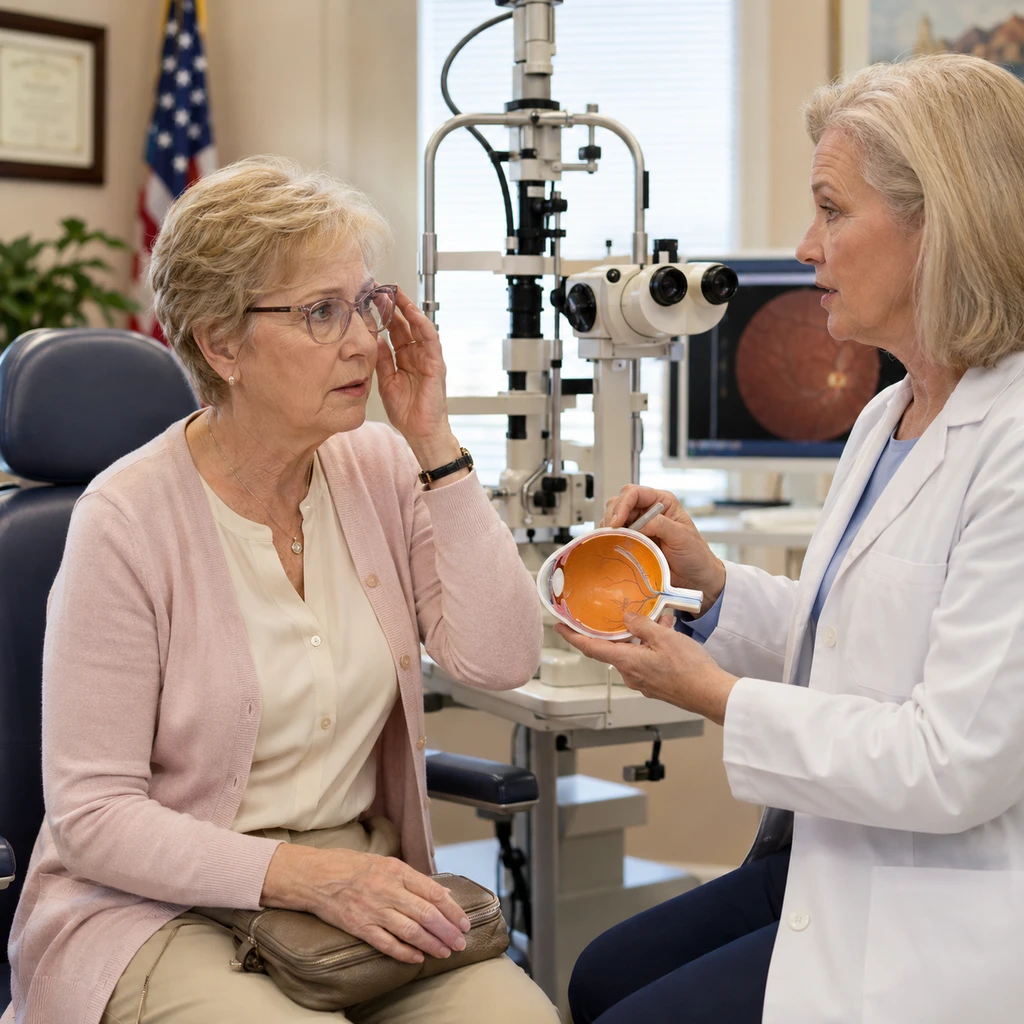
PCO is often easy to see with a slit-lamp microscope. The doctor may notice a fibrous haze, wrinkles, or small pearl-like clusters across the portion of the capsule directly behind the artificial lens.
The examination should not stop simply because cloudiness is present.
The ophthalmologist must decide whether that cloudiness is actually responsible for your symptoms.
A person can have mild PCO and significant macular degeneration at the same time. Another patient may have dry eye, an outdated prescription, and a slightly cloudy capsule. Someone with glaucoma may read poorly because the optic nerve has been damaged, even though the capsule also looks hazy.
If the retina or macula may be involved, the doctor might recommend optical coherence tomography, commonly called OCT. This painless scan produces detailed images of the retina and can reveal swelling or structural changes that may limit vision.
That information matters because clearing the capsule cannot repair every problem inside the eye.
A YAG laser can remove the cloudy obstruction created by PCO. It cannot reverse advanced macular degeneration. It cannot restore optic nerve tissue lost to glaucoma. It cannot correct every corneal irregularity or eliminate every need for glasses.
The most honest goal is to recover the vision being blocked by the cloudy capsule, not to promise perfect eyesight regardless of what else is happening.
When PCO is the main reason for the decline, the standard treatment is called Nd:YAG laser posterior capsulotomy.
The name sounds more complicated than the experience usually is.
The procedure does not replace the artificial lens.
It does not recreate the original cataract incision.
It does not require stitches.
It does not involve removing another cataract.
Instead, the ophthalmologist uses precisely focused laser energy to create an opening in the cloudy posterior capsule behind the implant. Once the central opening is made, light can pass through without being scattered by the hazy membrane.
Imagine a clear lamp shining through a frosted window.
The lamp is working properly, but the frosted glass is interfering with the light.
Replacing the lamp would not solve the problem. The obstruction is the cloudy window.
YAG capsulotomy creates a clear opening in that layer.
For many patients, the treatment is performed in an ophthalmologist’s office or outpatient eye clinic. The laser portion often takes only a few minutes, although the entire appointment may last much longer because of check-in, eye testing, dilation, examination, consent, and pressure monitoring.
On the day of treatment, your vision and eye pressure may be checked first. The staff will usually place drops in the affected eye to enlarge the pupil. Those drops may take twenty or thirty minutes to work.
Some patients receive medication before or after the laser to reduce the chance of a temporary rise in eye pressure. The exact routine varies according to the clinic, the doctor, and the patient’s medical history.
Once the pupil is ready, you sit at a machine that resembles the slit-lamp microscope used during an ordinary eye examination.
Your chin rests on a support.
Your forehead presses gently against a band.
Numbing drops may be placed in the eye.
The ophthalmologist may position a special contact lens on the surface of the eye to improve focus and help keep the eyelids out of the way. Because the eye has been numbed and lubricating fluid is used, the lens is generally not painful, although you may feel mild pressure.
You will be asked to hold your head still and look toward a target.
Then the laser begins.
You may hear a series of clicks. You may see bright flashes, colored spots, or brief bursts of light. Most patients do not describe the procedure as painful. The greater challenge is usually remaining still while looking into the bright examination light.
The ophthalmologist uses the laser to make an opening in the cloudy capsule directly behind the artificial lens. The implant remains in place. The rest of the capsular bag remains in place. Only the central portion blocking the visual pathway is opened.
When the doctor is satisfied with the opening, the contact lens is removed.
Your eye pressure may be checked again after a waiting period, particularly if you have glaucoma or other risk factors.
You then leave the clinic the same day.
That sounds simple, and in most cases it is.
But it would be misleading to say there is absolutely no recovery and no need to plan ahead.
Dilating drops can make near vision blurry and bright light uncomfortable for several hours. The examination lights and laser flashes may also leave temporary visual effects. Many clinics advise patients not to drive until their sight has returned to normal, so arranging a ride is the safest practical choice unless your own eye-care team tells you otherwise.
Bring sunglasses.
Even an ordinary American afternoon can feel painfully bright when your pupil is fully dilated. The reflection from a white parking lot, a grocery-store window, or the hood of a car may seem much harsher than usual.
Some people notice clearer vision before they reach home.
Others remain blurry for the rest of the day.
For many patients, the improvement becomes obvious within a few days as the dilation wears off and the eye settles.
You may see new floaters afterward.
They can look like dots, rings, threads, cobwebs, or tiny shadows drifting when your eye moves. A small number of floaters can occur after YAG treatment and often become less distracting over time.
A sudden storm of floaters is different.
If dozens of new spots appear at once, especially with flashes of light or a curtain-like shadow, contact an eye-care professional urgently. Those symptoms can indicate a retinal tear or detachment rather than routine post-laser settling.
Your eye may feel mildly irritated after the contact lens is removed. Some ophthalmologists prescribe anti-inflammatory drops for several days. Others do not use them in every uncomplicated case.
Follow the instructions written for your eye.
Do not use leftover drops from an old surgery.
Do not borrow medication from a spouse.
Do not assume that because a neighbor received one treatment plan, yours should be identical.
Most people return to ordinary activities quickly because the laser does not create an incision. There are generally fewer restrictions than after cataract surgery itself, but your doctor may alter the advice if you have inflammation, retinal disease, glaucoma, or another eye condition.
The goal of YAG capsulotomy is to recover the clarity that PCO has taken away.
It is not designed to give you a new artificial lens or change the basic focusing power of the implant. You may still need reading glasses, distance glasses, or correction for astigmatism.
If PCO has been the main obstacle, however, the improvement can feel dramatic.
Road signs regain their edges.
The white lines on the highway stop disappearing into glare.
Newspaper print looks black instead of gray.
Faces across the room become recognizable again.
The numbers on the oven are visible without leaning forward.
For someone who has quietly surrendered small pieces of independence, that return can be deeply emotional.
Margaret’s experience illustrates how easily fear can become larger than the medical problem itself.
Margaret was seventy-one when she underwent cataract surgery. She lived in a brick ranch house outside Columbus, Ohio, in the same neighborhood where she and her husband had raised three children.
Before surgery, she had stopped driving at night.
Headlights from oncoming traffic spread across the windshield in white bursts. Rain made the problem worse. She began declining invitations to evening Bible study and told her friends she preferred staying home after dark.
The truth was that she no longer trusted her eyes.
Reading was difficult too. Margaret kept a pair of glasses beside the recliner, another pair in the kitchen, and a third pair in her purse. She still struggled with small print. At the supermarket, she sometimes photographed labels with her phone and enlarged the picture.
The surgeries changed all of that.
Her right eye was treated first, and the left followed several weeks later. Once both eyes healed, Margaret said the world looked newly washed.
She could see individual leaves on the maple tree across the street.
She could read the newspaper by the living-room window.
At Christmas, she noticed details in her grandchildren’s faces that she had not realized she was missing.
The surgeries felt so successful that she eventually forgot they had happened.
For almost two years, she lived without thinking about her vision.
Then the red numbers on her bedside clock began to develop halos.
At first, she blamed the clock.
She bought another one at a department store, but the new display looked the same.
A few months later, she noticed that the right side of the television picture seemed faded. She cleaned her glasses with dish soap. She wiped the television screen. She moved her chair closer.
Nothing helped.
When she covered her left eye, the room became noticeably foggier.
When she covered the right, the picture sharpened.
The difference frightened her.
Margaret’s first thought was that the cataract had returned. Her second was that the artificial lens was failing. Her third was that she would need another operation.
She remembered arriving at the surgery center before sunrise. She remembered the stack of consent forms, the drops, the plastic shield taped over her eye, and the nervous first night when she was afraid to roll onto the wrong side.
The thought of repeating the entire process exhausted her.
So she said nothing.
Her daughter noticed that Margaret had stopped attending book club during the winter. Margaret said the roads were too dark. She began asking family members to read instructions printed on medicine bottles. She stopped trying new recipes because the measurements were difficult to see.
She did not think of these as major sacrifices.
She thought of them as adjustments.
That is how vision loss often enters a life—not with one dramatic announcement, but through a series of quiet decisions.
Margaret bought brighter lamps.
She ordered new glasses from an optical store.
The prescription helped the letters on the chart slightly, but the fog remained.
She waited another five months.
At her annual eye examination, the technician asked her to read the smallest line she could see.
Margaret guessed at the first letter and then stopped.
“I’m sorry,” she said. “I think my cataract came back.”
The ophthalmologist examined her eye and leaned away from the microscope.
“Your cataract didn’t come back,” he told her. “The capsule behind the implant has become cloudy.”
Margaret stared at him.
“Isn’t that the same thing?”
“No. The cloudy natural lens was removed. This is a membrane behind the new lens. Your implant itself looks good.”
He showed her a diagram and explained PCO.
The conversation lasted only a few minutes, but it changed the meaning of everything she had feared during the previous year.
The surgery had not failed.
Her eye was not rejecting the lens.
She did not need another cataract operation.
After the doctor examined her retina and discussed the risks, Margaret scheduled YAG capsulotomy.
Her daughter drove her to the appointment on a gray Monday morning. Margaret wore the navy-blue sweater she usually reserved for medical appointments and carried a folder containing every eye-care paper she had received in the previous five years.
The preparation took longer than the treatment.
She read an eye chart. Her pressure was checked. Drops were placed in the right eye. She waited while her pupil enlarged.
When she finally sat at the laser, she was surprised by how familiar the machine looked.
The doctor placed a lens against her numbed eye and told her to focus on the target.
Margaret heard several clicks and saw flashes of blue-white light.
Then the doctor leaned back.
“That’s it,” he said.
She thought he meant the first part was finished.
Instead, the procedure was over.
The pupil remained dilated for several hours, and her vision was still hazy when she returned home. She wore dark sunglasses in the passenger seat while her daughter stopped at a drive-through for coffee.
That evening, Margaret worried because the improvement was not immediate.
The next morning, she walked into the kitchen and noticed the digits on the oven clock looked darker.
By afternoon, the fog had thinned.
Two days later, she sat in her usual chair and read an entire newspaper article without closing one eye.
Her greatest relief was not measured on an eye chart.
It was the return of confidence.
She drove to Wednesday evening book club again. She read the directions on her prescription bottle without calling her daughter. She stopped arranging errands around sunset.
For nearly a year, Margaret had believed her eyesight was slipping away. The problem was addressed in an outpatient visit.
Her story is reassuring, but it should not be turned into a promise that everyone with blurry vision has the same diagnosis or result.
Real patients have different eye conditions, risks, and outcomes.
Her experience teaches a simpler lesson.
Do not let fear make the diagnosis for you.
One of the most common reasons people delay care is that they assume the fog is simply part of aging.
Getting older can affect vision in many ways, but a meaningful change after cataract surgery deserves an explanation.
You do not have to wait until you can no longer read the largest letters on the chart.
If glare is keeping you off the road, if you can no longer read comfortably, or if one eye has become noticeably worse, those changes matter.
Another common mistake is waiting automatically for the next annual examination.
If that appointment is nine months away, there is no benefit in spending nine months wondering. Call the office and describe the change. The staff can decide whether you need to be seen sooner.
A third mistake is repeatedly replacing glasses.
New glasses can help when the focus has changed, but they cannot make a cloudy capsule transparent. PCO mainly scatters light. A prescription can sharpen an image that is out of focus, yet the scattered haze may remain.
That does not mean an optometrist is the wrong person to visit. Optometrists routinely recognize PCO and refer patients to ophthalmologists for laser treatment when appropriate.
The mistake is not seeing an optometrist.
The mistake is assuming every decline must be corrected with stronger lenses.
A fourth mistake is searching for a home remedy that will dissolve the cloudy membrane.
Vitamins, eye exercises, warm compresses, and lubricating drops cannot remove PCO. Artificial tears may improve dry-eye symptoms that exist at the same time, but they do not create an opening in an opaque posterior capsule.
Be cautious with advertisements promising to reverse secondary cataracts naturally.
The language is appealing because it offers control without a medical visit. The underlying tissue, however, is a physical obstruction behind the artificial lens. When it becomes visually significant, YAG capsulotomy is the established treatment used to clear the visual pathway.
The procedure is widely used and generally considered safe, but safe does not mean risk-free.
A temporary increase in pressure inside the eye can occur after treatment. This is one reason doctors may use pressure-lowering drops or check eye pressure after the laser, especially in people with glaucoma or vulnerable optic nerves.
Inflammation may occur and can require medication.
Small marks can be created on the implanted lens if laser energy reaches its surface. These marks usually do not cause noticeable trouble, but they are a recognized complication.
Macular swelling can develop in rare cases. A retinal tear or retinal detachment is also an uncommon but serious possibility. Movement or dislocation of the artificial lens has been reported rarely, particularly if the structures supporting it are already weak.
Hearing about these risks can make a brief laser procedure sound alarming.
The more useful way to think about them is in context.
Every medical decision balances possible benefit against possible harm.
A person with minimal capsule clouding who reads and drives comfortably may gain little from immediate treatment.
A person whose vision has become so hazy that medication labels, road signs, and faces are difficult to recognize may gain a great deal.
Risk also varies from one eye to another.
Someone who is highly nearsighted may have a different retinal risk profile than someone who is not. A patient who has already experienced a retinal tear or detachment needs a careful discussion. A person with glaucoma may require particular attention to eye pressure.
Active inflammation or swelling in the macula may need to be treated before the capsule is opened.
An unstable artificial lens may change the plan.
A doctor may also recommend waiting if it is unclear whether PCO is truly responsible for the symptoms.
That caution is important because once an opening is made in the posterior capsule, certain future procedures involving the artificial lens can become more technically complicated. The ophthalmologist should therefore be reasonably confident that the capsule is the problem and that the implant itself does not need to be exchanged or repositioned.
There is no single rule that applies to every patient.
That is why statements such as “everyone should have the laser immediately” or “the procedure has no risks” should make you cautious.
Good eye care is individualized.
Before agreeing to treatment, ask the ophthalmologist what the examination showed.
Is the capsule cloudy enough to explain the vision loss?
Is the artificial lens centered and stable?
Does the retina look healthy?
Is there macular degeneration, swelling, glaucoma, or another condition that may limit improvement?
What level of clarity is realistically expected?
Should your pressure be checked after treatment?
Will you need drops?
Should you arrange transportation?
What symptoms require an urgent call?
These are not confrontational questions.
They are ordinary questions from a patient who wants to understand what is happening.
A thoughtful doctor will not be offended by them.
After the laser, follow the instructions given by the clinic even if the treatment felt almost too easy to count as a procedure.
Use prescribed drops for the full period directed.
Do not rub the eye if it feels irritated.
Wait until your vision is clear before driving.
Attend follow-up appointments if they are recommended.
Call promptly if the eye becomes increasingly painful or red, or if sight becomes worse instead of better.
Seek urgent help for repeated flashes, a sudden increase in floaters, a dark shadow, a curtain-like area, or rapid vision loss.
Do not reassure yourself with the thought that the laser was recent and therefore every symptom must be normal.
Most post-treatment effects are mild.
Serious warning signs still deserve attention.
It is also possible for the capsule to be opened successfully while vision remains less clear than you hoped.
That does not automatically mean the laser failed.
Suppose PCO was causing part of the blur while dry eye and macular degeneration were causing the rest. Removing the cloudy capsule can improve its share of the problem, but it cannot eliminate the other conditions.
Someone with glaucoma may regain contrast yet still have missing areas of peripheral vision.
A person with corneal disease may see more clearly but continue to experience glare.
Another patient may need a new glasses prescription once the eye has stabilized.
The result should be judged according to what the procedure was designed to fix.
YAG capsulotomy clears a cloudy membrane.
It does not rebuild the entire visual system.
For many people, however, that membrane is the main barrier, and its removal restores the level of sight they enjoyed after cataract surgery.
Family members often notice the behavioral change before the patient admits there is a vision problem.
A father who once met friends for breakfast begins declining invitations.
A mother who handled every household bill starts leaving envelopes unopened on the counter.
A grandmother who loved sewing says she has lost interest.
A grandfather who drove to every Little League game suddenly needs someone else to take him.
Those changes may be dismissed as fatigue, mood, or ordinary aging.
Sometimes the real problem is that familiar activities have become visually difficult.
Approach the conversation with respect.
Vision is closely tied to independence, and older adults may hide changes because they fear losing their driver’s license, being pressured to move, or becoming dependent on their children.
Saying, “You can’t see anymore,” may make someone defensive.
A gentler approach is more useful.
“I’ve noticed reading seems harder lately. Would you like me to help schedule an eye appointment so we can find out why?”
That wording preserves dignity.
It also leaves room for the person to remain part of the decision.
PCO is not a result of laziness or poor postoperative care.
You did not cause it by sleeping on the wrong side.
You did not cause it by reading too much.
You did not cause it by watching television in a dark room.
You did not cause it by taking a long flight or lifting grocery bags.
You did not cause it because you forgot one dose of an eye drop two years ago.
The clouding develops from changes in cells remaining within the capsular bag. Some patients develop enough opacity to affect vision, while others never need treatment. Age, eye conditions, lens design, surgical factors, and individual healing responses can influence the timing and likelihood.
Knowing that can remove a surprising amount of guilt.
It can also correct another common fear: the belief that the artificial lens has expired.
Modern intraocular lenses are intended to remain inside the eye. When vision becomes foggy, the implant itself is often still clear and correctly positioned.
The cloudiness is behind it.
That distinction matters because it changes the emotional meaning of the diagnosis.
You are not necessarily beginning the entire cataract journey again.
You may be dealing with a known change in the capsule that supported the original surgery.
PCO also does not damage the eye in the same way an infection or retinal detachment can. It interferes with vision by blocking and scattering light. When symptoms are mild, the ophthalmologist may monitor it. When the clouding interferes with daily life, the laser can create a clearer path.
Even after successful YAG treatment, regular eye examinations remain important.
Cataract surgery does not prevent glaucoma.
It does not prevent age-related macular degeneration.
It does not eliminate the risk of diabetic retinopathy, retinal tears, corneal disease, or dry eye.
Once the fog clears, it is tempting to stop thinking about eye care again. Enjoy the clarity, but continue the examinations recommended for your age and medical history.
The retina and optic nerve can develop problems without causing pain.
Routine care can identify changes before they become obvious in daily life.
Each eye should also be considered separately.
If both eyes have undergone cataract surgery, one may develop significant PCO while the other remains clear. The presence of clouding in one eye does not mean the second eye automatically needs treatment.
If both eyes require YAG capsulotomy, some ophthalmologists treat them during separate visits, while others may treat them on the same day depending on the patient, the clinic, and the circumstances.
There is no universal schedule.
The correct plan is the one created after both eyes are examined.
For most patients, the practical next steps are simple.
Notice whether the change has been gradual or sudden.
Compare the eyes without assuming the result gives you a diagnosis.
Write down the symptoms that are affecting daily life.
Call the professional who manages your eye care.
Explain that your vision became clear after cataract surgery and has now grown cloudy again.
Ask whether you may have posterior capsule opacification.
Attend the examination.
Discuss the expected benefit and the risks specific to your eyes.
Arrange transportation if laser treatment is scheduled.
Follow the aftercare instructions.
Know which symptoms require urgent help.
Then give your eyes time to settle before judging the final result.
The most important part of this process may be replacing a vague fear with a specific explanation.
When vision fades after successful cataract surgery, the mind naturally moves toward the worst possibilities.
Perhaps the operation failed.
Perhaps the lens is defective.
Perhaps blindness is beginning.
Perhaps nothing more can be done.
Posterior capsule opacification is a reminder that frightening symptoms can sometimes have manageable causes.
The cataract has not returned.
The artificial lens may still be working exactly as intended.
A thin membrane behind it may simply have lost its transparency.
For an appropriately selected patient, a brief outpatient laser procedure can create a clear opening without repeating cataract surgery. Vision often improves within a few days, although the exact timing and result vary from one patient to another.
The answer is not to diagnose yourself from a symptom list.
The answer is not to ignore the fog until another year has passed.
The answer is not to buy stronger and stronger glasses while giving up night driving, reading, church gatherings, family dinners, and the ordinary routines that once made you feel independent.
The answer is to make the appointment and let someone look.
If menus have slowly become difficult to read again, if headlights have regained their halos, or if morning sunlight seems to pass through a veil, call your eye-care professional.
Do it without panic.
Do it without blaming yourself.
Do it knowing that the cataract you had removed did not simply grow back.
You may have spent months worrying that your sight was disappearing when the real problem is a cloudy membrane an ophthalmologist can often identify within minutes.
For many patients, the most satisfying moment comes a day or two after treatment.
It does not happen inside the clinic.
It happens at home.
A woman looks across the breakfast table and sees the fine silver in her husband’s hair.
A man opens the morning paper and realizes he is no longer searching for the brightest lamp.
Someone drives past the neighborhood pharmacy at dusk and reads the sign before reaching the intersection.
The world does not become younger.
The eyes do not become perfect.
But the fog lifts.
And ordinary life, which had been quietly shrinking around blurred edges, becomes clear enough to step back into again.