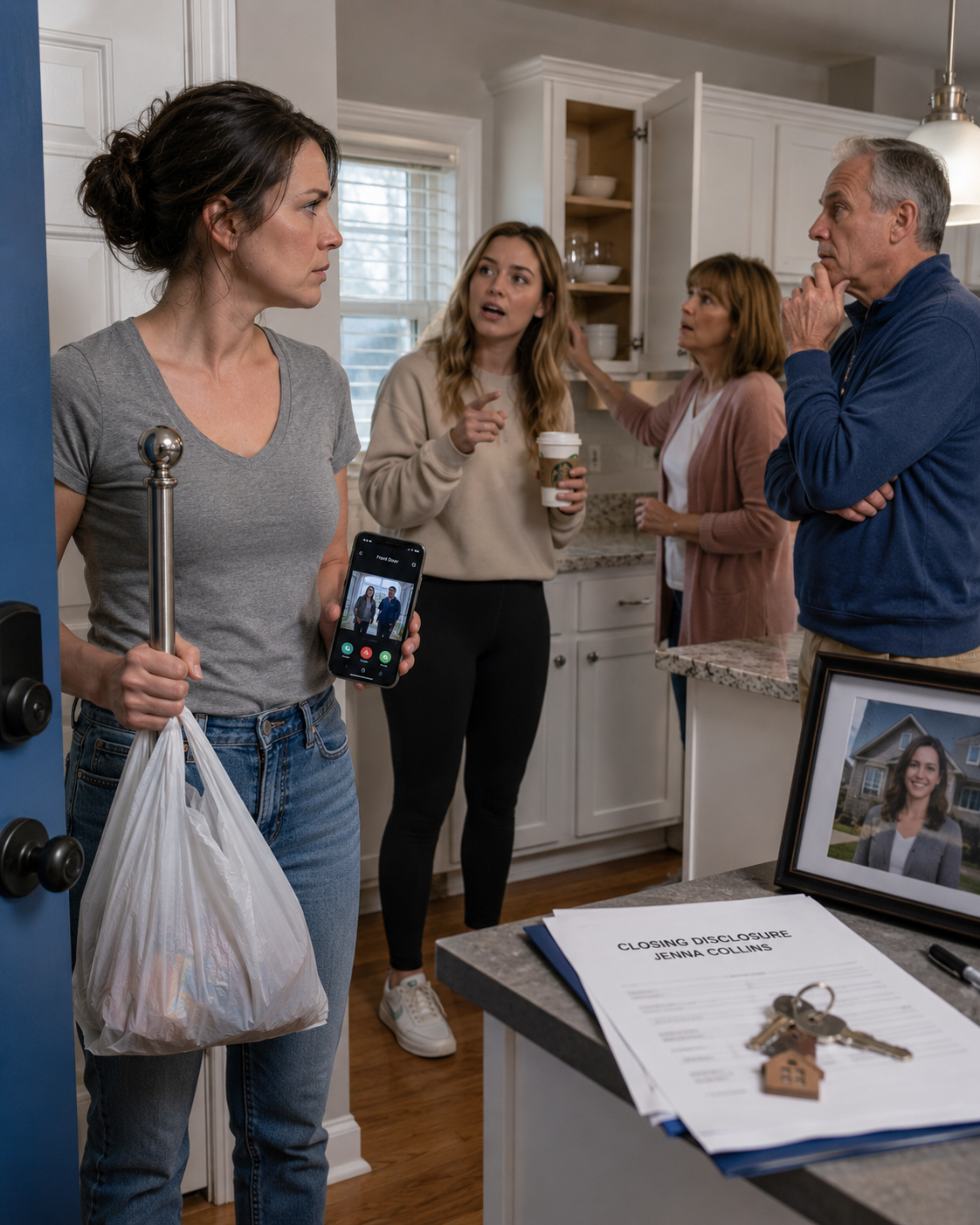
My family never helped me buy one lamp, one curtain rod, or one square foot of my new house, but the moment they saw it, my sister walked through the living room and said, “This place is finally worth sharing.”
I stood in the doorway of my small brick house in Richmond, Virginia, holding a hardware store bag against my chest while my mother opened my kitchen cabinets like she had been invited to inspect them.
Then I noticed the emergency key tag still hanging from my old apartment key ring in my mother’s hand, and I understood they had not found my home by accident.
They had come prepared to claim it.
My name is Erin Caldwell. I am thirty-four years old, and for most of my adult life, I was the daughter who was expected to make room.
Room in my schedule.
Room in my paycheck.
Room in my car.
Room in my heart for people who only remembered family when they needed something.
When my younger sister, Megan, wrecked her car, I was asked to “help just this once.”
When my parents fell behind on bills, I was told, “You’re doing better than the rest of us.”
When I saved money instead of going on vacations, nobody called it discipline.
They called it luck.
Luck.
That word always found me after the work was already done.
Lucky I found a decent job.
Lucky my old car kept running.
Lucky I did not have kids.
Lucky my landlord had not raised rent too much.
Lucky I could “afford” to help.
People use luck when they do not want to count the sacrifices that made your life look stable.
I grew up in a family where need always outranked effort.
My father, Glenn Caldwell, believed authority came with age and volume. He was not a cruel man in the way people would recognize quickly. He did not throw things. He did not rage for hours. He simply expected the house to bend toward him.
If Dad was tired, everyone else became quiet.
If Dad was broke, someone else should understand.
If Dad forgot a bill, my mother said he had “a lot on his mind.”
My mother, Patricia, was softer and more dangerous.
She could turn a demand into a sigh.
“Erin, honey, you know your sister is struggling.”
“Erin, your father doesn’t need stress right now.”
“Erin, family doesn’t keep score.”
That last one was her favorite.
Family doesn’t keep score.
It sounded noble until I realized the people saying it were always the ones losing track of what they owed.
My sister Megan was four years younger than me and had always been treated like weather.
If she made a mess, people talked about the storm, not the damage.
Megan missed payments because she was overwhelmed.
Megan lost jobs because managers did not appreciate her.
Megan wrecked cars because she was unlucky.
Megan needed help because that was what family did.
I became the steady daughter.
The one with a full gas tank.
The one who answered calls.
The one who had a little savings because she did not go anywhere, buy much, or ask anyone to rescue her.
By the time I was thirty-four, I had become so used to making room that I no longer noticed how little space I had left for myself.
I worked as an administrative coordinator for a small electrical contractor in Richmond.
Not glamorous work.
Schedules, permits, invoices, inspection forms, supply orders, change requests, job folders, and the occasional phone call from a homeowner who believed a ceiling fan should be installed by prayer and discount.
I knew how much houses cost after people bought them.
That mattered.
Everyone talks about mortgage payments.
Nobody talks enough about gutter repair, roof flashing, breaker boxes, property tax, trash fees, water bills, swollen doors, leaking toilets, and the strange little purchases that eat a paycheck one Saturday at a time.
I saw those costs every day.
Maybe that was why I saved carefully.
Maybe that was why I did not tell my family when I started looking for a house.
I knew what they would see.
Not my work.
Not my discipline.
Not the years of cheap lunches, thrift-store furniture, old coats, skipped trips, and apartments with thin walls.
They would see rooms.
Empty rooms.
Rooms they could explain themselves into.
The house I bought was not huge.
Just a small brick place on a quiet street in Richmond, with a green front door, a fenced backyard, two bedrooms upstairs, a little room on the first floor that could become an office, and a kitchen window that caught the morning light in a way that made the whole room feel forgiven.
The first time I saw it, I stood in the kitchen while my realtor, Marsha Bell, talked about the inspection report.
The cabinets were plain.
The counter had a burn mark near the stove.
The back door needed weatherstripping.
But sunlight came through that window and landed across the scratched wood floor like the house was already saying, You can rest here.
I made an offer that afternoon.
Not too high.
Not reckless.
Just enough.
The seller accepted after one counteroffer, and I cried in the parking lot of a grocery store when Marsha called.
Not loud.
Not pretty.
Just sitting behind the wheel with my hand over my mouth while people pushed carts past my car and the world kept going like I had not just touched the edge of a life I built myself.
I told almost no one.
My realtor knew.
My lender knew.
My best friend Lauren knew.
That was the plan.
Lauren had known me since community college, back when we both worked part-time jobs and shared one reliable printer between us. She was married now, with two children and a husband who knew better than to comment on women’s money. When I told her about the house, she cried harder than I did.
“You did it,” she said.
“I haven’t closed yet.”
“You did it when you believed you could.”
That was Lauren.
Soft when necessary.
Sharp when useful.
She helped me pack.
She brought boxes from her office, labeled things by room, and warned me three times not to give my family a key.
“I’m serious, Erin.”
“I know.”
“No. You know in your head. I need you to know in your bones.”
“I’m not giving them a key.”
“Good. Because your mama has never met a boundary she didn’t call disrespect.”
I laughed then.
Not because it was wrong.
Because it was too true.
I closed on the house on a rainy Tuesday morning at a title office off Broad Street.
The conference room had gray carpet, a bowl of peppermints, and a fake plant that looked like it had given up sometime around 2018. I signed my name so many times my hand cramped.
Erin Caldwell.
Erin Caldwell.
Erin Caldwell.
No co-signer.
No family gift letter.
No borrowed down payment.
No one standing behind me claiming a piece of the moment.
Just me, a stack of papers, my lender, the title agent, and a set of keys in a little envelope.
When I walked outside, rain was falling lightly.
I held the envelope under my jacket like it was alive.
For three weeks, I moved in quietly.
After work.
On weekends.
One carload at a time.
Dishes wrapped in towels.
Books in grocery bags.
Clothes on hangers laid across the back seat.
A lamp from Goodwill.
A small table from Facebook Marketplace.
A mattress delivered while I stood on the porch feeling like an adult and a child at the same time.
I kept my apartment until the end of the month because I had paid for it and because moving slowly felt safer.
That was how my mother got the address.
Not from me.
From the apartment.
Years earlier, when I had a bad case of the flu and passed out in my bathroom, I gave my mother an emergency key. I was twenty-seven. Living alone. Scared enough that it seemed wise.
She kept the key on a little metal tag from the apartment office.
Emergency copy — Maple Ridge Apt. 2B.
I never asked for it back.
That was my mistake.
Mothers who respect boundaries can keep emergency keys.
Mothers who believe your life belongs to the family should never be handed metal.
I did not know she still had it.
Until Thursday evening.
I came back from the hardware store with curtain rods, cabinet pulls, a pack of screws, a small level, and a little welcome mat I had bought because it made me smile.
The mat said Home in dark blue letters.
Simple.
Corny.
Mine.
Then I saw my parents’ SUV in my driveway.
For one second, my stomach dropped so hard I thought someone must have died.
But when I opened the front door, nobody looked hurt.
They looked comfortable.
Megan was standing in my living room with her shoes on my new rug, sipping iced coffee and turning slowly like she was touring a model home.
My mother was opening kitchen cabinets.
My father stood near the hallway, looking toward the stairs like he was already deciding which room belonged to whom.
“What are you doing here?” I asked.
Megan smiled like I was late to my own showing.
“Mom found the address,” she said. “You really thought you could hide a whole house?”
My chest tightened.
I looked at my mother.
She lifted her chin.
“Don’t look at me like that. Family doesn’t keep secrets this big.”
“This is my home,” I said. “Not a family project.”
My father frowned.
“Watch your tone.”
There it was.
The old rule.
They could enter my house without asking, but I was disrespectful for noticing.
Megan walked toward the stairs.
“Honestly, this works out,” she said. “My lease is up next month. The upstairs room with the big window is perfect for me.”
I stared at her.
“What?”
She laughed.
“Don’t be dramatic, Erin. You’re single. No husband, no kids, three bedrooms. Why would you hoard all this space?”
Hoard.
A word for greed.
As if I had been hiding canned goods during a famine instead of buying a house with my own money.
My mother stepped in softly, the way she always did when she wanted a demand to sound like love.
“Honey, family helps family. Megan needs a reset. Your father and I could stay sometimes too. Your dad’s back has been terrible lately.”
I looked at him, waiting for one decent sentence.
He only shrugged.
“You’re alone anyway.”
That was the sentence that changed the air.
Not because it was loud.
Because it was honest.
They did not see my house as a boundary.
They saw it as proof that I had something they had not taken yet.
I set my hardware bag down.
Then I opened the front door.
“Leave,” I said.
Megan’s smile slipped.
My mother blinked.
My father went red.
“Excuse me?” he said.
“You heard me.”
My mother pressed one hand to her chest.
“Erin, don’t be ugly.”
“You are standing in my kitchen opening my cabinets.”
“We are your family.”
“Then act like guests.”
Megan rolled her eyes.
“You’re really going to kick out your own mother?”
“Yes.”
That surprised all of us.
Maybe me most.
My father took one step toward me.
“Girl, you do not talk to me like that.”
I held the door open wider.
“You are in my house.”
He looked around, as if the walls might correct me.
They did not.
“Your house,” he said, with a little laugh. “You think a mortgage makes you better than everybody.”
“No,” I said. “I think it makes me responsible for who comes through this door.”
Nobody moved.
So I said it again.
“Leave.”
After they left, I stood in the quiet hallway and looked at the place I had bought with every tired piece of myself.
The white walls.
The unopened paint samples.
The curtain rods still in the bag.
The welcome mat leaning against my leg.
Then I looked down.
My mother had dropped the old key tag by the door.
The one from my apartment.
The one she was never supposed to use unless there was an emergency.
I picked it up slowly.
Emergency copy — Maple Ridge Apt. 2B.
And for the first time all night, I did not feel guilty.
I felt awake.
Because they had come planning to move in.
But they had not planned for me to finally lock them out.
I called Lauren before I even took off my shoes.
She answered with children screaming somewhere in the background.
“Hey, homeowner.”
“They found it.”
The background noise faded.
“How?”
“My mother had the old apartment emergency key. The tag was in her hand.”
Lauren swore.
Not loudly, but with feeling.
“Are they still there?”
“No. I made them leave.”
A pause.
Then she said, “Say that again.”
“I made them leave.”
“Good. Now lock every door and stay on the phone with me.”
I did.
I walked from room to room checking windows, doors, the sliding latch on the back gate, the basement entry.
Everything felt different now.
A house is not truly yours the first time you sleep in it.
It is yours the first time you defend the door.
The next morning, I called Maple Ridge Apartments.
The assistant manager, Missy, knew me because I had lived there six years, always paid on time, and never once complained without photographs.
“Erin,” she said, “everything okay?”
“Did anyone come by my old apartment this week?”
A pause.
“What do you mean?”
“My mother had an emergency key. I think she used it.”
Missy’s voice changed.
“Hold on.”
I heard typing.
More typing.
Then she sighed.
“Your mother came Tuesday afternoon.”
My hand tightened around the phone.
“What did she say?”
“She told maintenance you asked her to pick up a box you forgot.”
“I did not.”
“I’m sorry. She had the emergency key. We didn’t know.”
“Was she inside long?”
“Twenty-three minutes, according to the entry log and hallway camera.”
Twenty-three minutes.
Long enough to find my closing folder.
Long enough to photograph my moving boxes.
Long enough to read the address label on a utility confirmation.
Long enough to decide my home had become available for family use.
Missy sounded genuinely upset.
“Do you want a copy of the entry log?”
“Yes.”
“I’ll send it.”
“Thank you.”
“And Erin?”
“Yes?”
“Change your locks.”
“I am.”
The locksmith came that afternoon.
His name was Mr. Ruiz, and he arrived in a white van with a cracked dashboard, a toolbox, and the calm of a man who had seen many family situations at front doors.
“New homeowner?” he asked.
“Yes.”
“Family found out?”
I blinked.
“How did you know?”
He removed the old lock from the green front door.
“People who change locks this fast are usually either landlords or daughters.”
I almost laughed.
“Daughters?”
“Daughters with mothers who think keys are opinions.”
That time, I did laugh.
He changed the front door, back door, basement entry, and side gate lock. He installed a keypad deadbolt at the front and showed me how to change the code. I paid him from the account I had been saving in for years, and when he handed me the receipt, I put it directly into my house folder.
Keep good records.
That was the first rule of owning a house and surviving family.
Lauren came over after work with her husband, Dan, a ladder, and two pizzas.
Dan installed the curtain rods while Lauren helped me unpack dishes.
At one point, she opened a cabinet and stopped.
“What?”
“Your mother really rearranged these?”
“She tried.”
Lauren closed the cabinet slowly.
“Do you want me to curse her now or later?”
“Later.”
“Fine. I’ll hydrate first.”
That evening, after pizza, we installed a small camera above the front porch.
Not because I wanted to live afraid.
Because I wanted the truth to have a timestamp.
The texts began before breakfast the next morning.
Mom:
I don’t know what has gotten into you.
Megan:
You embarrassed Dad.
Dad:
You need to apologize to your mother.
Mom:
We only wanted to see where you were living.
Megan:
Must be nice to have all that space while your sister struggles.
Mom:
Family doesn’t lock family out.
I took screenshots.
Not because I planned to fight.
Because I had finally learned that peace without documentation was just another place for people to rewrite you.
On Saturday, a USPS confirmation card arrived.
Not for me.
For Megan Caldwell.
Change of address request.
Forwarding from her apartment to my new house.
My hands went cold.
She had not even waited.
I called the number on the card and canceled the request.
Then I called Megan.
She answered cheerfully, which told me she did not yet know the card had reached me first.
“Hey.”
“Did you forward your mail to my house?”
Silence.
Then, “It was just temporary.”
“No.”
“My lease is up soon.”
“No.”
“Erin, stop acting crazy. It’s mail.”
“It is how people start pretending they live somewhere.”
She laughed, but there was strain in it.
“You watch too many crime shows.”
“No. I read paperwork for a living.”
“That’s not normal.”
“Neither is forwarding mail to a house where you are not welcome.”
Her voice sharpened.
“You’re really going to leave me with nowhere to go?”
“You had somewhere to go before you assigned yourself my upstairs room.”
“You don’t need three bedrooms.”
“You don’t get to measure my need in a house I bought.”
She hung up.
Five minutes later, my mother called.
I did not answer.
Then Dad.
Then Megan again.
I texted all three in one group message.
No one has permission to live in, enter, receive mail at, store belongings at, invite others to, or use my address for any purpose. Any future visit must be arranged with my permission in advance.
My mother replied:
Listen to yourself. You sound hateful.
I typed nothing.
Lauren texted me later.
Do not answer the guilt buffet.
Good advice.
I did not answer.
For two days, nothing happened.
That almost made it worse.
Silence from family like mine is rarely peace.
It is planning.
On Tuesday, my neighbor Mrs. Whitaker knocked on my door.
She was in her seventies, with silver hair, bright lipstick, and the kind of posture that made you stand straighter without knowing why. She lived two doors down and had already informed me which trash day mattered, which mail carrier was reliable, and which neighborhood cats were freeloaders.
“Baby,” she said, “do you have a sister with a silver SUV?”
My stomach sank.
“Yes.”
“She was here at eleven this morning while you were gone.”
I stepped onto the porch.
“What did she do?”
“Tried the front door. Then the side gate. Then stood on the porch talking on the phone about how you changed the locks.”
I closed my eyes.
Mrs. Whitaker continued.
“I asked if she needed something.”
“What did she say?”
“That she was family.”
I opened my eyes.
Mrs. Whitaker’s expression had not changed.
“And what did you say?”
“I said that is not a key.”
I nearly hugged her.
She handed me a folded note.
“I wrote down the time. My grandson says everybody needs cameras now, but paper still scares fools.”
I took the note.
“Thank you.”
She looked at me for a long moment.
“Your house?”
“Yes, ma’am.”
“Your name?”
“Yes.”
“Then don’t let pity become a spare key.”
That sentence stayed with me.
That night, I called a lawyer.
Not because I wanted to sue my family.
Because I did not want to be surprised by them.
Her name was Nadine Porter, and her office was above a small accounting firm near downtown Richmond. She was in her sixties, wore burgundy glasses, and had the weary calm of a woman who had watched too many families behave badly around property.
I brought everything.
The deed.
Closing papers.
Mortgage documents.
The Maple Ridge entry log.
Screenshots.
The USPS change-of-address card.
Mrs. Whitaker’s note.
Photos from the porch camera of Megan trying the door.
Nadine read quietly.
Then she took off her glasses.
“You need two things.”
“What?”
“Boundaries and proof. You already started both.”
“I don’t want to overreact.”
“Erin, your family entered your prior apartment under false pretenses, found your home address, entered your new home without permission, attempted to forward mail, tried your locks, and announced intended occupancy. That is not overreaction territory. That is pattern territory.”
Pattern.
That word made my chest hurt.
Because a pattern is not one bad day.
It is design.
Nadine drafted a letter.
Formal.
Plain.
No emotional decoration.
Patricia Caldwell, Glenn Caldwell, and Megan Caldwell were not tenants, residents, guests, agents, or authorized occupants of my home. They had no permission to enter, receive mail, store property, or represent the address as theirs. Any future uninvited presence would be treated as trespass. Any additional mail forwarding, address use, or attempted entry would be documented.
She also advised me to notify the post office in writing, update my voter registration and DMV address securely, speak to my lender about any address-change attempts, and keep all communications.
“Do not explain your feelings,” she said.
“That sounds cold.”
“It is not. Feelings are for people negotiating in good faith. Documents are for people testing your locks.”
I paid her from my savings.
It hurt.
But not as much as losing a house would have.
The certified letters went out Thursday.
On Friday, my father called from a number I did not recognize.
I answered because I was expecting a hardware delivery.
“Erin.”
I closed my eyes.
“Dad.”
“You sent a legal letter to your mother?”
“Yes.”
“You ought to be ashamed.”
“No.”
The word came out before I could soften it.
He stopped.
I had never said no to shame that quickly.
He lowered his voice.
“You think because you bought a little house, you’re grown enough to disrespect us.”
“I think because I bought a house, I decide who enters it.”
“Megan needs help.”
“Then help her.”
“We all help how we can.”
“No. You help by assigning my space.”
He exhaled hard.
“You’re single, Erin. What are you doing with all that room?”
“Living.”
The line went quiet.
Then he said, “You have changed.”
“Yes.”
I hung up.
My hands shook afterward.
Not from regret.
From adrenaline.
People think standing up for yourself feels powerful.
Sometimes it feels like your nervous system has been chased by dogs.
Saturday morning, they came with boxes.
Of course they did.
A small rented moving van pulled up in front of my house at 8:17 a.m. I know the exact time because my porch camera caught it.
I was in the kitchen drinking coffee.
No makeup.
Hair wrapped.
Old T-shirt.
For one second, I felt the old reflex.
Open the door.
Smooth it over.
Do not let neighbors see.
Do not make Dad angry.
Do not make Mom cry.
Do not make Megan desperate.
Then I remembered Mrs. Whitaker.
Pity can become a spare key.
I called Lauren.
“They’re here with a van.”
She said, “I’m on my way.”
Then I called the non-emergency police line.
My voice shook, but I gave the address clearly.
My family had been notified in writing not to come.
They were outside with a moving van.
I was the homeowner.
I had documentation.
The dispatcher stayed calm.
So did I.
Mostly.
By the time I stepped onto the porch, Megan was already walking up the path with two plastic storage bins. My mother stood near the van holding a tote bag. Dad stood at the curb with his hands on his hips like he had come to supervise common sense.
Megan smiled too brightly.
“Don’t start, Erin. We’re just putting a few things in the garage until I figure stuff out.”
“No.”
Her smile dropped.
“Excuse me?”
“No.”
My mother came forward.
“Honey, we are not doing this on the sidewalk.”
“That is correct. You are leaving.”
Dad’s face darkened.
“You called the police on your own family?”
“I called before you tried to make me choose between family pressure and my front door.”
Megan looked around.
Neighbors were beginning to notice.
Good.
Let them.
For years, my family had used privacy as a curtain.
Curtains can make theft look like misunderstanding.
Mom’s eyes filled on command.
“You would really let your sister be homeless?”
“Megan has options.”
“No, I don’t,” Megan snapped.
“You had options before you decided mine was easiest.”
Dad walked toward the porch.
I held up one hand.
“Do not come closer.”
He stopped, shocked.
Maybe because I had never spoken to him like that.
Maybe because a police cruiser had just turned the corner.
The officer who arrived was a woman, maybe late forties, with calm eyes and a voice that did not invite speeches.
“Who called?”
“I did,” I said. “I’m Erin Caldwell. I own the house.”
My father started.
“Officer, this is a family misunderstanding.”
The officer turned to him.
“I’ll speak with the caller first.”
A small miracle.
I handed her my ID, the deed copy, Nadine’s letter, the certified delivery confirmation, the USPS card, and the porch camera still image.
She looked through them.
Not quickly.
Not dismissively.
My mother dabbed at her eyes.
Megan muttered something about dramatic.
Dad stared at me like I had betrayed the natural order of the universe.
The officer handed the papers back.
“Ms. Caldwell, do you want these individuals on your property?”
“No.”
She turned to my family.
“You need to leave.”
Dad stiffened.
“This is her mother and father.”
The officer’s face did not change.
“Sir, she owns the property. You have been told to leave.”
Megan’s voice rose.
“My stuff is in the van. I have nowhere—”
“You will need to make other arrangements.”
My mother looked at me.
Not angry now.
Worse.
Wounded.
“Honey, please.”
That word almost did it.
Please.
The sound of my mother asking, not demanding.
The sound of the old trap wrapped in softness.
But then I saw Megan’s bins.
The labels on top.
Bedroom.
Bathroom.
Closet.
Not temporary storage.
Move-in.
I looked at my mother.
“You had days to ask me like a person. You chose a van.”
Her tears stopped.
Just for a second.
Enough for me to see the calculation underneath.
The officer waited.
Dad cursed under his breath.
Megan dragged the bins back to the van.
My mother climbed into the passenger seat without looking at me.
As they pulled away, Megan shouted through the open window, “Enjoy being alone in your big empty house.”
The words hit.
I will not pretend they did not.
But they did not open the door.
Lauren arrived ten minutes later, breathless, carrying a bag of bagels and looking ready to fight a moving van barehanded.
When she saw the street empty, she stopped.
“They left?”
“They left.”
“You okay?”
“No.”
“Good. Come eat.”
I laughed because sometimes your best friend knows grief needs cream cheese.
That afternoon, Mrs. Whitaker came over with a pound cake.
Dan fixed the sticky back gate latch.
Lauren helped me hang the curtain rods.
By evening, the living room looked more like mine than it had before the invasion.
Curtains up.
Lamp plugged in.
Goodwill table under the window.
Welcome mat at the front door.
The house felt bruised, but standing.
So did I.
The family campaign lasted months.
Aunt Carol called.
Then Cousin Ray.
Then a woman from my mother’s church who said she was “not taking sides” before immediately taking one.
I said the same thing every time.
“No one is moving into my house.”
“But family—”
“No.”
“But Megan—”
“No.”
“But your mother—”
“No.”
No became easier with repetition.
Not easy.
Easier.
The first time, it felt like breaking a dish.
By the tenth time, it felt like closing a window before rain got in.
Megan found a room eventually.
Not with me.
With a coworker whose aunt rented a basement apartment in Henrico and charged actual rent with actual rules.
Megan hated it.
Good.
Rules are less charming when they come from people you cannot emotionally blackmail.
My parents did not speak to me for four months.
Those were the quietest four months of my adult life.
At first, I felt guilty every morning.
Then guilty every other morning.
Then one day, I woke up, made coffee, stood at the kitchen window with sunlight hitting the floor, and realized I did not feel guilty.
I felt rested.
That was when I understood how heavy constant obligation had been.
Rest can feel suspicious when you have spent years mistaking anxiety for love.
I made the house mine slowly.
Not all at once.
A blue chair from an estate sale.
A shelf for books.
A little herb garden by the kitchen window.
Curtains Lauren said were “very grown woman with boundaries.”
I painted the front door a deeper green.
I planted hydrangeas along the fence even though Mrs. Whitaker warned me they were “needy drama plants.”
I told her I was used to that.
She laughed for a full minute.
The first holiday was Thanksgiving.
My mother texted two days before.
Are you really going to sit alone in that house for Thanksgiving?
I looked around my kitchen.
There was a turkey breast in the refrigerator.
A pie from the bakery.
A bottle of wine Lauren had brought.
Three folding chairs because I had invited Lauren, Dan, their kids, Mrs. Whitaker, and Mr. Ruiz the locksmith, who turned out to be Mrs. Whitaker’s nephew and had nowhere to go until evening.
I replied:
No.
She sent:
So you’re coming here?
I wrote:
No.
That was all.
Thanksgiving in my house was noisy, warm, imperfect, and mine.
Lauren’s children spilled cranberry sauce.
Dan overcooked the green beans.
Mrs. Whitaker told a story about her late husband that made us all cry and then scolded us for letting the rolls get cold.
At one point, I stood in the doorway between the kitchen and living room, holding a dish towel, and looked at the table.
People I had invited.
People who knocked.
People who brought something without asking what they could take.
That was when the house finally exhaled.
Six months after the moving van, Megan called.
I almost did not answer.
Then I did.
“What?”
She was quiet.
No dramatic opening.
No attitude.
“Can we talk?”
“About what?”
“About what happened.”
I sat at the kitchen table.
The same table I bought from Facebook Marketplace and carried in with Dan swearing at both stairs.
“I’m listening.”
She took a breath.
“I was wrong.”
Those three words were unfamiliar enough in her voice that I stayed silent.
She continued.
“I told myself you had extra because you always seemed okay. I told myself you were hiding the house because you didn’t want to share. But I was mad because you did something I haven’t done yet.”
“What?”
“Built something that wasn’t waiting for Mom and Dad to approve it.”
That was the first honest sentence Megan had given me in years.
I did not rush to soften it.
“I appreciate you saying that.”
“I’m sorry for trying the door.”
“Good.”
“I’m sorry for forwarding my mail.”
“Good.”
“I’m sorry for the van.”
“That one needs more than good.”
She laughed once, weakly.
“I know.”
We did not become close overnight.
That is not how trust works.
But we began speaking again.
Carefully.
In public places first.
Coffee shops.
A diner near her work.
A park bench during one awkward lunch where she cried and admitted Mom had told her I would “calm down once the boxes were there.”
That sentence helped me understand something.
My family had not believed I would say yes.
They believed I would be too embarrassed to continue saying no once the performance began.
That hurt.
Then it freed me.
Because embarrassment had been the lock.
I had changed it.
Megan eventually came to my house again.
Invited.
She knocked.
I opened the door and did not step aside immediately.
She noticed.
Good.
“I brought something,” she said.
A lamp.
Small.
Nothing expensive.
Blue ceramic base.
White shade.
A little crooked.
“I know you said nobody helped you buy one,” she said, eyes wet. “So I thought maybe I could start with one.”
I looked at the lamp.
Then at her.
“This does not buy you a room.”
She laughed through tears.
“I know.”
I let her in.
We placed the lamp on the table by the window.
It is still there.
My parents took longer.
My father never apologized properly.
Men like him often age out of authority before they learn humility.
But he did say one thing, a year later, standing on my porch after dropping off a box of old Christmas ornaments my mother claimed were mine.
“I didn’t think you’d really keep us out.”
I looked at him.
“I know.”
He stared at the green door.
“Your mother cried over that.”
“I cried too.”
His jaw tightened.
That was the closest we came to truth for a while.
My mother apologized sideways.
“I suppose we came on too strong.”
I said, “You used my emergency key to get my address, opened my cabinets, tried to move Megan in, and sent a van after a legal letter.”
She looked wounded.
“I said too strong.”
I looked at her for a long moment.
“That is not the same as wrong.”
She did not answer.
We are still working on that.
Or maybe we are not.
Some relationships do not heal because one person keeps bringing gauze to a house fire.
I see them sometimes.
Birthdays.
Short visits.
Restaurants.
Not in my house unless I invite them.
They do not have keys.
No one does except Lauren, for true emergencies, and Mrs. Whitaker, because she once scared off my sister with a porch voice and earned her way into the inner circle.
Megan has been over many times since.
She always knocks.
Always.
Even if the door is open.
That is how I know the apology took root.
Two years after I bought the house, I hosted a summer cookout.
Nothing fancy.
Burgers.
Hot dogs.
A folding table in the backyard.
String lights along the fence.
Hydrangeas blooming like drama queens.
Lauren came with her family.
Mrs. Whitaker brought potato salad.
Megan came with the blue lamp’s matching little bowl she found at a thrift shop.
My parents came for one hour and behaved mostly because Mrs. Whitaker had positioned herself near the back door like a church usher with legal authority.
At some point, my mother stood in the kitchen while I pulled paper plates from a cabinet.
She did not open the cabinet herself.
Progress can be small and still count.
“This turned out nice,” she said.
“Yes.”
“I didn’t know you had been saving that long.”
I looked at her.
“You didn’t ask.”
She touched the counter.
Not inspecting this time.
Just touching.
“I guess I thought if you had enough to buy this, you had enough to help.”
That sentence contained more truth than apology, but truth was something.
“I had enough to buy this because I stopped helping every time someone asked.”
She looked at me.
For once, she did not argue.
Outside, Megan laughed at something Lauren’s youngest said. My father sat under the umbrella, eating too much potato salad and pretending not to enjoy himself.
My mother said quietly, “I miss when you needed me.”
I set the plates down.
That was the oldest truth under everything.
“I needed you then too,” I said. “You just kept needing me louder.”
Her eyes filled.
I did not hug her.
Not because I wanted to punish her.
Because I had learned not every emotional moment required me to give up ground.
She wiped her face.
Then picked up the plates.
“Where do you want these?”
I almost smiled.
A question.
A real one.
“Outside on the table.”
She carried them out.
I stood alone in the kitchen for a moment and let myself breathe.
The house held.
So did I.
Now, years later, people sometimes ask if I regret keeping my home secret.
I do not.
I regret giving my mother that emergency key and never asking for it back.
I regret all the times I answered “just this once” until my family began hearing “always.”
I regret thinking privacy was the same as betrayal.
It is not.
Privacy is how some dreams survive long enough to get keys.
The old apartment key tag is in a small frame in my office.
Emergency copy — Maple Ridge Apt. 2B.
Under it, on a card Lauren wrote for me, are the words:
Not every emergency is yours to solve.
I keep it there because it reminds me of the night I woke up.
My family came to my house prepared to claim it.
They came with entitlement dressed as need.
They came with an old key, a secret address, a plan for the upstairs room, and the belief that I would rather surrender than be called selfish.
They were wrong.
For once, I let them be uncomfortable.
For once, I let them cry without rushing to fix it.
For once, I let family mean something other than access.
The house is no longer new.
The welcome mat has faded.
The curtain rods are slightly crooked because Dan insisted he did not need a second measurement.
The kitchen cabinets are filled exactly the way I like them.
The morning light still comes through the window and lands across the floor like forgiveness.
I sit there sometimes with coffee before work, listening to the quiet.
Not empty quiet.
Owned quiet.
There is a difference.
The green front door locks cleanly.
The porch camera works.
The hydrangeas complain in summer.
The blue lamp Megan gave me glows in the living room at night.
And on the key hook by the door, there is only one key ring.
Mine.
No emergency copies floating through other people’s purses.
No old tags.
No silent invitations.
Just my house.
My name.
My door.
And the life I finally stopped making room for everyone else to overrule.