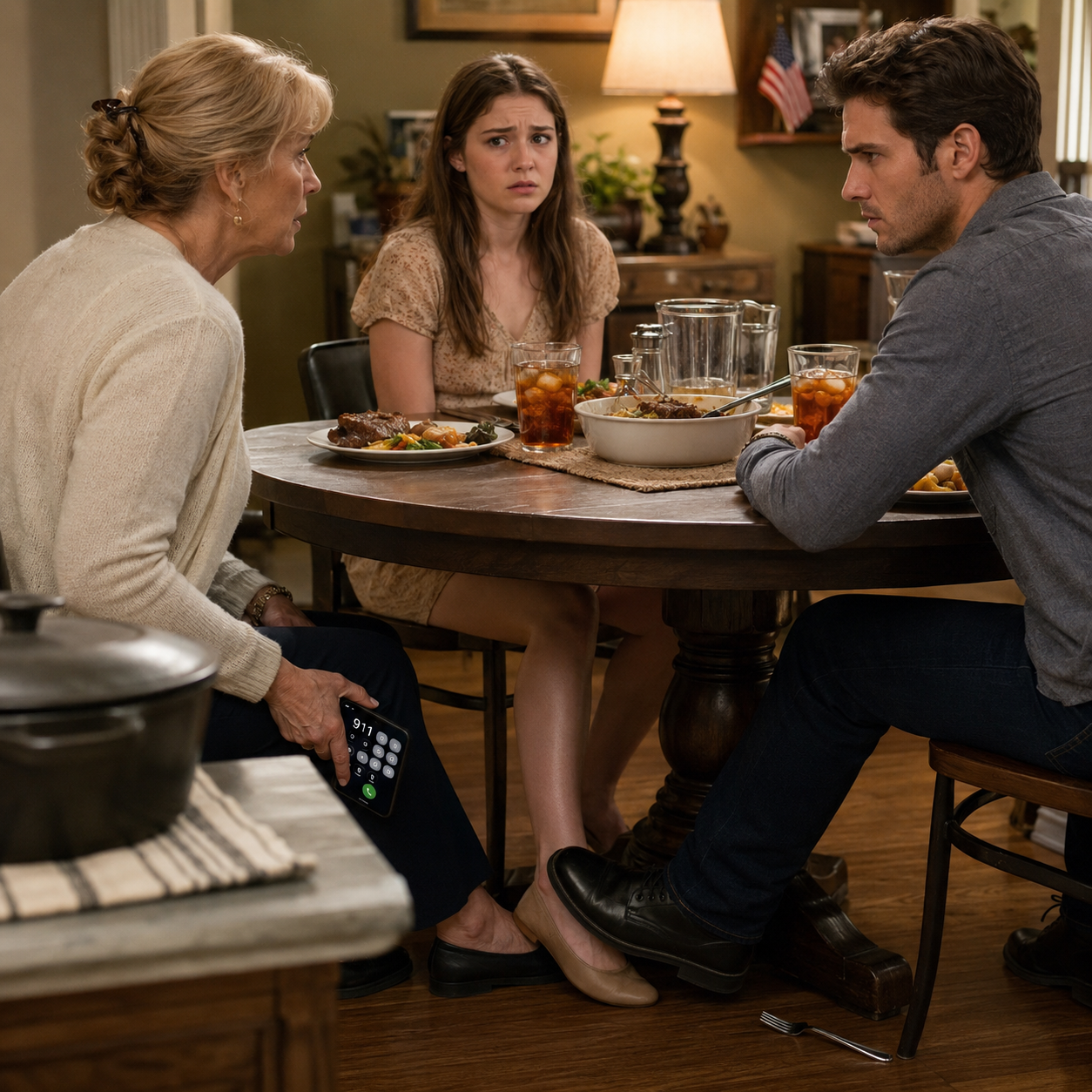
My 22-year-old daughter brought her boyfriend to dinner on a Thursday evening, and I welcomed him with the kind of smile mothers practice when they are trying not to judge too quickly.
He was handsome in the polished, deliberate way that made people trust him before he earned it.
Fresh haircut.
Clean white shirt.
Expensive watch.
A bouquet of grocery-store flowers wrapped in brown paper like he had seen in a movie and copied without understanding why it mattered.
“Mrs. Whitaker,” he said, holding out his hand. “Thank you for having me.”
His grip was firm. His smile was easy. His eyes did not move much.
That was the first thing I noticed.
Not because I was looking for trouble, but because mothers notice what the rest of the room forgives.
My daughter Danielle stood beside him in my small front entry, wearing a beige dress I had never seen before and earrings she used to borrow from me when she was in high school. She looked pretty, but not happy-pretty. More like a girl dressed for a photograph she didn’t want taken.
Her hair was pinned neatly at the back.
Her lips were pale.
When I reached to hug her, her body went stiff for half a second before she softened in my arms.
“Hi, Mom,” she whispered.
It had been nearly six weeks since I had seen her in person.
That was not like Danielle.
My girl used to drop by without warning, kick her shoes off by the door, and stand in my kitchen eating shredded cheese straight out of the bag while telling me every unnecessary detail of her day. She used to call me from the parking lot at Target because she couldn’t decide between two throw pillows. She used to send me pictures of ugly dogs she saw at the park and say, “This one looks like Uncle Ray.”
Then Evan came along.
Suddenly, she was busy.
Suddenly, she was tired.
Suddenly, her phone was always dying, her schedule was always changing, and every conversation ended with his voice somewhere in the background saying her name.
I told myself she was growing up.
I told myself daughters are supposed to build their own lives.
I told myself not every silence is a warning.
That night, I learned how wrong a mother can be when she is trying to be reasonable.
“Come in, come in,” I said, stepping aside. “Dinner’s almost ready.”
The house smelled like pot roast, onions, carrots, and thyme. I had put the roast in the Dutch oven that morning before work, the heavy cast-iron one my own mother left me. It was the kind of meal Danielle loved when she was homesick at college. She used to say it tasted like being forgiven.
I had set the dining table with my good plates, the ones with tiny blue flowers around the edge, even though one had a chip and another had a faint crack. I had ironed the napkins. I had made mashed potatoes from scratch because Danielle hated the boxed kind. I had brewed sweet tea and put lemon slices in the pitcher, because that was how my late husband Mark liked it.
Mark had been gone four years by then.
A heart attack in the driveway while carrying groceries.
One minute he was complaining that eggs cost too much, and the next minute he was on the concrete with a carton broken open beside him.
After he died, the house became too quiet in places. The hallway. His side of the closet. The garage where his tools still hung in careful rows. But the kitchen remained mine. Warm, stubborn, alive.
Danielle had grown up in that kitchen.
She had done homework at the table, cried over boys there, studied for her nursing boards there, and once announced at fourteen that she was becoming vegetarian, only to eat half a meatloaf three days later because “technically it was already cooked.”
I wanted that kitchen to remind her she had a place to come back to.
I didn’t know she had arrived needing rescue.
Evan pulled out Danielle’s chair before she could touch it.
A gentlemanly gesture, anyone would have said.
But he held the back of the chair too long.
Danielle waited until he nodded before she sat down.
That was the second thing I noticed.
“You have a beautiful home,” Evan said.
“Thank you,” I replied. “It’s old, but it’s held up.”
“Older houses have character,” he said, looking around the dining room. “You don’t see that in those new subdivisions where everything looks the same.”
He sounded pleasant. Too pleasant. Like every sentence had been polished in advance.
Danielle stared at her plate.
“Your mother told me you work in medical billing,” I said, sitting across from him.
“She told you that?” Evan looked at Danielle with a little smile.
Danielle’s shoulders tightened.
“I mean, I think so,” I said. “Maybe I misunderstood.”
“No, that’s right,” he said. “I work in healthcare administration. Danielle and I both care about helping people.”
Helping people.
He said it while his left foot shifted under the table.
Danielle flinched.
It was tiny.
A blink.
A breath caught behind her teeth.
I might have missed it if I hadn’t spent twenty-two years reading that face.
“You okay, honey?” I asked.
She looked up too fast.
“I’m fine.”
Evan laughed softly.
“She’s just nervous. She really wanted tonight to go well.”
“I’m not nervous,” Danielle said.
He turned to her.
The smile stayed on his mouth, but something in his eyes sharpened.
“Dani.”
That was all he said.
One word.
Her cheeks drained of color.
I felt a cold thread pull through my chest.
I served dinner because that is what women of my generation often do when fear enters the room. We keep moving. We carry plates. We refill glasses. We tell ourselves not to make a scene until the scene becomes impossible to deny.
Evan complimented the roast.
He asked where I bought my curtains.
He told a funny story about a supervisor at work who confused two patient files, then stopped halfway through and said, “I probably shouldn’t share that. Privacy rules.”
He seemed relaxed.
Danielle did not eat.
She moved food around her plate with her fork, cutting carrots into smaller and smaller pieces until they looked like orange coins.
“Danielle,” I said gently, “you used to eat this like you were training for the Olympics.”
She gave me a weak smile.
“I had a late lunch.”
“No, you didn’t,” Evan said.
The room went still.
He took a sip of sweet tea.
“You told me you were too busy for lunch.”
Danielle looked down.
“I forgot.”
“You forgot eating lunch?”
His voice was still quiet, but there was humiliation tucked into it.
I looked from him to her.
“She can be forgetful,” Evan said, turning back to me. “I’ve been helping her with routines. Meals. Sleep. Little things.”
Helping.
There was that word again.
Danielle’s fork slipped from her hand and clattered onto the floor.
All three of us froze.
“I’m sorry,” she whispered.
Before I could stand, Evan bent down and picked it up.
“No problem,” he said.
He wiped it carefully with his napkin and placed it beside her plate.
A normal man would have handed it to her.
Evan set it down like a warning.
I went to the kitchen for a clean fork. My hands felt strange. Too light. Too aware of themselves.
When I came back, Danielle’s eyes met mine for one quick second.
There was something in them I had not seen since she was a child lost in a department store.
Not sadness.
Not embarrassment.
A plea.
I set the clean fork beside her.
“Here you go, sweetheart.”
“Thanks, Mom.”
Evan put one hand under the table.
Danielle’s face tightened again.
That was when the old mother inside me woke up.
Not the polite mother.
Not the reasonable widow who paid bills on time and waved to neighbors and apologized when she took too long at the grocery checkout.
The mother who once lifted a fallen bookcase with both hands because her toddler was trapped beneath it.
The mother who slept in a plastic hospital chair for three nights when Danielle had pneumonia.
The mother who would tear the world in half if it stood between her child and breathing.
I watched the table.
I watched their shoulders.
I watched the way Danielle kept her left hand folded in her lap, unmoving.
“Evan,” I said, “would you like more gravy?”
“I’m good, thank you.”
“Danielle?”
She opened her mouth.
“No,” Evan said. “She’s had enough.”
The answer came so naturally from him that for a second the room accepted it.
Then it landed.
My daughter’s fork fell again.
This time, when it hit the floor, she whispered, “Sorry,” before anyone reacted.
Evan’s jaw tightened.
“I’ll get it,” I said.
I bent down slowly.
The floor beneath my table had a small scuff mark from when Mark dragged the Christmas tree stand across it years ago. I remember noticing that mark as my knees bent, as if my mind needed something ordinary to hold on to.
Then I saw it.
Evan’s dress shoe was planted on top of Danielle’s foot.
Hard.
Not accidental.
Not resting.
Pinning.
Her toes were trapped beneath the edge of his sole. The skin above her sandal strap had gone white. Her ankle trembled.
And tucked against the inside of her other shoe, half-hidden by the tablecloth, was a folded scrap of paper.
My breathing changed.
I reached for the fork with my right hand and, with my left, brushed the paper toward me.
Evan shifted.
“Everything okay down there?”
I forced a small laugh.
“Just old knees. They don’t bend like they used to.”
I came back up with the fork and the paper hidden in my palm.
Danielle stared at me.
Evan stared too.
I slipped the fork into my apron pocket instead of placing it on the table. Then I turned toward the kitchen.
“I’ll get another clean one.”
In the kitchen, I opened my hand.
The note was written in eyeliner, shaky and cramped.
Mom, don’t argue. He’s armed.
For a moment, every sound disappeared.
The hum of the refrigerator.
The low tick of the wall clock.
The faint traffic on Beechwood Avenue.
All of it vanished, and I was back in the hospital twenty-two years earlier, holding my newborn daughter, promising her with a certainty only a new mother can have that nothing bad would ever reach her.
But bad things do not ask permission.
They wear clean shirts.
They bring flowers.
They learn your daughter’s fears and call it love.
My first instinct was to run into the dining room and throw myself between them.
My second instinct, the one that saved us, was quieter.
I picked up my cell phone from the counter.
My hands were shaking so badly I almost dropped it.
I dialed 911.
When the operator answered, I did not speak.
I set the phone face down on the counter, close enough to hear the dining room, then opened the silverware drawer and took out a fork.
“Mary?” Evan called.
Mary.
Not Mrs. Whitaker anymore.
He had dropped the manners.
“Coming,” I said.
I returned to the table with my face arranged into something I hoped looked like calm.
Danielle’s eyes were fixed on my apron pocket.
Evan’s hand was under the table again.
“You were gone a while,” he said.
“I couldn’t find the forks. I swear things move around in my drawers by themselves.”
He smiled.
No warmth in it.
“Must be frustrating.”
“Most things are, at my age.”
I sat down.
For the next five minutes, I became two women.
One was Mary Whitaker, sixty-one years old, widow, church volunteer, part-time receptionist at the dental office on Maple, making small talk over pot roast.
The other was a mother listening to her silent phone and praying the 911 operator could hear enough to understand.
“So,” I said, folding my napkin. “How did you two meet?”
Danielle’s mouth opened.
Evan answered.
“At a coffee shop.”
“A coffee shop,” I repeated. “That sounds sweet.”
“It was,” he said. “She was struggling with her laptop. I helped her.”
Danielle looked at her plate.
“I wasn’t struggling,” she murmured.
Evan’s head turned.
“What?”
“I said I wasn’t struggling. The Wi-Fi was down.”
His smile hardened.
“You’re correcting me in front of your mother?”
My blood went cold.
Danielle swallowed.
“No. I just meant—”
“I know what you meant.”
His voice had dropped into something private, something he usually used when no one else was supposed to hear.
I leaned forward.
“Evan, how long have you worked in healthcare administration?”
His eyes flicked to me.
“Almost three years.”
“That’s a stressful field.”
“It can be.”
“Danielle’s always been good under pressure,” I said. “Even as a little girl. When she was nine, a boy fell off his bike in front of our house and split his chin open. She ran inside for a towel and told me, very seriously, that I needed to apply pressure and stop looking scared.”
For the first time all night, something like life crossed Danielle’s face.
“I forgot about that,” she whispered.
“I didn’t,” I said.
Evan’s fork slipped from his hand and struck the edge of his plate.
Not the floor.
The plate.
A sharp little sound.
“Cute story,” he said.
“It is,” I replied. “Mothers keep the cute stories.”
“And the embarrassing ones, I’m sure.”
“Oh, especially those.”
He studied me.
I studied him back.
The air between us changed.
He knew I knew something.
He just didn’t know how much.
Then Danielle’s fork fell for the third time.
This time, no one bent down.
It lay between her chair and his shoe like a small silver flare.
Evan closed his eyes.
“One second,” he said softly.
Danielle’s whole body went rigid.
I heard it then.
A faint sound from my phone in the kitchen.
Not words.
A muffled voice through the speaker, asking something.
Evan heard it too.
His head snapped toward the kitchen.
“What was that?”
“My timer,” I said.
“For what?”
“The pie.”
“There’s no pie.”
He stood so fast his chair scraped the floor.
Danielle made a small sound.
“Sit down,” he told her.
I rose too.
“Evan—”
His hand came out from under the table.
There was a gun pressed low against Danielle’s side, half-hidden by the tablecloth.
The sight of it did not feel real.
Guns in stories are loud.
Guns in real rooms are quiet at first.
They make the wallpaper look strange. They make your own furniture seem like it belongs to someone else. They turn every breath into a decision.
Danielle’s eyes filled with tears.
“I’m sorry, Mom.”
Evan looked at me.
No smile now.
“Act normal,” he said. “One weird word and I kill her right here.”
My daughter closed her eyes.
I thought of Mark.
Of how he used to say that panic is just fear looking for somewhere to go.
I needed somewhere useful to put mine.
“Okay,” I said.
My voice sounded far away.
“I’m calm.”
“You called someone.”
“I didn’t.”
“You think I’m stupid?”
“I think you’re upset.”
He laughed once.
“You don’t know anything about me.”
“I know your shoe was on my daughter’s foot.”
His expression flickered.
A tiny crack.
Then the doorbell rang.
All three of us turned.
A second later, a familiar voice called from the porch.
“Mary? It’s Linda! I brought bread. Saw the lights on and figured there must be dinner.”
Linda Alvarez had lived next door to me for twenty years.
She sold peaches, tomatoes, and homemade jam at the Saturday farmers market. She wore bright cardigans, drove a dented blue Subaru, and could tell from across the street if your hydrangeas needed water. She had a laugh that carried through walls and a talent for appearing exactly when you were trying to cry in peace.
But she had never once come to my house unannounced during dinner.
Never.
Hope is a dangerous thing in a room with a gun.
It rises too quickly.
It makes noise.
I forced mine down.
Evan pressed the gun harder against Danielle.
“Tell her to leave.”
Danielle whimpered.
“Coming, Linda!” I called. “I’m with Danielle and her boyfriend. I can’t come to the door right now.”
“Oh, even better!” Linda yelled. “I have to meet the boy!”
Evan leaned close to my daughter’s ear.
“If this is a trick, Dani, your mother pays for it.”
I saw Danielle’s face break.
Not from pain.
From guilt.
As if his threat against me belonged to her.
That was when something inside me became still.
Not peaceful.
Still.
There is a kind of anger that burns hot and makes you foolish. There is another kind that goes cold and clear, like winter light on a windshield.
That second kind settled over me.
“Linda is stubborn,” I said. “If I don’t answer, she’ll call half the block.”
Evan grabbed my arm.
His fingers dug into the soft skin above my wrist.
“We all go together.”
He pulled Danielle up with his other hand still low at her waist. She moved like someone trying not to startle a dog that had already bitten her.
We walked into the living room.
My living room had family pictures on every wall. Danielle at six with missing front teeth. Danielle at twelve holding a science fair ribbon. Danielle in her cap and gown, one arm around Mark’s framed photo because he had not lived long enough to see it.
Evan kept her between us.
I reached for the curtain.
“Slow,” he said.
I lifted the edge just enough to see the porch.
Linda stood there holding a brown paper bag.
She was not looking at the door.
Her eyes were aimed toward the corner of my yard.
Beneath the oak tree, almost swallowed by shadow, sat a police cruiser with its lights off.
I nearly cried.
Instead, I opened the door three inches.
Linda looked at me.
Her eyes moved once to my split expression, then behind me, then back again.
Some women can read a room through a crack in a door.
“Mary,” she said slowly, “your pot roast is burning.”
The stove was off.
The roast was fine.
But it was the most beautiful lie anyone had ever told for me.
“Oh, Lord,” I said. “I’m coming.”
I shut the door.
Evan yanked me back.
“What did that mean?”
“Nothing. She’s nosy. She always thinks something is burning.”
He looked through the peephole.
Linda was gone.
The bag of bread hung from the porch rail.
Evan cursed under his breath.
“We’re leaving.”
Danielle looked at me, terrified.
“No,” I said.
The gun turned toward me.
“What did you say?”
“I said you’re not taking my daughter.”
His smile came back then, but it was uglier without the manners.
“Ma’am, Danielle is coming with me because she wants to.”
“My daughter doesn’t want anything to do with a man who steps on her foot to keep her from talking.”
The blow came fast.
It split my lip but did not knock me down.
For half a second I tasted blood and pot roast and sweet tea all at once.
Danielle screamed.
“Don’t hit her!”
Evan shoved her backward.
She hit the bookshelf hard enough to send picture frames falling. A ceramic angel my sister gave me after Mark’s funeral broke against the floor. Glass shattered around Danielle’s graduation picture.
“This is your fault, Dani,” Evan snapped. “Everything gets worse when you don’t listen.”
Outside, I heard something.
Not a siren.
Not shouting.
Footsteps.
Careful ones.
Evan heard them too.
His face changed.
For the first time, he looked less like a man in control and more like what he was: a coward whose performance had been interrupted.
“What did you do, old lady?”
I did not answer.
He grabbed Danielle by the neck of her dress and dragged her toward the hallway.
“The back door. Move.”
My backyard backed up to a narrow alley and an old detached garage. Years ago, when Danielle was a teenager, she used to sneak over that garage roof and cut through Mr. Ellis’s abandoned yard to buy snow cones at the corner store. I had scolded her at least a dozen times.
That memory came back like a slap.
Evan knew.
“You showed him?” I asked Danielle.
She shook her head, sobbing.
“He made me send pictures of the house. Every door. Every window. He said if I loved him, I wouldn’t hide anything.”
A deep sickness opened in me.
How long had he been mapping my home like an escape plan?
How long had my daughter been trying to survive conversations I thought were just young-love drama?
How many times had she said, “I can’t come over, Mom,” while he sat beside her listening?
We reached the kitchen.
The 911 call was still open on my phone.
The screen glowed faintly on the counter.
Evan saw it.
His face twisted.
“You lying old—”
“Don’t,” Danielle whispered.
He shoved her toward the back door.
“Open it.”
I looked at the kitchen table.
The sweet tea pitcher sat near the edge, sweating in the warm room. Beside it was the Dutch oven, heavy and black, still warm from dinner. My mother had cooked in that pot. Then I had cooked in it. Danielle once told me it would outlive all of us.
Maybe she was right.
“Open the door!” Evan shouted.
I put my hand on the knob.
Then I turned back.
“Danielle needs water,” I said.
“What?”
“She’s pale. She’s going to faint.”
“Open the door.”
I picked up the pitcher.
Evan aimed at my chest.
“Put it down.”
I obeyed.
But not the way he meant.
I dropped the pitcher onto the tile.
It shattered with a sound so sharp it seemed to crack the whole night open. Sweet tea spread across the floor in a dark shining rush. Evan looked down by instinct.
One second.
That was all we had.
Danielle moved first.
My daughter, my frightened girl, my child with a bruised foot and trembling hands, drove her knee into his wrist with everything she had.
The gun went off.
The sound slammed into the ceiling.
Drywall dust fell like dirty snow.
Danielle threw herself sideways.
I grabbed the Dutch oven.
It was too heavy.
It burned my palms.
I lifted it anyway and hurled it at Evan.
There was nothing graceful about it.
No clean movie moment.
Just an old widow with a bleeding mouth throwing dinner at a man who thought my daughter was property.
The pot struck his shoulder. Hot gravy splashed across his white shirt and neck. He screamed, more from shock than pain, and stumbled backward onto the tea-slick floor.
The gun skidded near the table.
I lunged.
He lunged too.
My fingers touched the grip first, but he kicked my hand so hard pain shot up my arm.
Then Danielle grabbed a dining chair and brought it down across his back.
“Don’t ever touch my mother again!”
Evan dropped to one knee.
The front door burst open.
“Police! Drop the weapon!”
Two officers came in with their weapons drawn. Another appeared at the kitchen entrance. Linda stood on the porch behind them, one hand pressed to her mouth, the other clutching the little cross necklace she wore every day.
Evan raised his head.
He was covered in gravy, sweet tea, and fury.
“She’s crazy,” he said, pointing at Danielle. “She’s my fiancée. She’s having an episode. Her mother attacked me.”
Danielle was shaking so hard she could barely stand.
I kicked the gun toward the officers.
“He threatened her,” I said. “He had a gun under my table. He stepped on her foot to stop her from talking. She left me a note.”
One officer handcuffed Evan face-down on the floor.
“You don’t know who I am,” Evan spat.
The officer tightened the cuffs.
“We’ll find out.”
It was a simple sentence.
Plain.
Professional.
But it opened something in my chest.
For months, maybe longer, Evan had made himself the weather in my daughter’s life. He decided when storms came. He decided when sunlight was allowed. He decided what counted as truth.
And now he was face-down on my kitchen floor with pot roast gravy on his collar, being spoken to like any other man who had broken the law.
Danielle did not cry right away.
She stared at the cuffs.
At his shoe.
At her own foot, free of it.
Then she folded in half.
I crawled to her and pulled her into my arms.
The floor was wet. My lip was bleeding. My wrist throbbed. Broken glass glittered under the kitchen lights.
None of it mattered.
I held her like I had when she was five and fell off her bike on the sidewalk. Like I had when she was seventeen and got rejected from the college she wanted. Like I had the day we buried her father and she whispered, “What do we do now?”
“It’s okay,” I said into her hair. “I’m here. I’m here.”
She gripped my blouse with both hands.
“He was going to kill me, Mom.”
“No.”
“Yes.” Her voice cracked. “After dinner, he said we were leaving town. He said no one would find me. He said you’d think I ran away because I was dramatic.”
The paramedic who had followed the officers inside knelt beside us.
“Ma’am, I need to check her.”
Danielle shook her head and clung to me.
I cupped her face.
“Look at me. You don’t make choices out of fear anymore. Not for him. Not for anyone. You decide.”
Her red, swollen eyes blinked.
“I decide,” she whispered.
The paramedic checked her in the living room while officers moved through the house. One photographed the broken glass. Another bagged the gun. Another took the scrap of paper from my apron pocket and placed it into a clear evidence sleeve.
Danielle sat under a gray blanket, her hair coming loose from its pins.
Her foot was already swelling. There were marks on her calf. Old finger-shaped bruises along her upper arm. A yellowing bruise near her ribs that made my throat close.
“How long?” the paramedic asked gently.
Danielle stared at the floor.
“Three months.”
Then she swallowed.
“No. Since the first week. But at first, I didn’t call it abuse. I called it jealousy.”
The room went quiet.
Even Linda had no words.
And Linda always had words.
I sat beside my daughter while an officer asked me what happened. I told him about the fork. The foot. The note written in eyeliner. The gun. The threat. The phone on the counter. Linda’s bread.
As I spoke, I watched Danielle looking around the living room like she wasn’t sure she had permission to exist there.
Guilt worked its way through me.
Slow.
Cruel.
“I didn’t know,” I said.
The officer lowered his notepad.
“A lot of families don’t. People like him work hard to make sure you don’t.”
Danielle looked up.
“He told me my mom was controlling,” she said. “He said you wanted me to be alone so I’d keep needing you.”
I felt that one in my bones.
“He took my phone when I didn’t answer fast enough. He went with me to work and waited in the parking lot. He told me my coworkers were laughing at me. He said my friends were bad influences. He said if I told anyone, they’d think I was stupid.”
“You are not stupid,” I said.
She looked at me with a small, destroyed expression.
“I felt stupid.”
“The shame belongs to him. Not you.”
From the hallway, Evan laughed.
Even handcuffed, even surrounded, he could not resist trying to own the room one last time.
“Dani,” he called. “Tell them you’re exaggerating. Tell them your mother forced you to say all this.”
The officers turned.
Danielle stood.
The blanket slipped from her shoulders.
For a second, I thought she might fall, but she took one step toward the hallway. Then another.
“Stay back, ma’am,” one officer said.
Danielle stopped several feet from Evan.
She did not yell.
She did not curse.
She just looked at him.
Really looked.
As if the fog had lifted enough for her to see the size of the cage she had been living in.
“You didn’t love me,” she said.
Evan rolled his eyes.
“Don’t do this.”
“You didn’t save me. You didn’t protect me. You stole pieces of my life and told me I should be grateful.”
His jaw tightened.
“You’ll come back.”
Danielle shook her head.
“No. Not this time.”
Then she cried.
But it was not the same silent crying from the dinner table.
This cry had air in it.
Sound.
Release.
It was the sound of someone finding a door.
They took Evan out through my front entry, past the little table where his flowers still lay wrapped in brown paper. As he crossed the threshold, he tried to look at me the way he had looked at me over dinner, like I was just an old woman to manage.
I held his gaze.
“You got a stain on your shirt,” I said.
I don’t know why those were the words that came out.
Maybe because that white shirt had been part of his costume.
Maybe because monsters do not always arrive looking like monsters. Sometimes they arrive with flowers and good manners. Sometimes they say, “A pleasure to meet you.” Sometimes they ask for seconds. Sometimes they sit at your dinner table and press their shoe onto your daughter’s foot.
The patrol car pulled away with its red and blue lights washing over my curtains.
Only then did the neighborhood begin to breathe again.
Linda came inside and swept glass without asking. Tony from across the street brought trash bags and a roll of paper towels. Mrs. Dobbins, who was nearly eighty and had arthritis in both hands, shuffled over with a thermos of coffee and a stack of paper cups.
Nobody said much.
There are nights when talking feels disrespectful.
My kitchen looked like a storm had passed through it.
Tea on the floor.
Gravy on the wall.
A bullet hole in the ceiling.
My mother’s Dutch oven dented near the handle.
The dining table still held three plates of cold food. Danielle’s fork lay on a napkin, ordinary and silver and innocent, as if it had not saved her life by falling.
Danielle sat beside me at the table.
Her hands were wrapped around a mug of coffee she did not drink.
“Mom,” she said, “I wanted to come alone.”
“I know.”
“He wouldn’t let me. He said if I came without him, he’d show up anyway. He said he wanted to see where you lived. He said he needed to know what kind of woman had raised me.”
I looked at the broken picture frame on the floor. Mark’s face smiled out from beneath a web of cracked glass.
“What did he mean by that?”
Danielle’s mouth trembled.
“He said I was too attached to you. He said it wasn’t normal. He said grown women don’t call their mothers every day.”
I let out a breath that felt like it had been trapped in me for weeks.
“You used to call me from the cereal aisle because you couldn’t decide between Cheerios and Frosted Mini-Wheats.”
A small laugh escaped her.
Then it broke into another sob.
“I missed you.”
That hurt more than my lip.
“I missed you too, baby.”
“I thought you’d be mad.”
“I am mad.”
She lowered her head.
“At him,” I said. “At him. At anyone who taught you that love means shrinking yourself so another person feels powerful.”
She leaned against my shoulder.
Outside, a dog barked. Somewhere down the block, a motorcycle passed. The streetlights buzzed softly through the front windows. Life was still going on with an almost insulting calm.
Linda appeared in the doorway with a plate covered in foil.
“I saved some roast that didn’t hit the floor,” she said.
Danielle looked up.
For one fragile second, she smiled.
A real smile.
Small, but real.
“That was my favorite part,” she whispered.
“What, the roast?”
“No.” She wiped her cheek. “When Mom threw it.”
Linda nodded solemnly.
“Your grandma’s Dutch oven finally fulfilled its destiny.”
I laughed, even though my lip burned.
That laugh loosened something.
Not enough to fix us.
Not nearly enough.
But enough to remind us we were still alive.
Later, after statements were taken and the last neighbor left, Danielle came to my bedroom doorway with the gray blanket around her shoulders.
“Can I sleep in here?” she asked.
She sounded twelve years old.
I pulled back the covers.
She climbed into Mark’s old side of the bed and curled toward me.
For a long time, I sat awake in the chair beside her, watching her sleep. Her face without makeup looked younger. Softer. But even in sleep, her fingers twitched as if she were still bracing for someone to grab them.
I found the note again in the evidence copy the officer had allowed me to photograph.
Mom, don’t argue. He’s armed.
Six words.
My daughter had managed six words while sitting beside a man with a gun.
Six words had turned dinner into a rescue.
I opened the cedar keepsake box on my dresser.
Inside were Danielle’s baby bracelet from the hospital, three lost baby teeth in a tiny envelope, a faded pink ribbon from first grade field day, and a photograph of her at the county fair with cotton candy all over her face.
I did not put the note inside.
Not yet.
Some things do not belong with childhood.
Some things belong in court.
The next morning, dawn came through the curtains with a softness that felt almost rude.
The kitchen still smelled faintly of gravy and coffee. The bullet hole in the ceiling looked smaller in daylight, but the stain on the wall looked worse.
I stood at the stove making scrambled eggs because I did not know what else to do with my hands.
Danielle appeared in the doorway wearing one of my old sweatshirts.
Her hair was loose.
One foot was bandaged.
In her palm was a silver ring with a tiny stone.
“It wasn’t an engagement ring,” she said. “He said it was so I could start getting used to the idea.”
I looked at the ring.
It was pretty.
That made me hate it more.
Danielle walked to the trash can, lifted the lid, and dropped it in.
The sound was small.
Almost nothing.
But something about it felt bigger than a slammed door.
She stood there breathing hard.
“You okay?” I asked.
“No.”
I nodded.
“Good. We’ll start with honest.”
She looked at me.
Then, for the first time since she had walked into my house the night before, she stepped forward and hugged me without flinching.
We went to the police station after breakfast.
Linda drove us because my hands hurt too much to grip the wheel. She did not ask questions on the way. She just turned the radio low and kept a box of tissues in the cup holder.
The city looked ordinary.
A school bus stopped near the corner.
A man in a work vest bought coffee from the gas station.
Two women stood outside the pharmacy comparing coupons.
It amazed me how the world could look the same after your life had split open.
At the station, Danielle gave a full statement.
Not all at once.
It came out in pieces.
The first time Evan grabbed her wrist because she answered a text from a male coworker.
The first time he waited outside her workplace and said he was “just worried.”
The first time he called her selfish for visiting me.
The first time he took her phone.
The first time he shoved her and cried afterward, saying no one had ever loved him properly and she made him scared.
“He apologized so well,” she said, staring at the table in the interview room. “That’s what confused me. He always knew exactly what to say afterward.”
The detective, a woman about my age with tired eyes and a calm voice, nodded.
“That’s common.”
Danielle laughed bitterly.
“I hate that word.”
“What word?”
“Common. It makes me feel like I walked into a trap everyone else could see.”
The detective leaned forward.
“No. It means the trap has a design. It means he used patterns other people like him use. That does not make you foolish. It makes him practiced.”
Danielle covered her mouth.
I reached for her hand.
This time, she let me take it.
By noon, we had filed for an emergency protective order. By two, we were at the hospital getting her injuries documented. By four, we had changed the locks on my house and hers.
That evening, we sat in the parking lot of a strip mall while a locksmith made extra keys.
Danielle stared at the nail salon across the lot.
“He liked my nails short,” she said.
I looked at her hands. Her nails were trimmed down to the quick.
“He said long nails looked trashy,” she continued. “Then he said polish looked attention-seeking. Then he said bare nails looked lazy. I could never get it right.”
“That was the point.”
She turned to me.
“What?”
“If the rules always change, you stay busy trying to follow them. You don’t have time to ask why he gets to make them.”
Her eyes filled again.
“I don’t know who I am right now.”
I wanted to say, Of course you do.
I wanted to say, You’re Danielle.
But I had learned something in the last twenty-four hours: comfort can become another way of rushing someone past the truth.
So I said, “Then we’ll find out slowly.”
That night, she slept in my room again.
The next week moved like a bad dream with paperwork.
Police calls.
Victim services.
A court date.
Medical follow-up.
A new phone number.
A bag of her clothes collected from her apartment by two officers while she waited in the car with me.
Evan had not lived with her officially, but his things were everywhere. A razor by her sink. Shoes in her closet. A jacket over the back of her chair. His control had seeped into the apartment like smoke.
When the officers brought out her bags, Danielle stared at them.
“My blue sweater?” she asked.
One officer checked.
“Here.”
“My dad’s sweatshirt?”
The officer looked again.
“This gray one?”
Danielle pressed it to her face.
Mark’s old sweatshirt had paint on one sleeve from the year we redid the porch. She had taken it after he died and worn it through college finals, flu season, heartbreak, and every hard day since.
Evan had hated that sweatshirt.
“He said it was weird to wear dead people’s clothes,” she whispered.
I put my arm around her.
“Your father would have hated him.”
That surprised a laugh out of her.
“Dad hated everybody at first.”
“Only the ones who deserved a head start.”
She held the sweatshirt tighter.
The court hearing was held on a rainy Monday morning at the county courthouse, a brick building with metal detectors at the entrance and old wooden benches polished by decades of anxious people.
Danielle wore black pants, a cream blouse, and no makeup.
I wore the navy dress I usually saved for funerals and church Christmas service.
Linda came too, carrying a folder of printed photos from that night because she said, “Nobody dismisses women who come with documentation.”
Evan walked in with an attorney and a clean shirt.
No gravy.
No blood.
No gun.
Just a neat collar, combed hair, and the same controlled face he had worn at my dinner table.
For one awful moment, I understood why people believed men like him.
He looked calm.
Danielle looked shattered.
And the world is too quick to mistake calm for truth.
His attorney suggested it had been a “domestic misunderstanding.”
He said Danielle was emotional.
He said I had overreacted.
He said the gun was registered.
He said Evan had felt threatened after I attacked him with a pot.
When he said that, Linda made a noise beside me that sounded like a church lady swallowing a curse word.
The judge looked at the police report.
Then at the photos.
Then at the note.
Then at Danielle’s medical records.
The courtroom grew very still.
Danielle was called to speak.
Her hands shook as she stood.
I wanted to stand with her.
I did not.
This was her voice.
She deserved to hear it in the room.
“At dinner,” she said, “he had his foot on mine so I couldn’t move without pain. He had a gun pressed against my side. My mother saw what was happening because I dropped my fork. I wrote the note because I thought if she confronted him, he would shoot her.”
Evan stared straight ahead.
Danielle kept going.
“He told me I belonged to him. He told me my mother was poison. He told me if I left, he would make sure everyone thought I was unstable.”
Her voice trembled.
Then steadied.
“I am scared of him. But I am more scared of what happens if people keep believing men just because they know how to speak politely.”
The judge granted the protective order.
Evan was ordered to stay away from Danielle, from me, from my home, from her workplace, and from any place he could reasonably expect her to be. His attorney objected. The judge did not look impressed.
Outside the courtroom, Evan’s mother approached us.
I recognized her from one of Danielle’s photos. Elegant, silver-haired, wearing pearls and a raincoat that probably cost more than my monthly mortgage.
She looked at Danielle as if my daughter had spilled wine on a tablecloth.
“You have ruined his life,” she said.
Danielle went still.
I stepped forward, but Danielle touched my arm.
“No, Mom.”
Then she looked at the woman.
“He ruined his life when he brought a gun to my mother’s dinner table.”
The woman’s mouth tightened.
“You’ll regret this.”
Danielle’s face was pale, but she did not look away.
“I already regret staying as long as I did.”
We walked out of the courthouse into the rain.
No music swelled.
No crowd applauded.
Real victories are often quieter than people expect.
Sometimes they sound like wet shoes on courthouse steps and a woman breathing through fear without turning back.
On the way home, Danielle asked Linda to stop at the grocery store.
“For what?” I asked.
“Pot roast.”
I stared at her.
She shrugged.
“He doesn’t get to ruin it.”
So we bought another roast.
Carrots.
Onions.
A new glass pitcher because mine had shattered.
At checkout, the teenage cashier asked if we had found everything okay.
Danielle looked at me.
Then at Linda.
Then back at the cashier.
“Yes,” she said. “We did.”
That evening, the three of us cooked together in my kitchen.
The bullet hole was still in the ceiling. The gravy stain on the wall had faded but not vanished. The new lock on the back door shone brighter than the old brass around it.
Danielle peeled carrots slowly because her wrist hurt.
Linda made cornbread.
I seasoned the roast and placed it into the dented Dutch oven.
“Are you sure you want to use that pot?” Danielle asked.
I ran my hand over the dent.
“Absolutely.”
By the time dinner was ready, the house smelled like thyme again.
Like onions.
Like warmth returning carefully to rooms that had held fear.
We set three places at the table.
For a moment, Danielle stood frozen beside her chair.
I knew what she was seeing.
The fork on the floor.
The shoe.
The gun.
I pulled out the chair beside mine instead.
“Sit here.”
She did.
We ate slowly.
Nobody forced conversation.
Nobody commented on how much she ate.
Nobody told her when she had enough.
Halfway through dinner, Danielle set her fork down and looked at me.
“I want to go back to school.”
My heart moved.
“For what?”
“Counseling, maybe. Social work. I don’t know yet. Something where I can help women understand sooner.”
Linda reached for the cornbread.
“Well, first you’re going to rest.”
Danielle smiled.
“Yes, ma’am.”
It was not happiness.
Not yet.
But it was direction.
Weeks passed.
Evan’s case moved through the system in the slow, grinding way cases do. There were calls from prosecutors, more statements, more waiting. He tried to reach Danielle through a friend. That friend was warned. He sent one email from a new address. It was turned over immediately.
The email said he forgave her.
That was the line that made Danielle laugh for the first time with real disgust.
“He forgives me?” she said, standing in my kitchen with the printed email in her hand.
Then she tore it in half.
Not dramatically.
Just once.
Clean down the middle.
She started therapy.
She took walks with Linda every morning.
She went back to work part-time, then full-time.
She bought nail polish at the pharmacy, five colors she chose by herself, and painted each nail a different shade while sitting cross-legged on my living room floor.
“Looks like a pack of highlighters,” I said.
“Good,” she replied. “I’m done being tasteful for men with control issues.”
I did not argue.
One Saturday, we went to the farmers market where Linda sold her fruit. Danielle wore Mark’s gray sweatshirt, cutoff jeans, and bright red nail polish. She bought peaches, honey, and a bunch of sunflowers even though she said they were overpriced.
At the flower stand, she paused.
“What?” I asked.
“Last month, I thought I was going to die.”
The market moved around us.
Children tugging at parents.
A man tuning a guitar near the coffee truck.
Women comparing tomatoes.
The smell of kettle corn and rain on pavement.
“I know,” I said.
“But I didn’t.”
“No, honey. You didn’t.”
She lifted one sunflower and held it against her chest.
“I don’t feel brave.”
I looked at my daughter standing in the morning sun with bruises fading under her sleeves and life returning to her face by stubborn inches.
“Brave rarely feels brave while it’s happening,” I said. “Sometimes it feels like shaking and doing the next thing anyway.”
She considered that.
Then she bought the whole bunch.
That afternoon, we placed sunflowers in the new glass pitcher and set them in the middle of the dining table.
The same table.
The same room.
But not the same house.
Not anymore.
A house changes after terror enters it.
But it can change again after truth does.
The old version of my home had been a place where I thought safety was automatic because love lived there. The new version had stronger locks, a repaired ceiling, a dented Dutch oven, and two women who understood that love is not passive.
Love pays attention.
Love notices the third dropped fork.
Love listens when the voice on the phone sounds wrong.
Love does not always arrive loud and fearless.
Sometimes it arrives as a neighbor with bread.
Sometimes it arrives as a silent 911 call.
Sometimes it arrives as a mother bending under a dining table and finally seeing what her daughter could not say.
Months later, after Evan accepted a plea deal, Danielle asked me for the note.
The original had stayed in evidence, but I still had the photograph.
Mom, don’t argue. He’s armed.
I printed it and handed it to her.
She stared at it for a long time.
“I hate this,” she said.
“I know.”
“I’m proud of it too.”
“You should be.”
She folded the paper carefully and placed it inside her own small box, not with baby teeth or ribbons, but with her new apartment key, a copy of the protective order, and a photo of the sunflowers on our table.
“What are you going to do with that box?” I asked.
“Keep it,” she said. “For days when I forget I got out.”
She moved into a new apartment at the end of summer.
Second floor.
Good locks.
Big windows.
A balcony just large enough for two chairs and a pot of basil.
The first night, I helped her unpack dishes while Linda lined the kitchen shelves with contact paper because she said young people never think about crumbs until ants teach them.
Danielle placed Mark’s sweatshirt over the back of her couch.
Then she stood in the center of her living room and looked around.
“You okay?” I asked.
She nodded.
Then shook her head.
Then smiled.
“I’m scared.”
“That makes sense.”
“But I’m here.”
“Yes,” I said. “You are.”
She looked down at her feet.
Both of them flat on the floor.
Both of them free.
A few weeks later, she invited me over for dinner.
When I arrived, she opened the door wearing jeans, a soft green sweater, and yellow nail polish. Her apartment smelled like pot roast.
I stood in the doorway and cried.
“Mom,” she said, laughing softly. “It’s just dinner.”
“No,” I said. “It isn’t.”
She knew what I meant.
On her dining table sat two plates, a glass pitcher of sweet tea, and a small vase of white daisies.
No one watched how much she ate.
No one answered questions for her.
No one pressed a shoe against her foot.
Halfway through the meal, her fork slipped from her hand and landed on the floor.
Both of us froze.
For one second, the old fear entered the room.
Then Danielle looked at me.
I looked at her.
And she started laughing.
Not a small laugh.
Not a polite one.
A full, messy, alive laugh that bent her forward and brought tears to her eyes.
I laughed too.
We laughed until the fear had nowhere left to sit.
Then she picked up the fork, carried it to the sink, and got herself another one.
Such a small thing.
Such an ordinary thing.
But I watched my daughter choose for herself, and I understood that healing does not always announce itself with grand speeches or perfect closure.
Sometimes healing is a woman dropping a ring into the trash.
Sometimes it is buying nail polish in five loud colors.
Sometimes it is sitting in court and telling the truth while your voice shakes.
Sometimes it is cooking the same dinner again because the person who hurt you does not get to own the smell of thyme.
And sometimes healing is simply a fork falling to the floor without anyone being punished for it.
Danielle sat back down and lifted her glass.
“To Grandma’s Dutch oven,” she said.
I raised mine.
“To Linda’s bread.”
She smiled.
“To Mom looking under the table.”
The words landed softly between us.
I thought of all the mothers who miss the signs because the signs are hidden on purpose. I thought of all the daughters who smile through dinner with fear under their ribs. I thought of all the ordinary objects that become lifelines when love is paying attention.
A fork.
A note.
A phone left open on a kitchen counter.
A neighbor who knows your pot roast is not burning but says it anyway.
I reached across the table and squeezed Danielle’s hand.
Outside her apartment window, the evening settled over the street in shades of gold and blue. Cars passed. Someone laughed on the sidewalk below. A dog barked from a balcony.
Life went on.
Not the same life as before.
A truer one.
My daughter lifted her face toward the open window, and in her eyes I saw something that was not happiness exactly.
Not yet.
It was steadier than happiness.
It was return.
A woman coming back to her own name.
Her own body.
Her own voice.
And as we sat there together, eating pot roast in a little second-floor apartment with daisies on the table and sweet tea sweating in the pitcher, I finally let myself believe what I had been afraid to trust.
He had not taken her from me.
He had not taken her from herself.
Not all the way.
Not forever.
My daughter was still here.
Bruised, yes.
Changed, yes.
But here.
And sometimes that is the miracle.
Not that the house stays clean.
Not that the dinner goes perfectly.
Not that evil announces itself early enough for you to stop it at the door.
The miracle is that one night, when fear sits down at your table wearing a white shirt and good manners, love notices the foot under the table.
Love bends down.
Love sees.
And love calls for help before the monster realizes dinner is over.