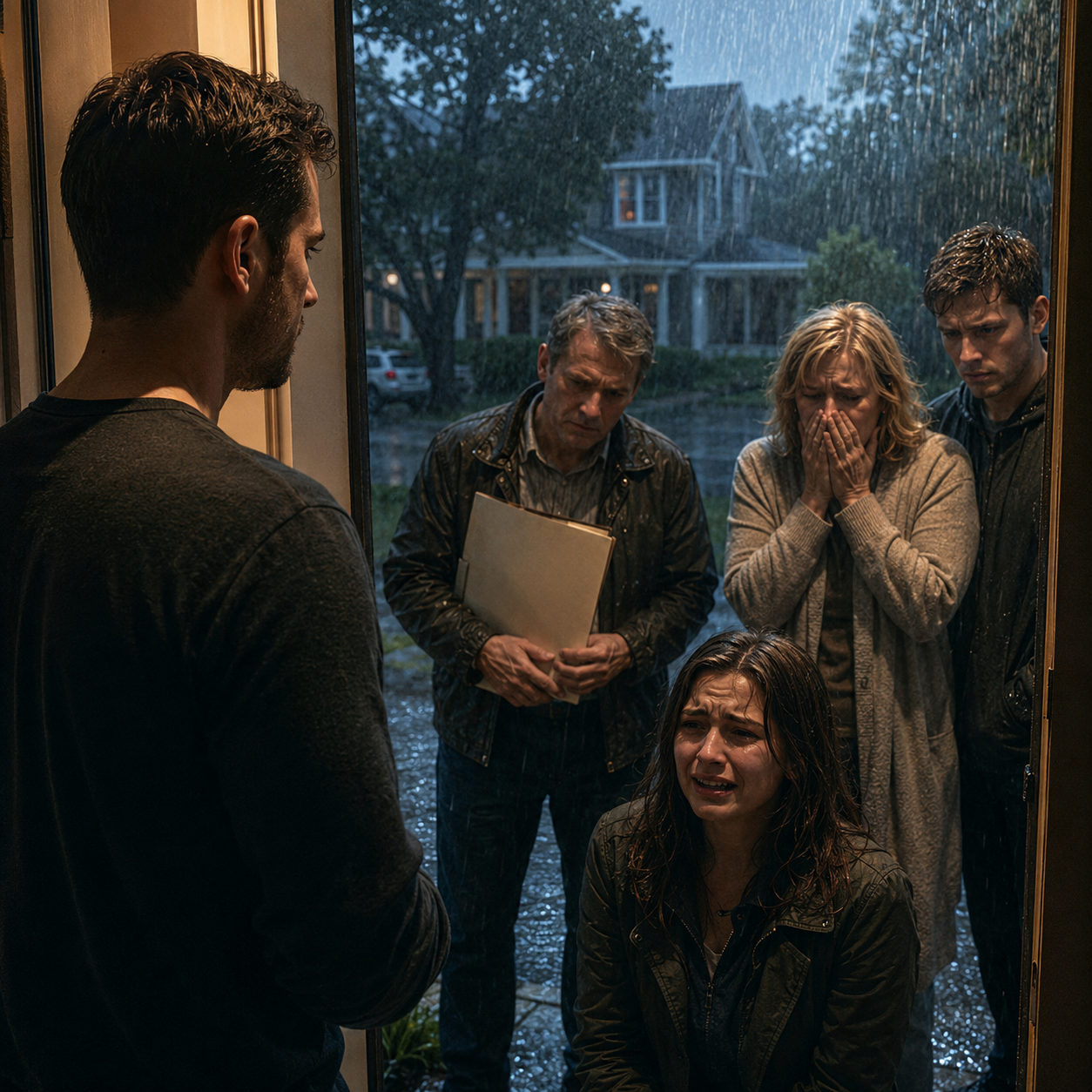
My family came back to my porch ten years after they threw me out, holding a folder they should have wanted before they ruined me. My mother stood in the rain with both hands over her mouth, my father looked smaller than the man who once hit me before I could speak, and my brother stared into the doorbell camera like the house itself owed him a second chance. Then Sophie stepped into the porch light, crying so hard she could barely stand, and said, “Evan, we know it wasn’t you.” That was when I realized the truth had finally found my address — but it had arrived years after I learned to live without theirs.
At seventeen, I learned that a family can stop being a family before the police even pull into the driveway.
It happened on a cold October night in a split-level house outside Cedar Rapids, Iowa, the kind of house where folding chairs came up from the basement whenever relatives visited, where my father’s grill smoked under the carport, and where my mother laughed too loudly when she needed everyone to believe we were still a happy family.
The dining room smelled like barbecue sauce, paper plates, wet jackets, and the cheap vanilla candle my mother kept burning on the kitchen counter.
My name is Evan Miller.
Back then, I was a senior in high school. I still shared a bathroom with my older brother, Noah. I still kept gas money in an old coffee can on my dresser. I still thought the worst thing that could happen that year was failing chemistry or losing my girlfriend, Kelly, because I worked too many weekend shifts at the grocery store.
I was wrong.
That night, my adopted sister, Sophie, stood up in the middle of the living room.
Sophie was fifteen.
My parents brought her home when she was eight, after years of saying they always wanted a daughter. I was ten when she arrived, small and quiet, with a pink backpack, a stuffed rabbit, and eyes that looked like they expected every room to ask her to leave.
I never thought of her as anything but my little sister.
I taught her how to ride a bike in the driveway.
I walked beside her at school pickup when kids whispered that she was “the adopted one.”
I checked her homework when Mom was tired.
I gave her my last pudding cup more times than I admitted.
If someone had asked me that afternoon what family meant, I would have said her name without hesitation.
By midnight, that name would become the sharpest thing in my life.
The whole family had gathered for my grandfather’s birthday. Nothing fancy. Burgers. Baked beans. Grocery store cake with blue frosting. My aunts drinking coffee at the dining table. Cousins sprawled on the carpet. My father, Raymond, standing near the patio door with a paper plate in his hand, proud of himself because the chicken was only a little burned.
My mother, Denise, kept moving through the rooms, refilling drinks, smoothing napkins, touching Sophie’s shoulder every few minutes like she could sense something wrong but did not want to name it in front of company.
Sophie barely ate.
She sat curled at the end of the couch in an oversized gray hoodie, twisting the hem between her fingers. Every few minutes, she looked toward the front window as if she were waiting for headlights.
I noticed.
Of course I noticed.
I had been noticing Sophie since she was eight.
“You okay?” I whispered when I passed her on my way to the kitchen.
She flinched.
Then nodded too quickly.
“I’m fine.”
I should have stayed.
That is one of the cruelest things memory does. It gives you small doors after the house has burned down.
After dinner, everyone crowded into the living room. Grandpa sat in the recliner, paper crown from the cake box tilted on his head. Noah leaned against the wall, scrolling through his phone. My mother sat beside Sophie. My dad stood near the fireplace. I sat on the arm of the old brown sofa because all the real seats were taken.
Then Sophie rose so fast the couch cushion snapped back behind her.
The room shifted toward her.
Her face was pale.
Her voice cracked.
“Evan.”
I looked up.
“What?”
Her eyes filled with tears.
“He hurt me,” she whispered.
For half a second, I did not understand.
Then she looked straight at me.
“He forced me.”
The room went silent so completely I could hear the wall clock ticking above my mother’s framed family photos.
My aunt’s fork stopped halfway to her mouth.
Grandpa stared at the carpet.
Noah looked at me like I had turned into something ugly right in front of him.
Then Sophie pressed both hands against her stomach and whispered, “I’m pregnant.”
My father hit me before I could breathe.
The punch landed across my mouth so hard the room flashed white. I remember the carpet against my cheek, the copper taste of blood, my mother screaming, and Sophie sobbing into her sleeves like she was the only person bleeding.
“Dad, I didn’t—”
Another blow cut the sentence in half.
People say they want the truth.
Most people only want a version that tells them who to hate.
Noah stepped close enough that his sneaker almost touched my hand.
“Get out,” he said, voice shaking with disgust. “You don’t deserve to breathe the same air as us.”
I looked around the room at the people who had watched me grow up.
Grandparents.
Uncles.
Aunts.
Cousins.
Neighbors who had known me since I sold them popcorn for Boy Scouts.
Nobody asked Sophie one question.
Nobody asked me for one full sentence.
My mother pulled Sophie into her arms and screamed, “Don’t you even say her name.”
“I didn’t do it,” I said. “I swear on my life, she’s lying.”
Nobody moved.
Sophie cried harder.
That was the sound everyone believed.
Someone called the police at 9:52 p.m.
By 10:21, I was sitting on the front porch under the yellow porch light with blood drying on my chin, watching a Cedar Rapids police cruiser roll past our mailbox and the little American flag my mother always kept by the steps.
The officer asked my father if I was the suspect.
My father nodded without looking at me.
At the station, they asked me questions under fluorescent lights that made my headache pulse. They wrote down my answers. They opened an initial report. They asked where I had been, when I had been alone with Sophie, whether I understood what she had said, whether I knew who else she spent time with.
I repeated the same words until my throat hurt.
It never happened.
By morning, they let me go because there was no evidence to hold me.
No charge.
No booking.
Nothing but a report number, a split lip, and a seventeen-year-old kid with nowhere to sleep.
When I got back to the house, my backpack was on the porch beside a trash bag of clothes.
My house key was missing from the ring.
My letter jacket was folded on top of the bag, like my mother had wanted to prove she could be neat while throwing away her son.
Noah’s truck was gone.
The curtains were closed.
My mother sent one text.
Don’t come back.
Kelly did not answer my calls.
My coach did not return my message.
By Monday, half the school knew enough of the story to stop looking me in the eye and not enough of the truth to ask questions.
That is how a life ends without a funeral.
Not all at once.
First, people stop sitting beside you.
Then they stop saying your name.
Then your locker gets quiet.
Then your teachers speak carefully.
Then your girlfriend’s mother calls you from her number and says, “Please do not contact Kelly again.”
Then you sleep on a friend’s basement couch for three nights until his father says, kindly but firmly, that this is “too complicated.”
I finished high school because one person refused to let me vanish.
His name was Mr. Alvarez, my government teacher.
He was a Vietnam veteran with a gray mustache, bad knees, and a habit of calling every student “citizen” when we answered poorly.
On the fourth day after I was kicked out, he found me sitting behind the gym before first bell.
I had slept in my car the night before. It was October in Iowa, cold enough that my fingers hurt when I woke up.
Mr. Alvarez stood over me and said, “Citizen Miller, school property is not a hotel.”
I did not laugh.
He sat on the concrete beside me with more effort than dignity.
“You do it?”
I stared at him.
“No.”
He looked at me for a long moment.
Then said, “All right.”
That was the first time anyone believed me.
Two words.
All right.
They saved enough of me to continue.
He helped me talk to the school counselor. The counselor called a youth housing program. I spent the rest of senior year living in a small room at a church-sponsored transitional house near downtown, eating donated casseroles and filling out community college forms at a folding desk.
I learned quickly that being believed by one person does not undo being abandoned by everyone else.
It only gives you a place to start bleeding less.
I graduated with no family in the bleachers.
Mr. Alvarez came.
So did a woman from the housing program named Bonnie, who cried when my name was called even though she had known me only six months.
My mother mailed my birth certificate in a manila envelope with no note.
My father sent nothing.
Noah blocked me.
Sophie disappeared from every public place I used to see her.
For years, I imagined confronting them.
Sometimes I imagined screaming.
Sometimes I imagined walking into a family dinner and placing proof on the table.
Sometimes I imagined my father crying, my mother begging, Noah apologizing, Sophie confessing.
But life does not pause politely for justice.
Rent comes due.
Cars break down.
Community college offices close at four.
You work overnight unloading trucks, then sit in class at nine in the morning trying not to fall asleep while someone explains macroeconomics.
You learn to keep your story short.
“My family situation is complicated.”
You learn to leave emergency contact lines blank.
You learn that shame can outlive innocence.
I became a man in places that never had my name on the mailbox.
Cheap rooms.
Shared apartments.
Night shifts.
A mechanic shop where the owner paid cash and yelled less if you showed up early.
Then a warehouse job.
Then an apprenticeship with an HVAC company.
I liked work that made sense.
Air moved or it did not.
A furnace lit or it did not.
A wire was live or dead.
No family vote required.
By twenty-four, I had my own service van.
By twenty-six, I rented a small house on the south side of Des Moines.
By twenty-eight, I bought one.
Nothing fancy.
Two bedrooms.
A fenced yard.
A garage where I could keep tools lined up in a way that would have made Mr. Alvarez proud.
The first night I slept there, I woke at two in the morning because it was too quiet.
Then I remembered.
No one could throw me out.
I got up, walked to the front door, checked the deadbolt, and cried standing barefoot in my own hallway.
I met Grace at a hardware store.
That sounds like something old men say in diners, but it is true.
She was arguing with a paint clerk because the sample on her wall had dried “like oatmeal with depression.” I was buying furnace filters. She asked if I knew anything about undertones. I said only in people, not paint.
She laughed.
That laugh changed the weather.
Grace was a middle school librarian, patient in the way strong people are patient, not because they are weak but because they have enough inside them to wait. She had curly brown hair, a crooked smile, and a habit of making tea when conversations got difficult.
I told her the truth about my family six months after we started dating.
Not all of it.
Enough to make her understand why I flinched when people said, “Blood is blood.”
We were sitting on her apartment floor eating takeout.
I expected her to look at me differently.
She only asked, “Did anyone ever apologize?”
“No.”
“Do you want them to?”
I did not answer.
She nodded like the silence was an answer too.
Grace loved me without trying to fix my past. That was the first miracle.
She married me in a small ceremony at a park in Des Moines with twenty-six people, none of them related to me by blood. Mr. Alvarez came with a cane and told Grace she was marrying “a citizen of high value but poor handwriting.” Bonnie came too, older now, still crying at every milestone as if she had signed up for the job permanently.
In our wedding photos, I look happy.
I was.
But happiness built after abandonment has a basement where certain sounds still echo.
A front door closing.
A father’s fist.
A mother’s text.
My brother’s voice.
Get out.
Ten years passed.
I built a life out of what they left me with.
Then, on a rainy Thursday evening in November, my doorbell camera lit up.
Grace and I were in the kitchen. She was making chili. I was repairing the loose handle on a cabinet because apparently even HVAC men live with broken cabinet handles longer than they should.
My phone buzzed.
Front Door Motion.
I glanced at the screen.
Then everything in me went cold.
My parents stood on my porch.
Raymond and Denise Miller.
Older.
Smaller.
My father’s hair had gone almost fully white. My mother held a tissue in one hand, pressed to her mouth. Noah stood behind them in a dark jacket, rain dripping off his sleeves.
And Sophie was there too.
Crying so hard she could barely stand.
For a second, I thought the camera was showing me something from the past.
Then Noah stepped into the porch light and looked directly at the lens.
“Evan,” he said.
His voice cracked through the tiny speaker.
“We know.”
Grace came to stand beside me.
She looked at the screen.
Then at my face.
I could not move.
Noah swallowed.
“Sophie told us. We know it wasn’t you.”
My mother made a sound I had never heard from her before.
Not crying.
Breaking.
My father held a folder against his chest like it was the only thing keeping him upright.
I stood on the other side of the door with my hand near the deadbolt, listening as the story I had waited ten years to hear arrived ten years too late.
Sophie had a son.
He was nine.
His name was Owen.
He was sick.
The kind of sick that makes hospitals move fast and families stop pretending. He needed a bone marrow transplant. Testing had begun. Relatives were screened. Genetic markers and medical histories did what no family conscience had managed.
They told the truth in a language nobody could shame into silence.
Owen’s biological father was not me.
Of course it was not me.
It had never been me.
Sophie had broken down during testing. The real father was an older man named Travis Bell, a twenty-six-year-old mechanic from Marion who had been secretly seeing her when she was fifteen. He had threatened her. Scared her. Told her if she told anyone, he would hurt her and make sure my parents sent her back into the system.
Terrified, pregnant, and trapped in a room full of relatives, she pointed at the one person she believed would not strike back.
Me.
The brother who taught her to ride a bike.
The boy who always defended her.
The person least likely to survive being chosen as the monster.
“I’m sorry,” Sophie sobbed through the doorbell speaker. “Evan, I was a kid. I was scared. I know that doesn’t fix it. I know. Please. I am so sorry.”
My mother stepped forward.
“Baby, please open the door.”
Baby.
The word hit me harder than I expected.
She had not called me that in ten years.
Not when I slept in my car.
Not when I graduated.
Not when I married.
Not when I bought my house.
Now she wanted the word back because the truth had arrived with paperwork.
“Please,” she said. “We want our son back.”
Grace stood beside me, silent.
She did not tell me what to do.
That is love too.
The porch camera showed four people under the rain, all looking like grief had finally found their address.
My father lifted the folder toward the camera.
“There are reports,” he said. “Tests. Statements. Sophie told the police. She told the hospital social worker. We know.”
I stared at the folder.
Ten years earlier, no one needed reports to condemn me.
Now they needed a folder to love me again.
I pressed the microphone button.
“There is nothing to make right,” I said.
My voice sounded strange.
Calm.
Empty in a way that frightened even me.
The porch went still.
“Evan?” my father said.
“I’m not opening the door.”
My mother began crying harder.
Noah stepped closer.
“Please. Just talk to us.”
“We are talking.”
“Not like this.”
“This is more conversation than you gave me.”
He flinched.
Good.
Some sentences should land somewhere.
My father’s voice shook.
“Son—”
“No.”
The word came out fast.
Sharp.
I had waited ten years to stop that word.
Son.
It did not belong in his mouth anymore.
“Your son was seventeen,” I said. “He was bleeding on your porch while you told the police he was the suspect.”
My father covered his face.
My mother whispered, “We thought—”
“You did not think. You chose.”
Grace reached for my hand.
I held on.
Sophie cried, “I’m sorry. I’ll say it anywhere. I’ll sign anything. I ruined your life.”
“No,” I said.
She looked up through the camera.
“You destroyed the life I had. I built another one.”
That sentence came from somewhere deeper than anger.
It was the truth I had not known until I heard myself say it.
Noah pressed both hands together like he was praying.
“Evan, I was wrong. I was a coward. I said things I can’t take back.”
“You blocked me.”
“I know.”
“You watched them put my backpack on the porch.”
“I know.”
“You told me I didn’t deserve to breathe the same air.”
His face crumpled.
“I know.”
My mother stepped closer.
“Let us explain.”
“No.”
“Please.”
“No.”
My father lowered his hands.
“What do you want from us?”
That question.
Ten years too late.
I looked around my hallway.
The framed wedding photo.
Grace’s rain boots by the door.
Our dog, Murphy, asleep on the rug, unaware that ghosts had come knocking.
The cabinet handle I had fixed.
The warm smell of chili from the kitchen.
The house that had my name on the mortgage and my life in the walls.
“What I wanted,” I said, “was one person in that room to ask one question.”
No one spoke.
I continued.
“I wanted my mother to say, ‘Let him talk.’ I wanted my father not to hit me before I opened my mouth. I wanted my brother to look at me and remember who I was. I wanted one adult to wonder if maybe a seventeen-year-old boy deserved a full sentence before becoming the family monster.”
The rain hit the porch roof.
My father shook.
My mother pressed the tissue to her mouth.
Sophie whispered, “I’m sorry.”
“I know.”
That surprised them.
Maybe it surprised me too.
“I believe you’re sorry,” I said. “But your sorrow does not get to walk in and rearrange my home.”
My father said, “We’re family.”
I looked at him through the screen.
“Family asks questions.”
His face folded.
“Family listens.”
Noah lowered his head.
“Family does not throw a bleeding kid onto the porch and call it justice.”
My mother made a small wounded sound.
I had once dreamed of that sound.
For years, I imagined making them hurt the way I hurt.
But standing there, watching it happen, I felt no victory.
Only distance.
Huge.
Cold.
Earned.
My father said, “I have never forgiven myself.”
“That was your job,” I said. “Not mine.”
He looked up.
“Evan—”
“I need you to leave.”
Sophie sobbed.
My mother shook her head.
“No. Please. Don’t do this. Don’t leave us out here in the cold.”
I looked at the rain streaking down the camera lens.
“I already know what that feels like.”
Then I released the microphone button.
I did not turn off the camera.
Not yet.
I watched them stand there.
My mother knocked once.
Then twice.
Grace squeezed my hand.
“Do you want me to call someone?” she asked.
“No.”
After five minutes, Noah guided my mother down the steps. My father stood longest, staring at the door like it might become ten years younger if he regretted hard enough.
Then he left too.
Sophie was last.
She looked into the camera, face soaked with rain and tears.
“I’ll make a statement,” she said, though I had not pressed the microphone. “I’ll tell everyone. I promise.”
Then she walked away.
I stood in the hallway until the porch was empty.
Then I sat down on the floor.
Not dramatically.
My legs simply stopped holding the man I had spent ten years becoming.
Grace sat beside me.
Murphy woke and placed his head on my knee.
For a long time, none of us moved.
The next morning, Sophie kept her promise.
That was the first thing that made the next part different from every apology I had imagined.
She did not wait for me to ask.
She went to the police station with a victim advocate from the hospital and made a formal statement. She admitted the accusation against me had been false. She named Travis Bell as the man who had been involved with her when she was a minor. She gave dates, messages she still had from an old email account, and the name of a friend who had known part of the truth back then but had been too scared to speak.
The police reopened the old file.
Not because I demanded it.
Because the new evidence required it.
A detective called me two days later.
Detective Karen Voss.
She had a steady voice and the careful language of someone who knew that delayed truth can cut both ways.
“Mr. Miller, I know this may be difficult. We would like to take a statement from you if you’re willing.”
I almost said no.
Then I thought of the seventeen-year-old boy under fluorescent lights, repeating the same sentence until his throat hurt.
It never happened.
He deserved an official record that said someone finally heard him.
So I went.
Grace came with me.
Not into the interview room.
Only as far as the lobby, because I asked her to wait there.
I sat across from Detective Voss and told the story from the beginning.
The barbecue.
Sophie standing.
My father’s fist.
The porch.
The station.
The backpack.
The trash bag.
The locked door.
I did not cry until she asked, “Where did you sleep that night?”
That question undid me.
Because nobody had asked it before.
Not my parents.
Not Noah.
Not the school principal.
Not Kelly.
Nobody.
I looked at the table.
“In my car,” I said.
Detective Voss stopped writing for a second.
Then continued.
“Thank you,” she said quietly.
For what?
For surviving long enough to be interviewed politely?
For not becoming the person they assumed I was?
For carrying the truth until it had somewhere to go?
I did not ask.
I gave the statement.
Then I walked out into the lobby, where Grace stood with two coffees and eyes full of restrained fury.
She handed me one.
“You okay?”
“No.”
“Good answer.”
We went home.
Over the next few weeks, truth began doing what truth does after being delayed too long.
It did not heal.
It uncovered.
Sophie’s old messages showed Travis Bell had known she was underage. He had threatened her after she told him she was pregnant. He had told her to “pin it on someone close” if she had to, because no one would believe she had been meeting him.
He had moved to Nebraska years earlier.
Now married.
Two children.
A job at a dealership.
A clean Facebook page full of lake photos and Bible quotes.
People are rarely as messy online as they are in the damage they leave behind.
The case against him became complicated because time had passed, memories had faded, and laws are not built to move as fast as regret. But Sophie’s statement, the medical records, the old messages, and the genetic evidence gave investigators enough to move forward in ways I will not detail here.
Because this is not his story.
And I will not make mine orbit him.
My family’s consequences came differently.
No arrests for what they did to me.
No charge for believing too fast.
No law against a mother texting Don’t come back.
No criminal code for a brother saying you do not deserve to breathe.
No prison sentence for a father’s refusal to ask one question before throwing the first punch.
There was only what remained after the truth arrived.
Their house became a museum of shame.
Relatives called.
Some apologized.
Most used phrases that protected themselves.
We didn’t know.
We were all in shock.
You have to understand how it looked.
We trusted Sophie.
We thought your parents knew more.
I stopped answering after the third call.
Grace helped me write one message and send it to every relative who asked to “reconnect.”
I am aware Sophie has made a statement. I am not available for family conversations. If you participated in, repeated, or relied on the accusation without ever asking me for the truth, please give me distance. I will decide if and when contact is appropriate.
My aunt replied with three paragraphs about healing.
I blocked her.
Healing is not a group project for the people who caused the wound.
Noah came first.
Not to the house.
I told him not to.
He wrote a letter.
Eight pages.
The first draft, I later learned, Grace would have thrown into traffic. The version I received was better because his wife, Leah, apparently told him that apology is not autobiography.
He wrote:
I called myself your brother and acted like a judge. I hated you because hating you was easier than being confused. I should have asked. I should have stood between you and Dad. I should have followed you outside. I should have brought your backpack back in. I did none of that.
I read that paragraph several times.
Then I put the letter in a drawer.
Not because it fixed anything.
Because it did not ask me to comfort him.
That was progress.
My mother sent flowers.
I sent them back.
Then she sent a letter.
Her handwriting shook.
Evan,
I have written this letter many times and destroyed every version that tried to explain before confessing.
I failed you.
I chose the child who looked hurt and abandoned the child who was bleeding in front of me. I did not ask questions. I did not protect you. I let fear and horror make me cruel. I told myself I was defending Sophie, but I was also protecting myself from the possibility that I had to hold two kinds of pain at once.
I sent that text. Don’t come back.
There is no motherly way to explain it.
I am sorry.
I know sorry is too small.
Mom
I read it once.
Then again.
Then I gave it to Grace.
She read it and said, “This one costs her something.”
“Yes.”
“What do you want to do?”
“I don’t know.”
That was the most honest answer I had.
My father did not write.
He came.
Three weeks after the doorbell night, he appeared at my HVAC shop.
I was loading filters into the van when I saw him standing near the office door.
For a second, I was seventeen again.
Then I looked down at my own hands.
Strong.
Scarred.
Holding my own keys.
Not a kid.
Not trapped.
“Evan,” he said.
I said nothing.
He looked smaller in daylight than he had in my nightmares.
Older.
Less certain.
“I’m not here to make a scene.”
“You already made one.”
He flinched.
Good.
He deserved at least that.
“I wanted to say it in person.”
“No.”
His brow furrowed.
“No?”
“You do not get in-person because you decided ten years later you can handle it. You can write. Like everybody else.”
His face tightened.
For one second, the old father appeared.
The man who believed authority should end arguments.
Then he looked at my work van, my name stitched on my shirt, the shop behind me, and maybe he realized authority had no keys here.
He nodded.
“You’re right.”
That startled me.
Then he said, “I’ll write.”
He left.
His letter came a week later.
It was short.
My father had never been good with words.
Evan,
I hit you before you spoke.
That is the sentence I cannot get past.
I have spent ten years telling myself I reacted like any father would. That was a lie. A father protects his children by seeking truth, not by choosing one child and destroying another.
I broke your jaw. I broke your trust. I helped break your life.
I do not ask forgiveness.
Dad
I stared at that letter longer than any of the others.
Not because it was enough.
Because it finally named the thing.
I hit you before you spoke.
That was the whole family in one sentence.
The truth did not bring them back into my life.
Not immediately.
Not fully.
Maybe not ever.
But it gave me something I had not realized I still needed.
A public record.
Sophie’s statement cleared my name in the old police file. The department added a supplemental report stating the original allegation had been recanted and contradicted by later evidence. My lawyer helped me obtain certified copies.
I did not sue my family.
People ask that sometimes.
Usually with the eager tone of someone wanting a cleaner revenge.
Could I have? Maybe. For defamation? Emotional distress? Some legal theory built on delayed truth and family ruin? Lawyers had different opinions.
But lawsuits are not magic.
They cost years.
They require you to keep standing in the room where people hurt you.
I had already spent ten years there.
Instead, I did something else.
I wrote my own statement.
Not for court.
For myself.
Then I sent it to my parents, Noah, Sophie, and the relatives who had been in that room.
It said:
At seventeen, I was accused, struck, questioned, expelled, and abandoned without being allowed to speak.
I lost my home, my family, my reputation, and my last year of childhood.
I did not lose my innocence.
Sophie’s confession and the updated police record confirm what I said that night: it never happened.
I am not obligated to restore relationships that others destroyed.
I will decide contact on my own terms. Any attempt to pressure, guilt, or rush me will end the conversation.
Do not call this family healing unless you are willing to name family harm.
Evan Miller
Grace read it before I sent it.
She cried.
Not because it was cruel.
Because it was not.
It was clean.
After that, silence.
A different silence than before.
Not the silence of being erased.
The silence of a locked gate.
My lock.
My gate.
Months passed.
Sophie’s son, Owen, received treatment. I heard through a message Noah sent, not asking for anything, just telling me the transplant donor had been found through a registry. Not me. Not the family miracle some dramatic version would have demanded.
A stranger.
A twenty-nine-year-old man in Oregon who joined the registry in college.
Owen survived.
I was glad.
That surprised me a little.
Then it did not.
The child had done nothing to me.
I sent a card through the hospital with no return address.
For Owen.
Hope you get strong enough to complain about vegetables soon.
— Someone rooting for you
Grace said it sounded like me.
Sophie later wrote a letter thanking me, though she did not know for sure the card was mine.
I did not answer.
A year after the doorbell night, Noah asked if I would meet him.
Just him.
I said yes.
Not at my house.
At a diner in Ames, halfway between Des Moines and Cedar Rapids.
Public.
Neutral.
Good pie.
He arrived early and stood when I walked in.
He looked older than I remembered. Tired. Nervous. No swagger. No disgust. No brotherly claim.
“Evan,” he said.
“Noah.”
We sat in a booth near the window.
For a while, neither of us spoke.
The waitress poured coffee.
Noah wrapped both hands around his mug.
“I keep thinking about your backpack,” he said.
Of all the things, that one surprised me.
“What about it?”
“I saw it on the porch. Mom packed it. Dad locked the door. I saw your chemistry notebook sticking out because the zipper was broken.”
I remembered that notebook.
Blue cover.
Coffee stain.
Equations I never understood.
“I remember thinking I should put it in a garbage bag because it might rain,” he said. “That’s what I thought. Not, Where will Evan sleep? Not, What if he’s telling the truth? I thought about the notebook getting wet.”
His eyes filled.
“I was that useless.”
I looked out the window.
Cars moved through the rainy parking lot.
The world went on, always.
“Yes,” I said. “You were.”
He nodded.
Tears slipped down his face.
He did not wipe them quickly.
That was new.
“I don’t know how to be your brother now,” he said.
“You may not get to be.”
“I know.”
“Do you?”
He looked at me.
“I’m trying to.”
We talked for ninety minutes.
Not about childhood memories.
Not yet.
About facts.
What happened after I left.
What he believed.
What he told people.
How long he repeated the accusation.
He admitted all of it.
Not perfectly.
But without asking me to soften it for him.
When he said, “I was young too,” I looked at him.
He stopped.
Then said, “That’s true, but not an excuse.”
Good.
By the end, I did not hug him.
He did not ask.
That mattered.
Six months later, I met my mother.
Same diner.
Different booth.
She brought a photo album.
I almost left when I saw it.
She noticed.
“I won’t open it unless you ask.”
I stayed.
We talked for two hours.
She cried.
I did not comfort her.
She apologized in specific sentences.
I sent the text.
I packed your bag.
I let your father hit you.
I did not call you the next day.
I did not come to graduation.
I told relatives you were dangerous because I was too ashamed to say I did not know.
Specific truth is heavy.
It also does not rot as quickly as excuses.
At the end, she said, “May I show you one picture?”
I almost said no.
Then nodded.
It was a photo of me at nine, standing in the driveway beside Sophie on a wobbly bicycle. My hands were out, ready to catch her. Her face was terrified. Mine was determined.
I remembered that day.
She fell twice.
I told her everyone falls when they learn.
My mother touched the edge of the photo.
“You were a good brother,” she said.
My throat closed.
“I know.”
She cried harder.
I let myself cry too.
Not because everything was repaired.
Because the boy in the photograph had deserved to hear that while he still lived in the house.
My father took longer.
Some doors stay locked because the person outside broke more than trust.
I met him two years after the doorbell night, at a park in Des Moines.
Grace came with me and sat on a bench twenty yards away reading a book she never turned a page of.
My father looked frail.
That angered me.
I wanted him to look like the man who hit me so I could keep hating the right body.
Instead, he was seventy-one, with shaking hands and eyes that could barely meet mine.
“I don’t expect anything,” he said.
“Good.”
He swallowed.
“I brought something.”
He held out an envelope.
I did not take it.
“What is it?”
“Your letter jacket patch. From the trash bag. Your mother kept it. I found it in a box.”
My chest tightened.
The patch had my name.
MILLER.
Track and field.
I had not known it survived.
He placed the envelope on the picnic table between us.
“I should have come looking for you that night,” he said.
“Yes.”
“I should have let you speak.”
“Yes.”
“I should have turned myself in after I hit you.”
I looked at him.
That was new.
He continued.
“I told myself I was defending Sophie. But I think part of me wanted someone to punish because I was scared.”
I said nothing.
He looked at his hands.
“I chose violence because it was easier than doubt.”
There it was.
The cleanest truth he had ever given me.
I sat across from him for a long time.
Then I took the envelope.
Not forgiveness.
Not reunion.
A receipt.
That year, Grace and I had our first child.
A daughter.
We named her Clara.
Not after anyone.
We just liked the name.
When she was born, I stood in the hospital room holding her tiny body against my chest and felt terror so deep it became prayer.
I promised her something before I promised love.
“I will listen before I decide.”
Grace, exhausted and smiling from the bed, whispered, “Good first policy.”
We laughed.
Then I cried into my daughter’s blanket because fatherhood had opened a room inside me I thought the past had sealed shut.
My family learned about Clara through Noah.
My mother sent a card.
No pressure.
No request to visit.
Only:
She is beautiful. I am grateful you are loved.
I kept it.
My father sent nothing.
Then, two months later, a letter came.
Clara deserves a father who listens. I know she has one.
I kept that too.
Sophie did not ask to meet Clara.
She sent a college fund contribution through a cashier’s check and a note.
For the childhood I helped take from you. I know money cannot return it. Please use this for your daughter or burn it if that feels better.
Grace read the note and looked at me.
“What do you want to do?”
I deposited the check into Clara’s college account.
Not because money fixed anything.
Because wasted money helps no one, and my daughter’s future did not need to reject every complicated gift from the past.
Sophie and I have not met alone.
Maybe someday.
Maybe never.
I no longer make promises to the future when the present has not asked for them.
I see Noah twice a year.
We are not what we were.
We are not strangers either.
He knows not to call me little brother.
He knows not to say we’re blood as if blood did anything useful that night.
He asks.
He waits.
He tells the truth even when it makes him look terrible.
That is all I require for now.
My mother has met Clara three times.
Always at our invitation.
Always in public or at our home when Grace and I are ready.
The first time she held my daughter, she looked at me with a grief I almost could not bear.
“I don’t deserve this,” she whispered.
“No,” I said. “You don’t.”
She nodded.
Then I added, “Clara does.”
That is the difference.
Forgiveness is not letting people skip consequences.
Sometimes it is allowing the next generation to receive love under supervision.
My father has not held Clara.
He has seen her once, from a picnic table at a park, while she slept in her stroller. He did not ask to touch her.
I respected that.
He sends birthday cards.
He signs them Raymond.
Not Dad.
He understands, at least in that, that names must be earned back slowly, if at all.
I am thirty now.
I am older than Travis Bell was when he changed the course of all our lives.
That fact sits strangely in me.
I have a wife.
A daughter.
A mortgage.
A dog who steals socks.
A company van with my name on the side because I started my own HVAC business last spring.
Miller Heating & Air.
For a long time, I thought about changing my last name.
Then one morning, while ordering decals for the van, I decided not to.
Miller was my name before they made it feel dirty.
I took it back.
Mr. Alvarez died last year.
Grace and I went to the funeral. His daughter asked if I was a former student. I said yes. She smiled and said, “He talked about his citizens all the time.”
After the service, she handed me a small envelope.
“My dad said to give this to you if you came.”
Inside was a note in his shaky handwriting.
Citizen Miller,
If you are reading this, I am dead, which proves even government teachers cannot argue with final deadlines.
I want you to remember this: You were believed before they came back. Their confession did not make you innocent. It only made them late.
Live accordingly.
— Alvarez
I stood outside the church and cried harder than I had cried in years.
Because he was right.
Their confession did not make me innocent.
I had always been innocent.
That is what I wish every abandoned person could know.
The truth arriving late does not create your worth.
It only exposes who refused to see it.
I keep three things in a box in my closet.
The updated police report.
My father’s letter.
Mr. Alvarez’s note.
Not because I need proof every day.
Because some days the old shame wakes up before I do, and paper helps me put it back where it belongs.
Grace says the box is not a shrine.
It is a boundary with hinges.
I like that.
Sometimes, on rainy evenings, the doorbell camera lights up and my body still remembers before my mind does.
A delivery driver.
A neighbor.
A kid selling fundraiser popcorn.
My chest tightens.
Then releases.
That is healing.
Not forgetting.
Releasing faster.
The night my family stood on my porch, they wanted a door opened.
They wanted their son back.
Their brother back.
Their absolution back.
But doors are not only wood and locks.
A door is a decision.
A threshold.
A line between the life that threw you out and the life you built without permission.
I did not open it that night.
I do not regret that.
If I had opened it, they would have rushed in with tears and folders and apologies so large they would have filled my hallway before I could breathe.
Keeping the door closed gave me time to remember something they had forgotten.
I was no longer the bleeding boy on the porch.
I owned the porch.
I owned the lock.
I owned the silence after the knock.
And I owned the right to decide whether family would ever again mean more than people I used to know.
At seventeen, I learned a family can stop being a family before the police even get there.
At twenty-nine, standing inside my warm house while the past cried in the rain, I learned something else.
A family can ask to come back.
But the person they left outside gets to decide whether the door opens.