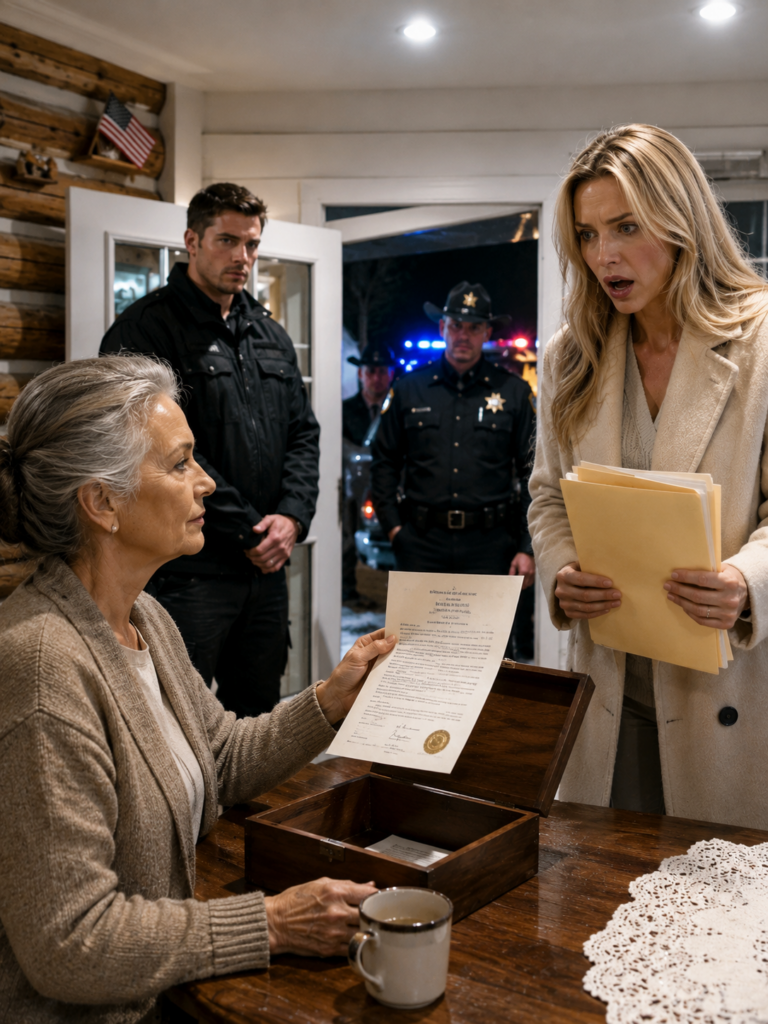
The first sound of betrayal was not a scream.
It was one sharp chirp from the security alarm at my front gate, slicing through the black Colorado dawn like a blade through silk.
At seventy-two years old, I had learned the private language of a quiet house. I knew the groan of old beams when the temperature dropped below zero. I knew the soft pop of pine logs settling in the fireplace. I knew the faint whistle of mountain wind sliding beneath the eaves, and the far-off crack of ice shifting along the creek behind the barn.
But that electronic chirp was different.
It did not belong to the mountain.
It belonged to trouble.
My phone lit up on the nightstand before the second chirp came. Its pale glow spread across the knotty pine walls, over the cedar chest where my late husband, Daniel, had kept his fishing tackle, and across the quilt I had sewn during his last round of chemotherapy.
I reached for the phone slowly.
Not because I was calm.
Because I had already spent three weeks preparing for this exact morning.
“Mrs. Harland,” Mike said.
His voice was low and tight.
Mike was my security guard, though he hated when I called him that. He preferred “property watch,” as if a softer phrase made a six-foot-two former Army Ranger look less intimidating standing beside a gatehouse with a thermos of black coffee and a licensed radio clipped to his coat.
I had hired him after my mailbox lock was pried open, after a woman at the county clerk’s office called to ask whether I had authorized a records request on my land, and after a black SUV began appearing near the lower road every few afternoons, idling just long enough for me to notice it.
There had been other little things too.
A missing property tax statement.
A strange voicemail from a moving company asking me to confirm an “estate transition.”
A glossy brochure from a senior community in Boulder tucked into my mailbox with my name misspelled.
And Melissa, always smiling.
“Your daughter-in-law is at the gate,” Mike said. “She has a moving truck. Three movers. She’s waving a manila folder and saying she owns the property now.”
I sat up.
Outside the bedroom window, the Colorado mountains were still swallowed in darkness. Snow clung to the pines. The sky above the ridge held that deep blue-black color that comes just before sunrise, when the whole world seems to be holding its breath.
“She says you were supposed to be out by now,” Mike added.
I looked at the mug of chamomile tea on my nightstand. I had brewed it at midnight because I could not sleep. It had gone cold hours ago.
Some part of me had known she would come before daylight.
People like Melissa preferred an audience when they were being charming and privacy when they were being cruel.
“Let her in,” I said.
Mike went silent. “Ma’am?”
“Open the gate.”
“She’s upset.”
“I’m sure she is.”
“She’s saying you’re confused and this could get embarrassing for you.”
That almost made me smile.
“Before you open the gate,” I said, “give her the visitor log. Full name. Exact time. Reason for visit. Make sure she writes it herself.”
Another pause.
Then Mike said, “Understood.”
“And Mike?”
“Yes, ma’am?”
“Do not argue with her. Do not touch the folder. Do not let the movers cross the threshold until I say so.”
“She’s claiming it’s an eviction.”
“It isn’t.”
“Should I call the sheriff?”
I looked toward the dark window and listened to the mountain wind drag itself along the glass.
“Not yet,” I said. “Let her walk herself all the way in.”
When I ended the call, the cabin returned to silence.
For a moment, I stayed where I was, my hand resting on the quilt.
Daniel used to say that a person’s true character was not revealed when they were hungry, tired, or afraid. Everybody had bad moments then. He believed character showed itself when a person thought there would be no consequences.
That morning, Melissa Harland believed she had finally found a moment without consequences.
Down below, beyond the bend in the private road, the gate motor hummed.
Then I heard the low diesel growl of a moving truck climbing toward my house.
My private road.
My private land.
My home.
Daniel and I had built that cabin twenty years earlier, after selling our tired brick house in Denver and moving west with more optimism than money. He had chosen the beams himself. Sanded them until his palms blistered. Fought with the stone mason over the fireplace until both men ended up laughing in the dirt driveway, filthy and stubborn and happy.
We had not built a mansion.
We built a life.
The kitchen windows faced east because Daniel liked the way morning light hit the copper kettle on the stove. The back porch wrapped around toward the creek so we could drink coffee and watch mule deer move through the aspens. Under the kitchen table, hidden where no guest would ever see it, Daniel had carved our initials into the underside of the wood on our twenty-fifth anniversary.
E + D.
He said a love note did not need to be visible to be real.
We raised our son, Adam, between that cabin and the city. Weekend hikes. Snow boots by the mudroom door. Christmas mornings beside the stone fireplace. Pancakes shaped like bears because Daniel had no artistic talent but unlimited confidence.
We buried our old Labrador beneath the blue spruce near the creek.
We buried Daniel’s ashes beneath the same tree four years later.
After he died, people kept telling me the cabin must feel too large.
They meant well, most of them.
A neighbor from church brought chicken soup and said, “You don’t have to decide anything right now.”
The pharmacist in town squeezed my hand when I picked up Daniel’s last prescription refill by mistake.
Even the mailman, Curtis, started driving my packages up to the porch instead of leaving them by the box during heavy snow.
But Melissa never said the cabin was too large because she worried about me.
She said it like she had already measured the rooms.
My daughter-in-law had always smiled as if she was forgiving you for existing.
She was polished in a way that made other women check their collars. Blonde hair cut just above the shoulder. Pearl earrings for school events. Cream-colored coats that never seemed to catch mud. She had the voice of a woman who could insult you so gently that people nearby would think she had offered you tea.
After Daniel’s funeral, she brought a casserole wrapped in foil and told everyone, “We’re just trying to make sure Eleanor doesn’t feel alone.”
She touched my arm in public.
She called me “Mom” when there were witnesses.
She told the women at church she worried about me “rattling around up there all by herself.”
At first, I let it pass.
Grief makes strange allowances. You forgive people for tone. You overlook small slights. You pretend not to hear things because you are too tired to fight over every splinter.
Then the suggestions began.
“You know, this place is a lot for one person.”
“Wouldn’t you be more comfortable closer to Denver?”
“Adam and I could help manage the property for you.”
By “manage,” she meant sell.
The cabin sat on thirty-seven acres of mountain land with timber rights, creek access, and a view developers had been circling for years. Daniel had refused every offer. So had I.
One man from a luxury resort group had once stood in my driveway wearing shoes too shiny for snow and said, “Mrs. Harland, you’re sitting on an opportunity most families would kill for.”
I told him, “Then I’m glad my family isn’t most families.”
He laughed as if I had made a charming elderly joke.
Daniel did not laugh.
He walked the man back to his car and told him never to come up our road again without an invitation.
For years, that was enough.
After Daniel died, the calls started again.
Not all at once. That would have been too obvious.
A postcard here.
A message there.
A “market valuation” from a realtor I had never met.
Then Melissa began slipping comments into family dinners like sugar into coffee.
“Property values are insane right now.”
“Lily’s college won’t pay for itself.”
“It seems almost selfish to keep land sitting unused.”
I remember the first time she used that word.
Selfish.
We were sitting at Adam and Melissa’s kitchen table in Denver, eating takeout from a Thai place because Melissa did not cook unless there would be photographs. Lily, my granddaughter, was on the floor with colored pencils, drawing a crooked picture of my cabin with smoke coming out of the chimney and a fox standing by the porch.
Melissa looked at the drawing and said, “It’s sweet how attached she is to that place.”
Then she smiled at me.
“But children attach to all kinds of things. It doesn’t mean adults should make financial decisions around nostalgia.”
Adam stared at his plate.
That was his habit.
My son was not a bad man. That almost made everything worse.
A bad man is easy to stop loving. A weak man breaks your heart slowly, one silence at a time.
Adam had Daniel’s kind eyes and my tendency to avoid public conflict. He worked in commercial insurance, wore blue shirts with the sleeves rolled up, and always looked as if he had forgotten something important in another room.
He loved his daughter.
He loved me.
I believe he loved Melissa too, though by then it was hard to tell whether love remained or whether he had simply become used to surviving her moods.
Melissa kept their house beautiful. She kept their calendar full. She kept Adam moving from obligation to obligation until he barely had time to ask whether any of those obligations made sense.
Charity brunches.
School fundraisers.
Campaign coffees.
Home renovation consultations.
Dinner with people who said “equity” the way church folks say “blessing.”
And debt.
So much debt.
Daniel had seen it before I did.
That was the part that still sat heavy in my chest.
Three weeks before he died, when his hands had become too thin and the skin around his wedding ring looked loose, he asked me to bring him the blue folder from the bottom drawer of his desk.
I thought it held insurance papers.
Instead, it held bank statements, copies of private loan documents, screenshots of messages Adam had sent asking for “short-term help,” and a handwritten list of every time Melissa had pressured him to ask us for money.
I remember sitting beside Daniel’s bed, the folder open on my lap, my throat too tight for words.
“She’s going to come for the house someday,” he said.
His voice was weaker than I could bear.
“No,” I whispered.
Daniel looked at me the way he did when one of us was lying out of mercy.
“Ellie.”
Only he called me that.
I shook my head because I could not stand the thought. Not then. Not while his pill bottles lined the dresser and the oxygen machine breathed softly in the corner. Not while our son still came over and kissed his father on the forehead and cried in the hallway where he thought we could not hear.
“She’ll come for it,” Daniel said. “And Adam will not stop her soon enough.”
I wanted to defend our son.
Instead, I cried.
Daniel reached for my hand. His fingers were cool.
“We protect the land,” he said. “We protect Lily. And we protect Adam from himself if we can.”
Six months after his funeral, I did what Daniel had asked.
With the help of an estate attorney in Denver, I placed the cabin and the surrounding acreage into the Harland Family Preservation Trust. The property could not be sold to developers. It could not be transferred by quitclaim deed. It could not be used as collateral. I retained the right to live there for the rest of my life.
After me, it would pass into a protected trust for Lily.
Not Adam.
Not Melissa.
Lily.
My granddaughter was eight years old and still believed the cabin was magic because chipmunks came near the porch when she sat very still. She had Daniel’s curiosity and Adam’s soft heart. She liked collecting smooth stones from the creek and lining them up on the windowsill by color.
Once, after Melissa told her not to get dirty because we had “family photos later,” Lily looked at me and whispered, “Grandma, why does Mommy only like things after they’re cleaned up?”
I had no answer for that.
So I gave her a towel and helped her wipe mud from her shoes.
I never told Adam about the trust.
That was my mistake, maybe.
Or maybe it was the last mercy I gave him.
For three years after Daniel died, Melissa pushed but did not strike.
Then she decided to run for county commissioner.
That was when everything sharpened.
Her campaign posters appeared along roadsides and in coffee shop windows. Melissa Harland, Family First. Melissa Harland, Protecting Seniors. Melissa Harland, Safeguarding Our Homes.
The first time I saw one of those signs outside the hardware store, I stood beside a rack of snow shovels and laughed until Curtis, the mailman, asked whether I was all right.
Melissa began bringing photographers to events with Adam and Lily dressed in matching blue. She posted pictures of herself delivering pies to elderly residents. She gave a speech at a luncheon about predatory real estate practices targeting older homeowners.
The local paper called her “a fresh voice for responsible growth.”
I clipped the article and placed it in the deed box with the other papers.
Not because I was petty.
Because Daniel had taught me to keep records.
Two months later, the county clerk called.
Her name was Marlene. She had known me since I used to bring lemon bars to the winter school fundraiser. Her voice was careful.
“Eleanor,” she said, “I don’t want to alarm you, but did you request certified copies of your property records this week?”
“No.”
There was a pause.
“All right,” she said. “That’s what I thought.”
A week after that, my mailbox lock was broken.
Then a notary named Diane Mercer left a message on my home phone saying she needed to “confirm a previously discussed signing appointment.”
I had never spoken to Diane Mercer in my life.
That was when I stopped pretending Melissa was only greedy in conversation.
I drove to Denver and met with Rebecca Shaw, the trust attorney Daniel had chosen. Rebecca was in her sixties, silver-haired, and spoke with the kind of calm that made panic feel slightly embarrassed.
She listened without interrupting as I laid out the postcards, the phone messages, the property inquiries, the missing mail, the strange moving company call, and the senior living brochure with my name misspelled.
When I finished, Rebecca folded her hands.
“Eleanor,” she said, “I think your daughter-in-law may attempt to manufacture evidence that you transferred the property.”
I looked out her office window at the traffic moving along Speer Boulevard.
For a second, I wanted to be the kind of old woman people imagined I was.
Sweet.
Confused.
Dependent.
Safe from the ugliness of knowing.
Instead, I looked back at Rebecca and said, “What do we do?”
She leaned forward.
“We let her think she’s smarter than she is.”
That was how Mike came into my life.
He had worked with Rebecca’s firm before, helping elderly clients document harassment and coercion. He drove up the first day in a dark pickup with snow tires, installed cameras along the gate and porch, and treated me with a respect so steady it nearly made me cry.
He never called me “little lady.”
He never told me not to worry.
He asked where the Wi-Fi router was, where the blind spots were, and whether anyone besides me had keys to the house.
“Adam has one,” I said.
“And Melissa?”
“Adam probably thinks she doesn’t.”
Mike nodded as if that explained more than enough.
For three weeks, we watched.
We documented.
We waited.
Diane Mercer, the notary, broke faster than any of us expected.
Rebecca’s investigator found the landscaping invoice first. Five thousand dollars paid from Melissa’s campaign-adjacent consulting account to a shell company owned by Diane’s cousin. Diane had notarized a quitclaim deed bearing my forged signature, then filed it electronically through a property attorney in Vail who claimed he had never met Melissa in person and believed he was processing a standard family transfer.
When confronted with the evidence, Diane cried in Rebecca’s conference room and said Melissa told her I was “mentally slipping” and that the family was only trying to move me somewhere safer before winter.
That phrase.
Somewhere safer.
As if stealing a woman’s home could be made holy by wrapping it in concern.
The county clerk flagged the deed, but Rebecca advised me not to confront Melissa immediately.
“She may still attempt possession,” Rebecca said.
I remember sitting across from her with my purse on my lap and my gloves folded neatly on top.
“You want me to let her come?”
Rebecca’s mouth tightened.
“I want her to reveal intent in a way no campaign manager, husband, or attorney can politely explain away.”
Daniel’s words returned to me then.
If she comes for the house, let her step inside.
At the time, I had thought grief made him dramatic.
Now I understood he had simply seen farther down the road than I had.
So that morning, when the alarm chirped and Mike said Melissa stood at my gate with a moving truck, I was not surprised.
I was dressed before the headlights reached the porch.
I put on my green nightgown, the heavy charcoal wool robe Daniel had bought me one Christmas, and the slippers Lily said made me look like a “fancy forest grandma.” I brushed my hair, washed my face, and walked into the kitchen.
The deed box sat on the table where I had left it the night before.
It was dark walnut with brass corners, scuffed along one side from the move twenty years earlier. Daniel had always kept important papers in it because he trusted boxes more than file cabinets. Inside were certified copies of the trust, notarized statements, emails, county receipts, Diane Mercer’s written confession, medical appointment records, security backup codes, and a small flash drive sealed inside a plastic evidence bag.
Beside it sat my cold tea.
I did not make fresh coffee.
That felt too welcoming.
Headlights swept across the front windows. The moving truck rolled into the driveway and stopped crooked, as if even the driver knew he should not be there.
Three movers climbed out. Young men in heavy jackets, faces red from the cold, looking more confused than threatening. One carried a clipboard. Another kept glancing toward the house as though expecting someone to appear and explain that this was all a mistake.
Then Melissa stepped down from the passenger side.
She wore a camel-colored coat, black leather gloves, and boots that had no business on a mountain road in February. Her hair was perfect. Her lipstick was perfect. Even at dawn, with frost silvering the porch rail, she looked ready for a camera.
In one hand, she held a manila folder.
In the other, my visitor log.
Good girl, I thought.
Then I hated myself a little for thinking it.
She marched up the steps with the confidence of a woman who believed paperwork made her untouchable.
She did not knock.
She opened my front door.
Cold air swept into the kitchen behind her.
“Eleanor,” she said, breathless and bright. “This doesn’t need to be difficult.”
I was sitting at the kitchen table, both hands around my mug.
The lamp above me cast a warm circle of light over the deed box.
Melissa stopped.
It was small, that pause.
A blink.
A slip.
But it told me everything.
She had expected panic. Maybe tears. Maybe an old woman dragging a suitcase from the bedroom while movers carried out boxes and Melissa spoke gently about dignity.
Instead, she found me seated in my own kitchen, in my own robe, under my own roof, looking at her as if she were late for an appointment.
Then she recovered.
People like Melissa recover quickly because they practice.
She lifted the folder.
“I have the filed quitclaim deed,” she said. “The property has been legally transferred. I’m giving you the dignity of leaving quietly.”
One of the movers looked down at his boots.
I looked at the folder.
Then at her.
“Did you sign the visitor log?” I asked.
Her mouth tightened. “Excuse me?”
“Full name. Time of arrival. Reason for visit.”
“This is my property now.”
“No,” I said softly. “This is my trap now.”
For the first time since she had entered my life, Melissa had nothing clever to say.
Her eyes flicked toward the windows.
At the bottom of the driveway, another set of headlights appeared. Then another. Red and blue lights began to flash against the snow-covered pines.
The movers stepped back.
Melissa’s fingers tightened around the folder.
Mike appeared on the porch behind her. “Mrs. Harland,” he said, voice firm, “the sheriff is here.”
I opened the deed box.
Melissa stared at it as if I had lifted the lid on a snake.
Sheriff Tom Whitaker stepped through the open door with two deputies behind him. Tom had known Daniel for thirty years. He had eaten trout at my kitchen table, borrowed Daniel’s chainsaw after a spring storm, and stood at the back of the church during Daniel’s funeral with his hat pressed against his chest.
He removed that same hat when he saw me.
“Morning, Eleanor.”
“Morning, Tom.”
Melissa turned toward him, and the tears began so quickly I almost admired the discipline of it.
“Sheriff, thank God. There’s been a misunderstanding. I have legal ownership of this property, and Eleanor is refusing to leave.”
Tom looked at the manila folder. “That so?”
“Yes.” She pulled out the quitclaim deed and handed it to him. “It was filed last week.”
Tom examined it for a few seconds.
Then he looked at me.
“Eleanor,” he said, “is this your signature?”
“No.”
Melissa gave a small, wounded laugh.
“She’s confused,” she said. “She’s been under emotional stress since Daniel passed.”
Something cold moved through me.
Not rage.
Precision.
“Melissa,” I said, “Daniel has been dead for four years.”
Her smile faltered.
“That document says I signed the transfer in front of a notary in Boulder last Thursday at 2:15 p.m.”
“So?”
“At 2:15 p.m. last Thursday,” I said, “I was sitting in Dr. Patel’s office in Denver with two witnesses, a timestamped medical record, and security footage from the clinic.”
Melissa’s eyes narrowed. “That doesn’t prove anything.”
“No,” I said. “But the notary already confessed.”
The kitchen went still.
Even the fireplace seemed to hush.
The paper in Melissa’s hand trembled once.
Sheriff Whitaker’s expression did not change, but one deputy shifted closer to the door.
Melissa swallowed.
“That’s impossible.”
“Her name is Diane Mercer,” I said. “She notarized your fake deed after you paid her five thousand dollars through a landscaping invoice. You really should have used cash.”
Her gaze shot toward the movers.
“They don’t know anything,” she snapped.
“I believe that,” I said. “That’s why Mike kept them outside the threshold.”
The movers immediately looked relieved and terrified at the same time.
“We were just hired online,” one of them said. “Lady told us it was a legal family move.”
Melissa glared at him so fiercely he stepped behind his clipboard.
I reached into the deed box and took out the visitor log Mike had brought up from the gatehouse.
Melissa’s handwriting was bold and clear.
Melissa Harland. 5:03 a.m. Reason for visit: New owner taking possession.
“Thank you for writing that yourself,” I said. “It saves everyone time.”
Her breathing quickened.
Then Adam walked in.
My son looked as if the night had taken ten years from him.
His coat was unbuttoned. His hair stood up on one side. His face had the gray, stunned look of a man who had driven too fast through the dark and arrived at the wreckage after knowing, deep down, that he should have seen the curve coming.
He could not look at his wife at first.
He looked at me.
Then the deed box.
Then the sheriff.
Finally, he turned to Melissa.
“Tell me you didn’t,” he said.
His voice sounded like paper tearing.
Melissa transformed.
It would have impressed me once, the speed of it. The arrogance disappeared. Her shoulders softened. Her eyes filled. Her mouth trembled just enough.
“Adam, honey, your mother is manipulating this. She’s always hated me.”
Adam flinched.
I did not.
There had been a time when that accusation would have wounded me.
I had spent years swallowing small humiliations to keep peace for my son. I had ignored Melissa correcting my recipes in my own kitchen. I had pretended not to hear when she told a neighbor, “Eleanor gets confused when routines change.” I had smiled through Thanksgiving when she moved my wedding photo from the mantel so her campaign photographer could get a cleaner shot of the fireplace.
I had said nothing when she referred to my home as “the mountain asset.”
I had said nothing when Adam looked away.
But that morning, peace was no longer the goal.
Truth was.
Adam held up his phone.
“The bank called me yesterday,” he said.
Melissa went pale.
“They asked why our home equity line of credit was being used to pay a property attorney in Vail.”
“Adam—”
“They sent me the documents.”
Her lips parted.
He stared at her, and for once, he did not blink first.
“There are emails, Melissa. Transfers. The invoice. Diane Mercer’s name. Your assistant’s name.”
Melissa’s tears hardened into anger.
“You had no right to go through my campaign accounts.”
“I didn’t,” Adam said. “They went through ours.”
The word landed hard.
Ours.
That was how Melissa had hidden for years.
Behind family.
Behind marriage.
Behind the soft confusion of shared accounts and shared obligations and one spouse assuming the other spouse knew what she was doing.
Adam looked at me then.
His eyes filled.
“Mom,” he said. “I’m so sorry.”
That hurt more than I expected.
Because I knew my son.
I knew the boy who once slept with a flashlight under his pillow because he was afraid I would trip going to the bathroom at night. I knew the teenager who shoveled the walkway before school without being asked. I knew the young man who cried the first time he held Lily.
I also knew the grown man who had ignored every warning because facing the truth about his wife was harder than dismissing his mother.
I stood.
“Adam,” I said, “I love you. But your apology is late.”
He lowered his head.
Melissa’s face twisted.
“This is insane,” she said. “You can’t arrest me for a paperwork mistake.”
Sheriff Whitaker folded the fake deed and handed it to a deputy.
“Forgery, attempted theft of real property, criminal impersonation, conspiracy, and attempted unlawful eviction of an elderly resident.”
“Elderly resident?” Melissa spat.
There it was.
The mask cracking.
“She’s sitting on millions while we struggle,” Melissa said.
The room shifted.
Not because the words surprised anyone.
Because she had finally said them in front of witnesses.
I leaned both hands on the table.
“You don’t struggle, Melissa. You spend.”
Her eyes blazed.
“You let this huge place rot around you while your own family could use it.”
“This place is not rotting.”
“You’re one woman.”
“I was one woman when I buried my husband,” I said. “One woman when I paid the taxes. One woman when I repaired the roof. One woman when developers came with checks big enough to make your hands shake. And I said no every time.”
She stepped closer.
“Adam is your only child.”
“Yes,” I said. “And that is why I protected him too.”
Adam looked up.
Melissa froze.
That was the moment she sensed another blade in the room.
I opened the deed box fully and removed the certified trust document.
“This cabin is no longer in my personal name,” I said.
Melissa stared.
Adam whispered, “Mom?”
“Six months after Daniel died, I placed the property into the Harland Family Preservation Trust. It cannot be sold to developers. It cannot be transferred by quitclaim deed. It cannot be used as collateral. It remains my residence for life.”
Melissa’s lips moved before sound came out.
“No.”
“Yes.”
“That’s not possible.”
“It is when the owners do it before anyone starts forging signatures.”
Her eyes darted toward Adam.
He looked as shocked as she did.
“And after I die,” I continued, “it does not go to Adam.”
My son stopped breathing.
The room seemed to tilt around us.
Melissa gave a short, cruel laugh.
“You disinherited your own son?”
“No,” I said. “Daniel did.”
Adam’s head snapped toward me.
I held up the final signed page.
There, in blue ink, was my husband’s signature.
Daniel Harland.
Dated three weeks before his death.
Adam took one step back as if the name itself had pushed him.
“Dad knew?”
I nodded.
This was the part I had dreaded.
Not Melissa’s rage.
Not the sheriff.
Not the fake deed.
This.
My son’s face breaking under the weight of his father’s last act of protection.
“Daniel knew you were drowning in Melissa’s debts,” I said gently. “He knew about the credit cards. The private loans. The pressure she put on you to ask us for money.”
Adam’s eyes filled.
“He didn’t want to punish you,” I said. “He wanted to save what was left of you.”
Melissa looked from me to Adam.
“That’s a lie.”
I turned the page.
“The beneficiary is Lily.”
Adam covered his mouth.
For a moment, every adult in that kitchen seemed to disappear around the name of that child.
Lily.
Eight years old.
Missing two front teeth.
Still convinced the moon followed our car down the mountain road.
Still sleeping with the stuffed fox Daniel bought her at the hospital gift shop the month before he died.
Still drawing the cabin with smoke from the chimney and creek stones in the windowsill.
Melissa’s voice dropped into something ugly.
“You gave my daughter my house?”
“No,” I said. “Daniel gave his granddaughter a home you could never sell.”
Melissa laughed.
It was not a sane sound.
“You stupid old woman,” she hissed. “You think Lily will keep this place? I’m her mother. I control everything she owns.”
“No,” said a voice from the doorway.
A woman stepped inside behind Sheriff Whitaker.
She wore a navy suit, sensible boots, and a dark wool coat dusted with snow. Her hair was pinned back. She carried a leather briefcase and had the calm, direct eyes of someone who had spent years watching families tell lies in courtrooms.
Melissa stared at her.
“Who are you?”
The woman smiled politely.
“Claire Donovan. Guardian ad litem for Lily Harland’s protected trust interests.”
Melissa blinked.
“What?”
Claire stepped into the kitchen and set her briefcase on the chair nearest the door.
“After the notary’s confession and the attempted transfer of trust property, an emergency petition was filed to protect Lily’s future estate from interference or coercion. The judge signed a temporary order late last night.”
Melissa backed away.
“No. You can’t do that.”
“The court can,” Claire said. “And did.”
Adam looked stunned.
“Is Lily safe?”
Claire’s expression softened.
“She is at school. I spoke with the principal twenty minutes ago. No one is permitted to remove her except you or Mrs. Harland until the court reviews the matter further.”
Melissa turned toward Adam.
“Are you hearing this? They’re trying to take my child from me.”
Claire did not raise her voice.
“No one said that, Mrs. Harland. This order concerns financial protection and immediate custody safeguards while law enforcement investigates what happened here.”
Melissa’s mouth opened, but no words came.
That was what finally frightened her.
Not the sheriff.
Not the forged deed.
Not me.
The possibility that the same public story she had crafted so carefully—loving mother, devoted wife, protector of seniors—might now be rewritten by a court record.
Adam looked at his wife for a long time.
Then, slowly, he removed his wedding ring.
The sound it made when he placed it on the kitchen table was very small.
A soft tap against old wood.
But to Melissa, it landed like a gunshot.
“You used our daughter,” he said.
“No,” she whispered. “I did this for us.”
“You did this for you.”
Her face hardened.
“You are weak,” she said.
Adam closed his eyes.
There were years in that silence.
Years of him trying harder.
Paying another bill.
Apologizing after she insulted someone.
Laughing off another public humiliation.
Telling me she was under stress.
Telling himself marriage meant loyalty even when loyalty began to look like self-erasure.
When he opened his eyes again, something had changed.
Not fixed.
Changed.
“I know,” he said. “I was weak. That ends today.”
For the first time, Melissa looked truly alone.
Sheriff Whitaker stepped forward.
“Melissa Harland, place your hands behind your back.”
She screamed then.
Not words at first.
Just rage.
It tore through the warm kitchen where Daniel used to dance barefoot while pancakes burned on the stove, where Lily used to sit on the counter licking frosting from a spoon, where I had folded hospital bills and Christmas napkins at the same table.
“You ruined everything!” Melissa shouted as the deputy cuffed her. “You lonely, bitter old woman! You’ll die here alone!”
I looked at her, and somehow I felt no triumph.
Only grief for the years my son had lost.
Only sadness for my granddaughter’s innocence.
Only a deep, steady relief that Daniel and I had seen the storm before it reached the child.
“No, Melissa,” I said quietly. “I’ll die here protected.”
They led her out past the movers, past the flashing lights, past the moving truck she had brought to steal my life before breakfast.
At the doorway, she twisted back one last time.
And that was when the final blow arrived.
Mike stepped onto the porch holding a tablet.
“Mrs. Harland,” he said, “the livestream backup finished uploading.”
Melissa went still.
Sheriff Whitaker frowned. “Livestream?”
I looked at Melissa.
“After my mailbox was broken into, Mike installed a private security system. Audio, video, cloud backup.”
Melissa’s mouth opened.
“Everything from the gate to the kitchen,” I said. “Including your statement that you came as the new owner to take possession.”
Adam stared at me.
But I was not finished.
“The trust attorney advised me to document everything privately,” I said. “But Daniel left one more instruction. If anyone ever tried to force me out of this house, the footage and records were to be sent to three places.”
Melissa’s voice shrank.
“What places?”
I counted them on my fingers.
“The sheriff.”
Her knees weakened.
“The county prosecutor.”
Her breathing became shallow.
“And the editor of the Denver Chronicle.”
The color drained from her face.
Because Melissa was not just greedy.
She was running for county commissioner.
Her whole campaign was built on family values, elder care, and protecting vulnerable homeowners from fraud.
By noon, the woman who had arrived at my cabin pretending to be its rightful owner would become the kind of headline no campaign survives.
Candidate Arrested In Attempted Theft Of Elderly Widow’s Mountain Property.
That was Daniel’s last trap.
Not revenge.
Exposure.
Melissa screamed my name as they placed her in the sheriff’s vehicle, but the mountains swallowed the sound.
The moving truck left empty.
The deputies took statements from the movers, who kept apologizing to me as if they had personally insulted my curtains.
Mike closed the gate.
Claire called Lily’s school again, then stepped onto the porch to speak quietly with Rebecca over the phone.
Adam remained at my kitchen table.
He sat with both hands over his face, his shoulders shaking.
For a while, I let him cry.
Mothers are strange creatures. Even when a son disappoints you, even when he wounds you, even when he chooses silence at your expense, some ancient part of your heart still sees the little boy with snow in his hair and mittens clipped to his coat.
But love, if it is worth anything, cannot be only softness.
I placed a clean mug in front of him and poured coffee from the pot I finally made after the sheriff left.
He looked at it as if he did not deserve coffee.
Maybe he didn’t.
I gave it to him anyway.
“Mom,” he said, voice raw, “I should have believed you.”
“Yes,” I said.
He flinched.
I sat across from him.
“I waited a long time to hear you say that,” I said. “But I need you to understand something. The worst thing Melissa did was not fool you.”
He looked up.
“The worst thing she did,” I continued, “was teach you to call your own mother dramatic so you would not have to call your wife dangerous.”
His face crumpled.
“I know.”
“You missed birthdays because she said the drive was too much. You let her talk over me because you said she was stressed. You let her make decisions about Lily coming here because you said keeping peace was easier.”
Tears ran down his face.
“I know.”
“Do you?”
He looked at the table.
The wedding ring still sat there.
“I think I’m starting to.”
That was honest enough for the morning.
I reached across the table and touched his hand.
“I love you,” I said. “But love will not erase consequences.”
He nodded.
“I don’t want it to.”
Outside, dawn finally broke over the ridge.
The first sunlight touched the pines, then the porch, then the kitchen window. It spilled across the table and lit the brass corners of the deed box. For the first time in years, the cabin did not feel haunted by what I had lost.
It felt guarded by what Daniel had left behind.
Around nine, Claire drove down to meet with the prosecutor. Mike went to check the lower gate and photograph the tire tracks. The movers’ company called me personally to apologize and promised to cooperate with law enforcement.
Adam asked if he could go to Lily’s school and explain that there had been “a family emergency.”
“No,” I said.
He looked hurt.
“She is eight,” I said. “She does not need adult explanations before lunch.”
“What should I do?”
“Call your attorney. Then call a counselor. Then call your bank. In that order.”
He almost smiled through the tears.
“You still sound like Dad.”
“No,” I said. “Your father would have made a joke first.”
That broke something open between us.
Not forgiveness.
Not yet.
But the smallest clean breath after years of stale air.
Later that morning, after Adam left to begin the ugly work of untangling his life, I washed the two mugs by hand.
The moving truck’s tire marks still cut dark lines through the frost outside, but the sun had begun to soften them. Snowmelt dripped from the porch roof. A jay landed on the railing, cocked its head toward the kitchen window, then flew off as if unimpressed by human foolishness.
I carried the deed box back to Daniel’s old desk.
That desk had always smelled faintly of cedar shavings and pipe tobacco, though Daniel had stopped smoking before Adam was born. I ran my fingers over the drawers, over the small nick near the corner from the time Lily had slammed a toy truck into it and burst into tears before Daniel even noticed the damage.
As I lifted the trust papers back into place, something shifted beneath the velvet lining.
I frowned.
The box had been opened so many times over the years. By Daniel. By me. By Rebecca. I knew every paper inside it.
Or thought I did.
I slipped my fingers beneath the lining and found an envelope, thin and cream-colored, tucked flat against the bottom.
My name was written on the front in Daniel’s shaky handwriting.
Eleanor.
For a moment, I could not move.
Grief is not a straight road. It is a house with rooms you forget exist until you open the wrong door.
I sat at his desk and held the envelope against my chest.
Then I opened it.
Inside were only three lines.
If they come for the house, don’t be afraid.
Let them step inside.
Some traps are built with love.
I read those words once.
Then again.
Then a third time, though I could barely see them through my tears.
I thought of Daniel in his final weeks, thin and tired, still worrying about me. Still worrying about Adam. Still thinking years ahead when the rest of us could barely think past the next doctor’s appointment.
He had known I would hate the trap.
He had known I would rather believe people could change before they harmed us.
He had known Melissa would mistake my quiet for weakness.
And he had known that someday, when I needed him most, I would find that note and understand that love can protect even after death.
I sat at the desk until the kitchen clock struck noon.
By then, Melissa’s arrest had reached the local news.
My phone buzzed so often I finally turned it facedown.
Neighbors called.
Church ladies left voicemails full of outrage and casseroles.
Marlene from the county clerk’s office sent a single text: Daniel would be proud.
The Denver Chronicle posted the first article before lunch.
By evening, Melissa’s campaign website had vanished.
Her social media accounts went private.
Her biggest donor released a statement about being “deeply troubled.”
And the same people who had smiled beside her at fundraisers began speaking in that careful public language people use when they are stepping away from a fire.
Adam called that night.
His voice sounded exhausted.
“Lily wants to talk to you.”
My breath caught.
A second later, my granddaughter came on the line.
“Grandma?”
“Hi, sweetheart.”
“Daddy said Mommy had to go talk to some people because she did something wrong.”
I closed my eyes.
“Yes,” I said. “That’s true.”
“Are you mad?”
I looked around the cabin. The warm lamp. The stone fireplace. Daniel’s chair by the window. The little row of creek stones Lily had arranged by color the previous summer.
“I’m sad,” I said. “But I’m safe.”
“Can I still come to the cabin?”
My throat tightened.
“Always.”
“Can we still make pancakes?”
“Yes.”
“Even if they look like bears but Daddy says they look like potatoes?”
I laughed then.
It surprised me, that laugh.
It came out cracked and wet and real.
“Especially then.”
There was a rustle on the other end, then Adam came back.
“Thank you,” he said.
“For what?”
“For not making me sound like the hero.”
I stared out at the dark windows.
“You’re not the hero yet,” I said. “You’re just at the part where you decide whether to become better.”
He was quiet for a long time.
Then he said, “I want to.”
That was enough for one day.
The weeks that followed were not simple.
Stories like mine never end as cleanly as people want them to.
There were court hearings.
Bank meetings.
Statements.
Lawyers.
Whispers at church.
Polite questions at the grocery store from people pretending not to ask for details while studying my face over the apples.
Melissa’s attorney tried to frame the whole thing as a “misguided family intervention.” That lasted until the prosecutor played the gate footage and Melissa’s own handwriting appeared on the visitor log.
New owner taking possession.
No speech could soften that.
Diane Mercer surrendered her notary commission and cooperated.
The property attorney in Vail produced emails.
The moving company produced work orders.
The campaign assistant produced text messages after receiving her own subpoena and discovering loyalty had limits.
By spring, Melissa accepted a plea agreement.
No dramatic courtroom collapse.
No screaming confession.
Just a woman in a gray blazer standing before a judge, answering questions in a voice so small it barely reached the gallery.
Yes, Your Honor.
No, Your Honor.
I understand, Your Honor.
People expected me to feel satisfied.
I did not.
Satisfaction came later, in smaller ways.
It came the first afternoon Lily returned to the cabin and ran straight to the creek without asking whether she might get her shoes dirty.
It came when Adam began driving up every other Saturday, not to ask for anything, not to perform guilt, but to split firewood, repair the porch step, and sit quietly beside me while the coffee brewed.
It came when he started therapy and told me, awkwardly, that he was learning the difference between being kind and being easy to control.
It came when Lily taped a new drawing to my refrigerator.
This one showed the cabin, the creek, the blue spruce, and three people on the porch.
Me.
Her.
And Daniel, drawn as a bright yellow star above the roof.
Underneath, she had written:
Grandpa still watches the house.
I stood in front of that drawing for a long time.
Then I taped Daniel’s note beside it.
Not for guests.
Not for drama.
For me.
To remember that I had not survived because I was hard.
I had survived because I had been loved well, and because I finally stopped confusing silence with peace.
By summer, the tire marks from Melissa’s moving truck were long gone. Grass grew thick along the driveway. Wildflowers came up near the lower gate where Mike had stood that morning with the visitor log.
The cabin remained what it had always been.
Not an asset.
Not a prize.
Not a number on a developer’s proposal.
A home.
One Saturday in July, Lily and I sat on the back porch eating watermelon from chipped blue plates while Adam fixed the loose hinge on the screen door.
The mountains were green and bright. The creek moved fast over the stones. Somewhere in the trees, a woodpecker hammered away as if the whole forest needed remodeling.
Lily looked up at me, juice shining on her chin.
“Grandma?”
“Yes?”
“Daddy said this house is protected.”
I glanced toward Adam.
He froze with the screwdriver in his hand.
“That’s right,” I said.
“Protected like with cameras?”
“With cameras,” I said. “And papers. And people who love it.”
She considered that.
“Can a house love people back?”
Adam looked down.
I looked at the beams Daniel had sanded with his own tired hands. The porch rail he had rebuilt twice. The stone path he laid badly the first time and perfectly the second. The swing he hung for Lily before she was born, when he was already sick but refused to say so.
“Yes,” I said. “I think sometimes it can.”
Lily leaned against my arm.
“Then this one loves you a lot.”
I closed my eyes for a second.
The wind moved through the aspens.
The screen door creaked.
Adam went back to fixing the hinge.
And for the first time since Daniel died, I did not feel like I was waiting for the next loss.
I felt rooted.
That night, after Lily fell asleep in the small loft room under the quilt I had made from Daniel’s old flannel shirts, Adam and I sat at the kitchen table.
The same table.
The same warm lamp.
But no sheriff.
No flashing lights.
No manila folder.
Just two mugs of tea and a silence that had finally become honest.
“I keep thinking about Dad,” Adam said.
“So do I.”
“He knew I was in trouble.”
“Yes.”
“And he didn’t tell me.”
I looked at my son carefully.
“He tried.”
Adam swallowed.
I knew he remembered. We both did.
Daniel asking gentle questions about credit cards.
Daniel offering to help Adam meet with a financial planner.
Daniel saying, “Son, love shouldn’t require you to hide from your own bank statements.”
Adam had brushed him off.
Melissa had called it interference.
And I had let the subject drop because Daniel was dying, and I wanted peace more than truth.
There was enough blame to go around.
Adam rubbed both hands over his face.
“I’m sorry I didn’t listen.”
“So am I.”
He nodded.
The old me would have rushed to comfort him.
The new me let the apology sit.
Not as punishment.
As medicine.
Some things have to sting before they heal.
After a while, Adam looked toward the refrigerator, where Lily’s drawing and Daniel’s note hung side by side.
“Some traps are built with love,” he read softly.
“Yes.”
He gave a sad smile.
“Dad always did know how to make a point.”
“He also knew how to overbuild a shed.”
Adam laughed.
So did I.
It was small, but it was real.
Outside, the mountain night settled around the cabin. The gate was locked. The cameras were on. The trust papers were back in the deed box, where they belonged.
But I no longer slept because of locks and cameras.
I slept because I had learned that being old did not mean being helpless. Being kind did not mean being available for theft. Being a mother did not require sacrificing my dignity so my son could avoid discomfort.
And being alone did not mean being unprotected.
Before bed, I stepped onto the porch.
The stars were sharp above the ridge. The blue spruce near the creek stood dark and steady, its roots deep in the same earth where Daniel rested.
I walked down the steps in my robe and stood beside it.
For a long moment, I said nothing.
Then I placed my palm against the bark.
“You were right,” I whispered.
The wind moved through the branches.
Behind me, the cabin glowed warm against the dark.
No moving truck.
No forged deed.
No woman at my door telling me to leave my own life behind.
Only home.
Only quiet.
Only the sunrise waiting somewhere beyond the mountain, ready to erase whatever tracks the next morning found in the frost.