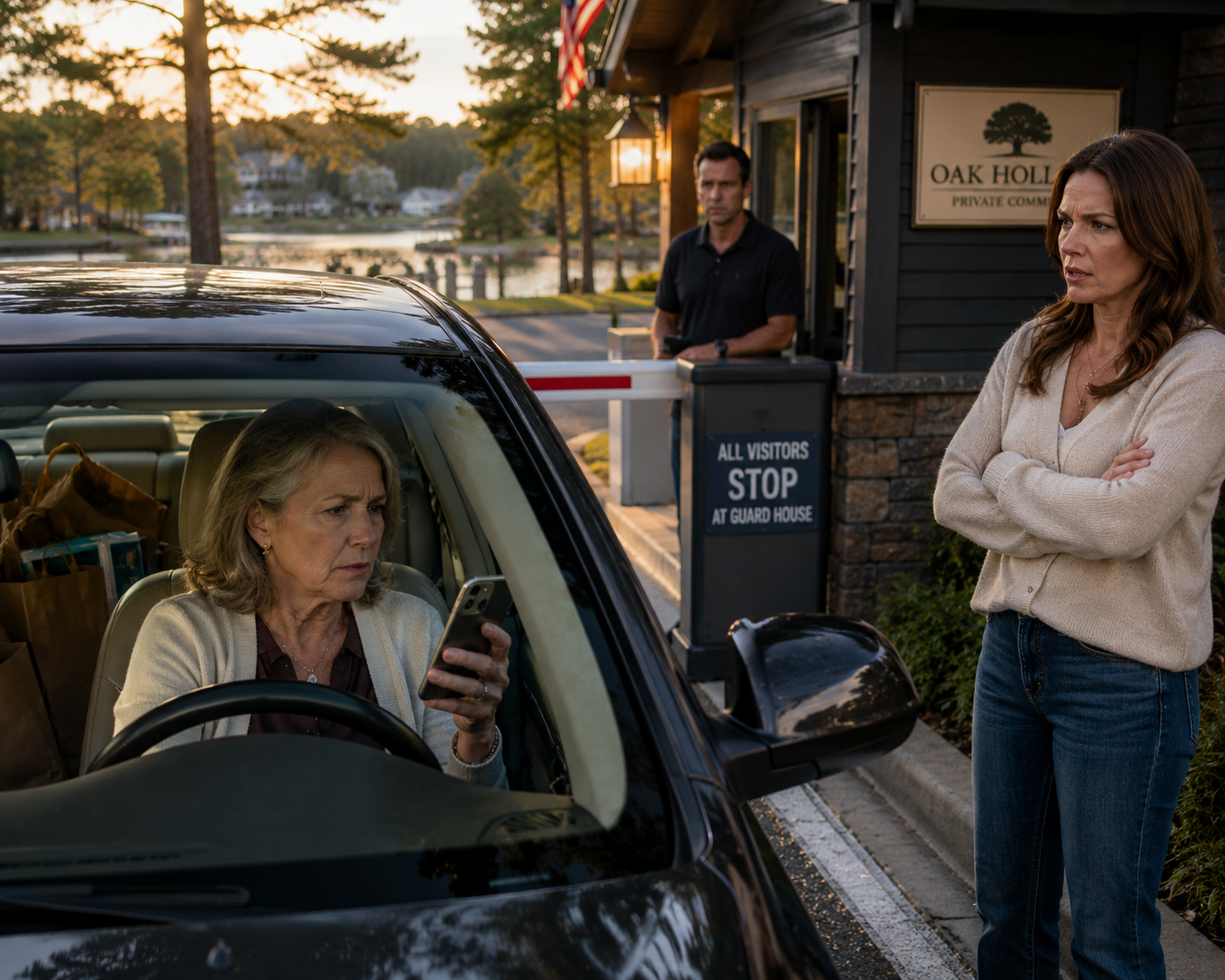
My daughter-in-law changed the gate code to my lake house and told security I was “no longer approved for access.”
I sat in my car outside the Oak Hollow entrance with grocery bags melting in the back seat, while my son let her say it was “just easier” if I stayed away for the weekend.
Then my phone buzzed with an owner portal alert showing Kendall had added herself as household manager without authorization.
That was when I realized she had not locked me out because she owned the place.
She had locked me out because she forgot who did.
My name is Elaine Porter. I am sixty-eight years old, and I own a small lake house outside Gainesville, Georgia, in a gated community with pine trees, speed bumps, HOA mailboxes, and a guard shack where everybody knows which families wave and which families pretend not to see you.
It is not a mansion.
Three bedrooms.
A screened porch.
Old dock.
Kitchen cabinets my husband painted twice and hated both times.
But that house was where my family learned how to be loud, sunburned, hungry, forgiven, and together.
After my husband Frank died, I kept the lake house because selling it felt like losing him twice.
I paid the taxes.
The HOA dues.
The dock repairs.
The insurance after the hailstorm.
The plumber who charged too much because he knew weekend homes never break at convenient times.
My son Jason loved that house.
Or at least he loved using it.
“Mom, can we take the kids next weekend?”
“Mom, what’s the Wi-Fi again?”
“Mom, did you renew the boat slip?”
“Mom, Kendall wants to host some friends there. Just casual.”
Just.
That word has cost mothers more than money.
Kendall married Jason eight years ago. She was pretty, organized, and dangerous in the way polished people can be when they learn that soft voices get them farther than honest ones.
She never said she wanted my lake house.
She said she wanted to help manage the calendar.
She never said I was in the way.
She said weekends were getting complicated.
She never said I did not belong.
She said, “Elaine, you shouldn’t have to worry about all these little logistics anymore.”
Little logistics.
That was what she called the bills I paid.
The gate access.
The vendor codes.
The marina forms.
The cleaning schedule.
The owner portal password she kept asking for in case of emergencies.
I gave Jason guest access.
Not Kendall.
That matters.
A guest can enter.
A guest cannot change the locks to someone else’s life.
The weekend it happened was the first warm weekend in May. I had planned to drive down Friday afternoon with peach cobbler, hot dog buns, and the little orange life jacket my grandson Mason had outgrown but refused to throw away.
Kendall had texted earlier:
We’re trying to keep things peaceful this weekend. Maybe it’s better if you come Sunday.
Peaceful.
I knew that word.
It meant her friends were coming.
It meant I was expected to pay for quiet from somewhere else.
I went anyway.
At the gate, my code failed.
Once.
Twice.
Three times.
The guard, Mr. Bell, stepped out looking embarrassed before he even reached my window.
“Mrs. Porter,” he said, “I’m sorry. The access list was updated this morning.”
“Updated by whom?”
He looked at his tablet.
“Kendall Porter.”
My hands went cold.
“She is not an owner.”
“I understand, ma’am. But she’s listed as household manager.”
Household manager.
I almost laughed.
Then my phone rang.
Jason.
His voice was tight, already coached.
“Mom, don’t make this dramatic.”
I looked through the gate at the road that led to my house.
“My code doesn’t work.”
“Kendall just thought it would be better to streamline access.”
“Streamline me out?”
He sighed.
“We have guests. Can you just get a hotel tonight?”
A hotel.
Twenty minutes from a house my name was on.
A house where my dead husband’s ashes had been scattered behind the dock.
I hung up before my voice betrayed me.
Then I parked beneath the pine trees, opened my phone, and logged into the Oak Hollow owner portal with the password Kendall had never managed to get.
There it was.
Access change request.
Household manager added.
Gate code replaced.
Guest permissions modified.
Kendall had clicked everything except the one tab that mattered.
Ownership.
At 5:42 Saturday morning, before the lake mist had lifted off the water, I removed her name from every authorization attached to my property.
Gate.
Dock.
Boat slip.
Vendor access.
Household management.
Then I added one note in the portal for security.
Owner present. No access changes permitted without written approval from Elaine Porter.
At 6:03, Mr. Bell called me.
“Mrs. Porter,” he said carefully, “Kendall Porter is at the gate demanding entry.”
I looked at my packed suitcase by the door.
Then at Frank’s old fishing hat hanging on the hook.
“Tell her,” I said, “the owner will be there shortly.”
Frank and I bought the lake house the year Jason turned fourteen.
That was 1998, when gas was cheap enough for middle-class families to pretend weekend driving did not count and everybody in North Georgia knew somebody with a cousin who could fix a dock.
The first time Frank took me to see it, I told him no before we even got out of the car.
The brown siding had faded in uneven patches.
The gravel drive was washed out.
The porch screen had a tear big enough for a raccoon with ambition.
Inside, the refrigerator hummed like it was angry about being alive, and one of the kitchen cabinet doors hung crooked.
Frank stood in the middle of that little house, hands on hips, smiling like a man looking at a miracle.
“Elaine,” he said, “listen.”
“To what? The refrigerator dying?”
“No. The quiet.”
I crossed my arms.
“Quiet is cheaper if we stay home and turn off the TV.”
He laughed.
Then he walked me out back.
The lake spread below the pines, blue and wide, sunlight flashing on the water like somebody had spilled coins across it. The old dock reached out from shore, worn gray boards, metal ladder, two rusted chairs left by the previous owner.
Jason ran ahead of us, all elbows and teenage impatience.
“Dad, can we fish here?”
Frank looked at me.
That man knew what he was doing.
A woman can resist bad siding.
It is harder to resist her son standing on a dock, suddenly looking like childhood has given him one more summer.
We bought it.
Not easily.
We adjusted.
Canceled a bigger vacation.
Used savings.
Took out a small loan.
Painted, repaired, patched, cleaned, argued, and sanded. Frank painted the kitchen cabinets the first time a shade of blue that looked charming on the paint card and like a municipal swimming pool in real life.
I hated it.
He pretended not to.
Three years later, he painted them cream.
Then hated that too.
“Cabinets are a trap,” he said.
“They’re storage.”
“They’re judgment with hinges.”
That was Frank.
He could turn a chore into a comedy routine and still leave one brush drying in a coffee can for six weeks.
The lake house became our family’s second language.
Jason learned to back the boat trailer there, badly.
Then better.
He caught his first decent bass off that dock and told everyone it was huge until Frank held up the picture and said, “Son, that fish was emotionally large.”
Frank taught our grandsons to wear life jackets before complaining.
He kept a tackle box under the porch bench with everything labeled in his handwriting.
Hooks.
Sinkers.
Do not touch unless you want Elaine mad.
We had Fourth of July cookouts, Labor Day weekends, rainy Saturdays full of board games, and Sunday mornings with coffee on the screened porch while the lake woke up slowly.
It was never fancy.
The guest bathroom door stuck when it rained.
The dock ladder had to be replaced twice.
The screened porch fan clicked no matter how many electricians claimed to fix it.
But the house held us.
That is what mattered.
After Frank got sick, the lake house became both comfort and torture.
He wanted to go even when he was too tired.
So I drove.
Packed his medications.
Brought the cushion for his back.
Helped him down the slope to the dock slowly, one step at a time.
He would sit in the old green chair with his fishing hat low over his eyes, pretending he was there for the fish.
We both knew better.
He was saying goodbye in pieces.
A man like Frank did not make speeches about death.
He checked the dock screws.
Told me which marina mechanic overcharged.
Made sure I knew where the shutoff valve was.
Made me promise not to sell too quickly.
“Quick decisions after death are mostly fear wearing shoes,” he said.
I told him not to talk like that.
He squeezed my hand.
“Elaine.”
I hated when he used my name like that.
It meant he was right and did not have strength to argue.
After he died, I brought his ashes to the lake in a blue ceramic urn Jason and I chose together. We scattered some behind the dock in the quiet cove where Frank used to claim the fish respected him.
Jason cried then.
So did I.
Kendall stood near the porch with sunglasses on, holding baby Mason against her shoulder. She had married into the family only two years earlier, and back then, I thought her distance was discomfort with grief.
Maybe some of it was.
Or maybe grief was just the first room where I noticed she preferred to stand where she could watch without being touched.
For a while after Frank died, Jason treated the lake house like something sacred.
He called before coming.
Asked if I needed repairs done.
Brought the boys down on weekends and made sure Frank’s fishing hat stayed on the hook by the back door.
Then life moved.
It always does.
Mason grew.
His little brother, Connor, arrived.
Jason’s job at a commercial real estate firm became busier.
Kendall became more confident in her role as family organizer.
At first, she asked nicely.
“Elaine, would you mind if I made a shared calendar? Just so nobody overlaps.”
That sounded reasonable.
Then:
“Elaine, do you want me to coordinate the cleaner? It must be a lot to keep track of.”
That also sounded reasonable.
Then:
“Elaine, can I get a copy of the vendor list? Just in case.”
Reasonable again.
Control rarely arrives wearing boots.
It comes in with a planner and a soft voice, carrying a label maker.
Before I knew it, Kendall was sending messages in the family thread as if the lake house belonged to the calendar, not to me.
Available weekends:
Memorial Day: Jason/Kendall
June 8: Kendall girls’ weekend
June 22: Jason client retreat, maybe
July 4: family, tentative
Elaine: TBD
TBD.
To be determined.
I had become something to schedule around at my own place.
I told myself she was helping.
That was easier than admitting I had let my daughter-in-law move into the space where my authority used to sit.
Jason did not help.
He said, “Mom, she’s just organized.”
Just.
There it was again.
I have learned that whenever someone says just, the next thing is almost never small.
Kendall’s friends began appearing at the lake house.
Women from Atlanta.
Mothers from the boys’ school.
A couple from their neighborhood who called the dock “cute.”
One weekend, I drove down with groceries and found monogrammed towels in the guest bath.
Kendall laughed when I asked.
“Oh, Elaine, they’re just for guests. It makes everything feel more intentional.”
Intentional.
Another word that means someone has started spending your money emotionally.
On the screened porch, Frank’s old green chair had been moved to the corner.
A new outdoor sectional sat where he used to read fishing reports.
“It opens up the conversation area,” Kendall said.
“It was already a conversation area.”
She smiled.
“I mean for groups.”
Groups.
Not family.
Groups.
The first time she asked for the owner portal password, she did it over brunch.
We were sitting in my kitchen in Gainesville, not at the lake. She had brought quiche from a bakery and acted like that meant the conversation was generous.
“Elaine,” she said, “it’s probably time for someone else to have the main login.”
I looked up from my coffee.
“Why?”
“In case of emergencies.”
“What emergency requires my password?”
“Well, gate access, vendors, the cleaner, dock questions. Things come up.”
“I handle those.”
She smiled.
“Of course. But you shouldn’t have to.”
There it was.
The phrase polished people use when they want something you have.
You shouldn’t have to.
I said no.
Her smile stayed.
Her eyes did not.
A week later, Jason called.
“Mom, Kendall says the portal is a pain.”
“Then Kendall can stop using it.”
“She’s trying to help.”
“She keeps asking for owner access.”
“She’s not trying to take over.”
“Then why does she need the thing that lets her take over?”
He sighed.
I hated that sigh.
Sons learn to sigh at mothers when they do not want to examine the woman beside them.
“Mom, you’re making this bigger than it is.”
Maybe I was.
Maybe I was making it exactly the size it needed to be.
I gave Jason guest access.
Not owner access.
Not household manager.
Guest.
The Oak Hollow portal was simple enough.
Owners could manage gate codes, guest passes, vendors, HOA messages, dock documents, and emergency contacts.
Guests could enter.
Guests could not modify.
I made sure of that.
Then I wrote the master password on a card and placed it in my safe, next to the deed, Frank’s death certificate, the insurance policy, and the dock contract.
I did not know then how grateful I would be for that old-woman habit.
The first warm weekend in May should have been easy.
I had been looking forward to it.
The boys had baseball and school events all spring, and I had not seen Mason properly in weeks. He had texted me asking if I still had his little orange life jacket.
He was twelve now.
Far too big for it.
Still attached.
Grandchildren are funny that way.
They grow out of objects before they grow out of what the object meant.
I packed it anyway.
Along with peach cobbler, hot dog buns, paper plates, sunscreen, and the old metal popcorn pot Frank used on rainy nights.
Kendall’s text came while I was at Publix.
We’re trying to keep things peaceful this weekend. Maybe it’s better if you come Sunday.
I stood in the bread aisle reading it twice.
Peaceful.
There was no mention of Mason asking me to come.
No mention of what I wanted.
No question.
Just a soft rearrangement of my place.
I replied:
I’ll be there Friday afternoon as planned.
She did not answer.
That told me enough.
The drive to Oak Hollow usually calmed me.
Past Gainesville.
Past gas stations with bait signs.
Past churches with letter boards and barbecue fundraisers.
Past neighborhoods where every boat seemed to wear a blue tarp.
The road into Oak Hollow curved beneath pines and dogwoods before reaching the guard shack.
That day, my stomach was tight before I even turned.
I punched in the gate code.
Nothing.
Tried again.
Red light.
Again.
Red.
Mr. Bell stepped out.
He was in his seventies, retired from somewhere official, and took his guard shack duties with the grave seriousness of a man finally allowed to say no professionally.
His face made my stomach drop.
“Mrs. Porter,” he said, “I’m sorry.”
People rarely begin good news with I’m sorry.
He looked at his tablet.
“The access list was updated this morning.”
“By whom?”
“Kendall Porter.”
My hands went cold on the steering wheel.
“She is not an owner.”
“I understand, ma’am. She’s listed here as household manager.”
“Since when?”
“Updated at 11:36 this morning.”
Behind me, a truck pulled up.
I could feel the driver getting impatient.
Mr. Bell looked mortified.
“Would you like me to call the house?”
“No.”
My phone rang.
Jason.
I knew before answering that Kendall had already called him.
“Mom,” he said, “don’t make this dramatic.”
Those were the first words.
Not, Are you okay?
Not, What happened?
Don’t make this dramatic.
I looked through the gate at the road that curved toward my house.
“My code doesn’t work.”
“Kendall just thought it would be better to streamline access.”
“Streamline me out?”
He sighed.
“We have guests. Can you just get a hotel tonight?”
The word hotel moved through me like cold water.
I could hear voices in the background.
Laughter.
Music.
Somebody living freely inside a house I could not enter.
“My groceries are melting,” I said.
“Mom.”
I hung up.
Not because I was calm.
Because I was not.
I pulled away from the gate and parked beneath the pines near the visitor overflow area.
For a minute, I sat gripping the steering wheel, looking at the Oak Hollow sign with its painted heron and tasteful lettering.
A gated community is strange.
You pay for privacy.
Then one day, someone uses it to keep you out of your own life.
My phone buzzed.
Owner portal alert.
Household manager added: Kendall Porter.
Access permissions updated.
Guest code replaced.
Vendor access modified.
Dock and slip access contact changed.
I stared at the screen.
The anger that came over me then was not hot.
It was clear.
The kind that arrives after hurt has finished explaining itself.
I opened the portal.
Kendall had been thorough.
She had added herself as household manager using Jason’s guest login as a request source and an uploaded note that read:
Elaine asked me to simplify weekend access. Please route all guest and vendor questions through me.
No signature.
No authorization.
No owner confirmation.
But someone at the HOA office had processed it because the last name matched and the note sounded confident.
Confidence is a dangerous costume when worn by the wrong person.
She changed the gate code.
Disabled my usual guest passes.
Added three names I did not recognize.
Removed Mr. Bell’s instruction to call me for dock questions.
Changed the cleaning vendor contact to her phone.
Changed the boat slip notification email to hers.
Then, in the household notes, she wrote:
Owner not expected this weekend. Family gathering in progress. Avoid unnecessary interruption.
Owner.
Not Elaine.
Not mother.
Owner not expected.
I almost laughed.
She had written the truth and missed it.
I drove home that night.
Not to surrender.
To avoid becoming the version of myself Kendall could call dramatic.
The groceries were half-ruined by the time I reached my kitchen.
I threw out the chicken salad.
Saved the peach cobbler.
Put the orange life jacket on the table and sat across from it like a person waiting for a witness to speak.
Then I called my attorney.
Her name was Margaret Lyle.
Maggie to friends, Ms. Lyle to people who learned too late that widows read contracts.
She had handled the lake house title after Frank died, updated my will, and once sent a letter to a roofing company so sharp the owner called to apologize before lunchtime.
I told her everything.
She listened.
Then said, “Elaine, you are going to remove every unauthorized access tonight.”
“I thought I’d wait until morning.”
“No. She used a digital system. Digital systems create records. Preserve them and act as owner.”
“Should I call Jason?”
“Not yet.”
“He’s my son.”
“And he asked you to get a hotel from your own house. Let the portal speak first.”
So I downloaded every log.
Every change.
Every timestamp.
Every user source.
Every note.
Then, at 5:42 Saturday morning, with coffee cooling beside my laptop and Frank’s fishing hat hanging on the hook by the door, I took back my house.
Removed Kendall as household manager.
Disabled all guest passes she added.
Replaced the gate code.
Canceled vendor access under her phone.
Restored dock and slip notices to me.
Flagged the account for owner approval only.
Added the note for security.
Owner present. No access changes permitted without written approval from Elaine Porter.
Then I called Mr. Bell and gave him the new verification phrase.
Frank’s cabinets.
He chuckled once.
“Mrs. Porter, I’ll remember that.”
At 6:03, he called back.
Kendall was at the gate.
Demanding entry.
I asked if Jason was with her.
“Yes, ma’am. And two cars behind them.”
Of course.
Guests.
A weekend built on my absence.
I looked at the suitcase by the door.
The orange life jacket on top.
Frank’s hat on the hook.
For one second, I felt tired.
Not sleepy.
Old tired.
The kind that asks why a woman who has buried her husband, paid every bill, kept every memory, and swallowed every small slight still has to prove she owns the keys.
Then I picked up the suitcase.
“Tell her the owner will be there shortly.”
I drove back to Oak Hollow with the peach cobbler on the passenger seat.
The road looked different in morning light.
Less wounded.
More awake.
When I reached the gate, the scene was exactly as embarrassing as it deserved to be.
Kendall stood outside her white SUV, phone in hand, sunglasses on top of her head even though the sun was barely up.
Jason stood beside her, one hand on his hip.
Behind them were two cars of friends.
People who had probably been promised coffee on the porch and lake views before breakfast.
Mr. Bell stood at the guard shack with his tablet held like a shield.
When he saw me, he straightened.
“Good morning, Mrs. Porter.”
“Good morning, Mr. Bell.”
Kendall turned sharply.
Her face went from irritation to calculation in half a second.
“Elaine,” she said. “There has been some sort of glitch.”
I rolled down my window.
“No glitch.”
Jason stepped toward my car.
“Mom, can we not do this here?”
I looked at him.
“Where would you prefer? The hotel?”
His face reddened.
One of Kendall’s friends looked down at her coffee cup.
Good.
Witnesses make careless people suddenly interested in privacy.
Kendall forced a laugh.
“I think the portal accidentally removed my access.”
“It did not accidentally do anything. I removed it.”
Her smile vanished.
“Why would you do that?”
“Because you added yourself without authorization.”
“I was helping.”
“Then you should have asked.”
Jason said, “Mom, Kendall was just trying to make the weekend easier.”
“For whom?”
He looked away.
There it was.
The same old answer.
Kendall stepped closer.
“Elaine, this is not productive. We have people waiting.”
“Yes,” I said. “I noticed.”
Her cheeks flushed.
“They drove from Atlanta.”
“I drove from Gainesville yesterday with groceries melting in the back seat.”
No one spoke.
Mr. Bell looked at his tablet very professionally.
Kendall lowered her voice.
“You are embarrassing us.”
“You locked me out of my own lake house at the gate,” I said. “Embarrassment arrived before I did.”
Jason looked at the line of cars behind him.
“Mom, what do you want?”
That question.
Not what happened?
Not are you okay?
What do you want?
As if my ownership were a demand to negotiate.
I opened my purse, took out a folded paper, and handed it to Mr. Bell.
“This is written authorization for my son Jason Porter to enter today as a guest only. No vendor access. No dock or boat slip authority. No portal changes. No additional guests beyond immediate family without my approval.”
Kendall stared.
“What?”
I looked at her.
“You are not approved for access today.”
Her mouth opened.
Closed.
For the first time since I had known her, Kendall did not have a polished sentence ready.
Jason stepped back.
“Mom.”
“You asked me to get a hotel,” I said. “I am not asking Kendall to get one. I am telling her she cannot enter my property after changing my access without consent.”
Kendall’s friend in the second car whispered something.
Kendall turned red.
“This is ridiculous.”
“No,” I said. “Ridiculous was listing yourself as household manager of a house you do not own.”
Jason said, “The boys are inside.”
That gave me pause.
Mason and Connor were inside the lake house.
Of course they were.
That complicated things.
Children always do, because children are people and not consequences.
I looked at Jason.
“Are they safe?”
“Yes.”
“Who is with them?”
“The sitter. And Mark.”
“Who is Mark?”
Kendall said, too quickly, “A friend.”
I looked at Mr. Bell.
“Is Mark on my approved guest list?”
Mr. Bell checked.
“No, ma’am. Added yesterday under Kendall Porter.”
I closed my eyes for one second.
Then opened them.
“Jason, you may enter with me. Kendall waits here. Her guests leave. The unauthorized adults on my property leave. The boys stay.”
Kendall laughed once.
“You cannot separate me from my children.”
“No,” I said. “But you cannot use your children as a shield for unauthorized access either. You may come to the house with Mr. Bell accompanying us, collect your children, and leave. Or Jason may remain with them. Your choice.”
The word choice hung there.
Kendall was not used to being given one she had not designed.
Jason looked miserable.
Good.
Miserable meant reality had finally reached him.
Kendall’s friends began backing their cars out first.
Not because I ordered them.
Because nobody likes realizing the lake weekend they accepted was built on a locked-out mother.
The woman in the second car rolled down her window.
“Kendall, we’re going to go.”
Kendall turned.
“Seriously?”
The woman’s face was awkward but firm.
“We’ll talk later.”
One by one, the guests left.
Their tires crunched on the gravel.
The gate area grew quiet.
Kendall stood there, humiliated.
Jason stood beside her, ashamed.
I did not enjoy it.
Not exactly.
But I did not rescue them from it either.
Mr. Bell opened the gate.
I drove through first.
The road to the lake house curved beneath pines and past the HOA mailboxes. Speed bumps lifted the car gently, one after another, as if the neighborhood itself were reminding me to go slow.
When the house came into view, my chest tightened.
The screened porch.
The brown siding.
The dock beyond.
And cars in the driveway that did not belong there.
My kitchen light was on.
Someone had hung a string of paper lanterns across the porch.
Frank’s green chair was on the lawn.
On the lawn.
I parked.
Jason got out slowly.
Kendall pulled in behind us after Mr. Bell allowed her through for child pickup only.
She marched toward the porch.
I walked past her.
Not quickly.
At sixty-eight, dignity travels at its own speed.
Inside, the house smelled like coffee, sunscreen, and somebody else’s perfume.
Mason stood in the kitchen holding a cereal bowl.
He saw me and froze.
“Grandma?”
He was twelve now.
Too old to run into my arms in front of strangers.
Too young to hide the relief on his face.
Connor, nine, appeared from the hallway in pajamas.
“Grandma! Mom said you weren’t coming.”
Kendall went pale.
I looked at Jason.
He closed his eyes.
Mason set down the bowl.
“I told Mom you always come first weekend in May.”
The sitter, a college girl named Paige, stood near the sink looking like she wished she had chosen any other summer job.
A man I did not know came out of the living room holding a mug that said Lake Mode.
“That must be Mark,” I said.
He looked at Kendall.
Not Jason.
Kendall’s cheeks burned.
“Mark and Paige were helping with the kids.”
I smiled without warmth.
“How thoughtful of them to help themselves to my house.”
Mark set the mug down.
“I’m going to grab my bag.”
“Good idea.”
He moved quickly.
Paige whispered, “I’m sorry, Mrs. Porter. I thought everything was cleared.”
“I believe you.”
That was important.
Young people believe confident adults.
It is one reason confident adults must be watched carefully.
I turned to the room.
“Everyone not named Porter by blood or legal marriage leaves in ten minutes.”
Kendall snapped, “Elaine.”
I held up one hand.
“I am not done.”
For once, she stopped.
Maybe because Mr. Bell stood in the doorway.
Maybe because Jason looked like a man watching his marriage and his mother collide with paperwork between them.
Maybe because the house itself had finally decided to listen.
I walked to the hook by the back door.
Frank’s fishing hat was gone.
My breath stopped.
“Where is Frank’s hat?”
Mason pointed toward the laundry room.
“I moved it there. Mom was going to put it in the closet because Mark kept joking about it.”
Kendall said, “It was old and dusty.”
The room went still.
Even Connor knew that was a mistake.
I walked to the laundry room and found the hat on top of the dryer.
Frank’s hat.
Faded tan.
Sweat-stained.
Ridiculous.
Sacred.
I put it back on the hook.
Then I turned to Kendall.
“You asked me once why I was so protective of this house. That hat is why. That dock is why. Those cabinets your friends think are dated are why. This place is not a backdrop for your weekend. It is the last place Frank still feels partly unpacked.”
Her face shifted.
Not enough.
Some.
Jason sat down at the kitchen table.
Hard.
“Mom,” he said.
I looked at him.
His eyes were wet.
That made me angry in a way I did not expect.
Tears from sons can pull mothers into old habits.
I refused.
“Do not cry before you explain.”
He flinched.
Good.
I turned to Paige.
“You can go. Kendall or Jason will pay you through the end of your scheduled time.”
Paige nodded quickly.
“I’m really sorry.”
“You were put in the middle.”
She left with Mark, who did not apologize.
No loss.
Kendall’s friends were already gone.
The house quieted.
Now only family remained.
Me.
Jason.
Kendall.
Mason.
Connor.
Mr. Bell near the door, pretending not to hear everything while absolutely hearing everything.
I looked at the boys.
“Go down to the dock for ten minutes. Stay where I can see you.”
Mason hesitated.
“Grandma—”
“I’m not mad at you.”
His face softened.
“I know.”
Connor grabbed his cereal bowl.
“No food on the dock,” I said automatically.
He sighed dramatically.
Normal.
Bless him.
The boys went outside.
I watched them through the window until they reached the dock and sat with their feet swinging above the water.
Then I turned back.
“Start,” I said.
Kendall crossed her arms.
“Elaine, I understand you’re upset.”
“No.”
Her eyebrows lifted.
“No?”
“No. You are not going to name my feelings before naming your actions.”
Jason looked at the table.
Kendall inhaled.
“I changed access because the weekend logistics were complicated.”
“Try again.”
Her face tightened.
“Elaine—”
“Try again, or Mr. Bell and I can call the HOA board chair and the county sheriff’s non-emergency line from my kitchen. I have all morning.”
Mr. Bell suddenly became fascinated by the doorframe.
Kendall’s jaw worked.
Jason said quietly, “Kendall.”
She looked at him.
For the first time that morning, he did not retreat.
“She locked you out, Mom,” he said.
The words looked like they hurt him.
They needed to.
Kendall’s eyes filled with angry tears.
“I was trying to host one weekend without feeling watched.”
“Watched?” I asked.
“Yes. Every time we’re here, it’s your way. Your cabinets. Frank’s hat. Your rules. Your memories. I wanted one weekend where it felt like ours.”
There it was.
Not legal.
Not practical.
Hungry.
I sat down across from her.
“That is the first honest thing you have said.”
She wiped under one eye.
“I know that sounds awful.”
“It is awful.”
Jason winced.
I continued.
“But awful and honest is better than soft and false.”
Kendall stared at the table.
Jason said, “I should have stopped it.”
“Yes,” I said.
“I knew she was changing the code.”
I had suspected.
Hearing it still hurt.
“Did you know she added herself as household manager?”
He hesitated.
“Yes.”
My chest tightened.
The boys laughed outside at something on the dock.
The sound made the kitchen feel even smaller.
“You let her make me a guest.”
His face crumpled.
“Yes.”
Kendall whispered, “Jason.”
He shook his head.
“No. That’s what we did.”
We.
A useful word when it finally stops hiding.
I looked at him.
“Why?”
He rubbed his face.
“Because I wanted to avoid the fight. Because Kendall said you would just show up and make everything about Frank. Because I liked using the house without dealing with the fact that it’s yours.”
That was ugly enough to be useful.
Kendall sat very still.
Jason continued.
“And because part of me thinks of it as ours. Even though I know it isn’t.”
I nodded slowly.
“There it is.”
He looked at me.
“I’m sorry.”
“For what?”
He closed his eyes.
“For asking you to get a hotel. For knowing about the access change. For letting Kendall call it streamlining. For letting our kids think you weren’t coming to your own house.”
Mason and Connor.
That was the wound under the property.
Not the gate.
Not the portal.
The boys learning that Grandma could be edited out of a place built by Grandpa.
I turned to Kendall.
She swallowed.
“I am sorry I changed the gate code.”
I waited.
“And added myself as household manager.”
I waited.
“And changed vendor and dock contact.”
I kept waiting.
“And told security you weren’t expected.”
Still.
Her face reddened.
“And used the word peaceful when I meant without you.”
There.
That one carried blood.
I nodded once.
“Thank you for saying it.”
She cried then.
Not neatly.
I let her.
Then I said, “You are leaving today.”
Her head jerked up.
“What?”
“You are leaving today. Jason and the boys may stay if they choose. You may come back after we have written rules, after the HOA corrects the account records, and after I decide whether I trust you with guest access again.”
Kendall stared.
“You cannot ban me from a family house.”
I looked around the kitchen.
At the crooked cabinet.
At Frank’s hat.
At my keys on the counter.
“It is not a family house because you say the word family over my deed.”
Jason looked at her.
“She can.”
That was another beginning.
Kendall stood, shaking.
“Fine.”
She packed fast.
Angry packing is loud.
Drawers slammed.
Suitcase wheels bumped.
Car doors thudded.
Connor cried when he realized she was leaving.
That was hard.
I did not let it change the decision.
I hugged him and told him his mother loved him and needed to go home for the day because grown-ups had made a bad choice.
Kendall looked at me sharply when I said it.
Good.
Let children hear clean truth before adults turn it into fog.
Jason chose to stay with the boys.
That surprised me.
Maybe Kendall too.
She drove away without looking back.
Mr. Bell left after confirming the account note.
Before he walked out, he took off his cap.
“Mrs. Porter, I’m sorry we processed that change.”
“Thank you.”
“We’ll have the HOA manager call Monday.”
“Yes, you will.”
He nodded.
Good man.
Embarrassed systems should be made useful quickly.
After Kendall left, the lake house felt bruised.
That is the only way I can describe it.
The porch lanterns came down.
Jason put Frank’s chair back on the screened porch.
Mason helped me unpack groceries.
Connor asked if we still had hot dogs.
Children are wonderfully committed to survival.
We ate lunch on paper plates.
The peach cobbler survived the night in my fridge at home and made the drive back better than any of the adults had.
After lunch, Mason brought the orange life jacket from my suitcase.
“I can’t believe you still have this.”
“You told me not to throw it away.”
“I was little.”
“I was listening.”
He held it against his chest.
It barely covered him now.
“Grandpa bought it, right?”
“Yes. You hated it because it scratched your chin.”
He smiled.
“I remember.”
Jason stood in the doorway, listening.
Good.
Memories should not always be convenient.
That evening, the boys fished off the dock while Jason and I sat on the screened porch.
The fan clicked overhead.
The lake moved gold and blue beneath the sunset.
For a long time, neither of us spoke.
Then Jason said, “I think I’ve been using this place to feel close to Dad without thinking about what it costs you to keep it.”
I looked out at the water.
“That is close.”
He turned toward me.
“I knew you paid for things. I didn’t know all of it.”
“No. You didn’t ask.”
He nodded.
“I didn’t want to know because knowing would make using it feel less free.”
That sentence mattered.
A man can only begin to repair what he is willing to describe accurately.
I said, “The house was never free. Your father and I paid first. Then I kept paying. Money, yes. But also memory. Every time I come here, I bring him with me. Sometimes that is comfort. Sometimes it is work.”
Jason wiped his face.
“I miss him.”
“So do I.”
“I should have protected your place here.”
“Yes.”
He took that without defense.
Good.
The next morning was Sunday.
I made pancakes.
Not because anyone deserved them.
Because Connor looked like the world might end without syrup.
After breakfast, Jason asked if we could go to the dock.
Just the two of us.
We sat on the bench Frank had built badly but stubbornly.
Jason looked at the water.
“Kendall is angry.”
“I assumed.”
“She says you humiliated her.”
“She changed my gate code.”
“I know.”
“She added herself as household manager.”
“I know.”
“She moved your father’s hat.”
He looked at me then.
“I know.”
That was the one that had reached him.
Maybe because hats hold fathers better than documents sometimes.
“I told her we need counseling,” he said.
I did not expect that.
“For your marriage?”
“For boundaries. Family. All of it.”
“Good.”
“She says you’re trying to control us.”
I laughed once.
“Jason, I stopped controlling you when you were old enough to crash your own bicycle. I am controlling my property.”
He almost smiled.
Then did not.
“I’m sorry, Mom.”
“I believe you.”
He looked relieved.
Too relieved.
I added, “Believing you are sorry does not restore access.”
His shoulders dropped.
“I know.”
“Good.”
On Monday, the HOA manager called.
Her name was Denise Whitaker, and she sounded like a woman already bracing for my attorney.
That was wise.
I had copied Maggie Lyle on every email.
Denise apologized.
Officially and then, more usefully, specifically.
Oak Hollow should not have granted household manager privileges without owner confirmation.
The note Kendall uploaded was not valid authorization.
Jason’s guest login should not have been able to initiate the request.
Security procedures would be updated.
The board would review digital access protocols.
I asked for all of that in writing.
Denise sent it by noon.
Maggie Lyle sent her own letter by three.
It was a beautiful piece of work.
Not rude.
Not loud.
Just sharp enough to make everyone sit straighter.
Unauthorized access changes.
Improper delegation.
Potential liability for dock and vendor access.
Owner verification required.
All future modifications to Elaine Porter’s property profile to require written confirmation through counsel.
I printed the letter and placed it in the lake house folder.
Then I did what I should have done years earlier.
I wrote rules.
Not a text.
Not a casual note.
Rules.
Lake House Use Agreement.
Owner: Elaine Porter.
Property: Oak Hollow residence, dock, boat slip, vendor accounts, security access, and household management.
No access changes.
No added guests.
No vendors.
No dock or boat use.
No overnight gatherings.
No parties.
No movement, storage, disposal, or replacement of personal items belonging to Frank or Elaine Porter without written permission.
No use of the term household manager by any person not legally designated by the owner.
Jason read it at my kitchen table the following week.
He looked embarrassed.
Good.
Kendall refused to come.
Also good.
The boys came with him because I had invited them for lunch, and I did not punish grandchildren for adult foolishness.
Jason signed.
Then he asked, “What about Kendall?”
“She can request guest access after she apologizes in person and completes the HOA authorization review with me present.”
“That sounds formal.”
“It is.”
He nodded.
No argument.
Progress.
Kendall took six weeks.
Her first text was not good.
I’m sorry things got out of hand.
No.
Her second was worse.
I never intended to hurt you, but I felt excluded too.
No.
The third came after Jason and she began counseling, if he told me the truth.
Elaine, I changed the gate code and added myself as household manager because I wanted control of the lake house for that weekend. I told myself you were being difficult, but I used that to justify removing your access to your own property. I am sorry.
That was the first sentence worth reading twice.
I called her.
She answered with a breath like she had been holding it for weeks.
“Thank you for the message,” I said.
“I meant it.”
“I hope so.”
She was quiet.
Then said, “Can I meet you there?”
“At the lake house?”
“Yes.”
“No. Meet me at the HOA office.”
She paused.
“Okay.”
That okay mattered.
The old Kendall would have argued the location.
The new Kendall, or at least the tired one, agreed.
We met on a Tuesday morning at Oak Hollow’s management office near the entrance, a low brick building beside the mailboxes and a bed of over-watered azaleas.
Denise was there.
So was Mr. Bell.
So was Maggie Lyle, because I had learned the comfort of a woman with a legal pad and no patience.
Kendall arrived alone.
No Jason buffer.
No boys.
No soft audience.
She looked smaller without her weekend crowd.
Still pretty.
Still polished.
But less certain.
We sat at a conference table with a framed lake map on the wall.
Denise reviewed the updated owner verification policy.
Maggie reviewed the consequences of unauthorized access changes.
Mr. Bell confirmed security notes.
Then I looked at Kendall.
“Say what you came to say.”
Her hands folded tightly.
“I am sorry I locked you out.”
I waited.
She took a breath.
“I am sorry I told security you were not expected. I am sorry I added myself as household manager. I am sorry I changed dock and vendor access. I am sorry I let your groceries melt at the gate and then acted like your hurt was embarrassing me.”
That was specific.
Specific enough that Denise looked down at her notes.
Kendall continued.
“I wanted the lake house to feel like mine because I hated feeling like a guest in a place Jason loved before he loved me.”
That sentence surprised me.
Not because it excused anything.
Because it was finally the root.
I sat back.
“You could have said that years ago.”
“I know.”
“No,” I said. “You could have said, Elaine, I want to feel included here. How can I help make memories without replacing yours?”
Her eyes filled.
“I didn’t know how.”
“That does not make what you did acceptable.”
“I know.”
“Do you?”
She looked at me.
“Yes.”
I believed she believed it then.
Time would show whether belief could behave.
I allowed Kendall limited guest access again.
Not household manager.
Not vendor contact.
Not dock authority.
Guest.
She accepted.
Not happily.
But without argument.
That was enough for that day.
The summer became careful.
Careful is underrated in families that have mistaken ease for love.
Jason asked before using the house.
Kendall sent guest lists.
I said no twice.
The world did not end.
The first time Kendall returned to the lake house with me present, she stood in the kitchen and asked, “Where do you want the groceries?”
I almost laughed.
Not because it was funny.
Because the question was ordinary and miraculous at once.
“Counter by the sink,” I said.
She put them there.
Did not rearrange.
Did not label.
Did not improve.
Mason noticed.
Children always do.
He whispered, “Mom is trying.”
“I see that.”
“Are you still mad?”
“Yes.”
His face fell.
I touched his shoulder.
“Less sharply.”
He thought about that.
“Is that good?”
“It’s honest.”
He nodded.
Then ran outside because Connor had apparently found a frog with moral urgency.
That August, we had a small family weekend.
Only us.
Me.
Jason.
Kendall.
The boys.
No friends.
No guests.
No paper lanterns.
No lake-mode mugs belonging to strangers.
Saturday evening, we ate hot dogs on the screened porch while the fan clicked overhead. The boys argued over who got the last slice of cobbler. Jason burned two marshmallows and called it technique.
Kendall sat in Frank’s green chair without thinking.
Then realized and stood.
“I’m sorry.”
I looked at the chair.
At her.
At Jason watching carefully.
“It’s a chair,” I said. “You may sit in it.”
Her eyes filled.
“I don’t want to take his place.”
“You can’t.”
That seemed to comfort her more than permission would have.
She sat carefully.
Not as an owner.
Not as a conqueror.
As family learning where the weight was.
Later, while the boys played cards with Jason, Kendall and I stood on the dock.
The water was dark.
Porch lights scattered along the cove.
Somebody across the lake was playing old country music quietly enough not to be rude.
Kendall said, “I was jealous of a dead man.”
I did not answer.
She continued.
“Not proud of that.”
“You shouldn’t be.”
A small laugh escaped her.
“I know.”
She leaned against the railing.
“Jason talks about Frank here more than anywhere else. The boys ask about him. You know all the stories. I felt like I came into a family that had already decided the best part happened before me.”
That was sad.
It was also not my fault.
I said, “Kendall, you tried to solve feeling outside by pushing me outside.”
She nodded.
“I know.”
“You almost taught your sons that the way to belong is to change the code.”
She closed her eyes.
That one reached her.
Good.
We stood quietly.
Then she said, “I want to build memories here. Not steal them.”
“Then start by asking what should stay.”
She looked back toward the house.
“The hat.”
“Yes.”
“The cabinets?”
I laughed.
“Unfortunately, yes.”
She smiled.
A real one.
Small.
Unarmed.
The lake house did not become peaceful all at once.
It became truthful.
That is better.
I still own it.
My name remains on the deed, HOA account, dock contract, insurance, and owner portal.
Jason is guest authorized.
Kendall is guest authorized with limited access.
The boys each have their own gate code now, labeled Mason and Connor, because grandchildren should know they belong without needing to borrow their parents’ assumptions.
Mason’s code does not work unless I activate it for the weekend.
He thinks that is unfair.
I told him ownership and access are cousins, not twins.
He groaned.
Grandchildren groan when wisdom arrives before snacks.
One year after the lockout, Kendall asked if she could host a weekend for her friends.
Properly.
With dates.
Guest list.
Cleaning payment.
No boat use.
No dock party.
No changes to the house.
I considered saying no because part of me wanted to.
Then I considered Frank, who believed houses died when people were too afraid to use them.
I said yes.
With conditions.
Kendall accepted every one.
The morning before her friends arrived, she texted me a photo.
Frank’s hat on the hook.
Caption:
Still there.
I stared at that picture for a long time.
Then replied:
Good.
Not a heart.
Not yet.
Maybe someday.
I keep a folder in the lake house desk.
Inside are the Oak Hollow portal logs, Kendall’s unauthorized household manager change, the security note, Mr. Bell’s incident report, Maggie Lyle’s letter, the updated HOA verification policy, the Lake House Use Agreement, and the text where Kendall finally wrote the words I locked you out.
I do not keep those papers because I want to stay angry.
I keep them because families are skilled editors.
Given enough time, someone might say there was a gate glitch.
Elaine overreacted.
Kendall was just helping.
Jason got caught in the middle.
No.
My daughter-in-law changed the gate code to my lake house and told security I was no longer approved for access.
My son asked me to get a hotel instead of correcting her.
Guests were inside my home while groceries melted in my car.
That happened.
And so did this:
The owner portal remembered.
The security logs showed the truth.
The household manager disappeared at 5:42 in the morning.
And the owner came back through the gate.
My name is Elaine Porter.
I am sixty-eight years old.
I am a widow.
A mother.
A grandmother.
The owner of a small lake house outside Gainesville with three bedrooms, a screened porch, an old dock, crooked cabinets, and a fishing hat that has earned its place more honestly than half the people who once sat under it.
I am not difficult because I expect my own code to work.
I am not dramatic because I refuse to sleep in a hotel while strangers drink coffee in my kitchen.
I am not selfish because I know the difference between sharing a place and surrendering it.
After Frank died, I kept that house open because I wanted our family to have somewhere to return.
But an open door is not the same as no door.
A key is not a suggestion.
A gate code is not a family vote.
And the woman who pays the taxes, signs the dock contract, handles the insurance, and knows which cabinet still sticks after rain does not become optional because somebody else wants a peaceful weekend.
Kendall thought peace meant my absence.
She was wrong.
Peace is not what happens when the owner is locked outside.
Peace is what becomes possible after everyone inside finally admits who holds the key.
Now, when I drive through Oak Hollow, Mr. Bell waves before I even reach the keypad.
Sometimes he says, “Morning, Mrs. Porter.”
Sometimes he says, “Cabinets still cream?”
I always say, “Unfortunately.”
Then the gate opens.
The road bends under the pines.
The lake flashes through the trees.
And every time my tires roll over the first speed bump, I remember the morning I stopped being embarrassed to defend what was mine.
The house is still there.
Frank’s hat is still on the hook.
The dock still creaks.
The fan on the screened porch still clicks.
And my code still works.