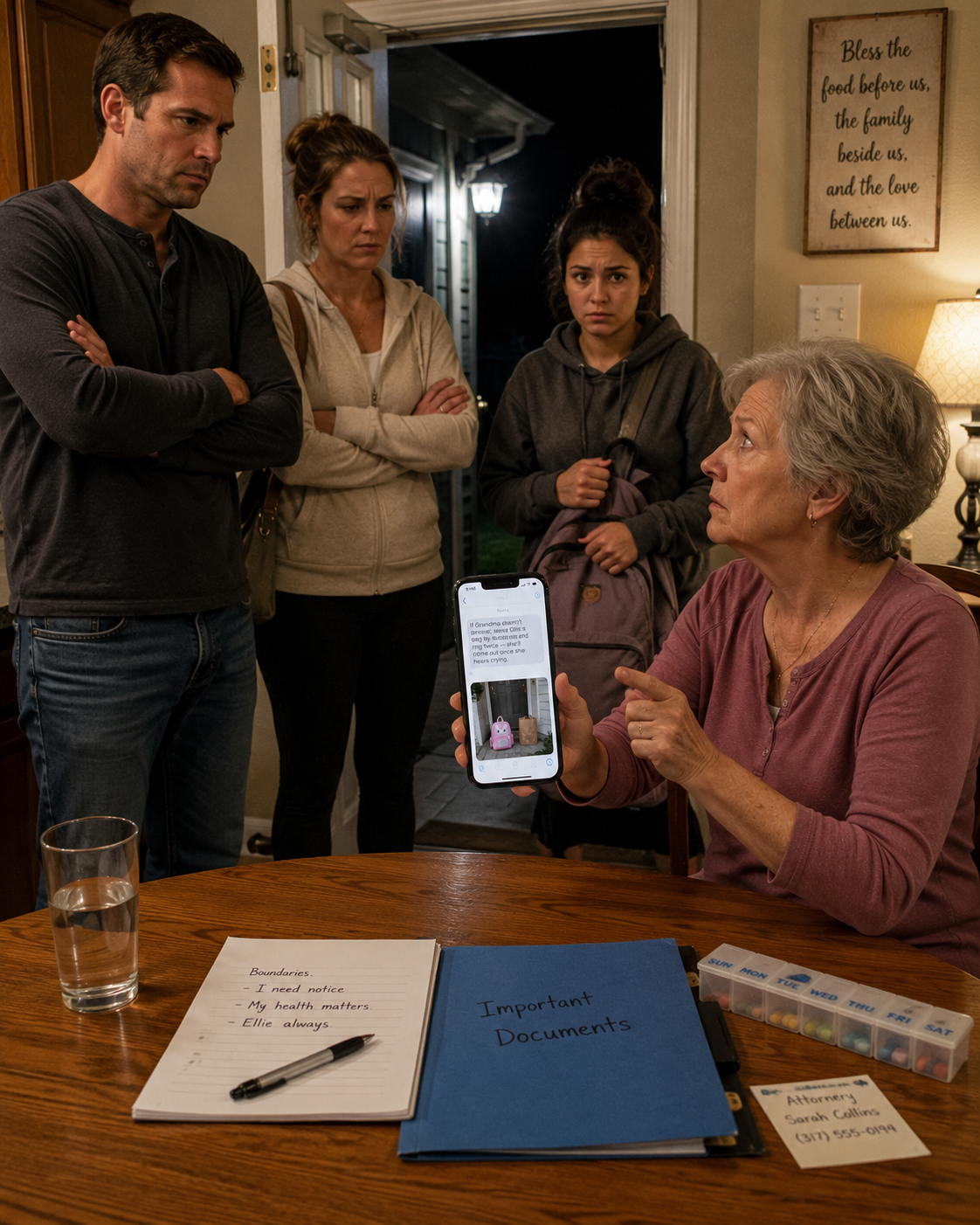
I was already in my slippers, the porch light was off, and my son had told me he and his wife were only going downtown for dinner.
Then the sitter sent me a screenshot of a text that said:
If Grandma doesn’t answer, leave Ellie’s bag by the door and ring twice. She’ll come out once she hears crying.
That was when I realized they had not forgotten to ask me.
They had decided my love was easier to use without permission.
My name is Martha Ellis. I am sixty-seven years old, and I live in a small ranch house outside Indianapolis with a cracked birdbath, two tomato plants by the back steps, and a kitchen table where every family emergency seems to arrive before anyone calls it one.
I love my granddaughter Ellie.
That part matters.
She is six years old, missing one front tooth, and believes pancakes taste better when I cut them into little stars. I have kept her when she had fevers. Picked her up from kindergarten when traffic trapped her parents on I-465. Bought her winter boots when my daughter-in-law said money was “tight until Friday.”
I have never refused that child love.
But love is not the same as being available for ambush.
For years, my son Brian and his wife Kelsey had treated my house like the backup plan they did not have to schedule.
At first, they asked.
Then they informed.
Then they assumed.
“Mom, daycare is closed tomorrow.”
“Mom, we put you on the pickup list.”
“Mom, Ellie’s already packed, so this should be easy.”
Easy.
That word has emptied more grandmothers than people admit.
After my blood pressure scare last spring, my doctor told me to reduce stress. I told Brian I needed notice. Real notice. Not a text from their driveway. Not a backpack on my porch. Not a child handed over while someone said, “We’re already late.”
Brian sounded sorry.
Kelsey sounded offended.
“We would never take advantage of you,” she said.
That is the kind of sentence people say when the arrangement is exactly what they wanted, but the wording makes them uncomfortable.
For a few weeks, things improved.
Then came Friday.
Kelsey texted me a photo of Ellie in pajamas with a movie blanket.
Madison is babysitting tonight. Date night downtown. Hope you rest, Martha.
I replied with a heart.
At 10:14, my phone rang from an unknown number.
A young woman whispered, “Mrs. Ellis? This is Madison. I’m Ellie’s sitter.”
My body knew before my mind did.
“Is Ellie okay?”
“She’s asleep,” Madison said quickly. “But I think you need to know what they asked me to do.”
Then the photos came.
Ellie’s unicorn backpack by the front door.
A grocery bag with snacks, medicine, and Pull-Ups.
A folded sheet titled Temporary Care Instructions.
My name typed under responsible adult.
Seven days.
Not one night.
Seven days.
My hand went cold around the phone.
Madison sent one more screenshot.
Kelsey had written:
We leave early for the airport. Drop Ellie at Martha’s after we’re gone. She gets emotional and says no at first, but she always gives in.
I sat down at my kitchen table.
The house was quiet except for the hum of the refrigerator and the old clock above the stove.
There is a particular kind of heartbreak in realizing your family has built a whole plan around your inability to let a child suffer.
I opened the blue folder in my drawer.
Doctor’s note.
Childcare boundary letter.
Attorney’s card.
Ring camera settings.
The unsigned care form Brian once left beside my coffee mug “just in case.”
Then I called Madison back.
“Do not bring Ellie here yet,” I said.
The girl went silent.
“I’m not refusing my granddaughter. I’m refusing the lie they packed around her.”
And before Brian and Kelsey reached the airport, my porch camera was already on, my attorney had the screenshots, and for the first time in years, the emergency was not going to land quietly on my kitchen table.
My husband, Frank, used to say I had a drawer for everything.
A drawer for batteries.
A drawer for twist ties.
A drawer for birthday candles.
A drawer for instruction manuals nobody else read until the garbage disposal made a noise like a raccoon had moved in.
“Martha,” he would say, standing in the kitchen with one hand on his hip, “why do we still have the manual for a toaster we threw away six years ago?”
“Because the toaster left before I was emotionally ready.”
He would laugh, kiss the top of my head, and put the manual back.
That was Frank.
A good man with rough hands, a soft heart, and a habit of pretending my carefulness annoyed him when really he trusted it more than anything.
He worked twenty-nine years for the city parks department. He knew every cracked sidewalk near every playground on the west side of Indianapolis. He could fix a mower, calm a furious Little League father, and make a child feel safe just by lowering himself onto one knee and listening.
When he died, the house did not know what to do with the quiet.
Neither did I.
Brian was already married by then. Kelsey was pregnant with Ellie. For a little while after the funeral, they came by often.
Brian changed the furnace filter.
Kelsey brought salads from a grocery store and called them “light dinners.”
They checked on me.
They asked if I was lonely.
They looked at me with that worried softness people use when they are trying to decide whether grief has made you fragile.
Then Ellie was born.
And suddenly I was useful again.
Not in a bad way at first.
A newborn in the house is medicine for a widow if nobody abuses the dosage.
I rocked that baby in Frank’s recliner while she made tiny bird noises against my shoulder. I sang songs I had sung to Brian. I kissed her little fists. I learned the smell of her shampoo, the schedule of her bottles, the difference between tired crying and gas crying.
I had loved being a mother.
But being a grandmother was different.
Less pressure.
More wonder.
At least in the beginning.
When Ellie was a baby, Brian and Kelsey asked before leaving her.
“Mom, could you watch her Thursday for two hours?”
“Mom, Kelsey has a doctor’s appointment. Are you free?”
“Mom, would you mind keeping Ellie while we go to dinner?”
I never minded.
That was the truth.
I had time. I had love. I had a quiet house and a heart that softened the moment Ellie’s little shoes appeared by my door.
Then two hours became five.
Dinner became overnight.
A quick errand became “we’ll pick her up tomorrow morning.”
Requests became assumptions dressed politely.
Kelsey was especially good at the soft kind of pressure.
“Martha, Ellie is so attached to you.”
“Martha, we don’t trust just anyone.”
“Martha, she feels safest at your house.”
Who argues with being a child’s safe place?
That is how they get you.
Not through cruelty at first.
Through praise.
Praise can be a leash if someone knows which part of you wants to be needed.
By the time Ellie turned four, my calendar had stopped being mine.
I missed Bible study because Kelsey had a late meeting.
Canceled lunch with my sister because daycare closed for “professional development.”
Skipped a doctor follow-up because Ellie had a cough and Brian said, “Mom, you know how she is when she’s sick. She wants you.”
I told myself that was love.
Some of it was.
But some of it was fear.
Fear that if I said no, I would see less of Ellie.
Fear that Brian would sound disappointed.
Fear that Kelsey would call me dramatic.
Fear that my usefulness was the rent I paid to remain close.
The day I fainted at the pharmacy, I finally scared myself.
It was a Wednesday afternoon at Kroger. I remember the smell of rotisserie chicken and floor cleaner. I remember holding my blood pressure refill, children’s cough medicine, and a little pack of glitter stickers because Ellie had been brave at the dentist.
The line was long.
A man argued about a discount card.
A woman behind me sighed like the entire pharmacy had been invented to inconvenience her.
My ears started ringing.
Then the floor came up fast.
I woke with a nurse from the minute clinic kneeling beside me and a store manager asking if I knew what day it was.
I did.
Unfortunately.
It was the day my body filed a complaint.
At urgent care, the doctor looked over my chart and asked about stress.
I said, “Nothing unusual.”
She gave me the look women give other women when both know a lie has entered the room wearing lipstick.
“Martha,” she said, “your blood pressure is not responding to ‘nothing unusual.’ What is going on?”
So I told her.
Not everything.
Older women edit the truth out of habit.
We make the burden sound lighter because somewhere along the way, we were taught that needing rest was a character flaw.
Still, I told enough.
The doctor listened.
Then printed a note.
Martha Ellis should avoid extended childcare responsibilities without prior agreement, adequate rest, and consideration of medical needs.
I felt silly taking it.
Like I needed a hall pass to say no.
But I folded it carefully and put it in the blue folder.
That night, I called Brian.
“I need notice,” I told him. “Real notice.”
He sounded worried.
“Mom, why didn’t you say you were feeling that bad?”
“I did say I was tired.”
“Tired isn’t the same as fainting in Kroger.”
“No. But it should have mattered before Kroger.”
He went quiet.
I could hear a TV in the background. Ellie laughing at something. Kelsey saying, “Ask her if Friday still works.”
I closed my eyes.
“Friday does not work.”
Another silence.
Then Brian said, “Okay.”
That one little word nearly made me cry.
It had been so long since a no had simply been accepted.
Kelsey called the next day.
She was sweet.
Too sweet.
“We would never take advantage of you, Martha.”
I sat at my kitchen table with the doctor’s note in front of me.
“I know you don’t like that phrase.”
“It’s not that I don’t like it,” I said. “It’s that it keeps happening.”
She laughed lightly.
An uncomfortable laugh.
“Martha, you know Ellie adores you.”
“I adore her too. That is not the issue.”
“Well, we’ll be more careful.”
For a few weeks, they were.
They hired Madison.
Madison lived in their neighborhood and worked part-time while studying nursing at Ivy Tech. She had a calm face, sensible shoes, and the kind of voice that made Ellie listen without feeling bossed.
I liked her immediately.
The first time I met her, she shook my hand and said, “Mrs. Ellis, Ellie told me your pancakes are shaped like stars.”
“They are. It’s a serious culinary innovation.”
Madison smiled.
“I hope to earn that privilege someday.”
She was a good girl.
And more importantly, she was a watchful girl.
That Friday night, she proved it.
When Madison called at 10:14, I knew by the whisper that she was trying not to wake Ellie. But I also heard something else.
Fear.
Not panic.
Moral fear.
The kind a decent person feels when someone asks them to do something wrong and calls it normal.
After she sent the photos and screenshot, I asked her to describe everything.
She said Brian and Kelsey had left around seven, dressed nicer than dinner required.
She said Kelsey had shown her the care sheet before leaving and acted like it was old news.
“She said you had agreed, but you might act surprised because you’re emotional about being needed,” Madison said.
I pressed my fingers to my forehead.
“She said that?”
“Yes, ma’am.”
“Did Brian say anything?”
“He was loading bags into the back of the SUV. I thought they were work bags or maybe donations. Then I saw passports on the counter after they left.”
Passports.
There it was.
Not dinner.
Not downtown.
Not a tired couple needing one night.
A trip.
Planned.
Packed.
And built around the assumption that Grandma’s heart could be used like an unlocked side door.
Madison’s next words came out smaller.
“She told me not to text you too early because you might ‘spiral.’”
I almost laughed.
Not because anything was funny.
Because of all the words people use for older women who notice being used, spiral may be one of the laziest.
I asked Madison to send everything.
The care sheet.
The screenshot.
Pictures of the backpack.
The grocery bag.
The authorization form.
A photo of the passports if she could do it without crossing a line.
She sent what she could.
Then I called my attorney.
Her name was Elaine Porter, and she had known me since Frank died. She handled his estate, my will, and one memorable dispute with a roofing company that tried to charge me for “premium flashing” as if I would not ask what kind of flashing non-premium people received.
Elaine answered through her after-hours service because she understood widows did not call at night for fun.
“Martha,” she said, “slow down and tell me what is happening.”
By the time I finished, she was quiet for two seconds.
Then she said, “Do not call Brian first.”
“He’s my son.”
“He is also part of the problem tonight. Paper first. Emotion later.”
I hated that.
I also knew she was right.
She told me to forward the screenshots, then start a group text.
Me.
Brian.
Kelsey.
Madison.
Elaine.
The message had to be clear and calm.
No insults.
No threats.
No dramatic language.
Just facts.
So I typed:
This is Martha. Madison has informed me that she was instructed to drop Ellie at my house for seven days after Brian and Kelsey leave for the airport. I did not agree to provide care for Ellie for one week. I do not consent to Ellie being left at my home tonight or any night without my prior agreement. Ellie is currently safe with Madison. Brian and Kelsey, you need to pick up your daughter immediately.
Elaine added:
This is Elaine Porter, attorney for Martha Ellis. Mrs. Ellis has not accepted responsibility for seven days of childcare. No child is to be left unattended at her home. Please keep all communication in writing tonight.
For almost a minute, no one responded.
I sat at the kitchen table staring at my phone.
The refrigerator hummed.
The old clock ticked.
A car passed outside.
The porch light stayed off.
Then Kelsey answered.
Martha, this is exactly what I meant. You always make things harder than they need to be.
Not, I’m sorry.
Not, We should have asked.
Not, Is Ellie okay?
This is exactly what I meant.
Brian texted next.
Mom, why is a lawyer involved? We were going to talk to you before we left.
I looked at the screenshot again.
Drop Ellie at Martha’s after we’re gone.
Before we left.
There are lies that do not even respect the evidence sitting beside them.
I replied:
Come get Ellie.
Kelsey wrote:
We already paid for the trip. This is one week. You always say you miss her.
My hands shook.
I typed slowly.
Missing my granddaughter is not consent.
Brian called.
I let it ring.
He called again.
Elaine texted privately:
Do not answer. Keep it in writing.
So I did.
Brian wrote:
Mom, please. Kelsey is exhausted. We need this.
Need.
There are needs.
Medication.
Food.
Shelter.
Safety.
Rest.
There are also wants that become needs only because someone else has been assigned the cost.
I replied:
Then you needed to arrange care with consent. Pick up Ellie.
Madison wrote into the group:
I am not comfortable transporting Ellie anywhere unless an adult confirms they are accepting care. She is asleep and safe here until a parent arrives.
Kelsey answered:
Madison, you were paid until 10. We paid extra for drop-off.
Madison replied:
You did not pay me to abandon a child.
That was the sentence that changed the night.
A young woman barely old enough to rent a car had named what the adults were trying to soften.
No one responded for three minutes.
Then Brian wrote:
We’re on our way back.
At 11:09, Madison texted:
They’re here.
At 11:21:
Ellie is with them. She woke up crying. I’m sorry.
I closed my eyes.
No boundary protects a child from every hurt.
Sometimes all it can do is stop adults from making that hurt bigger.
At 11:46, headlights swept across my living room wall.
Brian’s SUV pulled into my driveway.
I had turned the porch light on by then.
Not for them.
For Ellie.
I had also turned on the porch camera and set my phone to save motion clips automatically.
Not because I wanted to catch my son.
Because I was done letting everyone’s version of events arrive before mine.
Brian stepped out first.
He looked tired, guilty, and angry in the way men get when guilt has not yet decided whether it wants to become honesty.
Kelsey came around from the passenger side holding the folded care sheet in one hand and Ellie’s backpack in the other.
Ellie sat in the back seat, awake, red-faced, clutching her stuffed bunny.
That almost broke me.
She saw me through the open door and started crying again.
“Grandma!”
I stepped onto the porch.
She ran toward me.
I knelt carefully because my knees have never respected emotional timing.
Ellie threw her arms around my neck.
“I thought you didn’t want me.”
There are moments when anger becomes a clean thing.
Not hot.
Not messy.
Clean.
A line drawn in permanent ink.
I held her little face between my hands.
“That is not true, baby. Not for one second.”
“Mommy said you might say no because you get upset.”
Behind her, Kelsey inhaled sharply.
“Martha, she misunderstood.”
I looked up.
“No,” I said. “She understood the part that hurt.”
Brian closed his eyes.
Good.
Let him hear it.
Let him stand in the driveway of the mother he tried to use and hear what his child believed.
I brought Ellie inside and wrapped her in the pumpkin blanket she loved. I put on a cartoon with the volume low and gave her a cup of water in the plastic star cup she still preferred even though she was almost too big for it.
Then I stepped back onto the porch.
Kelsey held out the care sheet.
“Since she’s already here, can we please stop making this a legal production and just sign the form? We can still make the flight if we leave soon.”
I stared at her.
For a second, I could not even speak.
Not because I was weak.
Because the nerve was almost impressive.
“No.”
Kelsey blinked.
“No?”
“No.”
Brian said, “Mom, it’s one week.”
“Then one of you can stay with her for it.”
“We already paid.”
“Your daughter is not a nonrefundable reservation.”
Kelsey’s face flushed.
“You know what? I am tired of being treated like a bad mother because I need a break.”
“I never said needing a break makes you a bad mother.”
“Then why are you doing this?”
“Because you packed a child for seven days, typed my name under responsible adult, told the sitter I would give in, and planned to use Ellie’s crying as your doorbell.”
Her mouth opened.
Closed.
Brian looked toward the living room window. Ellie was visible on the couch, wrapped in the pumpkin blanket, watching a cartoon without really watching.
His face changed.
That was the first moment I thought he might actually see the night.
“Mom,” he whispered, “I’m sorry.”
“For what?” I asked.
He looked back at me, startled.
I had accepted too many vague apologies in my life.
I was done collecting fog.
“For not asking.”
“And?”
“For letting Kelsey put your name on the form.”
Kelsey snapped, “Brian.”
He kept going.
“For lying about dinner.”
That one hurt.
I already knew.
Hearing it still cut.
“And?”
He swallowed.
“For making Ellie think you didn’t want her.”
That was the sentence.
The one with weight.
I nodded once.
Kelsey crossed her arms.
“So I’m the monster now?”
“No,” I said. “You are the adult who wrote the text.”
She looked away.
Another pair of headlights turned onto my street.
Elaine Porter’s sedan pulled to the curb like a courtroom had learned to drive.
She got out wearing a long coat over what looked like pajamas, her gray hair tucked under a knit hat, a leather folder under one arm.
Kelsey stared.
“You actually came?”
Elaine walked up the path.
“Yes.”
“This is ridiculous.”
Elaine looked at the backpack.
The care sheet.
My porch camera.
Then through the open door toward Ellie.
“Is the child safe?”
“Yes,” I said.
“Good.”
She turned to Brian and Kelsey.
“I’ll be brief. Martha is not accepting seven days of childcare. No child is to be left unattended on this porch. No future care form may list Martha as responsible adult without her written consent. No school, medical, or travel document may use her name for extended care without her signature. Brian and Kelsey remain responsible for Ellie tonight.”
Kelsey laughed sharply.
“You brought documents to a family misunderstanding?”
Elaine looked at her.
“You brought a seven-day care sheet to a porch drop-off. I brought boundaries.”
That sentence almost made me smile.
Almost.
Elaine handed Brian a one-page acknowledgment.
He signed first.
No argument.
Kelsey refused.
For about thirty seconds.
Then Elaine said, “If you refuse to acknowledge Martha’s non-consent, I will document that refusal, the screenshot, the care sheet, the attempted drop-off, and advise Martha on further protective action.”
Kelsey signed hard enough that the pen nearly tore the page.
Brian took Ellie home that night.
Not Kelsey.
Brian.
He carried her backpack back to the SUV and buckled her in himself. Before he closed the door, Ellie called out, “Grandma?”
I walked over.
She looked so small in that back seat.
“Can I still come for pancakes?”
I touched her cheek.
“Yes. When we plan it.”
“Not when Mommy makes you?”
“No, baby. When Grandma invites you.”
She nodded slowly, trying to understand something adults had made too hard.
Then she whispered, “I like when you invite me.”
“So do I.”
After they left, I stood on the porch until the taillights disappeared.
Elaine stood beside me.
The night was cool.
Somewhere down the street, a dog barked like he had opinions about all of us.
Elaine said, “You did well.”
I laughed once.
“I feel like I swallowed a brick.”
“That too.”
Inside, she sat at my kitchen table while I made tea.
She complained it was weak.
I told her she could make her own next time.
That made her smile.
Then I cried.
Not pretty tears.
Not soft grandmother tears.
Angry, exhausted, shaking tears.
Elaine did not tell me to stop.
That is why I like lawyers sometimes.
Good ones know silence is not empty.
The next morning, the texts came.
Kelsey first.
We lost the resort deposit. I hope proving your point was worth it.
I did not answer.
Brian:
Mom, I’m sorry. I don’t know what to say.
I replied:
Start with the truth.
He did not answer for two hours.
Then:
We were not going downtown. We were going to Cancun. Kelsey said you would say no if we asked for a week. I agreed to let Madison bring Ellie after we left because I didn’t want the fight. I’m ashamed.
That was a beginning.
Not enough.
A beginning.
Kelsey’s mother called around noon.
I let it go to voicemail.
Her message said, “Martha, young parents need support. I hope you’ll think about the kind of damage you’re doing.”
I saved it.
Then sent it to Elaine.
Elaine replied:
Useful.
Lawyers are strange people.
Over the next week, Brian came by twice.
The first time, he brought flowers.
I opened the door, looked at them, and said, “Those are not large enough for what happened.”
He laughed, but his eyes filled.
“They’re for the table. I brought words too.”
I let him in.
We sat at the kitchen table.
The blue folder lay between us.
He stared at it like it was going to stand up and testify.
“What’s in there?” he asked.
“The things people make necessary when they don’t listen the first time.”
He closed his eyes.
I opened it.
Doctor’s note.
Childcare boundary letter.
Screenshot.
Care sheet.
Unsigned form he had left beside my coffee mug months earlier.
Email from Elaine.
Porch camera still image of Ellie running to me crying.
That image broke him.
He covered his mouth.
“I did that,” he whispered.
“You were part of it.”
“I did that.”
I did not soften it.
Sometimes guilt is the first honest thing a person has brought you in years.
He looked up.
“Mom, I am sorry for treating your love like something we could count on without respecting you. I am sorry for lying about dinner. I am sorry for letting Kelsey talk about you like you were emotional and easy to manage. I am sorry Ellie got hurt.”
Specific.
Finally.
“Thank you,” I said.
He cried.
I let him.
Then he said, “Kelsey says you humiliated us.”
“Kelsey wrote the text.”
He nodded.
“I know.”
“No, Brian. You need to know something else. I am not the keeper of your wife’s comfort. I am not the place your marriage drops its pressure. I am not emergency childcare unless I agree to be.”
“I know.”
“You are beginning to know.”
He nodded again.
That was enough for that day.
Kelsey took longer.
Much longer.
Her first apology came by text.
I’m sorry things escalated.
No.
Her second:
I’m sorry Madison misunderstood the plan.
Absolutely not.
Her third, after Brian started counseling and Ellie’s pediatrician suggested a child therapist because Ellie had begun asking whether Grandma’s house was “for love or emergencies,” was the first one I read twice.
Martha, I am sorry for what I did. I wrote the text telling Madison to drop Ellie after we left. I put your name on the care sheet without consent. I told people you would give in because I knew you loved Ellie. That was wrong. It was unsafe and cruel to both of you.
I sat with that message for a long time.
Then I called her.
She answered on the first ring.
“I got your text,” I said.
She started crying.
I let her cry for a few seconds.
Then said, “Do not ask me to comfort you through the guilt.”
She went quiet.
“Okay.”
That was the first real sign she might learn.
We met at a diner the following Thursday.
No Brian.
No Ellie.
Neutral ground.
Bad coffee.
A waitress named Patty who looked like she had witnessed every family in Indiana disappoint each other at least once.
Kelsey looked tired.
No careful makeup.
No polished smile.
Just a woman sitting across from the person she had tried to use.
“I was desperate,” she said.
“I believe you.”
“I felt like I was going to break.”
“I believe that too.”
Her face softened with relief.
Then I said, “And you tried to keep yourself from breaking by handing the weight to me without my consent.”
The relief disappeared.
Good.
Both truths needed to stay.
She nodded.
“Yes.”
“Why didn’t you ask me?”
“Because you would have said no.”
“Yes.”
“And because if I asked, I would have had to admit how much I expected.”
That one was honest.
Ugly.
Useful.
She kept going.
“I told myself you liked it. Being needed. Being close to Ellie. I told myself you were lonely.”
“I am lonely sometimes.”
“I know.”
“No. You knew enough to use it.”
She looked down.
Her hands shook around the coffee cup.
“Yes.”
That was the hardest yes she gave me.
The best one too.
We made rules that day.
Not suggestions.
Rules.
Any overnight care must be requested at least one week in advance unless there is a true medical emergency.
I may say no.
No explanation required.
No child may be brought to my home unless I have clearly agreed.
My name may not be placed on any school, medical, travel, or care document without my signature.
If I agree to extended care, the dates, pickup time, medication instructions, and emergency contacts must be in writing.
If they cancel plans after I say no, that is their adult problem.
Kelsey wrote them down.
That mattered.
People who do not plan to change avoid writing things down.
Madison remained Ellie’s sitter.
That mattered too.
Brian and Kelsey paid her for the night she protected Ellie.
I sent her a thank-you note.
Handwritten.
Inside, I wrote:
You trusted the right discomfort. Never lose that.
She sent me a note back.
Mrs. Ellis, I was scared, but I kept thinking, “This doesn’t feel right.” I’m going to remember that in nursing school.
Good.
The world needs more young women who listen when something does not feel right.
Ellie came over two weeks later.
Not because daycare closed.
Not because Brian and Kelsey needed dinner.
Because I invited her.
That changed everything.
I turned the porch light on before she arrived.
I made pancake batter.
She came running up the sidewalk with her bunny under one arm and a backpack bouncing behind her.
“Grandma, did you invite me?”
“Yes.”
“Because you wanted me?”
“Yes.”
She nodded seriously.
“Good.”
Children make small sentences carry entire worlds.
We made star pancakes for dinner because rules are flexible when syrup is involved. She slept in the little room with the yellow lamp. In the morning, Brian arrived at exactly ten.
Not 10:45.
Not with an apology and a coffee.
Ten.
He knocked.
He waited.
That was new.
When Ellie ran to him, he hugged her and then looked at me.
“Thank you for inviting her.”
Not keeping her.
Not helping us.
Inviting her.
That was the right word.
I nodded.
“You’re welcome.”
Progress is not always a grand apology.
Sometimes it is a corrected verb.
The porch camera stayed on.
The blue folder stayed in the drawer.
Not because I expected another ambush.
Because trust, once cracked, does not become stronger by pretending glass was never broken.
Over the next year, the family found a new rhythm.
Not perfect.
Perfect usually means someone is lying or someone is silent.
But better.
Brian called more.
Not always to ask for something.
Sometimes just from the grocery store to ask whether I still liked the lemon cookies Frank used to buy.
Kelsey learned to request instead of assign.
Martha, could you watch Ellie on the 12th from noon to four? Please say no if it does not work.
At first, I said no more often than I needed to.
Practice.
My no had been so underused it needed physical therapy.
Sometimes Kelsey handled it well.
Sometimes I could feel the disappointment through the phone.
The world did not end.
Ellie started therapy for a few months.
That was Brian’s idea, and I give him credit for it.
Her therapist helped her understand that grown-up planning was not her job and Grandma’s love did not disappear when Grandma said no.
One afternoon, Ellie drew a picture at my kitchen table.
My house.
The birdbath.
The tomato plants.
A yellow porch light.
Me at the door with a purple dress I do not own.
At the top, she wrote:
Grandma’s House — Ask First.
I laughed until my eyes filled.
Then, after she went home, I placed the drawing in the blue folder.
It belonged there.
A year after the cancelled Cancun trip, Brian and Kelsey planned an anniversary weekend.
They told me two months ahead.
Not because they needed me.
Because Ellie might mention it.
Madison would stay at their house.
A retired teacher from church was the backup.
I was listed as emergency contact only after reviewing and signing the form.
Kelsey said, “We are not asking you to be available.”
I looked at her.
“Good.”
She nodded.
No offense.
No guilt.
Just acceptance.
That weekend, Ellie FaceTimed me from her bedroom.
Madison had made pancakes for dinner.
Circles.
Not stars.
“She tried,” Ellie whispered.
Madison called from off-screen, “I heard that.”
I laughed.
Ellie laughed.
Madison laughed.
No one was crying on my porch.
That is what safety sounds like sometimes.
Ordinary laughter in the right house.
Kelsey eventually came over for coffee alone.
No crisis.
No childcare.
No forms.
Just coffee.
She brought muffins from a bakery.
I served them on plates because I was raised right and because forgiveness, when it begins, can use a plate.
“I used to think you were judging me,” she said.
“I was sometimes.”
She laughed nervously.
I smiled.
“Kelsey, you were not wrong that I noticed things. But noticing is not the same as wanting you to fail.”
“I know that now.”
“Do you?”
“I’m beginning to.”
Better.
We sat quietly.
Then she said, “My mother never helped. Not without making me pay for it emotionally. When you helped so easily, I think I started believing easy meant endless.”
That sentence gave me a little more room to understand her.
Not excuse.
Understand.
“Easy is still effort,” I said.
She nodded.
“I know.”
“Beginning to know.”
She smiled through tears.
“Yes. Beginning to know.”
Two years have passed since Madison’s call.
My porch light still turns on too early.
The birdbath is still cracked.
The tomato plants still overproduce in August like they are trying to win a contest nobody entered.
Ellie is eight now.
She has both front teeth again, though one came in slightly crooked and makes her smile even better.
She still likes star pancakes.
She also likes helping me label soup containers for the freezer.
Chicken noodle.
Tomato basil.
Vegetable.
Emergency chili.
She asked once why chili was an emergency.
I said, “Because some days need beans.”
She accepted that.
Children understand more than adults sometimes.
I still keep the blue folder.
Inside are the doctor’s note, the childcare boundary letter, Elaine’s card, the unsigned care form, Madison’s screenshot, the seven-day care sheet, the porch camera still, the signed acknowledgment, the updated school form, Madison’s thank-you note, Ellie’s Ask First drawing, and a handwritten note from Brian.
Mom,
I thought family meant you would always open the door. I forgot family also means asking before you knock.
I am sorry.
Brian
I do not keep those papers because I want to stay angry.
I keep them because families are skilled editors.
Given enough time, someone might say Brian and Kelsey were overwhelmed.
Madison panicked.
Martha misunderstood.
The trip was badly timed.
The text sounded worse than intended.
No.
My son and daughter-in-law packed their six-year-old daughter’s bag for seven days, typed my name under responsible adult, and instructed the babysitter to bring her to my house after they left for the airport.
They planned to use Ellie’s crying as the doorbell.
That happened.
And so did this:
Madison called.
The screenshot arrived.
The blue folder opened.
The porch camera came on.
The attorney answered.
The airport trip stopped before the child was abandoned into someone else’s guilt.
My name is Martha Ellis.
I am sixty-seven years old.
I live in a small ranch house outside Indianapolis with a kitchen table that has held birthday cakes, unpaid bills, coloring books, medicine bottles, and more family emergencies than it should have.
I am a grandmother.
Not a drop box.
Not a backup plan in slippers.
Not a porch light that turns on whenever other adults fail to make arrangements.
I love Ellie with my whole heart.
That is exactly why I said no.
Love does not require a grandmother to be tricked.
Love does not leave a child outside to force a door open.
Love does not write someone’s name on a care sheet and hope their conscience will do the rest.
Kelsey was right about one thing.
If Ellie had been left crying on my porch, I would have opened the door.
Of course I would have.
That is what made the plan so cruel.
They counted on the best part of me to cover the worst part of what they were doing.
But that night, the sitter called first.
The paper had no signature.
The porch stayed empty.
And for once, the emergency did not land quietly on my kitchen table.
Now when Ellie comes over, I turn the porch light on before she arrives.
Not because someone trapped me into it.
Because I invited her.
Because she is wanted.
Because the door is mine.
Because love feels different when it enters by consent.
And every time she sits at my kitchen table with syrup on her chin, cutting pancakes into little stars with the seriousness of a surgeon, I remember the lesson that cost one terrible night but saved the rest of my grandmotherhood.
An open door is a gift.
It is not an obligation.
And the people who love you should know the difference before they knock.