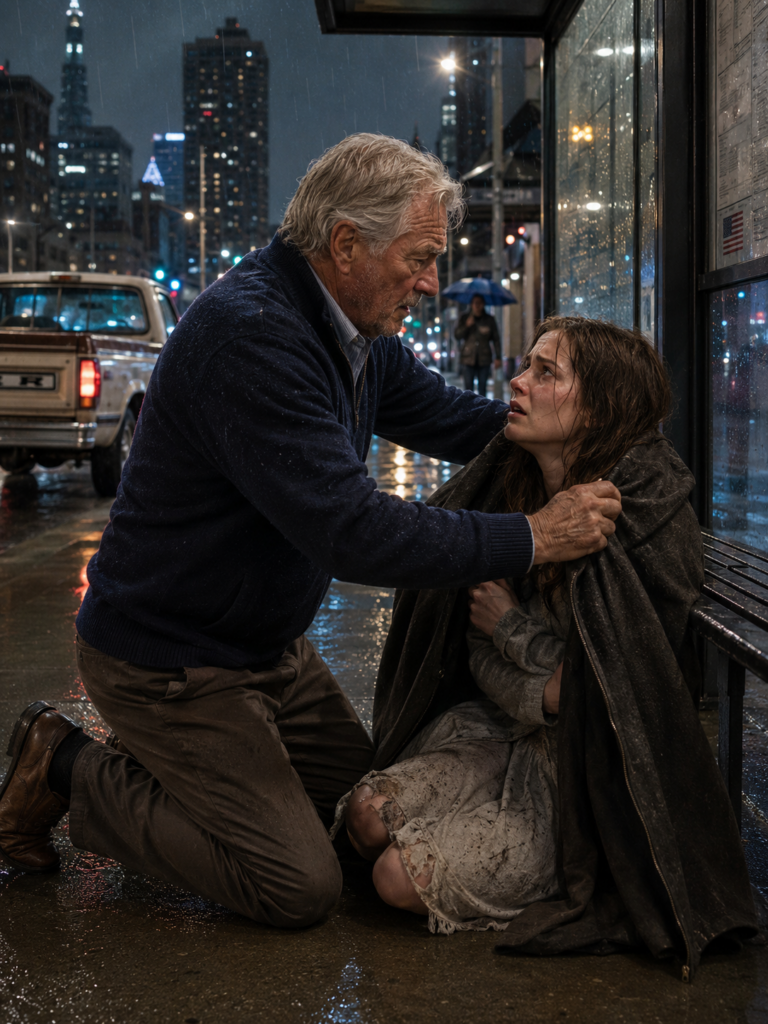
The night I found my daughter sleeping under a bus shelter in downtown Chicago, something inside me went quiet and never fully came back.
At first, I walked right past her.
The rain had been falling since late afternoon, a cold October rain that made the whole city shine like black glass. Traffic crawled along Wabash. Tires hissed through puddles. The train tracks overhead rattled every few minutes, shaking loose drops from the steel beams.
I had only gone downtown because my doctor’s office had called about a billing error. A stupid thing, really. I almost ignored it. At seventy-one, I had learned that half the mail you receive after retirement is either a bill, a warning, or someone trying to sell you a stairlift.
But something made me go.
That was what I kept thinking later.
Something made me go.
I was walking back toward the parking garage with my collar turned up, one hand on the handle of my umbrella, when I saw a woman curled beneath the yellow light of a bus shelter. She had a torn gray coat pulled around her shoulders. Her knees were tucked tight to her chest. Her hair was wet and hanging over her face.
People stepped around her without looking.
A man in a wool overcoat glanced down, then looked away. A woman with a red Target bag shifted her purse to the other side of her body. Two young men laughed at something on a phone and moved past her like she was part of the sidewalk.
I did the same.
Three steps.
Maybe four.
Then she shifted.
The light caught the side of her face.
And my whole body stopped.
Emily.
My little girl.
For one impossible second, my mind refused to accept what my eyes had already seen.
This could not be the same child who used to fall asleep against my shoulder during Cubs games, her small fingers sticky from a melting blue snow cone. This could not be the girl who once covered our entire kitchen in flour because she wanted to bake her mother a birthday cake by herself. This could not be the woman I had walked down the aisle five years earlier, while Daniel Vale stood at the altar in a black tuxedo and promised me, with tears in his eyes, “I’ll take care of her, sir. Always.”
And yet there she was.
On concrete.
In the rain.
My umbrella slipped from my hand and hit the sidewalk.
“Emily?”
Her eyes opened slowly.
They were swollen. Red. Terrified.
For one terrible moment, she looked at me like she expected me to be ashamed of her. Like she expected me to back away and pretend I had not seen her.
“Dad?” she whispered.
I dropped to my knees so fast pain shot through both legs.
“Baby,” I said, reaching for her face. “What happened?”
Her lips trembled. She tried to sit up but did not have the strength.
“Please don’t be angry.”
Angry.
That word nearly split me open.
I took off my coat and wrapped it around her shoulders. Her hands were ice cold. Her cheeks had hollowed. The bones at her wrists looked too sharp. She seemed smaller than the daughter I remembered, as if life had been quietly carving pieces from her while everyone around her kept smiling for photographs.
I did not ask questions there.
Not beside the bus stop.
Not with rain dripping off the shelter roof and strangers pretending not to stare.
I gathered up my umbrella, helped her to her feet, and guided her toward the parking garage. She leaned on me with almost no weight, and that scared me more than anything. Emily had always walked fast. Even as a little girl, she ran ahead of us in grocery store aisles, calling back, “Come on, Dad.”
Now she moved like every step had to be negotiated with her own body.
In my truck, she sat with my coat around her, staring through the windshield as the wipers pushed water across the glass.
“I’m sorry,” she said.
I turned the heat up.
“For what?”
“For making trouble.”
I gripped the steering wheel.
My daughter had been sleeping outside in the rain, and someone had taught her that being found was trouble.
I wanted names. I wanted reasons. I wanted to drive straight through whatever polished door Daniel Vale was hiding behind and drag answers out of him by the collar of his expensive shirt.
Instead, I drove home.
There are moments when a father has to decide whether he wants the truth fast or whether he wants his child safe first.
That night, I chose safe.
My house sat on a quiet street in Oak Park, the same two-story brick house where Emily had grown up. The porch light still had the small dent from when she hit it with a softball at twelve. The maple tree in the front yard still dropped leaves on the walkway every fall, no matter how often I swept them. Her mother, Laura, had planted hydrangeas along the side fence before she got sick, and I still talked to them in the morning like a fool because grief makes ordinary men do strange, tender things.
Emily stared at the house when I pulled into the driveway.
“It looks the same,” she whispered.
“It is the same.”
She looked at me then, and for the first time I saw the fear behind her exhaustion.
“I didn’t know if I was allowed to come back.”
I sat there a moment, listening to the soft clicking of the turn signal I had forgotten to switch off.
“Emily,” I said carefully, “this house has never stopped being yours.”
Her face crumpled, but she did not cry yet. She seemed too tired even for that.
Inside, I gave her dry clothes, thick socks, and the guest room that had once been hers. I did not tell her I had kept the blue quilt Laura made. I simply pulled it from the cedar chest and laid it on the bed.
When Emily saw it, she touched one corner with two fingers.
“Mom made this.”
“She did.”
Her mouth moved, but no sound came out.
I left her alone long enough to shower and change, then made tomato soup and grilled cheese the way I used to when she was sick. Nothing fancy. Canned soup, a little milk, black pepper, two slices of bread browned in the same skillet Laura had refused to throw away even when the handle started to wobble.
Emily sat at the kitchen table wrapped in a blanket, holding the bowl with both hands. At first, she ate slowly. Then faster. Desperately. Like someone might walk in and take it from her.
That was the first sign.
Not the torn coat. Not the dirty shoes. Not the trembling.
The food.
My daughter ate like hunger had become a habit.
Every few minutes, she whispered, “I’m sorry, Dad.”
And every time, I said, “You’re home.”
Near dawn, after hours of silence, the truth began to come out in broken pieces.
Daniel had sold their house three years earlier.
Not his house.
Emily’s house.
The little brick bungalow in Evanston that Laura had helped her buy before cancer took her from us. Half the down payment had come from Laura’s life insurance, money she had set aside in an envelope labeled “Emily’s start.” I still remembered Laura sitting at this very kitchen table, thinner than she should have been, pushing the paperwork toward me.
“Promise me she’ll have something that can’t be talked out of her,” Laura had said.
I promised.
And I had failed.
“He said the papers were for refinancing,” Emily told me, staring into her mug. “He said interest rates were changing, and if we didn’t sign quickly, we’d lose money. I was working doubles at the clinic then, and Mom had only been gone a year, and I was so tired all the time.”
She swallowed.
“I trusted him.”
I said nothing.
There are words that demand silence because anything else would be too small.
“He brought the documents home already marked,” she continued. “Little yellow tabs. He said the notary had signed off because we had done most of it electronically. I asked if that was normal, and he laughed. Not mean at first. Just like I was being cute.”
Her fingers tightened around the mug.
“He said, ‘Em, this is what I do for a living.’”
Daniel Vale had been an accountant when Emily met him. Smooth, ambitious, always wearing a suit even to casual dinners. He had a habit of making numbers sound like moral authority. At Christmas, when the rest of us talked about weather and recipes, Daniel talked about acquisitions, tax exposure, investment vehicles, donor structures.
Laura had liked him at first.
I had tried to.
A father can smell arrogance in another man from across the room, but a daughter in love hears confidence.
“What happened after the sale?” I asked.
Emily’s eyes stayed on the table.
“He said the money had to move through his company account temporarily because of tax timing. Then he said the market was bad. Then he said we needed to rent for a while. Then he said I was getting emotional and not remembering things correctly.”
Her voice thinned.
“By the time I realized the house was gone, my name was barely anywhere.”
I felt something old and precise wake inside me.
Not anger yet.
Anger is loud. This was quieter.
This was the part of me that had once spent thirty-one years following fraudulent transfers through shell companies, campaign donations, offshore accounts, charity boards, and men who believed a good suit could make theft respectable.
Before I retired, before I became the old widower who bought birdseed at Ace Hardware and watered rose bushes at sunrise, I had been a forensic fraud investigator.
I had ruined men with cleaner hands than Daniel Vale.
But this was my daughter.
That made me dangerous in a different way.
“When you questioned him,” I said, “what did he do?”
Emily flinched.
It was small, but I saw it.
A father always sees what hurt leaves behind.
“He told people I was unstable,” she said. “At first, just little things. He’d tell friends I was having a hard time since Mom died. Then he told his business partners I was drinking. Then he told my doctor I was paranoid about money.”
“Your doctor?”
She nodded.
“Dr. Levin. Daniel went with me to appointments. He said he was worried. He was so calm. So reasonable. He made me sound like a woman falling apart.”
Her eyes filled.
“And after a while, people started looking at me differently.”
I looked toward the refrigerator, where a faded photograph of Emily at seventeen still sat under a Cubs magnet. She was laughing in the picture, hair flying in the wind, one arm around Laura. There was a smear of mustard on her sleeve from a hot dog at Wrigley Field.
That girl had not been weak.
She had been loved.
That was what Daniel had stolen first.
Not the house.
Not the money.
Her certainty that she deserved to be believed.
“And Vanessa Cross?” I asked.
Emily let out a small laugh that had no humor in it.
Everyone in Chicago knew Vanessa Cross, or at least knew the version printed in glossy magazines. She was on hospital boards, museum boards, charity boards. She wore cream-colored suits and diamond bracelets and spoke at fundraisers about dignity, housing, and women’s resilience. Her family money had been old enough that people stopped asking where it came from.
I had seen her picture beside Daniel’s more than once.
At first, he was the young financial adviser helping her foundation modernize its accounts.
Then he was at her table.
Then he was standing too close.
“He moved into the Aurelia Tower with her,” Emily said. “Penthouse floor. Private elevator. River view. The doorman knew his name before he knew hers.”
I kept my face still.
Emily had already survived enough without watching her father come apart.
“She told everyone I disappeared because I was embarrassed,” Emily said. “She told them Daniel tried everything to help me. She called me tragic.”
That word caught in the room.
Tragic.
A word rich people use when they have no intention of helping.
“What made you leave?” I asked.
Emily stared down at her hands.
“He emptied the joint account. Canceled my phone plan. Told my landlord I was dangerous. I found out because the woman at the leasing office wouldn’t look me in the eye when she handed me the notice.”
She breathed in shakily.
“I tried shelters, but Daniel had already told people I had a history of making false claims. He sent emails. Letters. I don’t even know to whom. Every time I tried to ask for help, someone treated me like I was lying before I opened my mouth.”
She looked up.
“I didn’t come here because I thought you’d be safer if you didn’t know.”
That was when I had to stand.
I walked to the sink and gripped the counter so hard my knuckles ached.
For years, I had believed Emily was distant because grief had changed her. Because marriage had carried her into a different life. Because adult children sometimes drift, and a good father learns not to clutch too hard.
Daniel sent holiday cards. Polite ones. Expensive ones. Thick paper, embossed return address, Emily’s name signed in a handwriting that looked too neat to be hers.
At Thanksgiving, he texted from her phone.
Dad, I’m exhausted this year. Maybe next month.
At Christmas, he wrote:
Emily needs quiet. Hope you understand.
I had understood.
God forgive me, I had understood.
When I turned around, Emily was watching me with the face of a child waiting to be blamed.
“I should have known,” I said.
She shook her head quickly. “No.”
“Yes.”
“No, Dad. He made it look normal. That was the worst part. He didn’t lock me in a room. He just made every door lead back to him.”
That was the most honest sentence I had ever heard about men like Daniel.
I returned to the table and sat across from her.
“Listen to me,” I said. “You are going to sleep. You are going to eat again when you wake up. Then we are going to start carefully.”
Her eyes searched mine.
“What does carefully mean?”
“It means Daniel thinks he won because he was cruel.”
I reached across the table and covered her cold hand with mine.
“But cruelty is not the same as intelligence.”
By sunrise, Emily was asleep under the blue quilt.
I stood in the doorway for a long time and watched her breathe.
There is a specific kind of guilt that belongs only to parents of grown children. When they are little, danger is obvious. Hot stoves. Busy streets. Fever in the middle of the night. You know what to do. You lift them. You hold them. You call the doctor. You stay awake.
But when they are grown, danger can wear a wedding ring. Danger can smile at you across a rehearsal dinner table. Danger can send polite texts from your daughter’s phone. Danger can sound calm, educated, concerned.
And by the time you understand, your child has already learned to apologize for needing you.
I went into my study and opened the locked bottom drawer of my desk.
Inside were things I had not touched in years.
My old badge from the inspector general’s office.
A notebook with names I used to call when a paper trail got too quiet.
A sealed file from Daniel Vale’s first business audit.
And a business card for Margaret Ellis.
Margaret had been the sharpest attorney I had ever known. She had built her reputation in federal courtrooms where men with private elevators discovered they were not as untouchable as they had believed. She did not raise her voice. She did not perform. She simply found the one piece of paper everyone else had missed and placed it on the table at the exact moment it could do the most damage.
I had not called her in nearly six years.
The last time we spoke was after Laura’s funeral. Margaret stood beside the church steps in a black coat, holding a casserole dish someone had handed her as if she had no idea what to do with it. She told me to call if I needed anything.
I never did.
Pride is a foolish thing, especially in old men.
At 6:03 that morning, I called.
She answered on the fifth ring.
“Robert?”
Her voice was rough with sleep, but alert.
“Margaret,” I said. “I need your help.”
There was a pause.
Then all the sleep left her voice.
“Is it Emily?”
I closed my eyes.
“Yes.”
By 9:15, Margaret was sitting at my kitchen table in a charcoal suit, silver hair pinned back, reading the scraps of evidence Emily had managed to keep.
An old email account Daniel had forgotten.
A photo of a notary page.
A bank alert forwarded to a backup address.
Two voicemails from Daniel, each one a master class in polite threat.
Emily sat beside me, wrapped in the blue quilt, looking as if the chair might disappear beneath her.
Margaret read without speaking for almost twenty minutes.
Then she placed one page flat on the table and tapped it once.
“This refinancing packet is fake.”
Emily blinked.
“What?”
“The notary stamp is real,” Margaret said, “but the date is impossible.”
She turned the page toward us.
“This woman was admitted to Northwestern Memorial the day before this was supposedly signed. She remained there for nine days. I represented her son years ago. I remember the name.”
Emily stared.
“But the stamp—”
“Was used without her present,” Margaret said. “Or copied from another document.”
She looked at me.
“Daniel got lazy.”
I opened the sealed audit file and pushed it toward her.
Margaret’s expression changed when she saw the label.
“Robert.”
“I kept it.”
“You told me that file disappeared.”
“The official one did.”
She looked at me over the top of her glasses.
I said nothing.
After thirty-one years in fraud, a man learns that the only copy of anything important should never be the only copy.
Margaret untied the string and began reading.
The file was old, but not dead.
Daniel Vale’s name appeared on the third page, connected to a client fund transfer that had moved through three accounts before vanishing into a consulting firm that existed only on paper. At the time, Daniel had been too low-level to prove intent. His supervisor resigned. The firm paid a settlement. Daniel walked away clean and reinvented himself.
I had hated that.
But I had not imagined that one day he would sit in my living room, hold my daughter’s hand, and ask for my blessing.
Emily read my face.
“You knew?”
That was the second time that night I felt something inside me break.
“I suspected,” I said. “I did not know.”
“You let me marry him.”
Her voice was not loud, and that made it worse.
Margaret stopped reading.
I looked at my daughter and forced myself not to hide behind age, grief, or good intentions.
“Yes,” I said. “I did.”
Tears gathered in Emily’s eyes.
“Why?”
“Because your mother had just died, and for the first time in months, you were smiling. Because every time I tried to ask about him, you heard criticism instead of caution. Because I had suspicion, not proof.”
I swallowed.
“And because I was afraid if I pushed too hard, I would lose you.”
Emily looked down.
“That happened anyway.”
“I know.”
The kitchen clock ticked above the stove. Outside, the rain had stopped, leaving the windows gray and streaked.
I said the only thing left.
“I am sorry.”
Emily pressed both hands over her face.
Margaret gave us the mercy of silence.
After a while, Emily whispered, “I wanted you to tell me I was wrong about him.”
“I should have tried harder.”
“Yes.”
She wiped her eyes.
“But I also would not have listened.”
That was Emily. Even wounded, she was fair.
I reached for her hand.
“We are done letting Daniel write the story.”
For the next week, my house became something between a kitchen and a war room.
Margaret filed emergency motions. I traced corporate transfers from Daniel’s firm into a charitable foundation called Vale Urban Renewal. The name alone made my teeth hurt. Men like Daniel always put words like renewal, dignity, and community on letterhead right before stealing from people who cannot afford lawyers.
Emily slept twelve hours the first day, then woke ashamed of sleeping. I told her sleep was work. She did not believe me, but she slept again.
On the third morning, she came downstairs in one of Laura’s old cardigans and stood in the doorway of my study.
“I want to help.”
I looked at her. “You are helping by staying alive.”
Her chin lifted.
“I want to help more than that.”
So we began slowly.
I set up a new phone for her. Margaret arranged for a physician who had no connection to Daniel. We requested records. We pulled property documents from Cook County. We found the sale of Emily’s Evanston bungalow buried under an LLC with a name so bland it might as well have been called Nothing To See Here Holdings.
Daniel had not been as careful as he thought.
Fraud is rarely one dramatic lie. It is usually a hallway of small lies, each door left slightly open because the liar believes no one will walk the whole length.
We walked it.
There was the forged signature.
There was the notary irregularity.
There were emails Daniel sent from Emily’s account while she was documented at work.
There was the transfer of sale proceeds into Daniel’s company.
There was the foundation payment that moved almost the same amount out two days later.
There were consulting invoices from Vanessa Cross’s private office.
There were donations from Vanessa’s foundation to Dr. Levin’s research initiative within three months of his first note describing Emily as “delusional regarding financial matters.”
Margaret read that phrase twice.
Then she removed her glasses and placed them on the table.
“Men like Daniel do not just take money,” she said. “They build a room around the person they are stealing from, then convince everyone outside the room not to open the door.”
Emily sat very still.
“That’s exactly what it felt like.”
Margaret’s voice softened.
“Then we open the door.”
By the end of the week, Emily had color in her face again.
Not much. But enough.
She started eating breakfast. She took walks with me around the block, wearing Laura’s raincoat and keeping her hands in the pockets. She stood in the grocery store one afternoon for nearly a minute, staring at the cereal aisle like it was a foreign country.
“What is it?” I asked.
She gave a tired little smile.
“I forgot people could choose things.”
I pretended to study oatmeal so she would not see my face.
That was the part most people do not understand about being controlled.
It is not always one large cage.
Sometimes it is someone making every choice smaller until even cereal feels like permission.
On Friday afternoon, Margaret arrived with a folder tucked under one arm and that particular expression lawyers get when the facts have started behaving.
“He is hosting a fundraiser tomorrow night,” she said.
“Daniel?”
“Daniel and Vanessa. Aurelia Tower ballroom. Housing justice gala.”
Emily laughed once, sharp and bitter.
Margaret sat down.
“Half the city’s donor class will be there. Judges, aldermen, foundation people, reporters from two local outlets. Daniel is scheduled to receive an award.”
“For housing justice,” I said.
Margaret’s mouth barely moved.
“He has always had a taste for theater.”
Emily went pale.
“You want me to go.”
“I want you to have the choice,” Margaret said.
Emily stood and walked to the window. Across the street, Mr. Donnelly from three doors down was dragging his garbage cans up the driveway in slippers, arguing with one of them as if it had personally offended him.
Normal life. Ridiculous life. The kind Daniel had taken from her.
“If I go,” Emily said, “he’ll say I’m unstable.”
“Yes,” Margaret said. “He will.”
“He’ll act worried.”
“Yes.”
“He’ll make that face.”
Margaret waited.
Emily turned around.
“I hate that face.”
“So do I,” I said.
Margaret opened the folder.
“Then let him make it in front of witnesses.”
I did not like the idea.
I had spent my career around public exposure, and I knew the cost. People imagine justice as a clean light. It is not. Justice can be fluorescent and humiliating. It can require a person who has already been hurt to stand in a room full of strangers while their pain becomes evidence.
“I don’t want Emily used as bait,” I said.
Margaret looked at me. “Neither do I.”
Emily crossed her arms.
“I’m sitting right here.”
“I know,” I said.
“No, Dad. You’re doing it too.”
That stopped me.
She looked smaller in Laura’s cardigan, but her voice had something in it I had not heard since she was young.
“I know you want to protect me,” she said. “But please don’t protect me by making the decisions Daniel used to make.”
I leaned back slowly.
She was right.
God help me, she was right.
Margaret watched us both, saying nothing.
Emily took the folder from the table and opened it.
“What happens if I go?”
Margaret explained it clearly. No drama. No promises she could not keep.
A civil filing had already been prepared. Emergency property claims. Fraud affidavits. Requests for asset freezes. Medical record subpoenas. Complaints to licensing boards. Possible criminal referrals.
“We are not going there to scream,” Margaret said. “We are going because Daniel has built his reputation in public. Reputations can be corrected in public.”
“And Vanessa?” Emily asked.
Margaret’s eyes sharpened.
“Vanessa may be smarter than Daniel.”
I had been thinking the same thing.
Daniel’s theft was ugly, but Vanessa’s fingerprints were too elegant. Money moved through her foundation. Doctors received grants. Social circles repeated language that sounded rehearsed. Even the word tragic had been too polished, too useful.
Daniel wanted money.
Vanessa wanted control.
Those are different appetites.
That night, Emily almost ran.
I found her in the guest room just before midnight, standing beside the bed with her old backpack open. She had folded two shirts and placed them inside with the careful movements of someone trying not to wake a house.
“You don’t have to sneak out of your own home,” I said from the doorway.
She froze.
Then her shoulders fell.
“I can’t do this.”
I stepped into the room.
“Then we won’t.”
She looked at me quickly.
“I mean it,” I said. “No case is worth breaking you.”
Her eyes filled. “But if I don’t go, he wins again.”
“No,” I said. “He only wins if you believe you have no choices.”
She sat on the edge of the bed.
“I’m scared of seeing him.”
“I know.”
“I’m scared I’ll hear his voice and become stupid again.”
“You were not stupid.”
“I signed everything.”
“You were lied to.”
“I believed him.”
“You loved him.”
She pressed her lips together.
Outside, a car passed slowly along the wet street, headlights sliding across the ceiling.
After a long time, she whispered, “I used to think if I could explain it right, someone would understand. Then after a while, I stopped explaining. I started thinking maybe Daniel was right. Maybe I was confused. Maybe I was too emotional. Maybe I really did ruin everything.”
I sat beside her.
“When your mother was sick,” I said, “there was one night at the hospital when she asked me if she was becoming a burden.”
Emily turned toward me.
“I never told you that. She had tubes in her arm and a blanket over her knees, and she looked at me like she was ashamed of needing help. I remember thinking, whoever taught good women to apologize for suffering ought to answer for it.”
Emily’s eyes spilled over.
“You are not a burden,” I said. “You are my daughter.”
She leaned into me then, and for a minute she was seven again, crying after a nightmare while rain ticked against the window.
The next evening, Emily chose to go.
She wore a simple navy dress Margaret had bought for her at Macy’s, because Daniel had taken nearly everything else. I polished my old black shoes. Margaret arrived in a dark suit with a folder that looked thin enough to be harmless and heavy enough to end a man’s career.
Before we left, Emily stood in the hallway and looked at the framed photograph of Laura near the stairs.
“I wish Mom were here,” she said.
“She is,” I said.
Emily touched the frame.
“No. I mean I wish she could tell me what to do.”
I thought about Laura’s hands kneading dough. Laura in her garden gloves. Laura sitting in a hospital chair, still worrying about whether Emily had eaten. Laura looking at Daniel during the wedding reception with that small crease between her eyebrows I had ignored.
“She would tell you to stand up straight,” I said. “Not because you owe anyone bravery. Because you are still you.”
Emily took a breath and lifted her chin.
The Aurelia Tower ballroom glittered forty stories above the river.
It was the kind of room built to make ordinary people feel underdressed. Crystal chandeliers. Floor-to-ceiling windows. White orchids on every table. A string quartet near the bar playing something soft enough to be expensive. Waiters moved through the crowd with champagne glasses and tiny food balanced on silver trays.
Through the glass, Chicago shone below us—bridges, headlights, office towers, the dark bend of the river cutting through it all.
Banners hung near the stage.
Vale Urban Renewal Foundation
Restoring dignity through housing
I stared at those words until they blurred.
Daniel stood near the podium in a black tuxedo, smiling for a photographer. He looked older than I remembered but handsomer in the way men become when money polishes them. His hair was perfectly cut. His cufflinks caught the light. One hand rested lightly at Vanessa Cross’s back.
Vanessa wore ivory silk and a diamond necklace that could have paid for a dozen down payments. Her blond hair was swept into a low knot. She had the serene face of a woman who had never been interrupted by consequences.
Then Daniel saw Emily.
For one second, something naked crossed his face.
Fear.
It vanished so fast most people would have missed it.
I did not.
He came toward us with both hands slightly open, the picture of concern.
“Emily,” he said. “My God. Where have you been?”
People turned.
A few conversations slowed.
Daniel lowered his voice just enough for nearby donors to hear.
“We’ve all been so worried.”
Emily’s hand trembled at her side.
I wanted to step in front of her, but I remembered what she had said.
Do not make my choices.
So I stood beside her.
Daniel’s eyes flicked to me, then to Margaret.
His smile tightened.
“Robert,” he said. “Margaret. I wish someone had called me before bringing her here. This really isn’t the right environment.”
Margaret’s expression did not change.
“For fraud?”
A woman nearby stopped with a champagne glass halfway to her mouth.
Daniel laughed softly.
There it was.
The face.
Warm. Patient. Saddened by everyone else’s behavior.
“Emily,” he said, “are you taking your medication?”
The room seemed to contract around us.
Emily went still.
For one second, I thought she might fold.
Then she looked him straight in the eye.
“No,” she said. “Because I never needed what you told people I needed.”
The air changed.
Vanessa stepped forward, her smile gentle enough to cut skin.
“Sweetheart,” she said, “this is painful for everyone. Daniel has tried so hard to help you.”
Emily turned to her.
“Don’t call me sweetheart.”
It was not loud.
It did not need to be.
Margaret removed one envelope from her folder and handed it to Daniel.
“You’ve been served.”
Daniel looked down at it.
His jaw shifted.
“This is absurd.”
“No,” Margaret said. “It is organized.”
Vanessa’s eyes moved to the envelope, then to Margaret, then to me.
For the first time, I saw calculation flicker behind the diamonds.
Daniel stepped closer to Margaret and lowered his voice.
“You do not want to create a scene here.”
Margaret smiled.
“I rarely create them. I document them.”
At that moment, a man near the stage approached the microphone. The program chair, according to the little card on our table. He was about to introduce Daniel for his award.
Margaret walked toward him.
Daniel followed.
“Margaret,” he hissed.
She said something quietly to the program chair. His polite fundraiser smile faltered. He looked at Daniel, then at Vanessa, then at the folder in Margaret’s hand.
The music faded.
The room turned toward the stage.
Margaret stepped behind the podium.
“Ladies and gentlemen,” she said, “I apologize for interrupting the program.”
A low murmur spread through the room.
Daniel’s face hardened.
“Margaret,” he said, still smiling for the crowd, “this is a private matter.”
Margaret looked at him.
“No. It became public when you built a charity reputation on stolen housing money.”
Someone gasped.
A reporter near the back lifted her phone.
Vanessa’s hand closed around her clutch.
Margaret did not raise her voice.
She did not need to.
“My client, Emily Vale, alleges that Daniel Vale forged her signature, sold her premarital home without lawful consent, moved the proceeds through corporate accounts, and used medical influence and social pressure to discredit her when she objected.”
Daniel laughed once.
It was the wrong laugh.
Too sharp. Too quick.
“This is a disturbed woman’s fantasy,” he said.
Emily flinched, but did not look away.
Margaret nodded toward me.
I connected my laptop to the ballroom screen with the help of a very nervous young technician who looked like he wanted to be anywhere else in Illinois.
The first document appeared behind Daniel.
Emily’s signature.
Then another.
A verified sample.
The difference was visible even from the back of the room.
A few people leaned toward each other.
The next slide showed the notary date and hospital admission record.
The next showed the property transfer.
The next showed proceeds moving into Daniel’s company account.
Daniel’s smile had vanished.
“This is confidential financial information,” he snapped.
“Yes,” Margaret said. “Fraud often is.”
Vanessa turned to Daniel.
“What is this?”
He did not answer her.
That told me something.
I clicked again.
Consulting invoices from Vanessa Cross Advisory.
Payments from Vale Urban Renewal.
Donations to Dr. Levin’s research project.
A timeline of medical notes changing after those donations.
Dr. Levin, who had described Emily as confused.
Dr. Levin, who had never once called me.
Dr. Levin, whose name would now be read by every licensing attorney Margaret knew.
The room had gone quiet in the way expensive rooms go quiet when people realize the scandal is not happening somewhere else.
Daniel pointed at Emily.
“She has been unstable for years. Ask anyone. Ask Vanessa. Ask her doctors.”
Emily took one step forward.
My heart nearly stopped.
She faced the room, pale but steady.
“My mother helped me buy that house before she died,” she said. “I signed what I was told were refinancing papers. When I asked questions, my husband told people I was sick. He took my phone. My money. My home. Then he told all of you I disappeared because I was ashamed.”
Her voice shook, but did not break.
“I was not ashamed. I was afraid.”
No one moved.
Then an older woman near the front table slowly lowered her champagne glass.
That small gesture meant more than applause.
Vanessa recovered first.
She stepped toward the stage, her voice smooth.
“This is very sad. Truly. But grief can distort memory, and Emily suffered a great deal after her mother died.”
I watched her carefully.
There it was again.
Not denial.
Framing.
People like Vanessa did not argue facts first. They taught the room how to feel about the person presenting them.
Margaret saw it too.
“Interesting you mention Laura,” she said.
The name landed like a glass cracking.
Vanessa’s face changed.
Only for a second.
But Margaret caught it.
So did I.
Daniel looked between them.
“Laura?” he said.
Margaret turned to me.
“Robert.”
I hesitated.
The last file on my laptop was not part of the civil complaint. I had found it that morning in an archive I should have searched years ago. An old hospital foundation record. A donor complaint. A funding delay.
A name.
Vanessa Cross.
I had not wanted to show it in front of Emily.
But Vanessa had brought Laura into the room.
So I clicked.
A hospital committee memo appeared on the screen, dated five years earlier. The month Laura’s oncology trial funding was delayed. The same funding Laura’s doctor had described as “held up by administrative review.” The delay had not killed my wife by itself. Life is rarely that clean or that cruel. But it had stolen time from her. Hope from her. Options from her.
The memo cited an anonymous ethical complaint claiming Laura’s eligibility documents had been misrepresented.
The next page showed the complaint source, unsealed later during an internal review that no one had bothered to send me.
Vanessa Cross.
Margaret whispered, “Robert…”
Vanessa stood motionless.
Daniel looked genuinely confused.
That was when I understood something important.
Daniel had stolen Emily’s house.
Daniel had ruined her name.
Daniel had taken advantage of her grief.
But Vanessa’s story had started earlier.
Before Daniel.
Before the foundation.
Before Emily was sleeping under a bus shelter.
Vanessa had known my family’s name when Laura was still alive.
Emily stared at the screen.
“What is that?”
I did not answer quickly enough.
She turned to me.
“Dad?”
Margaret stepped away from the podium, her face pale in a way I had never seen.
Vanessa laughed then.
It was quiet, brittle, and completely without warmth.
“You always did keep old papers, Robert.”
The room seemed to lean in.
I looked at her.
“Why?”
For the first time all night, Vanessa’s polish cracked.
Her eyes moved to Margaret.
Not to Daniel.
Not to Emily.
To Margaret.
“You never told them?” Vanessa said.
Margaret’s mouth tightened.
“Vanessa, don’t.”
“Oh, now you want privacy?”
Daniel looked at Vanessa.
“What is she talking about?”
Vanessa’s smile trembled.
“Ask Margaret why she came running the second Robert called. Ask her why she has spent half her career circling this family like a guard dog.”
The room was silent.
Margaret closed her eyes briefly.
I felt old memories rise up, unwelcome and sharp.
Before Laura, before marriage and mortgages and school plays, Margaret and I had been young. Too ambitious. Too proud. We had loved each other badly for a short season and hurt each other quietly. Then life moved. I met Laura. Margaret built her career. We became professional allies, then distant friends, then people who sent Christmas cards until even that stopped.
Vanessa had been part of Margaret’s world then. Not mine. Wealthy, brilliant, possessive. I had known her only as a name at parties I never liked.
Margaret opened her eyes.
“That was decades ago,” she said.
Vanessa’s laugh shook.
“Not to me.”
It was ridiculous.
It was also true.
Some people do not move on. They simply dress the old wound in better clothes and wait for a chance to make someone else bleed for it.
“You interfered with Laura’s treatment review because of Margaret?” I asked.
Vanessa’s face hardened.
“I filed a concern.”
“You lied.”
“I asked questions.”
“You cost my wife time.”
Vanessa looked away.
And that was the first honest thing she had done all night.
Emily stepped back as if the floor had shifted.
Daniel grabbed Vanessa’s arm.
“Tell me you didn’t use my foundation for this.”
She turned on him with sudden fury.
“My money built your foundation.”
The words echoed.
Daniel let go of her.
There are moments when criminal partnerships end, and the room can feel it happen.
This was one.
Vanessa looked at him with contempt.
“You were useful, Daniel. Don’t confuse that with being important.”
His face went white.
For all his cruelty, Daniel had believed himself the architect. He had believed Vanessa loved him, or at least admired him. He had believed he had climbed into power by talent.
Now he was learning he had been a tool with cufflinks.
Margaret signaled to someone near the entrance.
Two investigators from the state attorney’s office entered with building security. No dramatic shouting. No Hollywood scene. Just quiet professionals in dark coats moving through a crowd that parted quickly.
Daniel backed up.
“This is insane,” he said. “You can’t arrest me at a charity event.”
One investigator answered calmly.
“We are asking you to come with us.”
“For what?”
“For questioning related to financial fraud and identity theft.”
Vanessa’s attorney—because of course she had one in the room—appeared almost instantly, whispering at her side.
But Vanessa was no longer listening.
She was looking at Emily.
Really looking.
Not as a tragic ex-wife. Not as an obstacle. As a person.
“I didn’t mean for you to end up on the street,” Vanessa said.
Emily’s face hardened.
“That may be the worst apology I’ve ever heard.”
Vanessa blinked.
Emily stepped closer, her voice low enough that people strained to hear.
“You didn’t mean to see it. That’s all.”
The room held its breath.
Emily turned to Daniel.
He looked smaller now. Not physically, but in every way that mattered.
For years, he had lived inside the power of being believed.
Now belief had left him.
“Emily,” he said, and his voice cracked into something almost pleading. “I can fix this.”
She stared at him.
That sentence had probably worked before.
On bank managers. On board members. On doctors. On friends who wanted the comfortable version of events.
It did not work on my daughter.
“You already showed me what you fix,” she said.
Then she turned away.
Not dramatically.
Not with a speech.
She simply turned her back on him, and I knew that was the moment Daniel Vale lost the last thing he had been trying to keep.
Control.
The next few weeks were not pretty.
Real justice rarely is.
There were statements. Motions. Medical reviews. Property filings. Reporters on the sidewalk. Former friends calling Emily with voices full of trembling concern now that concern was socially safe. Some apologized. Some only wanted distance from Daniel. Some pretended they had always wondered.
Emily stopped answering most of them.
Margaret handled the court filings with surgical focus. The emergency order froze Daniel’s primary accounts. The sale proceeds from Emily’s bungalow were traced through two company accounts and one foundation grant. A judge who had no patience for charming men in tailored suits ordered documents preserved, devices surrendered, and transactions reviewed.
Dr. Levin’s attorney called Margaret twice.
Margaret did not call back until the licensing complaint had been filed.
Vanessa disappeared from the charity pages first.
Then from the board website.
Then from the society column.
In Chicago, disgrace moves through wealthy rooms faster than truth ever does.
Daniel tried one last thing.
A letter arrived at my house in a cream envelope.
His handwriting on the front.
Emily sat at the kitchen table, staring at it.
“You don’t have to open it,” I said.
“I know.”
She opened it anyway.
I watched her read.
Her face did not change much.
Then she slid it across the table to me.
Emily,
I know you have been hurt, but I hope someday you understand that everything I did began as an attempt to protect us. Your grief made things complicated. I made mistakes. So did you. I believe we both deserve privacy while we heal.
Daniel
I read it twice.
Then I walked to the drawer beside the sink, took out a black marker, and handed it to her.
“What’s this for?” she asked.
“For editing.”
For the first time since I found her, Emily laughed.
Not much.
But enough.
She crossed out every sentence except one.
I made mistakes.
Then she took a picture and sent it to Margaret.
Margaret replied within one minute.
Useful.
By early December, the criminal case had begun taking shape. Daniel’s former assistant turned over emails. Vanessa’s foundation accountant produced records that contradicted her public statements. The notary admitted her stamp had been accessed while she was hospitalized by someone in Daniel’s office. Dr. Levin requested retirement sooner than planned.
Emily’s house was not simply handed back in a day. Nothing worth recovering ever is. But the court placed a hold on the title, then unwound the fraudulent transfer, then ordered restitution from frozen assets.
The first time we drove to Evanston to see it, Emily did not get out of the truck.
The bungalow sat on a quiet street lined with bare trees. A new family had rented it through one of Daniel’s companies, not knowing its history. There were pumpkins sagging on the porch and a child’s bike near the steps.
Emily stared at the front window.
“I can’t take it from them,” she said.
“They were given notice,” I said gently. “Margaret said they have time.”
“I know. But they didn’t do this.”
“No.”
She wiped her cheek.
“I loved that house.”
“I know.”
“Mom helped me paint the kitchen yellow.”
“I remember.”
“She said yellow made small rooms brave.”
I smiled despite myself.
“That sounds like her.”
Emily looked at the house for a long time.
Then she said, “I don’t want to live here again.”
That surprised me, though it should not have.
“Are you sure?”
“Yes.”
She turned toward me.
“I want it back because it was stolen. But I don’t want Daniel in every wall.”
I nodded.
A house can be restored on paper and still not be a home.
“What do you want to do with it?” I asked.
She looked at the porch.
“I want to sell it legally. In my name. With my signature. Then I want to use part of the money to help women who have nowhere to go when everyone thinks the charming man is telling the truth.”
My throat tightened.
“Your mother would like that.”
Emily smiled faintly.
“She’d probably tell me to get a better name for it.”
“She would.”
By Christmas, my house no longer felt like a war room.
It felt like a home again.
Emily baked cookies badly, just as she had when she was twelve. She burned the first tray and blamed my oven. We put up Laura’s old ornaments. Margaret came by one evening with paperwork and stayed for pot roast. She and Emily talked in the kitchen while I pretended not to listen from the living room.
Margaret had changed too.
She was still sharp. Still controlled. But after the gala, something old between us had been named and released. Not rekindled. Life is not that simple, and love does not become young again just because two people survive a hard thing.
But peace came.
That was enough.
On Christmas Eve, Emily and I went to Laura’s grave.
The cemetery was quiet, the grass silvered with frost. Someone had left a small wreath on a nearby stone. In the distance, traffic moved along Harlem Avenue, ordinary and indifferent.
Emily stood with her hands in her coat pockets.
“I’m sorry I stayed away,” she said.
The wind moved through the bare branches.
I did not tell her Laura understood. People say that because silence makes them uncomfortable. Instead, I put my arm around her shoulders.
“She would be proud of you.”
Emily looked at the stone.
“I don’t feel brave.”
“Brave people rarely do.”
She leaned against me.
After a while, she said, “Do you ever stop missing her?”
“No.”
“Does it get easier?”
I thought about lying. Then decided against it.
“It gets more familiar.”
Emily nodded.
“That’s something, I guess.”
“It is.”
In January, Daniel accepted a plea agreement on some charges while others continued through civil proceedings. Vanessa fought harder, as people with old money often do, but money could not erase the memo, the transfers, the emails, or the witnesses who began remembering things once remembering became safer than silence.
The foundation collapsed under review.
The gala footage spread online for a while, then faded as all public scandals do. People moved on. Another name trended. Another apology was issued. Another rich man looked solemn beside another lawyer.
But Emily did not fade.
She worked with Margaret to establish a small fund in Laura’s name. Not glamorous. Not big enough for magazine covers. Just practical help: hotel vouchers, legal consults, rides to appointments, replacement phones, document storage, emergency groceries.
Things people need when they are trying to leave a life someone else has trapped them inside.
The first thank-you card arrived in March.
Emily read it three times.
Then she placed it on the refrigerator under the Cubs magnet, beside the old photo of herself and Laura.
By spring, she had moved into a small apartment not far from me. Second floor. Good light. A bakery on the corner. She bought a yellow kettle because Laura would have approved. She got a part-time job at a community clinic, then full-time. Her laugh returned slowly, like a shy animal.
Some days were still hard.
There were mornings when a letter from court made her hands shake. Nights when she called me because she had dreamed Daniel was standing in the hallway. Afternoons when she got quiet in the grocery store because a man nearby wore the same cologne.
Healing is not a straight line.
It is more like Chicago weather.
Bright one minute, punishing the next, then suddenly clear when you had stopped expecting it.
One Saturday in May, Emily asked me to meet her downtown.
I found her near the same bus shelter where I had found her months earlier. The city looked different in spring. Sunlight on glass. Tulips in concrete planters. Tourists taking pictures near the river. The bus shelter had been cleaned. A new advertisement for a pharmacy covered one side.
Emily stood beneath it wearing jeans, a blue sweater, and the yellow scarf Laura had knitted years ago.
For a second, I saw both versions of her.
The woman on the sidewalk.
The child with flour in her hair.
The daughter standing now with her shoulders back.
“You okay?” I asked.
She nodded.
“I wanted to see it.”
We stood there together.
People passed us without knowing anything.
That was the strange mercy of cities. They witness everything and remember nothing unless someone chooses to.
Emily looked down at the concrete.
“I thought I was going to disappear here.”
I said nothing.
She reached into her purse and pulled out a small folded card.
“What’s that?”
“The first voucher from Mom’s fund was used yesterday,” she said. “A woman and her teenage daughter got three nights in a hotel and an appointment with an attorney.”
She handed me the card.
On it was a printed logo Margaret had helped design.
Laura’s Table
Because everyone deserves a place to sit safely
I had to look away.
Emily touched my arm.
“Dad?”
“I’m fine.”
“You’re doing that thing where you say you’re fine and your face disagrees.”
I laughed softly.
She smiled.
Then she turned toward the street.
“I don’t want this place to be only where you found me,” she said. “I want it to be where something started.”
So we walked two blocks to a diner with red vinyl booths and coffee strong enough to remove paint. Emily ordered pancakes for dinner because she could. I ordered meatloaf because I was old enough to know what made me happy.
Halfway through the meal, she looked at me across the table.
“Can I ask you something?”
“Always.”
“When you found out about the birth certificate…”
I set down my fork.
That had been the one part of the original chaos I had refused to let become public.
Among Laura’s private papers, Margaret had found a sealed envelope. It did not contain the kind of soap-opera secret people expect from ruined families. It contained a letter from Laura, written during her illness, explaining that Daniel’s father had once been part of her life before me. There had been uncertainty when Emily was born. Laura had been young, frightened, and ashamed of the uncertainty, though she never needed to be.
A later private test had answered the question.
Emily was not my biological daughter.
Laura had planned to tell me. Then years passed. Then fear became habit. Then illness came.
The truth hurt.
Of course it hurt.
Not because Emily was less mine.
Because Laura had carried fear alone in a marriage where I thought she had never needed to.
Emily had taken the news quietly. Too quietly.
I had worried for months that it would build a wall between us.
Now she looked at me in the diner, hands folded around her coffee mug.
“Do you ever look at me differently?”
“No.”
She searched my face.
“Not even a little?”
I leaned back.
“When you were three, you got the flu so bad your mother cried in the hallway because your fever would not break. I sat beside your bed all night with a washcloth and promised God every foolish thing a man can promise if you would just open your eyes.”
Her eyes filled.
“When you were nine, you hid your report card because you got a C in math, and I found you in the garage trying to run away with a backpack full of peanut butter crackers.”
A tear slid down her cheek.
“When you were twenty-six, I walked you down the aisle even though every part of me wanted to keep you safe from the world. And when I found you under that bus shelter, my heart knew you before my mind did.”
I reached across the table.
“Biology is a fact. Fatherhood is a lifetime.”
Emily covered my hand with hers.
“You are my dad,” she whispered.
“I know.”
She laughed through tears.
“You could pretend to be humble.”
“I’m too old.”
The waitress came by and refilled my coffee without asking. That is one of the reasons I still believe in diners.
By summer, Emily sold the Evanston house.
The closing was held in a plain office with beige walls, a humming printer, and a bowl of peppermints near the receptionist’s window. No chandeliers. No speeches. No dramatic confrontation. Just Emily sitting at a conference table, reading every page herself.
When the final document was placed in front of her, the title officer said, “Sign here.”
Emily held the pen for a moment.
Then she looked at me.
I nodded.
She signed her name slowly.
Emily Laura Bennett.
Not Vale.
She had taken back her mother’s maiden name.
When she finished, she placed the pen down with the care of someone setting down a weapon she no longer needed.
Outside, the air smelled like cut grass and hot pavement. Somewhere nearby, a kid was complaining about being made to wear sunscreen. A dog barked behind a fence. Ordinary life again, noisy and imperfect.
Emily stood on the sidewalk holding the folder.
“It’s done,” she said.
“Yes.”
She looked almost surprised.
“I thought I would feel more.”
“Sometimes peace is quiet.”
She nodded.
Then she smiled.
“I’m hungry.”
That was how I knew we were going to be all right.
We drove to a little Italian place Laura used to love, the kind with checkered tablecloths and framed photographs of somebody’s grandparents on the wall. Emily ordered too much pasta. I let her. She took leftovers home.
That evening, back at my house, I sat on the porch and watched the sun drop behind the maple tree.
Emily came outside with two glasses of iced tea.
She handed me one and sat in the chair beside mine.
For a while, neither of us spoke.
The hydrangeas along the fence were blooming again. Laura’s hydrangeas. Blue this year, though I had done nothing to deserve credit.
Emily looked at them.
“Mom would say you finally watered them correctly.”
“Your mother said many unfair things about my gardening.”
“She was usually right.”
“Unfortunately.”
Emily laughed.
A real laugh.
Not careful. Not apologetic. Not borrowed from an older version of herself.
Just Emily.
After a while, she said, “Do you ever think about what would have happened if you hadn’t gone downtown that night?”
“Yes.”
“Me too.”
The porch boards creaked as I shifted in my chair.
“I used to think finding you was the miracle,” I said.
She looked at me.
“Now I think the miracle was that you survived long enough to be found.”
Her eyes softened.
“I almost didn’t.”
I closed my hand around the glass.
She leaned her head back against the chair.
“But I did.”
“Yes,” I said. “You did.”
Across the street, Mr. Donnelly’s sprinkler clicked in lazy circles, watering half his lawn and most of the sidewalk. Somewhere down the block, a family was grilling dinner. A child rode past on a bicycle with streamers on the handlebars.
Nothing about the evening would have looked special to anyone passing by.
An old man on a porch.
A grown daughter beside him.
Two glasses of iced tea.
Flowers against a fence.
But I have learned that some of the most sacred things in life look ordinary from the street.
Months earlier, my daughter had slept on concrete while a city stepped around her.
Now she sat under her mother’s hydrangeas, holding a folder with her own name on it, planning a life no one else had permission to shrink.
Daniel Vale lost his company, his reputation, and the protection of every room that had once believed him. Vanessa Cross lost the polished silence that money had always purchased for her. Their names lived for a while in headlines, then in court records, then in the kind of warning people whisper when another charming man asks to be trusted too quickly.
But Emily did not build her life around their downfall.
That may be the part I am proudest of.
She built it around women who needed a hotel room before they needed a speech.
Around documents kept safe.
Around doctors who listened.
Around friends who did not ask, “Why didn’t you leave sooner?”
Around a yellow kettle, a blue scarf, a second-floor apartment, and pancakes for dinner whenever she pleased.
One evening near the end of August, she called me from her apartment.
“Dad,” she said, “I bought curtains.”
I waited.
“That’s the news?”
“They’re yellow.”
“Your mother would approve.”
“I know.”
There was a pause.
Then she said, “I think I’m happy today.”
Not fixed.
Not healed forever.
Happy today.
At seventy-one, I can tell you that is no small thing.
I looked out my kitchen window at the maple leaves just beginning to turn.
“I’m glad, baby.”
Her voice softened.
“Me too.”
After we hung up, I stood there for a long time.
The house was quiet. The kind of quiet that used to feel empty after Laura died. But that night, it felt different. Not full exactly. Fullness takes time. But open.
Like a door had been unlocked.
I walked into the hallway and looked at the photograph near the stairs. Laura holding Emily at twelve. Both of them laughing. The Cubs magnet photo still on the refrigerator. The blue quilt folded now in the guest room, ready but not waiting in sadness.
I thought about the bus shelter.
The rain.
The way Emily had whispered, “Please don’t be angry.”
I wish I could go back to that moment and tell her what I know now.
That shame belongs to the person who harms, not the person who survives.
That a stolen house can be reclaimed.
That a stolen name can be restored.
That even when the whole world steps around you, one person seeing you can still change the ending.
But life does not let us go back.
It only lets us decide what we do after we finally understand.
So I keep answering the phone.
I keep watering Laura’s hydrangeas.
I keep a folder in my desk with copies of everything, because old habits die hard and some habits save lives.
And every Sunday, Emily comes over for dinner.
Sometimes she brings laundry like she is twenty again. Sometimes she brings paperwork from Laura’s Table. Sometimes she brings nothing but herself, which is more than enough.
She still sits in her mother’s chair.
I still pretend not to notice.
And when she leaves, she always says the same thing from the porch.
“See you next week, Dad.”
Not sorry.
Not ashamed.
Not asking permission to come home.
Just promising to return.
And every time, I stand in the doorway and watch until her car turns the corner, grateful for the ordinary miracle of seeing my daughter walk away safely under her own power, into a life that belongs to her again.