The smell hit me first.
That peculiar mixture of must and neglect that settles into a house when something is wrong.
I stood in my sister Charlene’s foyer, keys still dangling from my fingers, and called her name into the silence. The curtains were drawn against the afternoon sun, casting the living room in an unnatural twilight. Charlene had always been fanatical about natural light.
“God’s antidepressant,” she called it.
“Charlene,” I called again, moving deeper into the house. “It’s Gail. I’ve got news about Dad.”
The past two weeks had established a grim routine: twelve-hour shifts as head nurse at St. Mary’s, then visits to the neurology wing where our father lay recovering from his stroke. Then home to my empty apartment where I’d call Charlene with updates—only she hadn’t answered in three days. With important decisions about Dad’s care looming, I couldn’t wait any longer.
Setting my purse on the kitchen counter, I noticed the accumulation of unwashed dishes in the sink—another red flag. My sister was meticulously tidy, a trait that had intensified after Robert’s death five years ago.
More concerning was the untouched diabetic testing kit beside her prescription bottles. Charlene’s type 2 diabetes required daily monitoring, especially since she’d started the new medication regimen.
“Char,” I tried again.
My nurse’s instincts were fully engaged now. Something was very wrong.
That’s when I heard it. Faint but unmistakable—a rhythmic tapping from below. Three slow knocks, then silence. Three more.
The basement.
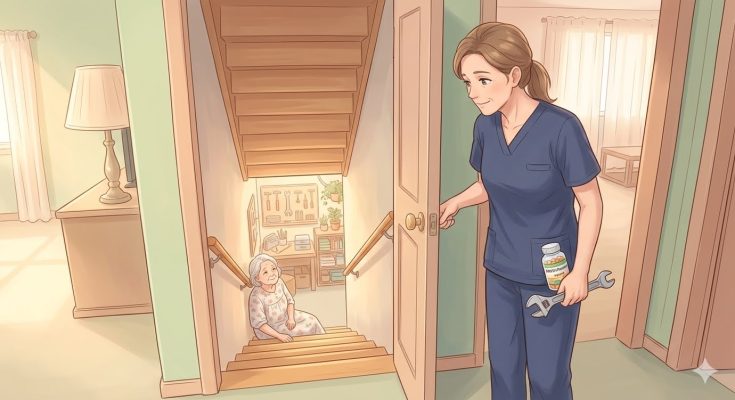
I moved toward the basement door and immediately noticed what had changed since my last visit. The original door had been replaced with a heavier model, and an industrial padlock now secured it firmly. This was new—installed within the past month, I guessed.
John had been renovating the basement as his personal space since moving back in with Charlene after Robert’s death. A temporary arrangement that had somehow stretched to five years.
“Charlene,” I called toward the door. “Are you down there?”
The knocking intensified slightly—still weak, but with a desperate urgency that tightened my chest. I tried the handle, confirming it was locked.
Looking around frantically, I spotted Robert’s old toolbox in the hall closet. Inside, I found a heavy wrench and returned to the door.
The padlock was substantial, a serious security measure—not something you’d use to keep people out of a hobby room.
Using the wrench as leverage, I managed to break the hardware securing the lock to the door. It gave way with a splintering crack, and I yanked the door open.
The stairwell was dark. The air rising from it was stale and close. I fumbled for the light switch, illuminating a narrow descent into John’s domain.
I’d rarely been allowed down here since he’d claimed it as his space.
“It’s private, Aunt Gail. My gaming equipment is valuable.”
“Charlene, I’m coming down,” I called, taking the stairs carefully.
The basement was a maze of expensive computer equipment, gaming consoles, and collectibles. Posters of violent video games lined the walls. Empty energy drink cans cluttered every surface.
But it was the far corner, partially concealed behind stacked boxes, that drew my attention.
There, on a thin mattress on the concrete floor, lay my sister.
“Oh my God—Charlene!”
I rushed to her side, my medical training instantly assessing her condition: dehydration, weak pulse, dry lips, disorientation—and the distinct fruity odor of ketoacidosis on her breath. Without her diabetes medication, she was in serious danger.
Her eyes fluttered open at my touch, unfocused at first, then widening in recognition.
“Gail?” Her voice was a cracked whisper. “Is… is it really you?”
“I’m here, Char. I’m here.” I was already reaching for my phone to call an ambulance while checking the nearby water bottle. Empty—except for a few drops. “What happened? Who did this to you?”
Charlene’s fingers weakly clutched at my wrist.
“John,” she whispered, tears forming in her sunken eyes. “He said he needed Dad’s insurance money. Locked me down here three days ago.”
The implications slammed into me with physical force.
My nephew—Charlene’s only child—had imprisoned his diabetic mother in a basement, knowing her condition required daily medication. He’d left her with minimal water, a package of stale crackers, and a bucket in the corner as a toilet.
And he’d done it for money.
Our father’s insurance policy, which listed Charlene as a beneficiary.
“I’m calling an ambulance,” I told her, already dialing 911. “Just hold on, Char.”
While we waited for the paramedics, I gathered her diabetes supplies from upstairs and administered an emergency glucose solution. My hands were steady—the same professional calm that carried me through trauma cases in the ER.
But my mind was racing with barely contained fury.
John had always been difficult. As a child, he’d had explosive tantrums. As a teenager, he’d been manipulative and secretive. As an adult, he’d drained Charlene’s finances while convincing her he was just between opportunities.
But this—deliberately endangering his mother’s life for a potential inheritance—crossed into territory I couldn’t begin to process.
The paramedics arrived within minutes, efficiently transferring Charlene to a stretcher. I rode with her in the ambulance, holding her hand as she drifted in and out of consciousness.
At the hospital—my workplace—everything looked the same, and yet I felt miles removed from the capable head nurse I’d been just hours before.
I provided her medical history to the attending physician while they worked to stabilize her.
“Will she be okay?” I asked Dr. Lyndon, a colleague I’d worked with for years.
“She’s severely dehydrated, and her blood sugar levels are dangerously off balance,” he said frankly. “But we caught it in time. Had she been down there another day…”
He didn’t need to finish the sentence.
I sat beside Charlene’s hospital bed long after she’d been stabilized, watching the IV fluids drip steadily into her arm.
My phone buzzed with a text message.
John: at Dad’s place. Where’s Mom? She’s not answering.
The casual tone—the absolute normalcy of it, as if he hadn’t locked his mother in a basement and left her to deteriorate—made something shift inside me.
I’d always been the practical sister, the problem solver, the one who kept her emotions in check. But in that moment, I understood with perfect clarity that John needed to learn a lesson he would never forget.
Not through violence. Not through rage.
Through consequences—so precisely calibrated to his specific weaknesses that he would never recover from them.
I texted back:
She’s with me. We’re visiting Dad. Don’t wait up.
Then I called Detective Elaine Cortez—a police contact I’d made through the hospital’s domestic violence cases.
“It’s Gail Brenner,” I said when she answered. “I need your help. My nephew just tried to kill my sister.”
Detective Cortez arrived at the hospital within the hour, her compact frame radiating calm authority as she entered Charlene’s room.
I’d worked with her on numerous cases—battered women, abused seniors, children with suspicious injuries—but I’d never expected to be on this side of her professional attention.
“Gail.” She nodded, her dark eyes taking in Charlene’s unconscious form. “You said this was family-related.”
I stepped into the hallway with her, keeping my voice low.
“My nephew, John Mitchell. He locked my sister in his basement for three days. No diabetes medication. Minimal water. Inadequate food.”
My clinical description belied the rage still churning beneath my professional exterior.
“She would have died if I hadn’t found her.”
Cortez’s expression remained neutral, but I saw the slight tightening around her eyes.
“That’s attempted murder if we can prove intent.” She pulled out a small notebook. “Walk me through the timeline.”
I explained my father’s hospitalization, Charlene’s failure to answer calls, my visit to her house, and the discovery in the basement—before she lost consciousness in the ambulance.
“He told me he did this because he needed Dad’s insurance money,” I added.
“Your father’s still alive, though?”
“Yes, but his condition is precarious. John may have been accelerating the timeline.”
The implications of what I was suggesting hung between us.
“We’ll need a formal statement from your sister when she’s stabilized,” Cortez said. “Has John contacted you since the discovery?”
I showed her the text message.
“He’s pretending everything’s normal,” she said after reading. “Keep it that way for now. We don’t want to spook him before we build our case.”
She pocketed her notebook. “I’ll station an officer outside your sister’s room as a precaution. And Gail—stay here with her. Don’t confront John alone.”
After Cortez left, I returned to Charlene’s bedside, studying my sister’s face in the harsh hospital lighting.
The years had not been kind to Charlene. At forty-eight, she looked a decade older, her once vibrant features now permanently etched with worry lines.
Most of those lines had deepened after Robert’s death—five years ago, when he’d fallen from a ladder while repairing their roof.
John had been the one to find him.
John, who’d inherited nothing directly from his stepfather’s modest life insurance.
John, who’d moved back home “temporarily” to help Mom through her grief.
A chill ran through me as connections began forming.
I’d always found the circumstances of Robert’s death slightly suspicious. A meticulous man like my brother-in-law, falling from a ladder he’d used safely hundreds of times.
But Charlene had been so devastated—so fragile—that I’d pushed my questions aside.
Now I wondered if this wasn’t the first time John had seen death as a solution to financial problems.
My thoughts were interrupted by a soft knock.
Rebecca Simmons—head social worker and my closest friend—stood in the doorway with two coffee cups.
“Thought you could use this,” she said, handing me one.
“Elaine filled me in,” she added, pulling a chair beside mine. Her presence was a welcome anchor in the storm.
Rebecca and I had weathered twenty years of friendship, including my messy divorce and her breast cancer battle. If anyone could help me navigate this nightmare, it was her.
“I can’t wrap my head around it, Beck,” I said quietly. “He left his own mother to die.”
Rebecca’s expression was grim. “Some personality disorders manifest exactly this way—superficial charm masking a complete lack of empathy. The question is, what are you going to do now?”
“Legally, press charges, obviously.” I stared into my coffee. “But personally… I need to make sure he can never hurt her again. Or anyone else.”
“That sounds ominous.”
“Not violent,” I clarified. “Just… final.”
Rebecca studied me carefully. “You’re thinking beyond legal justice.”
“Legal justice can fail,” I said. “Especially with someone like John who’s perfected his misunderstood nice-guy act.”
We’d both seen it too many times—manipulative abusers walking free because they could perform normality convincingly for judges and juries.
“Be careful, Gail,” Rebecca said softly. “Whatever you’re planning…”
“I’m not planning anything illegal,” I assured her. “Just a lesson he’ll never forget.”
Our conversation paused as Charlene stirred, her eyes fluttering open.
She looked confused momentarily before focusing on me.
“Gail… where am I?”
“Hospital. You’re safe now.” I squeezed her hand gently. “How are you feeling?”
“Thirsty,” she whispered.
I helped her sip water through a straw while Rebecca discreetly excused herself.
After drinking, Charlene’s eyes filled with tears.
“John… he really did that to me, didn’t he? I wasn’t hallucinating.”
“No, honey. He really did.”
I kept my voice gentle, knowing how fragile victims of family violence could be—how prone to self-doubt and denial.
“Do you remember why?”
She nodded weakly. “Dad’s insurance policy. John’s in debt. Gambling, I think. He said… he said he needed to secure his future before it was too late.”
Her voice broke.
“My own son, Gail. How could he?”
The door swung open before I could answer, and a nurse I recognized from pediatrics entered.
“Ms. Mitchell, there’s someone insisting on seeing you. Says he’s your son.”
Ice flooded my veins.
John was here.
Charlene’s monitor showed her heart rate spiking.
“I don’t want to see him,” she whispered. “Please, Gail.”
I stood. Decision made instantly.
“Tell him his mother is resting and can’t have visitors,” I instructed the nurse. “And please alert security that he’s not permitted in this room.”
After the nurse left, Charlene gripped my hand with surprising strength.
“He’ll be so angry.”
“Let him be angry,” I said firmly. “He lost the right to see you when he locked you in that basement.”
“What happens now?” Her voice was small—childlike.
“Detective Cortez will want your statement when you’re stronger. And then we make sure John faces consequences.”
“You want me to press charges against my own son?” The horror in her voice was palpable.
“Char, he nearly killed you.” I struggled to keep my frustration in check. “This isn’t a misunderstanding or a mistake. He deliberately imprisoned you, knowing your medical condition.”
Tears streamed down her face.
“He’s still my boy, Gail. My little boy.”
I bit back what I really wanted to say—that her “little boy” was a thirty-year-old man who’d calculated his mother’s death for financial gain.
Instead, I squeezed her hand again.
“Let’s focus on getting you better. We don’t need to decide anything right now.”
But I had already decided. Whether Charlene could bring herself to press charges or not, John would learn his lesson.
I would make sure of it.
My phone vibrated with another text.
John: again at the hospital. They won’t let me see Mom. What’s going on?
I typed back carefully.
She’s sleeping, very weak. Doctor’s orders. No visitors except immediate family tonight.
His response came instantly.
I am immediate family.
Not for long, I thought grimly. Not if I have anything to say about it.
John was waiting for me in the hospital cafeteria, looking perfectly ordinary in his expensive running shoes and designer hoodie. My nephew had always been handsome in that generic way that opens doors—tall, athletic, maintained through a gym membership Charlene paid for.
He stood as I approached, concern etched on his features.
“Aunt Gail. What’s going on? Why can’t I see Mom?”
I’d spent twenty minutes in the bathroom preparing for this encounter—washing the fury from my face, rehearsing the precise level of concerned-but-not-suspicious to project.
Now I slid into the seat across from him and set down my lukewarm coffee.
“Your mother’s in pretty bad shape, John. They found her severely dehydrated and in diabetic ketoacidosis. She’s stable now, but very weak.”
“Found her?” he repeated. “What do you mean, found her?”
His expression remained perfectly calibrated—worried son blindsided by unexpected news.
“I went to your house when she wasn’t answering calls. I found her in the basement.”
I watched his face carefully as I delivered the words, searching for any flicker of guilt or panic.
Nothing.
Not even a twitch.
“The basement.” He frowned, confusion seeming to cloud his features. “That doesn’t make sense. Mom never goes down there.”
“She was on a mattress behind some boxes—dehydrated, confused.” I kept my voice neutral, as though discussing a medical case rather than his attempted matricide. “The door was padlocked from the outside.”
Now I saw it—a slight tightening around his eyes, quickly masked by an expression of horrified concern.
“Oh my God. Someone broke in. Did they hurt her?”
The performance was masterful. If I hadn’t seen Charlene with my own eyes—hadn’t heard her weak voice naming her son as her captor—I might have been convinced.
“The police are investigating,” I said vaguely, watching his reaction.
“Police?” he asked. “Shouldn’t we wait until Mom can tell us what happened?”
A note of calculation entered his voice.
“She already has.”
I held his gaze steadily.
“She regained consciousness in the ambulance.”
John leaned back slightly, processing this information. I could almost see the gears turning as he assessed his options.
Finally, he shook his head, his expression morphing into sorrowful concern.
“Poor Mom,” he murmured. “She must be so confused. You know how she gets when her blood sugar crashes. Disoriented—sometimes even hallucinating.”
And there it was: the strategy I’d anticipated—gaslighting, discrediting the victim’s account by suggesting she was mentally compromised.
I’d seen this tactic countless times in the ER from abusive partners trying to explain away injuries.
“The doctors have stabilized her blood sugar,” I replied mildly. “She’s quite lucid now.”
“That’s great,” he said quickly. “But trauma can affect memory. Maybe she fell and knocked herself out, then was too weak to get back upstairs, and in her confusion she might have…”
He trailed off, letting me fill in the blanks.
Imagined her own son locking her in a basement for three days.
I finished for him, unable to keep a slight edge from my voice.
“That’s quite a specific hallucination, John.”
His expression hardened momentarily before smoothing back into concern.
“I’m just saying we shouldn’t jump to conclusions. I would never hurt Mom. You know that.”
Did I?
The truth was, I’d been ignoring red flags about John for years—the possessiveness that masqueraded as protection; the isolation of Charlene from her friends after Robert’s death; the gradual assumption of control over her finances, justified as helping Mom manage the complicated stuff.
“The police will want to speak with you,” I said instead of answering.
“Of course,” he nodded immediately. “I want to help find whoever did this to her.”
“They’ll be here tomorrow morning. Detective Cortez from Major Crimes.”
His eyebrows rose slightly.
“Major Crimes? Isn’t that excessive for what was probably an accident?”
“Imprisoning a diabetic woman without her medication isn’t an accident,” I said, letting the words land. “It’s attempted murder.”
He flinched.
The first genuine reaction I’d seen.
“That’s absurd,” he said. “Why would anyone want to murder Mom?”
“Insurance money, perhaps.” I took a deliberate sip of my coffee. “Dad’s policy is substantial, and with his condition, it might be paid out soon.”
John’s expression didn’t change, but I noticed his hand tightening around his water bottle.
“That’s a pretty dark theory, Aunt Gail.”
“These are dark circumstances.”
I stood, gathering my purse.
“I’m going back to sit with your mother. The police have requested she not have visitors except for immediate medical family until they’ve completed their initial investigation.”
“But I’m her son,” he protested.
“And I’m her medical power of attorney,” I countered smoothly. “Doctor’s orders, John. I’m sure Detective Cortez will update you after your interview tomorrow.”
As I walked away, I felt his eyes boring into my back.
I’d thrown down the gauntlet—let him know I wasn’t buying his act.
It was a calculated risk. He might flee, destroying evidence in the process.
But my instincts told me he wouldn’t.
John’s narcissism wouldn’t allow him to behave like a guilty man.
He believed he could talk his way out of anything.
Back in Charlene’s room, I found Detective Cortez reviewing notes with a uniformed officer.
“Your nephew’s in the cafeteria,” I told her without preamble. “I’ve informed him you’ll want to speak with him tomorrow.”
She nodded.
“Officer Jenkins will remain posted here overnight. We’ve contacted crime scene to process your sister’s basement.”
She studied me carefully.
“You told him we’re investigating.”
“I thought it best to see his reaction.”
“He’s already trying to suggest Charlene imagined the whole thing due to diabetic confusion.”
Cortez made a note. “Classic DARVO. Deny, attack, reverse victim and offender. We see it in domestic cases constantly.”
She glanced at Charlene’s sleeping form.
“Has she said anything more about motive?”
“Just that John needed money from our father’s insurance policy. She believes he’s in gambling debt.”
“We’ll look into his financials,” Cortez promised. “Get some rest, Gail. Tomorrow will be challenging.”
Rest was impossible.
I spent the night in the recliner beside Charlene’s bed, dozing fitfully between nurse checks and my own monitoring of her condition.
My mind kept circling back to Robert’s “accident” five years ago—the convenient timing, John’s sudden interest in moving back home afterward, the gradual isolation of Charlene from her support network.
By morning, I had the outlines of a plan forming—not just for immediate justice, but for ensuring John could never harm Charlene again.
It would require careful orchestration, leveraging every professional connection I’d built in my twenty-five years of nursing.
Most importantly, it would require Charlene’s cooperation.
And that was far from guaranteed.
When my sister woke at dawn, her eyes were clearer, her color improved. She looked at me with painful awareness.
“It wasn’t a nightmare, was it?” she whispered. “John really did this to me.”
“Yes,” I said simply. “And I think we need to talk about Robert’s accident, too.”
Her eyes widened in shock, then filled with tears.
“You know about that?”
A chill ran through me.
My suspicions—until now just formless anxiety—suddenly crystallized into certainty.
“Tell me everything, Charlene,” I said quietly. “It’s time for the truth to come out.”
Charlene’s fingers twisted in the hospital blanket. Her eyes darted nervously toward the door as if expecting John to materialize at the mention of his name.
“I can’t,” she whispered. “You don’t understand what he’s capable of.”
“I think I do,” I said gently. “He left you to die in that basement, Char. What could be worse than that?”
Her eyes met mine, filled with a haunted knowledge that made my stomach clench.
“Watching it happen to someone else,” she said, “and knowing you could have prevented it.”
I took her hand, feeling the bones beneath paper-thin skin. At forty-eight, my younger sister looked decades older than me—worn down by secrets and fear.
“Tell me about Robert’s accident,” I urged.
She closed her eyes, tears seeping from beneath the lids.
“It wasn’t an accident.”
The words hung in the air between us—confirmation of what I’d already suspected but had been unwilling to fully acknowledge.
My nephew—the boy I’d bounced on my knee, taught to ride a bike, defended from our father’s criticism—was not just an opportunistic abuser.
He was a murderer.
“I saw them arguing on the roof,” Charlene continued, her voice barely audible. “John had asked Robert for money again— a lot of money—for some investment scheme. Robert refused. Said it was time John stood on his own feet.”
She swallowed hard.
“I was in the garden. I saw John push him—just once. Robert lost his balance, tried to grab the ladder…”
“You witnessed your son killing your husband.”
I couldn’t keep the horror from my voice.
“I wasn’t sure what I saw,” she insisted desperately. “It happened so fast. And afterward, John was so distraught—so convincing—when he told the police he’d tried to save Robert from falling.”
Her fingers clutched mine painfully.
“I convinced myself I was mistaken. That grief was making me imagine things.”
“But you knew,” I said quietly. “Deep down. You knew.”
She nodded, fresh tears flowing.
“And I protected him. What kind of monster does that make me?”
“Not a monster, Char. A victim.” I squeezed her hand. “John’s been manipulating you for years.”
“He threatened me,” she admitted. “Not directly, but… implications. After Robert died, he’d talk about how fragile life is, how easily accidents happen. He’d remind me how much I needed him now that I was alone.”
She shuddered.
“When he found out about Dad’s stroke, something changed. He became obsessed with money—with Dad’s insurance policy. When I refused to discuss it, he… he got so angry, and he locked me in the basement to keep me from interfering.”
I finished for her. “He took your phone, your medication—everything.”
She nodded miserably.
“He said it would just be for a day or two, that I needed to calm down and think about our future.”
“Charlene,” I said firmly, “you need to tell Detective Cortez everything you’ve told me—about the basement, and about Robert.”
Panic flashed across her face.
“I can’t testify against my own son.”
“If you don’t, he’ll do this again,” I said. “Maybe to you. Maybe to someone else. John is dangerous— not just impulsive or troubled, but genuinely dangerous.”
“He’s still my boy,” she whispered, the maternal instinct warring with her self-preservation.
“No,” I said gently but firmly. “The boy you raised is gone—if he ever truly existed. This man, this adult who deliberately endangered your life, needs to face consequences before he escalates further.”
Our conversation was interrupted by a soft knock.
Detective Cortez entered, her expression professional but kind.
“Mrs. Mitchell, I’m Detective Elaine Cortez. I’d like to ask you some questions about what happened to you—if you’re feeling up to it.”
Charlene shot me a panicked look.
I squeezed her hand encouragingly. “It’s okay. I’ll stay right here.”
For the next hour, Charlene haltingly recounted her ordeal in the basement. Detective Cortez recorded the statement, occasionally asking clarifying questions, but mostly allowing Charlene to speak at her own pace.
When she reached the part about John’s motivation—access to our father’s insurance money—Cortez’s expression darkened.
“Mrs. Mitchell,” she said gently, “this may be difficult to discuss, but I need to ask: has your son shown violent or controlling behavior before this incident?”
Charlene’s eyes flicked to mine, seeking guidance.
I nodded almost imperceptibly.
“He… he’s always been possessive,” she began hesitantly. “After my husband died, it got worse. He monitored my phone calls, discouraged friends from visiting, gradually took over all my finances.”
“Classic isolation tactics,” Cortez noted. “Did your husband’s death involve any suspicious circumstances?”
The direct question seemed to shock Charlene. She paled visibly, her monitor showing an elevated heart rate.
“I think my sister needs a break,” I interjected, worried about her physical state.
“Of course.” Cortez stood. “But Mrs. Mitchell—if there’s anything else you believe might be relevant to this investigation, anything at all about your son’s past behavior, it would be extremely helpful.”
After Cortez left, Charlene turned to me, eyes wide with fear.
“She suspects about Robert.”
“What do I do, Gail?”
“You tell the truth,” I said firmly. “All of it.”
“I can’t,” she whispered. “It would destroy everything.”
“Everything is already destroyed, Char. The only question now is whether we rebuild on truth or continue living in fear.”
I adjusted her blanket—a nurse’s automatic gesture.
“Rest now. We’ll talk more later.”
In the hallway outside Charlene’s room, I found Detective Cortez making notes.
“She knows more than she’s saying,” Cortez observed without looking up.
“Yes,” I agreed. “But she’s terrified of her son. Of herself, too—of her complicity.”
I lowered my voice.
“I believe John was responsible for Robert’s death five years ago. And I think Charlene witnessed it, but has been too afraid to come forward.”
Cortez’s pen stilled.
“That’s a serious allegation.”
“I know. But it fits the pattern. Robert refused to fund John’s gambling habit. Shortly afterward, he died in a tragic accident. John moved in with Charlene, gradually taking control of her life and finances. When our father had his stroke—potentially triggering an insurance payout that Charlene would control—John tried to remove her from the equation.”
“We’ll look into reopening the investigation into Mr. Mitchell’s death,” Cortez said after a moment. “In the meantime, your nephew is scheduled for questioning at noon.”
“He’ll be prepared,” I warned. “John is exceptionally good at presenting a normal, concerned facade.”
“So are most sociopaths,” Cortez replied dryly. “Don’t worry, Ms. Brenner. This isn’t my first dance with a manipulative abuser.”
As Cortez walked away, my phone vibrated with a text from Rebecca.
John in lobby asking about C’s room number. Security notified.
My plan was taking shape now—crystallizing with each new piece of information.
John wouldn’t just face legal consequences, though I certainly hoped for those as well.
He would face something far more devastating to a man like him:
Complete exposure.
The stripping away of his carefully constructed image.
The dismantling of every lie he’d told himself and others.
I texted Rebecca back.
Tell security to let him up. Room 418. Time for the next phase.
I was waiting when the elevator doors opened on the fourth floor, deliberately positioning myself where John would see me immediately.
His expression shifted from determination to weariness as our eyes met.
“Aunt Gail,” he approached cautiously, expensive sneakers silent on the hospital linoleum. “How’s Mom doing this morning?”
“Better,” I said neutrally. “Her blood sugar has stabilized.”
“That’s great news.” He smiled—the perfect picture of filial concern. “I brought these.”
He held up a small gift bag containing what appeared to be luxury hand cream—Charlene’s favorite brand.
The thoughtfulness of the gesture, given what I now knew, made bile rise in my throat.
“She’s resting now,” I told him, blocking his path toward her room. “And she’s given a formal statement to the police.”
The smile remained fixed on his face, but something cold flickered behind his eyes.
“About her confusion in the basement. I’ve been thinking about that. Mom mentioned last week that she was having dizzy spells. Maybe she went downstairs for something and passed out.”
“The padlocked door suggests otherwise,” I said.
I kept my voice clinical—detached.
“As do her specific memories of you telling her she needed to think about your future while you waited for your grandfather to die.”
Now the smile vanished completely.
“That’s absurd. Mom must be confused from the ketoacidosis.”
“Blood tests show she’s been in ketoacidosis for approximately seventy-two hours,” I said quietly. “Precisely the time frame during which she was locked in your basement without her medication.”
He stepped closer, lowering his voice.
“Aunt Gail, you’ve always had it in for me. Ever since I was a kid. Mom and I were doing fine until you started filling her head with paranoia.”
The attempt to rewrite history was so brazen it almost made me laugh.
I’d been Charlene’s most loyal defender—practically raising John myself during the years when my sister struggled with postpartum depression.
“Detective Cortez is expecting you at noon,” I said, ignoring his accusation. “Room 307, administrative wing.”
“Fine,” he snapped, mask slipping further. “I’ll clear this ridiculous misunderstanding up right now. But I want to see Mom first.”
“That’s not possible.” I stepped directly in front of Charlene’s door. “Doctor’s orders.”
“I’m her son,” he hissed, his handsome face contorting with barely contained rage. “You can’t keep me from her.”
“Actually, I can.”
As her medical power of attorney—and the hospital’s head nurse—I had full authority over her visitors.
I gestured to the security guard now approaching from the nurse’s station.
“If you attempt to enter her room against medical advice, you’ll be removed from the premises.”
John’s eyes darted between me and the guard, calculating.
Finally, he stepped back, composing his features into a mask of reasonable concern.
“This is completely unnecessary,” he told the guard. “I’m just worried about my mother.”
“The same mother you left in a basement without her diabetes medication for three days,” I couldn’t resist.
His eyes flashed dangerously.
“You have no idea what you’re talking about.”
“I know exactly what I’m talking about, John. And so does your mother. And soon, Detective Cortez will, too.”
He leaned in, his voice dropping to a whisper meant only for my ears.
“Be careful, Aunt Gail. Accidents happen to nosy people all the time.”
The naked threat sent ice through my veins, but I maintained my composure.
“Are you threatening me in a hospital corridor surrounded by security cameras,” I asked, “while you’re already under investigation for attempted murder?”
Realizing his mistake, John straightened, forcing a rueful laugh.
“Of course not. I’m just upset about these ridiculous accusations.”
He turned to the security guard with his most charming smile.
“Sorry for the drama. Family stress, you understand?”
As he walked toward the elevator, his posture was relaxed, confident—a man certain he could talk his way out of any situation.
I waited until the doors closed behind him before releasing the breath I’d been holding.
Inside Charlene’s room, I found her awake and anxious, having clearly heard at least part of our confrontation.
“Was that John?” she asked, eyes wide.
“Yes,” I said. “He wanted to see you, but I refused.”
I checked her monitors automatically.
“He’ll convince her,” Charlene said miserably. “He always does. He can make anyone believe anything.”
“Not this time,” I assured her. “Cortez is extremely good at her job, and we have physical evidence—the padlock, your medical condition, your statement.”
She shook her head, tears forming.
“You don’t understand. John will find a way to twist this. He’ll say I went down there voluntarily, that I locked myself in accidentally, that I’ve been mentally unstable since Robert died.”
Her words echoed my own fears.
Abusers like John often escaped justice through precisely such tactics: gaslighting, character assassination, manipulating evidence.
Even with Cortez’s experience and Charlene’s testimony, there was a real possibility he could evade serious consequences.
That was why we needed to tell her about Robert.
“I can’t,” Charlene whispered. “I just can’t.”
I sat beside her bed, taking her frail hand in mine.
“Char, listen to me. John threatened me just now. Implied I might have an accident if I kept pushing. He’s escalating.”
Her face crumpled.
“This is all my fault. I should have stopped him years ago.”
“No,” I said firmly. “The fault lies entirely with John. But now we have a chance to prevent him from hurting anyone else.”
“How?” she asked. “Even if they arrest him for what he did to me, he’ll eventually get out. And then…”
“Not if we can link him to Robert’s death,” I said. Then I decided complete honesty was necessary. “And not if we can ensure that everyone in his life knows exactly who and what he is.”
She looked at me, confused.
“What are you planning, Gail?”
“Justice,” I said simply. “But I need your help—your complete honesty, no matter how painful.”
Charlene studied my face for a long moment, then nodded slowly.
“What do you need me to do?”
“First, tell Detective Cortez everything about Robert’s death—every detail you remember.”
And then I explained my plan—not just for legal justice, which might or might not be achieved depending on evidence and prosecutorial decisions, but for a more certain form of consequence.
By the time I finished, Charlene’s expression had shifted from fear to grim determination.
“He’ll hate us forever,” she whispered.
“Probably,” I agreed. “But he’ll never be able to hurt you—or anyone else—again.”
When Detective Cortez returned an hour later, Charlene was ready.
With trembling voice but unwavering resolve, she recounted what she had witnessed on the roof five years earlier: John’s argument with Robert, the push, her husband’s desperate grab for the ladder that failed to save him.
“I’ve been living with this knowledge for five years,” she concluded, tears streaming down her face. “I convinced myself I was mistaken, that grief was making me see things that weren’t there. But when I found myself locked in that basement—knowing my son was waiting for me to die—I couldn’t deny the truth anymore.”
Cortez’s expression remained professional, but her eyes reflected both compassion and determination.
“Mrs. Mitchell, this changes everything. I’ll need to reopen your husband’s case immediately.”
After Cortez left to make arrangements, I squeezed Charlene’s hand.
“You did the right thing.”
“What happens now?” she asked, her voice small.
“Now,” I said, checking my watch, “John meets with Detective Cortez, and we set our trap.”
By two o’clock, the pieces of my plan were falling into place with the precision of a well-designed nursing care protocol.
Rebecca had accessed John’s financial records through her contacts in the hospital’s billing department. Not strictly ethical, but necessary.
The picture they painted was grimmer than even I had suspected.
Massive gambling debts. Multiple maxed-out credit cards. High-interest loans from entities that didn’t sound like legitimate banks.
“He’s underwater by at least one hundred eighty thousand,” Rebecca reported, her voice low as we huddled in the small consultation room adjacent to Charlene’s. “And that’s just what I can trace through conventional records. Who knows what he might owe to less savory creditors?”
Detective Cortez joined us after her interview with John, her expression a mixture of professional detachment and barely concealed disgust.
“Your nephew is quite the performer,” she said, setting her notebook on the table. “Concerned son, bewildered innocent, steadfast caretaker—he cycled through personas like a theater actor changing costumes.”
“Did he stick to his story about Charlene accidentally locking herself in?” I asked.
“Initially,” Cortez said. “Then, when confronted with physical evidence, he pivoted to suggesting she might have gone down there voluntarily to get away from stress, and that he’d been respecting her need for space.”
Cortez’s mouth tightened. “When I pointed out that this ‘space’ lacked her essential medication, he suggested she must have forgotten to bring it down herself.”
“Typical,” Rebecca murmured.
“DARVO in action,” I added.
“Precisely,” Cortez nodded. “By the end, he was insinuating that Charlene has been mentally unstable since her husband’s death—and that you, Gail, have been encouraging her ‘delusions’ out of some long-standing jealousy.”
The accusation was so absurd I might have laughed under different circumstances.
I’d spent my life cleaning up after Charlene’s messes—supporting her through postpartum depression, an unfaithful first husband, Robert’s death, and her increasingly dangerous relationship with John.
“What now?” I asked. “Did you arrest him?”
“Not yet,” Cortez acknowledged. “We’re building our case. His financial records provide clear motive, and the physical evidence from the basement is compelling. Most importantly, your sister’s testimony about her husband’s death changes the stakes significantly.”
Cortez’s dark eyes met mine.
“We’re reopening the Robert Mitchell case immediately. The medical examiner has agreed to review the original findings in light of this new witness statement.”
“But John is still free,” I said, unable to keep the edge from my voice.
“For now,” Cortez said. “We’re monitoring him closely. If he attempts to flee—”
“He won’t,” I interrupted. “Not immediately. His ego won’t let him run like a guilty man. He still believes he can manipulate his way out of this.”
“That works in our favor,” Cortez said. “It gives us time to build an airtight case.”
“And to implement our plan,” Rebecca added.
Cortez raised an eyebrow. “What plan?”
I explained my strategy—not just for legal justice, which would proceed on its own timeline with its own uncertainties, but for ensuring John could never harm Charlene again, regardless of legal outcomes.
It involved leveraging my position at the hospital, Rebecca’s network of social service providers, and Charlene’s newly awakened determination to protect herself—and others—from her son.
When I finished, Cortez was silent for a long moment.
“That’s unconventional,” she said finally.
“But not illegal,” Rebecca pointed out.
“No,” Cortez agreed. “Not illegal. Ethically complicated, perhaps. But…” She sighed. “I’ve seen too many abusers walk free on technicalities or because victims recant under pressure. Your approach has merit.”
“Then you’ll help?” I asked.
“Within the bounds of my professional responsibilities,” she qualified. “The legal case proceeds independently. But as for the rest…”
She nodded once, decisively.
“Yes. I’ll help.”
The next piece fell into place when Dr. Michael Torres, the hospital’s consulting psychiatrist, joined our impromptu war council. I’d worked with Torres on numerous cases involving suspected abuse, and his insights into manipulative personality types had proven invaluable.
“Based on what you’ve described,” he said after hearing Charlene’s account and reviewing John’s financial and behavioral patterns, “we’re potentially looking at antisocial personality disorder with narcissistic features. The calculated nature of the imprisonment, the complete disregard for his mother’s medical needs, the history of financial exploitation, and the suspected involvement in his stepfather’s death all point to a severe pathology.”
“Can you document this assessment?” I asked. “Not for legal purposes necessarily, but for Charlene’s protection.”
“I can prepare a preliminary analysis based on reported behaviors and pattern recognition,” he confirmed. “It won’t have the weight of a formal diagnosis without direct evaluation, but it could support protective measures for your sister.”
By evening, my father had taken a turn for the worse. His latest stroke—his third—had left him with minimal brain function, and the neurologist had gently suggested it was time to consider comfort care only.
In the strange parallel universe I now inhabited, I found myself simultaneously planning my father’s end-of-life care, coordinating Charlene’s ongoing treatment, and orchestrating John’s downfall.
“Dad’s not going to recover,” I told Charlene gently that night after the nurses had completed their evening rounds. “We need to make some decisions.”
She nodded, tears welling.
“He wouldn’t want extraordinary measures. We both know that.”
“And we both know John will fight us on this,” I warned. “He needs Dad alive until he can figure out how to access the insurance money.”
A flash of something—determination, anger—crossed Charlene’s face.
“It’s not his decision,” she said. “It’s ours. And Dad deserves peace—not to be kept alive as John’s potential payday.”
This newfound strength in my previously pliable sister surprised and heartened me. Perhaps the horror of her basement imprisonment had awakened something long dormant in her: a will to resist, to protect herself.
“I’ve arranged for Dr. Torres to speak with you tomorrow,” I told her. “He’s preparing documentation that will help ensure John can’t make medical decisions for you again, regardless of what happens with the criminal case.”
“You really think of everything,” she said softly. “You always have.”
“Not everything,” I admitted. “I should have seen the signs with John years ago. Should have pushed harder after Robert died.”
“We both missed—or ignored—the signs,” she corrected. “But that ends now.”
As night settled over the hospital, I made my final preparations.
Tomorrow would set everything in motion: the legal proceedings against John, the protective measures for Charlene, and most importantly, my carefully orchestrated lesson for my nephew.
A lesson he would never forget—delivered not through violence or vengeance, but through the complete dismantling of the image he’d spent his life constructing.
In the quiet of Charlene’s darkened room, I sent a single text to Detective Cortez.
We’re ready. Tomorrow, 10 a.m.
Her reply came moments later.
Understood. No turning back now.
Morning arrived with the controlled chaos typical of hospital shift change—nurses exchanging notes, medication carts rolling down corridors, the soft beeping of monitors forming a familiar backdrop to my preparations.
I’d slept little, my mind continuously refining the details of what we’d set in motion.
Charlene was awake early, her face bearing the determined expression I’d rarely seen since we were children competing in school science fairs. Back then, my serious, methodical sister had often surprised everyone with her quiet tenacity when properly motivated.
“Are you sure about this?” I asked as I helped her into the robe Rebecca had brought from my apartment. “Once we start, there’s no going back.”
“I’ve been going back for years,” she replied, her voice stronger than it had been since her rescue. “Going back to excuses, to denial, to fear. Not anymore.”
Dr. Torres arrived at eight-thirty bringing the protective orders and psychiatric assessment he’d prepared. Though not a formal diagnosis, his documentation of John’s behavior pattern—controlling, manipulative, parasitic, showing disregard for others’ well-being—provided strong support for the legal measures we were implementing.
“I’ve outlined what clinicians call the dark triad,” he explained as Charlene signed the papers. “Narcissism, Machiavellianism, and psychopathy. These traits exist on a spectrum, and your son appears to exhibit concerning levels of all three based on the reported behaviors.”
“Will this help keep him away from me?” Charlene asked directly.
“Combined with the criminal charges and your testimony—yes,” Torres confirmed. “These documents establish a pattern of calculated abuse rather than isolated incidents, making it much harder for him to explain away his actions as misunderstandings.”
Detective Cortez arrived next, bringing news that made my heart race.
“We’ve exhumed Robert Mitchell’s body,” she said without preamble. “The medical examiner found evidence inconsistent with an accidental fall—specifically defensive wounds on the hands that weren’t noted in the original examination.”
“What does that mean exactly?” I asked, though I already suspected the answer.
“It means we’re upgrading from reopening an investigation to a probable homicide case,” Cortez said. Her expression was grim, but satisfied. “Combined with your sister’s eyewitness statement and the financial records establishing motive, we have grounds for an arrest warrant.”
Officers are picking up John Mitchell as we speak.
A wave of emotions washed through me—relief, vindication, and a complicated grief for the nephew I’d once loved, the child who had somehow transformed into this calculating predator.
“He’ll still try to manipulate his way out,” Charlene warned.
“Which is why we’re proceeding with our plan as well,” I reminded her. “The legal process has its own timeline and uncertainties. Our approach ensures protection regardless of legal outcomes.”
At nine forty-five, Rebecca entered with the final components we needed: a laptop, portable speakers, and a USB drive containing files that had taken all night to compile.
“Everything set up in the conference room,” she confirmed. “Dr. Lyndon approved the use of the space as a ‘family therapeutic intervention.’ Hospital administration has been notified that we’re conducting a sensitive mental health conference that may involve raised voices.”
The stage was set.
At precisely ten o’clock, the elevator doors opened and John stepped out, escorted by two plainclothes officers who maintained a careful distance—present, but not obviously restraining him—creating the illusion of freedom that was critical to our plan.
Cortez had explained the arrangement to me earlier.
“We’ll execute the arrest after your conversation,” she’d said. “It gives you the window you requested while ensuring he doesn’t flee.”
John’s expression as he approached was a masterpiece of aggrieved innocence, his posture communicating both concern and mild indignation at being summoned so formally.
He dressed carefully—khakis and a blue button-down that made him look like the responsible young professional he pretended to be.
“Aunt Gail,” he nodded stiffly. “The officer said Mom wants to see me. That there’s some kind of family meeting.”
“Yes,” I confirmed, leading him toward the conference room. “Your mother has something important to discuss with you.”
Inside, Charlene sat at the head of the long table, flanked by Dr. Torres and Rebecca.
The change in her appearance from the weak, disoriented woman I’d found in the basement was remarkable. Though still physically frail, she radiated a calm determination that seemed to momentarily unsettle John.
“Mom.” He moved toward her, arms outstretched as if for an embrace. “You look so much better. I’ve been so worried.”
Charlene raised a hand, stopping him mid-approach.
“Sit down, John.”
The gentle but firm command—so unlike her usual placating tone—caused a flicker of confusion to cross his face.
He recovered quickly, taking a seat opposite her with a concerned smile.
“What’s this all about? The police have been asking bizarre questions, and Aunt Gail isn’t letting me see you. I’ve been going crazy with worry.”
“Have you?” Charlene asked quietly. “Worried about me—or worried about what I might say?”
His expression shifted minutely: a tightening around the eyes, a slight tension in his jaw.
“I don’t understand. What would you say except that you had some kind of accident in the basement?”
He shot me an accusatory glance.
“Unless someone has been filling your head with confused memories while you were medically vulnerable.”
It was exactly the tactic I’d anticipated—suggesting Charlene’s recollections were false memories implanted during her recovery, with me cast as the manipulative villain.
“My memories aren’t confused, John,” Charlene said evenly. “I remember everything. The padlock you installed on the basement door. The mattress you prepared—showing this was premeditated. Your exact words as you left me there: ‘Just until Grandpa’s situation resolves itself. Then our financial troubles will be over.’”
John’s face remained composed, but I noticed a slight tremor in his right hand, which he quickly concealed by placing it under the table.
“Mom, you were in ketoacidosis,” he said. “Confusion and hallucinations are common symptoms. Ask any doctor.”
He looked imploringly at Dr. Torres.
“Isn’t that right, Doctor?”
“Acute confusion during ketoacidosis typically resolves once blood sugar is stabilized,” Torres replied neutrally. “Mrs. Mitchell’s recollections have remained consistent since treatment.”
John’s eyes narrowed slightly, recognizing he’d miscalculated in appealing to Torres.
He shifted tactics smoothly, his expression melting into wounded concern.
“I don’t know what’s happening here,” he said, voice breaking perfectly on cue. “But something is very wrong, Mom. After everything I’ve done for you since Dad died—moving back home, managing your finances, taking care of you—how could you think I’d ever hurt you?”
It was a masterful performance. In another context, with observers less informed about his true nature, it might have worked.
Charlene did not waver.
“I thought about that question for five years, John,” she said quietly. “Ever since I watched you push Robert off that roof.”
The words landed like physical blows.
For a crucial moment, John’s mask slipped completely—revealing a cold fury and calculation that transformed his handsome features into something almost unrecognizable.
In that unguarded instant, I glimpsed the true nature usually hidden beneath the charming facade, and I knew with absolute certainty that my sister had been living with a predator.
The moment passed quickly—John’s expression morphing back into wounded disbelief with practiced ease.
But we had all seen it.
That flash of raw, calculating rage.
“Mom,” he said, voice carefully modulated to convey shock and hurt, “what are you saying?”
“I loved Robert,” Charlene said. “I was devastated when he fell.”
John turned to the others in the room, his eyes wide with apparent distress.
“She’s never said anything like this before—not once in five years.”
“Because I was afraid,” Charlene replied, her voice gaining strength with each word. “Afraid of you. Afraid of what you might do if I told the truth.”
“This is insane,” John protested, looking around the table for support and finding none. “Some kind of shared delusion. Or a conspiracy.”
His gaze fixed accusingly on me.
“Aunt Gail has always resented me—always tried to turn you against me.”
I remained silent, allowing Charlene to maintain control of the confrontation.
This was her moment—her reclamation of power after years of manipulation and abuse.
“No one turned me against you, John,” she said firmly. “You did that yourself when you locked me in that basement and left me to die.”
John’s strategy shifted again, desperation beginning to seep through his performative calm.
“If you really believe that—if you really think I’m capable of such terrible things—why are we having this conversation? Why not just call the police?”
“We did.”
Detective Cortez spoke for the first time, rising from her seat in the corner where she had been observing quietly.
“Officers are waiting outside to arrest you for the attempted murder of Charlene Mitchell—and the reopened homicide investigation of Robert Mitchell.”
The color drained from John’s face.
“This is a setup.”
“No, John,” I finally interjected. “This is consequences.”
Rebecca placed her laptop on the table, turning it to face him.
“Before that happens,” she said, “we thought you might like to see what we’ve been working on.”
She pressed a key, and the screen filled with what appeared to be a professional website template titled:
The Truth About John Mitchell
A resource for potential victims.
“What is this?” John demanded, the polished veneer cracking further.
“Public safety,” I explained calmly. “This website contains documented evidence of your financial exploitation of your mother, your gambling addiction, your mounting debts, and your escalating pattern of abuse and control. It includes police reports, financial records, and testimonials from former friends and associates who’ve witnessed your behavior.”
Rebecca clicked through several pages showing sections labeled:
Financial Predation
Emotional Manipulation Tactics
History of Violence
Warning Signs
“This is defamation,” John hissed, his features contorting with rage. “I’ll sue all of you.”
“Truth is an absolute defense against defamation,” Dr. Torres noted mildly. “Everything here is factual and documented.”
“The site isn’t live yet,” I continued. “It’s ready to launch. But its activation depends entirely on your future behavior.”
John’s eyes narrowed, calculation replacing panic as he grasped the nature of our strategy.
“You’re blackmailing me.”
“We’re offering a choice,” Charlene corrected, her voice steady despite the tears streaming down her face. “The legal process will proceed regardless. You’ll be arrested today for what you did to me, and the investigation into Robert’s death continues.”
“But this—” she gestured to the laptop—“this is insurance.”
“Insurance?” he repeated.
“Against the possibility that you might someday be free to harm others,” I explained. “If you ever contact Charlene again—through lawyers, friends, or directly—this site goes live immediately. If you contest the protective orders, it goes live. If you attempt to access any of Charlene’s finances or property, it goes live.”
“Every potential employer, landlord, romantic partner, or friend who searches your name will find this,” Rebecca added. “Your entire history—laid bare.”
John’s expression went completely cold now, the charming mask abandoned as useless.
“You can’t do this. It’s… it’s extortion.”
“No,” Detective Cortez interjected. “It’s consequences for your actions and protection for potential future victims. Nothing here prevents you from living your life. It simply ensures transparency about who you really are.”
“We’re not demanding money,” I pointed out. “We’re not even demanding your silence. We’re simply ensuring that if you choose to continue your pattern of predatory behavior, you’ll do so without the advantage of secrecy.”
John turned to Charlene—his final desperate attempt at manipulation, targeting the person who had always been most vulnerable to his influence.
“Mom, please. I’m your son—your only child. Are you really going to let them destroy my life like this?”
Charlene met his gaze steadily, a new strength visible in her posture despite her physical frailty.
“You destroyed your own life, John. And you nearly destroyed mine—twice.”
She took a deep breath.
“I failed you as a mother by enabling your behavior for years. I won’t fail society by enabling it any longer.”
The change in John’s demeanor was immediate—and chilling.
As his last hope of manipulation evaporated, the pretense of humanity fell away completely, revealing something cold and calculating beneath.
“You’ll regret this,” he said, voice flat and emotionless. “All of you.”
“That sounded remarkably like a threat, Mr. Mitchell,” Detective Cortez observed. “Would you care to clarify?”
John didn’t respond. His gaze fixed on Charlene with such naked hatred that I instinctively moved closer to my sister.
“I think we’re done here,” Cortez said, signaling to the officers waiting outside. “John Mitchell, you’re under arrest for the attempted murder of Charlene Mitchell. You have the right to remain silent.”
As the officers entered and began the formal arrest process, John maintained his icy composure, offering his wrists for the handcuffs with a mechanical compliance that was somehow more disturbing than resistance would have been.
Only as he was being led away did he turn back, his eyes finding mine with laser-like focus.
“This isn’t over, Aunt Gail,” he said quietly, a smile devoid of warmth spreading across his face. “Not by a long shot.”
Then he was gone—the conference room door closing behind him with a soft click that seemed to release the tension we’d all been holding.
Charlene’s shoulders sagged, and I moved to support her immediately.
“You did it,” I murmured, holding her trembling form. “It’s over.”
But the chill from John’s parting words lingered in the air, and I knew with grim certainty that while this chapter might be closing, the story was far from complete.
We had won this battle.
But the war against John’s influence—against the trauma he’d inflicted, against the system that sometimes failed to protect victims—would continue.
For now, though, Charlene was safe.
And that was enough for today.
The next three months unfolded in a blur of legal proceedings, medical appointments, and the painstaking reconstruction of Charlene’s life.
Our father passed away peacefully two days after John’s arrest. The decision for comfort care was made jointly by Charlene and me, without the complication of John’s objections.
The funeral was small and dignified, attended by old colleagues and a handful of friends—John conspicuously absent due to his continued detention.
The district attorney denied bail, citing flight risk and the severity of charges now formally filed: attempted murder, false imprisonment, elder abuse, and—following the conclusive results of Robert’s re-examination—second-degree murder in the death of Robert Mitchell.
The evidence was substantial: financial records showing John’s desperate need for money; the modified basement with its padlock purchased days before Charlene’s imprisonment; and most damning—Robert’s exhumed body showing defensive wounds inconsistent with an accidental fall.
Through it all, I divided my time between the hospital, where I’d taken a temporary reduction in hours to manage the crisis, and the small apartment I’d helped Charlene secure once she was discharged.
Her house—too full of painful memories and potential evidence—remained unoccupied while the legal process unfolded.
“Do you think I’ll ever be able to go back there?” she asked one evening as we sorted through family photographs in her new living room, deciding which memories were worth preserving.
“Do you want to?” I countered gently.
She considered this, turning a framed photo of Robert in her hands.
“No,” she admitted finally. “Too many ghosts. Too much deception—including my own.”
Self-recrimination had become Charlene’s persistent struggle—the belief that she had failed as a mother, that she had enabled John’s behavior through years of denial and passive acceptance.
“You were a victim, Char,” I reminded her, a refrain that had become common between us. “Manipulation and abuse distort your perception of reality. That’s how they work.”
“I know,” she sighed. “Intellectually, I know. But here…” She tapped her chest. “It still feels like failure.”
Dr. Torres had warned us about this—the long, nonlinear path of recovery from prolonged psychological abuse.
Charlene attended therapy three times weekly now, gradually untangling the complex web of manipulation that had ensnared her for decades.
Some days brought clarity and strength.
Others brought crushing guilt and doubt.
Through it all, I remained her constant—unwavering support not out of obligation, but from a deepened understanding of how profoundly John had isolated and controlled her.
The preliminary hearing for John’s case brought its own challenges.
Seated in the courtroom, watching my nephew in his orange jumpsuit, his handsome features arranged in an expression of solemn innocence for the judge’s benefit, I felt a complex grief for what might have been.
The bright, charismatic child who had once followed me adoringly during hospital visits—proudly wearing the toy stethoscope I’d given him for his eighth birthday—was gone.
Or perhaps had never truly existed beyond the manipulative facade.
Charlene’s testimony that day was both heartbreaking and inspiring.
Her voice trembled as she recounted finding herself locked in the basement—realizing her own son had imprisoned her—understanding with terrible clarity that he intended for her to die there.
“And why did the defendant do this to you, Mrs. Mitchell?” the prosecutor asked.
“He wanted access to my father’s insurance money,” Charlene replied steadily. “He knew I was the beneficiary, and he knew I wouldn’t give it to him willingly, given his history of gambling and financial irresponsibility. So he decided to remove me from the equation.”
John’s attorney—an expensive criminal defense lawyer somehow retained despite his claimed financial distress—attempted to undermine her testimony by suggesting confusion due to her diabetic condition.
But Charlene remained firm.
When he pivoted to questioning her mental stability following Robert’s death—suggesting she had fabricated her memory of John pushing Robert—she looked directly at her son for the first time since entering the courtroom.
“I spent five years trying to convince myself I hadn’t seen what I saw,” she said, her voice gaining strength. “Five years making excuses, denying reality, protecting someone who didn’t deserve protection. I won’t do it anymore.”
The judge found sufficient evidence to proceed to trial, setting a date six months out.
As John was led away, he turned toward us.
His expression briefly revealed the cold calculation beneath the performative mask.
He didn’t speak, but the message in his eyes was clear.
This isn’t over.
That evening, as we sat in Charlene’s apartment with cups of tea gone cold, Rebecca called with an update that sent a chill through me despite the summer heat.
“John’s attorney filed a motion challenging Charlene’s competency as a witness,” she reported. “They’re claiming long-term psychological manipulation by you, Gail—suggesting you’ve been systematically turning Charlene against John for years out of some pathological jealousy.”
“That’s absurd,” I protested.
Though the strategy didn’t surprise me. It was exactly what John had attempted during our confrontation at the hospital—casting me as the manipulator, himself as the victim, and Charlene as the pawn caught between us.
“It’s unlikely to succeed,” Rebecca assured us. “The evidence is too substantial, but it shows he’s still trying to control the narrative—still attempting to drive a wedge between you two.”
After the call ended, Charlene and I sat in troubled silence until she finally spoke.
“He’ll never stop, will he?” Her voice was small but determined. “Even from jail, he’s still trying to manipulate everything.”
“Probably not,” I acknowledged. “People like John rarely change fundamentally. But his power is diminished now. The truth is out. The evidence is preserved. And most importantly—you’re free of his influence.”
She nodded slowly, then asked the question that had clearly been weighing on her.
“Do you think our backup plan was wrong? The website, I mean—the threat of exposure if he ever contacts me again?”
I considered this carefully. The ethics were indeed complicated. Using the threat of public exposure as a deterrent against future harassment could be seen as problematic from certain perspectives.
But given what John had done—and what he might still do if given the opportunity—I couldn’t pretend the world was fair or the system flawless.
“I think it was necessary,” I said finally. “Not as revenge, but as protection—for you and for others who might cross his path in the future.”
The legal system didn’t always provide adequate safeguards, especially with someone as manipulative as John.
“That’s what I keep telling myself,” she admitted, “that it’s not punishment. It’s prevention.”
As summer faded into autumn, our lives settled into a new, cautious normal.
Charlene began volunteering at a community center, teaching piano to children—a small but significant step toward reclaiming her identity beyond victimhood.
I returned to my full schedule at the hospital, finding comfort in the familiar rhythms of medicine.
After months of chaos, the trial date approached with the inexorability of an incoming tide.
We both knew the courtroom would bring fresh challenges—new attempts by John to manipulate and control the narrative.
But something had fundamentally shifted.
In our understanding of him.
And, more importantly, in our understanding of ourselves.
The lesson I had promised to teach him—that his actions would have permanent, inescapable consequences—had transformed into a lesson for us as well:
That truth, however painful, was ultimately the only path to freedom.
The courthouse steps were slick with November rain as I guided Charlene through the crowd of reporters, her hand gripping mine with surprising strength.
Six months had transformed my sister. The fragile, disoriented woman I’d found in that basement was gone—replaced by someone still physically delicate, but possessed of a steely determination I’d glimpsed only rarely throughout our lives.
“Mrs. Mitchell,” a reporter called out, thrusting a microphone toward us, “how do you feel about testifying against your own son?”
Charlene paused, and I prepared to shield her from the intrusion, but she surprised me by turning to face the cameras directly.
“I’m testifying for the truth,” she said, her voice clear and steady. “Any mother would want that—even when the truth breaks her heart.”
Inside, the courtroom hummed with tension.
The prosecution had built a methodical case over the previous two weeks: financial records establishing motive; medical evidence documenting Charlene’s near-fatal experience; forensic findings from Robert’s exhumation; and testimony from neighbors who had heard arguments between John and Robert the day of the fatal fall.
Today would bring the most crucial testimony of all—Charlene’s direct account of both incidents.
As she took the stand, I watched John at the defense table, immaculately dressed in a conservative suit that made him look like a young executive rather than a man accused of attempted matricide.
His expression remained neutral, but I caught the calculating assessment in his eyes as he watched his mother settle into the witness box.
“Mrs. Mitchell,” the prosecutor began gently, “can you please tell the court about the events of July 12th of this year?”
Charlene’s testimony unfolded with devastating clarity.
She described waking to find John in her bedroom, his expression oddly detached as he explained that she needed to take “a little break” while they waited for news about her father’s condition.
She recounted his clinical efficiency in leading her to the basement, showing her the mattress he’d prepared—evidence of premeditation—and his chilling words as he secured the padlock.
“Just until Grandpa’s situation resolves itself. Then our financial troubles will be over.”
The courtroom fell silent as she described those three days in the basement: her growing weakness as ketoacidosis set in, her desperate rationing of the minimal water and food he’d left, her gradual realization that her own son intended for her to die there.
“Did you believe the defendant knew about your medical condition?” the prosecutor asked.
“He knew everything about it,” Charlene replied. “He drove me to doctor’s appointments. He watched me test my blood sugar daily. He knew exactly what would happen if I went without medication.”
When the questioning turned to Robert’s death, I held my breath.
This testimony was both essential and excruciating, forcing Charlene to publicly acknowledge what she had denied for five years—even to herself.
“Mrs. Mitchell,” the prosecutor asked gently, “were you present when your husband Robert died?”
“Yes,” she said, voice softer but unwavering. “I was in the garden. I could see the roof where Robert was working on the gutters. John went up to speak with him.”
Step by painful step, she recounted what she had witnessed: the argument that grew increasingly heated, John’s aggressive gestures, Robert’s defensive posture—and then the push.
The terrible moment when Robert lost his balance, his desperate grab for the ladder, the sickening sound of impact.
“And what did you do then, Mrs. Mitchell?”
“I… I convinced myself I hadn’t seen what I’d seen,” she admitted, tears finally breaking through her composure. “John was so distraught when he came down—or seemed to be. He called 911, performed CPR. He played the role of devastated son perfectly. And I… I wanted to believe him. I needed to believe him.”
“Why are you telling the truth now after five years of silence?”
Charlene looked directly at John for the first time.
“Because when I was lying in that basement, realizing my son had left me there to die, I understood that my silence had enabled him—that by protecting him after Robert’s death, I had allowed his behavior to escalate to the point where he could do this terrible thing.”
Her voice broke slightly.
“I bear that responsibility. And I won’t compound it by remaining silent any longer.”
During cross-examination, John’s attorney attempted to paint Charlene as confused, suggestible, and manipulated by me—the controlling sister who always resented John’s close relationship with his mother.
But Charlene remained composed, contradicting nothing in her previous testimony, despite the aggressive questioning.
When it was John’s turn to testify in his own defense, he delivered a performance that would have been compelling had we not all seen behind the mask.
He spoke of his deep love for his mother, his concern about her deteriorating mental state since Robert’s death, and his complete shock at finding her missing from the house that July day.
“I never locked my mother in the basement,” he insisted, his expression earnest. “I can only imagine she went down there herself in a confused state and somehow got trapped.”
“As for the padlock—yes, I installed it,” he added, “but to secure my valuable gaming equipment from potential burglars, not to imprison anyone.”
Regarding Robert’s death, he expressed appropriate sorrow and emphasized his close relationship with his stepfather.
“The suggestion that I would harm the man who raised me is not just false,” he said, his voice catching perfectly on cue, “it’s heartbreaking.”
Throughout his testimony, I watched the jury carefully.
Some seemed moved by his apparent sincerity.
But others—particularly an older woman in the back row who reminded me of one of my more perceptive nursing colleagues—regarded him with visible skepticism.
The jury deliberated for three days.
When they filed back into the courtroom, Charlene gripped my hand so tightly I lost feeling in my fingers.
The forewoman stood, her expression grave, and delivered the verdict.
“On the count of attempted murder of Charlene Mitchell, we find the defendant guilty.”
A collective exhale swept through the courtroom.
“On the count of false imprisonment, we find the defendant guilty.”
Charlene’s shoulders began to shake with silent tears.
“On the count of elder abuse, we find the defendant guilty.”
John remained perfectly still, his expression unchanged.
“On the count of second-degree murder in the death of Robert Mitchell, we find the defendant guilty.”
Only then did John’s composure crack—a flash of raw fury, quickly masked, but not before I caught it.
Not before the judge caught it, too.
His gaze sharpened as he observed that brief glimpse of John’s true nature.
The sentencing hearing a month later brought the final chapter of our ordeal.
John received forty years to life, the judge citing the calculated, predatory nature of his crimes and his continued lack of remorse or insight as factors in the harsh sentence.
As the bailiff led John away for the last time, he turned toward us, his mask of civility now completely abandoned.
“This isn’t justice,” he spat. “This is betrayal. My own mother choosing strangers over her son.”
Charlene stood, her small frame somehow imposing in that moment.
“No, John,” she said, voice steady. “This is consequence—the lesson you’ve needed to learn your entire life.”
Outside the courthouse, snow fell in gentle flakes, dusting Charlene’s hair with white as we descended the steps together.
Reporters called questions. Cameras flashed.
We moved past them in silence, arm in arm, toward the waiting car.
“It’s over,” I said once we were inside, the heater’s warmth gradually thawing our chilled hands.
“Is it?” Charlene asked softly. “The trial is over. The sentencing is over. But living with what happened—with what he did, with what I allowed—that continues.”
“Yes,” I acknowledged. “But we continue too—together.”
We drove through the winter streets toward Charlene’s apartment, where Rebecca waited with a simple dinner and the quiet understanding of true friendship.
Tomorrow would bring new challenges: therapy appointments, decisions about selling Charlene’s house, the ongoing process of rebuilding a life shattered by betrayal.
But tonight, at least, we could rest in the knowledge that John had finally learned his lesson.
Not through violence or vengeance.
But through the most powerful teacher of all:
Consequence.
The natural, inevitable result of his own actions—stripped of the manipulation and denial that had protected him for so long.
As we pulled into the parking lot, Charlene turned to me, her expression reflective.
“You know what’s strange?” she said. “I feel lighter. Not happy exactly, but… free.”
“Free is enough,” I said, squeezing her hand. “For now, free is enough.”
And it was not a perfect ending—but a just one.
Not a happy conclusion—but a true one.
The basement door had been opened.
The light had entered.
And neither of us would walk in darkness again.