PART 3
My eyes filled with tears. “Carol and Jeanette grew up believing that the things they could hold in their hands were proof of how much their mother loved them. They measured affection in gold, silver, and expensive gifts. I tried to teach them that love was something different, but somewhere along the way, I failed.”
I wiped my cheeks. “Then you came into our family in December 1985.” I remembered that Christmas.
I had been married to Daniel for only a few months. I was young, nervous, and desperately trying to make a good impression on his family.
Carol was 31 then, already married and living in a beautiful house.
Jeanette was 28, recently engaged, and always dressed like she was attending an important business meeting.
And I was 24, wearing a simple secondhand dress and trying not to embarrass myself at the dinner table.
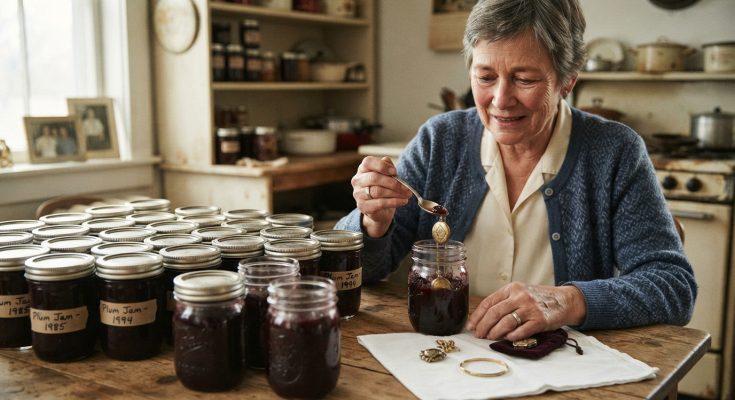
Ruth had placed a jar of plum jam in front of me.
I remembered thanking her.
I remembered Carol laughing.
But Ruth’s letter continued.
“That first Christmas, after everyone had gone home, I noticed something you probably never knew. You had taken the jar of jam home, but you had not opened it. You placed it carefully on the kitchen shelf beside your wedding photograph.”
How could she possibly have known?
“Daniel told me later that you were saving it because you thought it was too special to eat. That was when I realized something about you, Linda. You were grateful for things that other people considered worthless.”
I couldn’t stop crying.
I remembered that jar.
It had been the first homemade gift Ruth had ever given me.
I had eaten the jam eventually, but I had kept the empty jar because I couldn’t bring myself to throw it away.
Apparently, Ruth had noticed.
I turned to the second page.
“Linda, I want you to know that every bond inside those jars was purchased with money I earned myself. I sold eggs, vegetables, preserves, and anything else I could produce. I never used Daniel’s inheritance, and I never took money from the family accounts.”
I looked at the bonds again.
They were all issued in my name.
Every single one.
The first was worth $50.
The second was $75.
The third was $100.
The amounts increased over the years.
Some were $200.
Others were $500.
A few were worth $1,000.
I had no idea what their current values were, but I knew enough about savings bonds to understand that they could have accumulated substantial interest over four decades.
I picked up my calculator.
Then I stopped.
I couldn’t do it yet.
I needed to finish the letter.
Ruth had written:
“Every year, I bought a bond for you. I placed it inside the jar before giving it to you. But I knew you would never find it because I sealed the papers beneath the metal lids, and you always used the jam before washing the jars.”
I stared at the page.
Then I looked toward the basement sink.
She was right.
For thirty-nine years, I had emptied the jars, washed them, and stored them.
But I had never removed the lids completely.
I had simply rinsed them and placed them on the shelf.
Ruth knew exactly what I would do.
And she had been counting on it.
I turned to the third page.
This was where her handwriting became slightly shakier.
“Why didn’t I simply give you the bonds? Because I needed to protect you from something I discovered about my own daughters.”
My stomach tightened.
I read the sentence again.
“Carol and Jeanette have spent their entire adult lives believing that everything I own belongs to them. They have never understood that my money is mine, and that I am allowed to decide what happens to it.”
I sat completely still.
“Several years ago, I overheard them discussing Daniel’s marriage. They said you had married him because our family owned land and had money. They said you were waiting for me to die so you could inherit something.”
I felt sick.
I remembered countless uncomfortable family dinners.
The little jokes.
The comments about my clothes.
The occasional suggestion that I was lucky Daniel had chosen me.
But I had never imagined they felt that way.
Ruth continued:
“I wanted to tell them that they were wrong. But I knew that if I openly gave you money, they would make your life miserable. They would question Daniel, pressure him, and turn every family gathering into a battle.”
I closed my eyes.
Daniel had always been caught between his mother and his sisters.
He loved his family, but he hated confrontation.
Perhaps Ruth had understood that better than anyone.
“I also knew that you would never ask me for anything. That is why I chose the jam. They could laugh at it. They could make jokes. They could even believe they had won something.”
I let out a small, broken laugh.
All those years, I had thought I was the punchline.
But Ruth had been protecting something.
Something that belonged to me.
I turned the final page.
The first paragraph was short.
“Linda, there is one more thing you must understand. The forty jars are not the entire gift.”
My heart began beating faster.
I continued.
“The bonds are only the beginning. I have also arranged for the sale of my farmhouse and the surrounding land. The proceeds have been placed into a separate trust for you.”
I stopped reading.
I actually stood up.
Then I sat down again.
The farmhouse.
The old property where Ruth had raised her children.
The property she had refused to sell despite years of complaints from Carol and Jeanette.
I had visited that house hundreds of times.
It had a white wooden porch, a red barn, an old apple tree, and a small kitchen where Ruth made her preserves.
I remembered the daughters arguing about the property’s value.
Carol wanted to sell it years ago.
Jeanette wanted to divide it into smaller parcels.
Ruth had always refused.
I continued reading.
“The property was appraised last year. Its value is considerably higher than either of my daughters believes. I have placed the proceeds, together with my remaining savings, into a trust. You are its sole beneficiary.”
My fingers went numb.
Then came the sentence that changed everything.
“Daniel knows about the trust, but he does not know the amount. I asked him not to tell you because I wanted the truth to reach you directly from me.”
I looked at the letter.
Daniel knew?
My husband had known that his mother had left me something?
I felt a strange mixture of sadness and confusion.
Why hadn’t he told me?
Had he been protecting Ruth’s wishes?
Or was there something else?
I read the remaining lines.
“Please do not tell Carol or Jeanette until you have spoken with the attorney. They will tell you that I was confused in my final months. They will say you manipulated me. They will say you stole what belonged to them.”
I swallowed hard.
“Do not argue with them. Do not defend yourself. Let the documents speak.”
The final sentence was written in slightly larger letters.
“Thank you for being my daughter when nobody was watching.”
I pressed the letter against my chest.
For the first time in forty years, I understood what Ruth had been trying to tell me.
I hadn’t been the unwanted daughter-in-law.
I had been the daughter she had chosen.
And she had spent four decades making sure I would never be left with nothing.
The following morning, I called the number printed on the back of the letter.
A woman answered.
“Good morning. Haddon Legal Associates.”
“My name is Linda Haddon. I believe you represented Ruth Haddon.”
There was a brief silence.
“Mrs. Haddon,” the woman said carefully. “We’ve been expecting your call.”
My heart skipped.
“Expecting?”
“Yes. Ruth left specific instructions concerning a letter that would be delivered to you after her final Christmas gift.”
I gripped the telephone.
“She told you about the jam?”
A soft laugh came through the receiver.
“She certainly did. She was very particular about it.”
I couldn’t help smiling.
The woman introduced herself as Margaret Ellis, the attorney who had handled Ruth’s estate planning for nearly twenty years.
She asked whether I had found the bonds.
I told her I had.
Then she said something that made me sit down.
“Mrs. Haddon, before we discuss the trust, I need you to bring all forty jars, the letter, and the original bonds to our office. There is an additional document inside the estate file that I believe you should see.”
“What document?”
“A recorded statement from Ruth.”
I felt a chill.
“Recorded statement?”
“Yes. She made it approximately six months before her death. She anticipated that there might be questions about her intentions.”
I looked at the forty jars.
“Did she say why?”
Margaret paused.
Then she answered.
“Because your sisters-in-law had already contacted our office.”
My stomach dropped.
“What?”
“They requested information about Ruth’s estate and expressed concerns about her mental capacity. We explained that we could not disclose confidential information without authorization.”
I couldn’t speak.
Margaret continued.
“Linda, I don’t want to alarm you, but Ruth was very clear about one thing. She wanted you to understand that the arrangements were made voluntarily, while she was fully capable of making her own decisions.”
I thanked her and scheduled an appointment for that afternoon.
After hanging up, I sat at the kitchen table for nearly twenty minutes.
Then I heard the front door open.
Daniel had returned from his morning appointment.
He walked into the kitchen, removed his jacket, and noticed the papers spread across the table.
His expression changed immediately.
“Linda?”
I looked up.
“Your mother left me something.”
Daniel froze.
“What do you mean?”
I placed the letter in front of him.
He looked at the handwriting.
Then he closed his eyes.
“Oh, Mom.”
The sound of his voice told me everything.
He knew.
I stood up.
“You knew about the bonds?”
He nodded slowly.
“Not all of them. She told me about the first few years ago. She made me promise not to interfere.”
“Did you know about the trust?”
He hesitated.
“Yes.”
The room became painfully quiet.
I stared at my husband.
“How long?”
“About eight months before she died.”
I felt tears rising again, but this time they were not entirely from sadness.
“Eight months, Daniel?”
He stepped toward me.
“Linda, please let me explain.”
“Did you know she was leaving me the property?”
“I knew she had made arrangements. I didn’t know the final amount.”
“Why didn’t you tell me?”
He looked down.
“Because she asked me not to. She said she wanted you to discover it yourself. She was afraid that if you knew, you would feel obligated to tell Carol and Jeanette.”
I shook my head.
“Your sisters have spent forty years laughing at me. They thought I was receiving scraps while they received everything.”
“I know.”
“No, Daniel. You don’t know.”
My voice broke.
“Every Christmas, I sat there while they opened beautiful jewelry. I smiled. I thanked your mother for the jam. I listened to the jokes. I never complained because I didn’t want to make your mother uncomfortable.”
Daniel reached for my hand.
I pulled away gently.
“And all those years, she was hiding something inside those jars.”
He nodded.
“She loved you, Linda.”
I looked at him.
“Then why did she make me feel like I was the least important person in the family?”
Daniel had no answer.
He simply stood there.
After a moment, he said something that surprised me.
“There’s something else.”
I looked up.
“What?”
“Mom asked me to keep a second envelope.”
My heart started racing.
“Where is it?”
Daniel walked toward the hallway.
“In her old sewing cabinet. She gave it to me a few weeks before she died.”
“Why didn’t you mention it?”
He stopped.
“Because she told me not to open it unless you discovered the first forty jars.”
He returned a few minutes later carrying a yellow envelope.
My name was written across the front.
But beneath it, in smaller handwriting, were five words.
Only Linda should read this.
Daniel placed it on the table.
I stared at the envelope.
Then I slowly opened it.
Inside was a single sheet of paper and a small brass key.
The paper read:
“Linda,
If you have reached this point, then I know you have found the forty bonds.
The key belongs to the small locked drawer in my bedroom writing desk.
Inside that drawer is something I kept for forty years.
It is not money.
It is not jewelry.
It is something that explains why I chose you long before you understood what you meant to this family.
Please go there with Margaret Ellis.
And Linda, whatever you do, do not let Carol or Jeanette take that drawer.
Love,
Ruth.”
I read it twice.
Then I looked at Daniel.
“What’s inside the drawer?”
He shook his head.
“I honestly don’t know.”
I held the brass key in my palm.
It was surprisingly heavy.
And suddenly, I remembered something.
The last time I visited Ruth in the hospital, she had held my hand and whispered something I couldn’t quite understand.
At the time, I thought she was confused.
Now I remembered her exact words.
“Don’t let them throw away the little blue book.”
I looked at Daniel.
“Did your sisters clean out your mother’s bedroom?”
His expression changed.
“Yes. Carol and Jeanette took care of it.”
“Did they empty her writing desk?”
He nodded.
“Everything was removed.”
My stomach tightened.
“Daniel, I think they might have found something.”
He looked at me.
“What are you talking about?”
I picked up the letter again.
Ruth had written that the drawer must not be taken.
But the drawer had already been emptied.
And if Carol and Jeanette had found the little blue book, they might have known about something Ruth had been hiding from them.
My phone suddenly rang.
It was Carol.
I answered.
“Hello?”
Her voice sounded unusually cheerful.
“Linda! Finally. I’ve been trying to reach you.”
“Is something wrong?”
“Oh, nothing serious. Jeanette and I were discussing Mom’s things, and we realized there might be some paperwork you need to sign.”
“What paperwork?”
“Just some routine estate documents. We thought it would be easier if you came over tomorrow.”
I glanced at Ruth’s letter.
“What kind of documents?”
Carol sighed impatiently.
“Honestly, Linda, I don’t understand why you’re making this complicated. It’s just paperwork concerning Mom’s remaining property.”
I stayed quiet.
Then Carol added something that made my blood run cold.
“By the way, did you happen to find anything unusual inside that last jar?”
I stopped breathing.
My eyes moved toward the forty jars on the basement stairs.
Carol continued.
“Mom was getting forgetful near the end. She sometimes put strange things in places where they didn’t belong.”
I forced myself to remain calm.
“Why do you ask?”
A pause.
Then she laughed.
“Just curious. You know how she was.”
I didn’t answer.
She changed her tone.
“Anyway, bring the jar tomorrow. Jeanette wants to see it.”
I looked at Daniel.
He was watching me carefully.
“Why does Jeanette want to see the jar?”
Carol sighed.
“Linda, please don’t make this awkward. We’re family.”
Then she hung up.
I slowly lowered the phone.
For several seconds, neither Daniel nor I spoke.
Finally, he said:
“They know.”
I nodded.
“Yes. I think they do.”
But there was something else I couldn’t ignore.
Carol hadn’t asked whether I found money.
She hadn’t asked whether I found a bond.
She had asked whether I found something unusual.
And that meant she might know about the little blue book.
That afternoon, Daniel and I drove to Margaret Ellis’s office.
I brought all forty jars in two sturdy cardboard boxes.
Margaret examined the bonds carefully, checking their dates, registration details, and identifying numbers.
She seemed genuinely impressed.
“Ruth was extraordinarily organized,” she said.
“That was always her way,” I replied.
Margaret smiled.
“She visited me every December for forty years. Sometimes she came with a basket of preserves. Sometimes she brought eggs. She always insisted on paying her own legal fees in cash.”
I laughed softly.
“That sounds like her.”
Margaret opened a file.
“Now, let’s discuss the trust.”
She explained that Ruth had established it years earlier and updated it several times.
The farmhouse and surrounding land had been transferred into the trust.
The property had recently been sold under arrangements Ruth had approved before her death.
The proceeds, along with her remaining savings and investments, had been placed into the trust.
Margaret turned a page.
“Based on the final accounting, the current trust value is approximately $1,860,000.”
I stared at her.
Daniel leaned back in his chair.
Even though he had known about the arrangements, he seemed stunned by the final number.
“One million eight hundred and sixty thousand?” I whispered.
Margaret nodded.
“That’s the current estimated value, subject to the final accounting and any applicable expenses.”
I looked down at my hands.
I had spent forty years believing I was receiving a modest jar of homemade preserves.
Meanwhile, Ruth had quietly built a future for me.
Margaret continued.
“The forty savings bonds are separate from the trust. We will need to verify their current redemption values, but they are also registered in your name.”
I couldn’t find words.
Then Margaret reached into another folder.
“There is one more thing.”
She placed a sealed envelope on the desk.
It had Ruth’s handwriting.
“She asked me to play this recording for you before we discuss the remaining documents.”
Margaret opened her laptop.
A familiar voice filled the office.
Ruth’s voice.
Older.
Softer.
But unmistakably hers.
“Hello, Linda.”
I immediately covered my mouth.
“I hope you’re sitting down. I know you probably have questions. I know you’re wondering why I let those girls laugh at you for so long.”
I began crying.
Ruth continued.
“Please don’t be angry with me. I had my reasons. But there is something I never told Daniel, Carol, or Jeanette. Something that happened in the summer of 1985, before you married my son.”
I looked at Daniel.
He appeared just as confused as I was.
On the recording, Ruth took a breath.
“Linda, do you remember the afternoon you came to my house for the first time? You were wearing a yellow dress, and you helped me carry groceries into the kitchen.”
I nodded instinctively.
Of course I remembered.
I had been nervous and had spilled a bag of apples on the porch.
Ruth laughed softly in the recording.
“You probably thought I didn’t notice what happened afterward. But I did.”
The recording paused briefly.
Then her voice became serious.
“You found an envelope underneath the kitchen table that afternoon. It contained money I had been saving for Daniel’s medical bills. You could have kept it. Nobody would have known.”
I felt my face go pale.
I remembered the envelope.
There had been several hundred dollars inside.
I had found it near the kitchen table and immediately handed it to Ruth.
I hadn’t thought about it again.
But Ruth remembered.
“You didn’t know how much was inside. You didn’t ask for a reward. You simply gave it back and told me I should keep it somewhere safer.”
Her voice softened.
“That afternoon, I decided something. I decided that if you ever became part of this family, I would make sure you were never treated as though you were worth less than my daughters.”
I couldn’t hold back my tears.
Then came the final part of the recording.
“Linda, the little blue book is important. It contains something that could change what you understand about this family. I wanted you to have it because the truth belongs to you, too.”
The recording ended.
Margaret closed her laptop.
For several seconds, the office was silent.
Then she opened another document.
“Linda, I believe we should discuss the blue book before you meet with Carol and Jeanette.”
I looked at her.
“Why?”
Margaret hesitated.
Then she said:
“Because Ruth’s final estate instructions mention a financial transaction from 1985 involving the Haddon family property.”
Daniel frowned.
“What financial transaction?”
Margaret turned the document toward us.
At the top was a date.
August 17, 1985.
And beneath it was a name I recognized immediately.
My father’s name.
I stared at the paper.
My father had died when I was nineteen.
He had never told me anything about the Haddon family.
I looked at Margaret.
“Why is my father’s name in my mother-in-law’s estate file?”
Margaret folded her hands.
“That’s exactly what Ruth wanted you to discover.”
Then she opened another folder and removed a photocopy of an old handwritten agreement.