He looked at the window. “I thought you’d tell me to leave and never come back.” “I might have, if you’d continued lying.”
He looked surprised. I continued. “I don’t want to spend the rest of my life hating you. But I won’t confuse forgiving you with pretending you didn’t hurt anyone.”
He sat down slowly. “Mom says you used to forgive people more easily.”
I almost smiled. “Your mother has a selective memory.”
He laughed once, then looked embarrassed.
I reached for the coffee pot.
“Would you like some?”
He nodded.
I poured two cups.
For a few minutes, we sat at the table like we used to when he was younger.
Then he asked, “Can I ever come back to the property?”
I looked at him.
“Not yet.”
His shoulders sank.
“But maybe someday,” I added, “if you’ve paid everyone back, if you respect the boundaries I’ve set, and if I believe you understand what went wrong.”
He swallowed.
“All right.”
“And if I ever allow you to hunt there again, it will be because I choose to invite you. Not because you assume you have a right to be there.”
He nodded.
“I understand.”
I hoped he did.
But hope, I had learned, was not a substitute for evidence.
So I kept the gate locked.
Winter came early that year.
The creek froze solid enough to hold a thin layer of snow along its edges. The oak trees stood bare against the sky, and the deer moved through the timber in the early morning, leaving tracks that crisscrossed the frozen ground.
I went out to the property every Saturday.
Sometimes I walked the fence line.
Sometimes I sat in the stand with coffee and watched the light change across the field.
Sometimes I did nothing at all.
At first, the silence felt unbearable.
Every tree reminded me of Wes. Every repaired fence post seemed to carry his fingerprints. Even the old shed smelled faintly of the oil he used on his tools.
But as the weeks passed, I began to notice things that weren’t memories.
A hawk circling above the creek.
The sound of water moving beneath the ice.
A young oak growing beside the stump of an older tree.
Life was still happening on that land.
And I was still part of it.
In January, Richard Miller sent me a letter.
He thanked me for handling the situation honestly and told me that he and Evan had decided to visit a state wildlife area the following season.
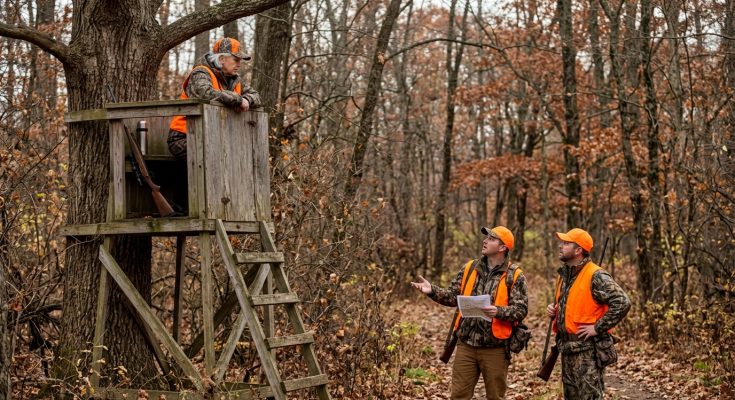
He included a photograph of the two of them standing beside a small cabin, both wearing orange vests.
Evan was holding a thermos.
At the bottom of the letter, Richard had written:
He still talks about the woman who offered us coffee before telling us the truth. Thank you for treating my son with kindness on a difficult morning.
I read that sentence several times.
Then I placed the letter in the desk drawer beside Wes’s old photographs.
I had worried that the incident would leave nothing but bitterness.
Instead, it had reminded me that kindness and firmness could exist together.
I could tell the truth without humiliating someone.
I could protect my property without treating every stranger as an enemy.
And I could love my nephew without allowing him to take advantage of that love.
Those were lessons Wes had understood instinctively.
I was learning them more slowly.
But I was learning.
By the following spring, Cody had repaid the first three hunters in full.
He had made smaller payments to the others, keeping a record of every transfer. Deputy Schmitt confirmed that Cody had cooperated with the inquiry, though the appropriate authorities still had to determine whether any further action was warranted.
I didn’t interfere with that process.
Cody had made his choices, and he needed to accept their consequences.
My relationship with Linda remained strained.
For several months, she spoke to me only when necessary. At family gatherings, she sat at the opposite end of the table and avoided discussing the property.
I let her have the distance she wanted.
I had learned that peace purchased through silence wasn’t always peace at all.
Then, in April, Linda called.
“Cody wants to do something for you,” she said.
“What sort of thing?”
“He says he owes you for the fence.”
I frowned.
“The fence?”
“He wants to pay for the repairs you made last summer. He says he told the hunters he was maintaining the property when he wasn’t.”
I sat down.
“Has he paid everyone back?”
“Almost. Two people are still owed money, but he’s following the repayment plan.”
I looked out the window.
“Then he can start by finishing that.”
“I thought you might say that.”
There was something different in her voice.
Not anger.
Not quite acceptance.
Perhaps the beginning of understanding.
Before she hung up, she said, “Marlene, I owe you an apology, too.”
I didn’t speak.
“I should have listened when you told me what happened. I defended him because I didn’t want to believe my son could do something like that. I made you feel as though you were the one hurting him.”
My eyes filled.
“Thank you for saying that.”
“I still think you could have handled some things differently.”
“I’m sure I could have.”
“But you were right about the land.”
I looked toward the desk drawer where I kept the deed.
“I wish being right hadn’t been necessary.”
Linda sighed.
“So do I.”
We didn’t solve everything that afternoon.
We didn’t suddenly return to the easy closeness we’d once had.
But we spoke honestly for the first time in months.
And that was enough.
In May, Cody arrived at the property with a truck full of fence posts.
He had called two days earlier to ask whether he could help repair the northern boundary. I had told him I would be there Saturday morning, and that we could discuss it then.
He arrived at eight.
He parked outside the gate and waited for me to unlock it.
That small gesture meant more than he probably realized.
I handed him a pair of work gloves.
“It’s the north fence,” I said. “The corner post is leaning, and two rails need replacing.”
He nodded.
We worked for three hours.
Cody dug out the old post while I held the new one upright. He mixed the concrete, checked the level, and tightened the wire along the adjoining section.
He didn’t complain about the work.
He didn’t ask for permission to hunt.
He didn’t mention inheritance.
At noon, we sat on the bench beneath the oak tree and ate sandwiches from a paper bag.
For a while, neither of us spoke.
Then Cody said, “Wes used to make me hold the post while he checked it.”
I smiled.
“He said a fence was only as straight as the person willing to stand there and make sure it was.”
Cody looked at the repaired corner.
“I didn’t understand him when I was younger.”
“Most of us don’t.”
He turned toward me.
“I’ve been thinking about what you said. About accepting no.”
I waited.
“I think I convinced myself that if I worked hard enough, or if I was useful enough, people would eventually give me what I wanted. And when they didn’t, I took it personally.”
He rubbed his palms together.
“I told myself you didn’t need the land as much as I did. That you were alone out here. That I was just using something that would otherwise sit empty.”
He looked down.
“But it wasn’t empty. It was yours.”
I felt a tightness in my throat.
“Yes,” I said. “It was.”
He nodded.
“I can’t undo what I did. But I can stop pretending it wasn’t wrong.”
For a long time, I studied the young man sitting beside me.
He was thirty-one now.
Not the boy Wes had taught to cast a fishing line, but not beyond the reach of change, either.
“I appreciate that,” I said.
Then I reached into my pocket and took out a small brass key.
Cody stared at it.
“What’s that?”
“A key to the equipment shed.”
He looked at me, uncertain.
“You’re giving me a key?”
“I’m lending you one. You’ll use it only when we’ve agreed you’re coming out here to work. You’ll return it when you’re finished.”
He accepted it carefully.
“Thank you.”
“Don’t thank me yet. I expect you to follow the rules.”
A small smile appeared on his face.
“I will.”
“And one more thing.”
He looked up.
“You’re not paying me back for the fence repairs. You’re helping repair a fence because you said you wanted to make things right. Those are different things.”
He nodded.
“All right.”
We sat together for another few minutes, watching the breeze move across the grass.
Then he picked up the empty sandwich bag and carried it to the truck so he could throw it away.
It was a small act.
But small acts were where trust began.
By the time autumn returned, Cody had repaid the final hunter.
He sent me a copy of the last payment confirmation without being asked.
No speech.
No request for praise.
Just the record.
I called him that evening.
“You finished?”
“Everyone has been paid.”
I closed my eyes.
“Good.”
“I wanted you to know.”
“Thank you for telling me.”
He hesitated.
“There’s something else.”
“What is it?”
“I’d like to take Mom out to the property sometime. Just for a walk. No hunting. No equipment. I want to show her the creek.”
I looked toward the photograph of Wes on the mantel.
For years, Linda had visited the land only when Wes invited her. She’d never understood why he loved it so much.
Perhaps Cody wanted her to understand.
“Let me think about it,” I said.
“Of course.”
“And Cody?”
“Yes?”
“You don’t need to ask for forgiveness every time we speak.”
He was quiet.
“You need to keep showing me that you’ve changed. The rest will take care of itself, one day at a time.”
“All right, Aunt Marlene.”
We hung up.
The following Saturday, I drove to the property and opened the gate.
I walked to the creek, where the ice had long since melted and the water ran clear over the stones. A pair of deer stood at the far edge of the clearing, watching me.
I sat on Wes’s bench.
The stand needed a fresh coat of paint. One of the ladder rungs had loosened. The roof on the equipment shed needed attention before winter.
There was plenty of work to do.
For the first time in a long while, I looked at the list and felt no resentment.
The land wasn’t a burden left behind by a dead man.
It was something we’d built together.
Something I could continue caring for.
Something I could share when I chose to share it.
And something I could protect without apology.
The following Sunday, I invited Linda and Cody to walk the property with me.
Linda arrived carrying a small thermos of coffee.
“I thought you might need this,” she said.
I laughed.
“That’s my line.”
She smiled.
We walked along the southern fence and followed the path toward the creek. Cody pointed out a place where he’d once caught a bass with Wes. Linda remembered the summer Wes had helped her repair the roof on her first house.
For once, nobody argued about the past.
At the edge of the water, we stopped.
Cody looked across the clearing.
“I used to think inheriting something meant someone had chosen you,” he said.
Linda glanced at him.
“What do you mean?”
“I thought if Wes left me the land, it would prove I mattered to him.”
I looked at my nephew.
“Did you ever doubt that you mattered to him?”
He swallowed.
“Sometimes.”
I took a breath.
“Wes didn’t need to leave you eighty acres to prove he loved you. He showed you every time he taught you something. Every time he picked you up. Every time he made room for you at his table.”
Cody’s eyes filled.
“I know that now.”
I placed my hand on his shoulder.
“Then don’t spend the rest of your life trying to prove you deserved what he already gave you.”
He bowed his head.
For a moment, none of us spoke.
Then Linda took my hand.
“I miss him,” she whispered.
“So do I.”
We stood beside the creek until the wind grew colder.
When we finally turned toward the gate, Cody walked a few steps behind us.
He stopped at the old oak tree and looked up at the stand.
“Aunt Marlene?”
I turned.
“Yes?”
“Would you ever let me sit up there with you again?”
I looked at the ladder.
I thought about the morning I’d found him selling what wasn’t his. I thought about Richard and Evan, the eleven hunting groups, the money, the lies, and the long months it had taken to repair even a small part of the damage.
Then I thought about the fence we’d repaired together.
The money he’d repaid.
The way he’d waited outside the gate until I opened it.
Trust wasn’t a door that swung open because someone knocked.
It was a gate that had to be unlocked one careful decision at a time.
“Not this season,” I said.
He nodded.
“I understand.”
“But maybe next year, if you keep doing what you said you’d do.”
He smiled faintly.
“I’d like that.”
We walked back to our cars.
Before Cody left, he handed me the shed key.
“I won’t need this again until you ask me to help.”
I looked at the brass key in my palm.
“You can keep it for now,” I said. “But remember what it opens.”
He nodded.
“The shed.”
“And?”
He looked across the land.
“Something I don’t own.”
I smiled.
“That’s right.”
He drove away, and Linda followed a few minutes later.
I stayed at the gate until both vehicles disappeared down the gravel road.
Then I locked it.
Not because I was angry.
Not because I wanted to punish anyone.
But because it was my land, and I had finally stopped feeling guilty about protecting what was mine.
That evening, I sat in the living room with Wes’s old photograph in my hands.
His smile was exactly as I remembered it.
I ran my thumb along the edge of the frame.
“You would have hated all that fuss,” I whispered.
Then I laughed softly.
“But I think you’d have liked the ending.”
Outside, the wind moved through the maple branches.
And for the first time in twenty months, the house didn’t feel quite so empty.
I had learned that love could be generous without being blind. That forgiveness could be offered without surrendering your boundaries. And that family was not entitled to everything you owned simply because they shared your history.
Wes had left me eighty acres of timber, creek bottom, and memories.
But he had left me something else, too.
The knowledge that a good life wasn’t measured by how much you gave away.
It was measured by whether you could give freely, stand firmly, and still leave room in your heart for people to change.
I turned off the lamp and went upstairs.
The next morning, I would check the fence again.
I would pay the taxes when they came due.
I would keep the gate locked when it needed to be locked, and open it when I decided the time was right.
And every autumn, when the first cold wind moved across the creek, I would take Wes’s old thermos to the stand, pour myself a cup of coffee, and remember the man who had taught me that caring for something meant protecting it.
Even when the person you had to protect it from was someone you loved.


One Comment on “END PART: My Nephew Sold Hunting Rights to My Late”