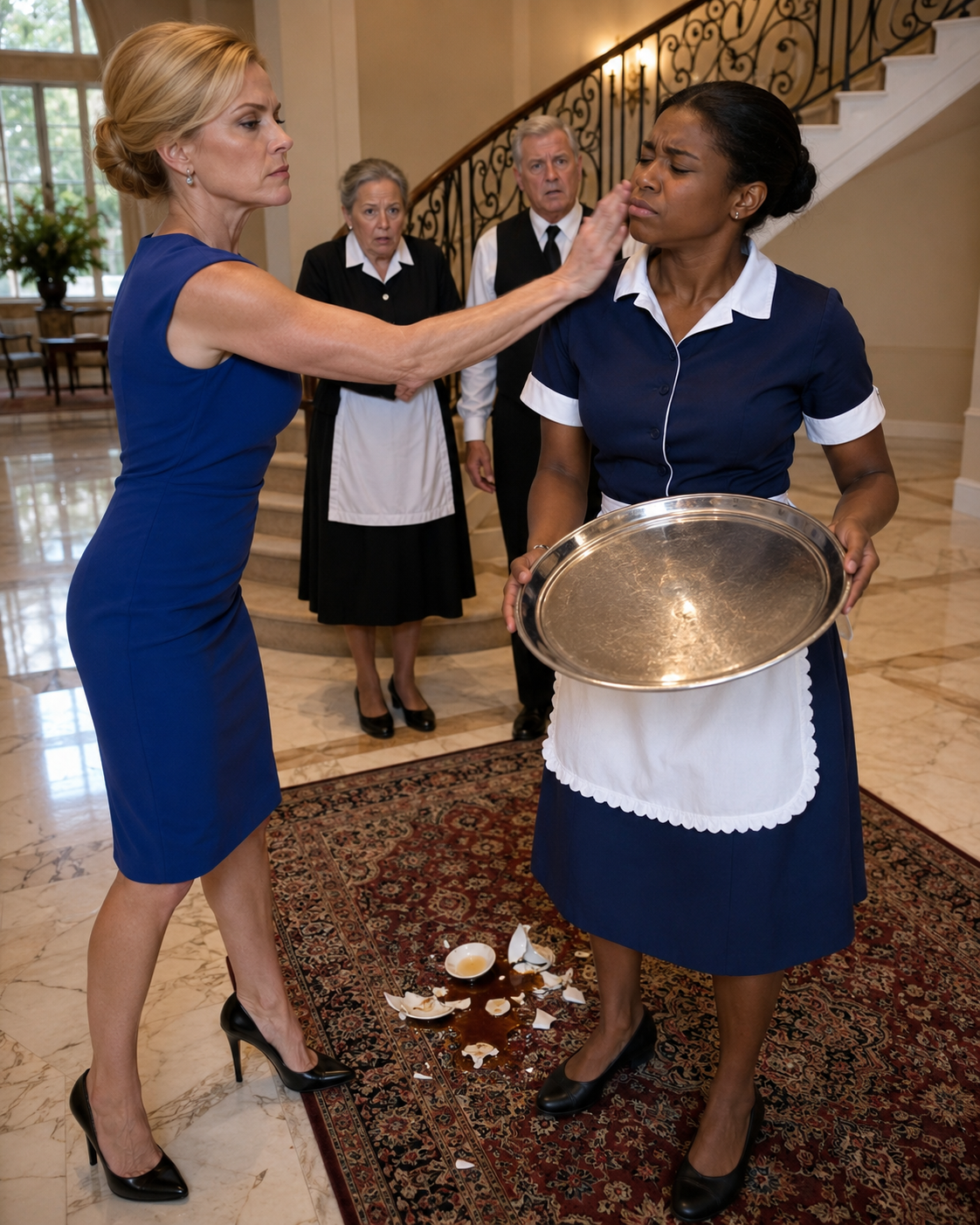
Making it through the first day had only bought Aisha time, and time was what she needed to understand why five women had walked out of the Sterling house before her—before Olivia realized that cleaning was not the only reason she had taken the job.
Aisha knew the risk.
She knew the paycheck mattered.
She knew getting fired would hurt.
But the real fear was leaving with the same unanswered question that had brought her through Richard Sterling’s front door in the first place.
That question had a name.
Grace Daniels.
Grace was Aisha’s older sister, and she had been the third maid to work for Richard after Olivia entered his life.
Before the Sterling job, Grace had spent years doing housekeeping work without a single employer calling her careless, disrespectful, or incompetent.
Then she lasted nine days in that house.
She came home on the ninth night with swollen eyes, a red cheek, and her uniform folded into a grocery bag because she could not stand to look at it.
Grace told Aisha that Olivia had blamed her for breaking an expensive perfume bottle in the dressing room, even though Grace insisted the bottle had already been sitting too close to the edge of the counter when Olivia called her inside.
When Grace tried to explain, Olivia slapped her.
Grace quit the next morning.
What bothered Aisha most was not the story itself.
It was what happened afterward.
Grace changed.
She stopped defending herself.
She stopped applying for similar jobs.
She started wondering aloud whether maybe she really had been careless, whether maybe Olivia had seen something in her that everyone else had missed.
Aisha hated that part.
Humiliation had followed Grace home long after the job ended.
Then Aisha heard that another maid had left.
Then another.
Five in total.
So when the Sterling household posted another opening, Aisha applied without telling Grace.
She did not arrive with a hidden camera, a lawsuit, or some elaborate revenge plan.
She came with one simple intention: work the job, watch closely, and find out whether her sister had been telling the truth.
By the end of her first afternoon, Olivia had answered part of that question herself.
The slap in the marble hall had been real.
So had Olivia’s laugh afterward.
“That’s what the last five maids said before they left crying! Maybe I should speed things up for you.”
Richard had heard every word.
That mattered.
The next morning, Aisha was in the breakfast room before seven, setting down clean napkins while pale daylight spread across the long windows and a coffee maker hissed quietly from the adjoining pantry.
Her cheek no longer burned, but the memory of Olivia’s hand did.
Maria entered carrying a small stack of household notes and stopped beside her.
“You never answered me last night,” she said.
Aisha kept arranging the napkins.
“I know.”
Maria lowered her voice.
“What did you mean when you said you didn’t come here just to clean?”
Aisha looked toward the doorway before answering.
“One of the five maids was my sister.”
Maria’s face tightened immediately.
“Which one?”
“Grace Daniels.”
Maria slowly set the papers on the sideboard.
For several seconds, she said nothing.
Then she whispered, “Grace was good.”
Aisha’s hands stopped.
That was the first thing anyone from this house had said about Grace that felt solid.
Not emotional.
Not defensive.
Just true.
“She thinks she wasn’t,” Aisha said.
Maria looked down.
“I should have called her.”
“Why didn’t you?”
Maria’s answer took longer.
“Because every time something happened, Mrs. Sterling had an explanation, and every time one of us questioned it, we were told we were making household drama.”
Aisha glanced at her.
“We?”
Maria pressed her lips together.
Then footsteps sounded in the hall.
Olivia entered wearing a pale robe and carrying her phone, her expression sharpening the second she saw Aisha and Maria standing together.
“Is this what I’m paying you for?” she asked.
Maria straightened.
“We were discussing the breakfast setup.”
Olivia’s eyes moved to Aisha.
“Were you?”
Aisha picked up the stack of napkins.
“Yes, ma’am.”
Olivia smiled without warmth.
“Then perhaps you can manage something simple today without destroying it.”
Aisha felt Maria shift beside her.
She said nothing.
That became Aisha’s strategy.
Watch first.
Answer only what mattered.
Remember everything.
For the next four days, Olivia tested her in ways that were small enough to dismiss individually and obvious enough to exhaust anyone living through them.
A folded towel was suddenly declared crooked after Olivia had walked past it twice without complaint.
A vase was moved from the center of a table to the narrow edge, then Aisha was ordered to dust around it while Olivia stood nearby criticizing her speed.
A breakfast tray Olivia had approved was called incomplete ten minutes later because a spoon was missing, even though Maria quietly found that spoon in Olivia’s sitting room.
Each incident looked ridiculous alone.
Together, they formed a rhythm.
Maria began noticing it too.
So did the older staff members who had watched Olivia slap Aisha.
Nobody made speeches.
They simply stopped pretending.
One afternoon, Olivia accused Aisha of leaving a stain on a guest-room pillowcase.
Aisha was holding the linen when Maria came through the doorway.
“I changed that set yesterday,” Maria said.
Olivia turned.
“And?”
“The stain was already there.”
Olivia’s jaw tightened.
“You’re certain?”
“Yes.”
Aisha waited.
Olivia looked from Maria to her, then took the pillowcase out of Aisha’s hands.
“Fine.”
One word.
No apology.
But it was the first accusation that had failed in front of another person.
That evening, Maria found Aisha in the laundry room pairing towels beneath bright ceiling lights while a dryer thumped through its final cycle.
Maria carried an old spiral notebook.
“I keep staff schedules in this,” she said.
Aisha looked at it but did not touch it.
Maria opened the cover herself.
She had written each employee’s start date, usual duties, days off, and departure date because she was the one constantly rebuilding the schedule whenever somebody quit.
Grace’s name appeared halfway down one page.
Nine days.
Below it was another woman.
Eleven days.
Another lasted four.
One made it six.
The fifth had left during her second week.
Next to each name, Maria had written a short practical note explaining why the schedule needed changing.
Carelessness dispute.
Argument with Mrs. Sterling.
Walked out after confrontation.
Refused next shift.
Quit unexpectedly.
Maria stared at her own handwriting as if it belonged to somebody else.
“I kept thinking each woman was a separate problem,” she said.
Aisha closed the dryer door.
“And now?”
Maria looked at the list.
“Now I’m wondering why the problem always stayed after they left.”
Aisha did not smile.
That would have been too easy.
Because Maria’s notebook still did not prove every accusation false, and Aisha had no interest in turning suspicion into certainty just because certainty would feel better.
She wanted the truth.
Nothing bigger.
Nothing smaller.
She had watched Olivia manufacture pressure.
She had watched Maria contradict one accusation.
She had watched Richard witness the slap and still allow the household to return to normal by dinner.
That last fact bothered her more each day.
Richard was not cruel to the staff.
In some ways, that made the situation harder to understand.
He thanked people.
He remembered names.
He sometimes carried his own coffee cup back to the kitchen instead of leaving it for someone else.
But whenever Olivia became angry, Richard treated her behavior like weather: unpleasant, temporary, and easier to wait out than confront.
His silence had become part of the house.
Everyone adjusted around it.
Until Aisha didn’t.
On her sixth morning, Richard found her alone in the pantry checking the silver before breakfast.
He paused at the doorway.
“How’s your cheek?”
Aisha looked up.
“Fine.”
He nodded, uncomfortable.
“I’m sorry about what happened.”
Aisha waited a beat.
“Are you sorry it happened, or sorry you saw it?”
Richard’s expression changed.
The question was dangerous.
She knew that.
But she had not entered his house to help him feel comfortable.
Richard stepped inside.
“That’s a fair question.”
Aisha set down the polishing cloth.
“My sister worked here before me.”
His brow furrowed.
“Your sister?”
“Grace Daniels.”
Recognition came slowly.
He remembered the name.
Aisha could see it.
“She left months ago,” Richard said.
“Yes.”
“I was told she broke something in Olivia’s dressing room and then became argumentative.”
Aisha nodded.
“That’s what Grace was told about herself too.”
Richard said nothing.
Aisha continued.
“She came home with a red cheek.”
His eyes lifted sharply.
“She said Olivia slapped her.”
Richard’s face hardened, but Aisha could not tell yet whether he was angry at Olivia, at the accusation, or at himself.
“Did anyone see it?” he asked.
“No one Grace knew about.”
Richard exhaled through his nose.
Aisha understood the problem.
One person’s word against another.
So she did not push past what she could prove.
“I’m not asking you to believe something you didn’t see,” she said. “I’m asking you to look at what you did see.”
Richard’s eyes stayed on her.
“Olivia hit me in front of you.”
He swallowed.
“And she told you the last five maids left crying.”
That landed differently.
Because those were not Grace’s words.
They were Olivia’s.
Richard had heard them himself.
That morning, he did not confront his wife.
Not yet.
Instead, he asked Maria for the staff notebook.
That worried Aisha.
It worried Maria more.
By lunch, Olivia knew something had changed.
She noticed Richard speaking privately with Maria near the study.
She noticed one of the older employees stop lowering her eyes when Olivia passed.
She noticed Aisha was still there.
That seemed to irritate her most.
The confrontation came before dinner.
Aisha was carrying fresh towels toward the upstairs guest rooms when Olivia stepped directly into her path at the base of the staircase.
“Give me those.”
Aisha handed them over.
Olivia dropped the stack onto a side table.
“You’re fired.”
Aisha’s stomach tightened.
There it was.
The paycheck.
The rent.
The groceries she had already calculated twice that week.
Real consequences.
She kept her voice level.
“May I ask why?”
“Because I don’t trust you.”
“That’s not a work reason.”
Olivia stepped closer.
“I do not owe you a debate.”
Richard appeared at the top of the stairs.
The scene looked painfully familiar.
Only this time, Aisha was not holding a shaking tray.
“Olivia,” Richard said, “did you fire Aisha?”
“Yes.”
“Why?”
Olivia turned toward him.
“Because she has been stirring up the staff, snooping into private matters, and questioning me in my own home.”
Aisha felt the urge to defend herself immediately.
She didn’t.
Richard came downstairs.
Maria emerged from the corridor behind him, the spiral notebook in one hand.
Olivia saw it.
Her eyes narrowed.
“What is that?”
Maria answered before Richard could.
“My staffing book.”
Olivia looked at Aisha.
“So this is what you’ve been doing.”
Aisha finally spoke.
“I came here because my sister was one of the five women who left.”
Olivia froze for half a second.
Then she laughed.
“Of course.”
Richard watched her carefully.
“You remember Grace?”
Olivia folded her arms.
“I remember a lot of bad employees.”
Maria’s face changed.
“No.”
The word was quiet.
Olivia turned toward her.
Maria held the notebook against her apron.
“Grace was not a bad employee.”
Olivia stared at her.
Neither woman moved toward the other.
Maria continued.
“She worked hard. She listened. She was careful.”
Olivia’s voice sharpened.
“She broke my perfume bottle.”
“I didn’t see her break it.”
“You didn’t have to.”
Maria shook her head.
“That’s the problem.”
Richard looked down at the notebook.
Then at Olivia.
Then at Aisha.
One of the two older staff members who had witnessed the first-day slap had stopped farther down the hall.
She did not interrupt.
She did not need to.
Richard had already seen enough of the present to reconsider the past.
Olivia pointed at Aisha.
“This girl came into our home under false pretenses.”
Aisha answered calmly.
“I came here to work.”
“You came here looking for something.”
“Yes.”
“What?”
Aisha looked directly at her.
“A reason five capable women suddenly became incompetent the minute they worked for you.”
Olivia’s expression hardened.
For a moment, Aisha expected another slap.
It never came.
Richard stepped between them without touching either woman.
“Enough.”
Olivia stared at him.
“You’re taking her side?”
Richard shook his head.
“I’m taking responsibility for what I ignored.”
The words were not dramatic.
That made them heavier.
Richard had heard complaints.
Richard had seen turnover.
Richard had watched Aisha get slapped.
Richard had still hoped the problem would solve itself.
Now five names were written in Maria’s notebook, and a sixth woman was standing in the same hallway being thrown out after less than a week.
The pattern no longer required imagination.
Olivia looked at Maria.
“So what, everyone is against me now?”
Maria’s shoulders dropped slightly.
“No, ma’am.”
She paused.
“We’re just done pretending this is normal.”
Olivia turned back to Richard.
“You have no idea what I’ve dealt with trying to manage this house.”
“Then we can talk about that,” Richard said. “But you do not get to hit employees.”
Olivia opened her mouth.
Richard kept going.
“And you do not get to fire Aisha tonight.”
Olivia’s face went still.
Aisha did not feel victorious.
Mostly, she felt tired.
Because she had never wanted to destroy a marriage or humiliate anyone in a marble hallway.
She had wanted Grace to stop wondering whether she deserved what happened.
Richard looked at Maria.
“From now on, staff issues go through you and me.”
Maria nodded once.
Then Richard looked at Olivia.
“No private punishments. No screaming at people. No physical contact. If there’s a work problem, it gets documented and handled like a work problem.”
Olivia gave him a stunned look.
“You’re setting rules for me in my own house?”
“I’m setting rules for how people are treated in mine.”
The distinction hurt.
Aisha could see that.
Olivia’s anger did not vanish.
She did not suddenly become apologetic.
She picked up her handbag from the entry table, walked past everyone, and pulled open the front door.
Richard called her name once.
She kept moving.
A moment later, the door shut behind her.
Nobody celebrated.
That mattered too.
Maria picked up the towels Olivia had dropped onto the table.
Aisha reached for half the stack.
Maria let her take them.
Work still needed doing.
The next several days were uncomfortable in a completely different way.
Olivia stayed away from the house while she and Richard decided what their marriage would look like after the confrontation.
Richard did not discuss those details with the staff, and Aisha respected that boundary.
What happened between husband and wife belonged to them.
What happened to employees did not.
Richard met with each staff member separately.
He listened more than he spoke.
One worker admitted she had nearly quit twice because of Olivia’s insults.
Another said she had started arranging her schedule to avoid being alone with her.
Maria admitted she had protected the household’s peace by asking employees to absorb behavior she should have challenged.
Richard did not excuse himself.
He also did not turn the meetings into performances.
He changed the reporting structure.
Maria controlled schedules again.
Complaints were written down.
No one could be dismissed in the middle of an argument.
Simple rules.
Long overdue.
On Aisha’s twelfth day, Richard asked her to meet him in the kitchen before her shift ended.
Maria was there too.
For one terrible second, Aisha thought he had changed his mind.
Instead, he placed Maria’s notebook on the counter.
“I corrected Grace’s departure note,” he said.
Aisha looked down.
The old shorthand about a dispute had been crossed out carefully.
Beside it, Maria had written that Grace had left following inappropriate treatment by the household employer and that no finding of poor performance had been established.
It was not a legal victory.
It was not money.
It would not erase the night Grace came home crying.
But it was the first written thing connected to the Sterling house that did not make Grace carry the blame.
Aisha touched the edge of the page.
“Can I tell her?”
Richard nodded.
“You should.”
That evening, Aisha called Grace from the front porch after clocking out.
She did not tell the story like a hero.
She told it like a sister.
She explained the notebook.
She explained Maria’s words.
She explained that Richard had finally acknowledged there was no basis for calling Grace incompetent.
Grace was quiet for a long time.
Then she asked, “So you believed me?”
Aisha’s throat tightened.
“I always believed you.”
“No,” Grace said softly. “I mean after seeing the house.”
Aisha looked through the front window toward the marble hallway where the porcelain cup had shattered on her first day.
“More than before.”
Grace let out a shaky breath.
That was enough.
On day fifteen, Maria walked into the staff kitchen carrying two paper coffee cups and set one beside Aisha without comment.
Aisha looked at the calendar.
Fifteen days.
Longer than several women before her.
Maria noticed where she was looking.
“You made it,” she said.
Aisha smiled.
“Apparently.”
But lasting was never the impossible part.
Enduring cruelty can look like strength from the outside when sometimes it is only necessity.
What changed the Sterling house was that Aisha refused to let endurance become silence.
She did not outspend Olivia.
She did not outshout her.
She did not become Richard’s confidante or suddenly step into some glamorous new life.
She stayed a maid.
Maria stayed the housekeeper.
Richard stayed responsible for the home he had failed to manage.
And Olivia, whether she returned to the marriage or not, could no longer pretend that every woman who left had simply been defective.
Aisha had broken that story.
Weeks later, she crossed the same marble hall carrying another silver tray.
The Persian rug had been professionally cleaned, but if she looked closely she could still remember exactly where the tea had splashed and the porcelain had broken.
This time her hands were steady.
Maria called from the kitchen that a grocery delivery had arrived at the service entrance.
One of the older staff members passed carrying folded linens.
Richard was upstairs on a call.
It felt almost ordinary.
Aisha glanced once at the place where Olivia had slapped her.
Then she kept walking.
The job was still demanding.
The house was still enormous.
Nothing had magically become perfect.
But for the first time since Grace had worked there, being employed inside the Sterling home no longer required someone to surrender her dignity just to keep her paycheck.
And that—not surviving a slap, not outlasting an angry woman, not living in a billionaire’s mansion—was the impossible thing Aisha had actually done.