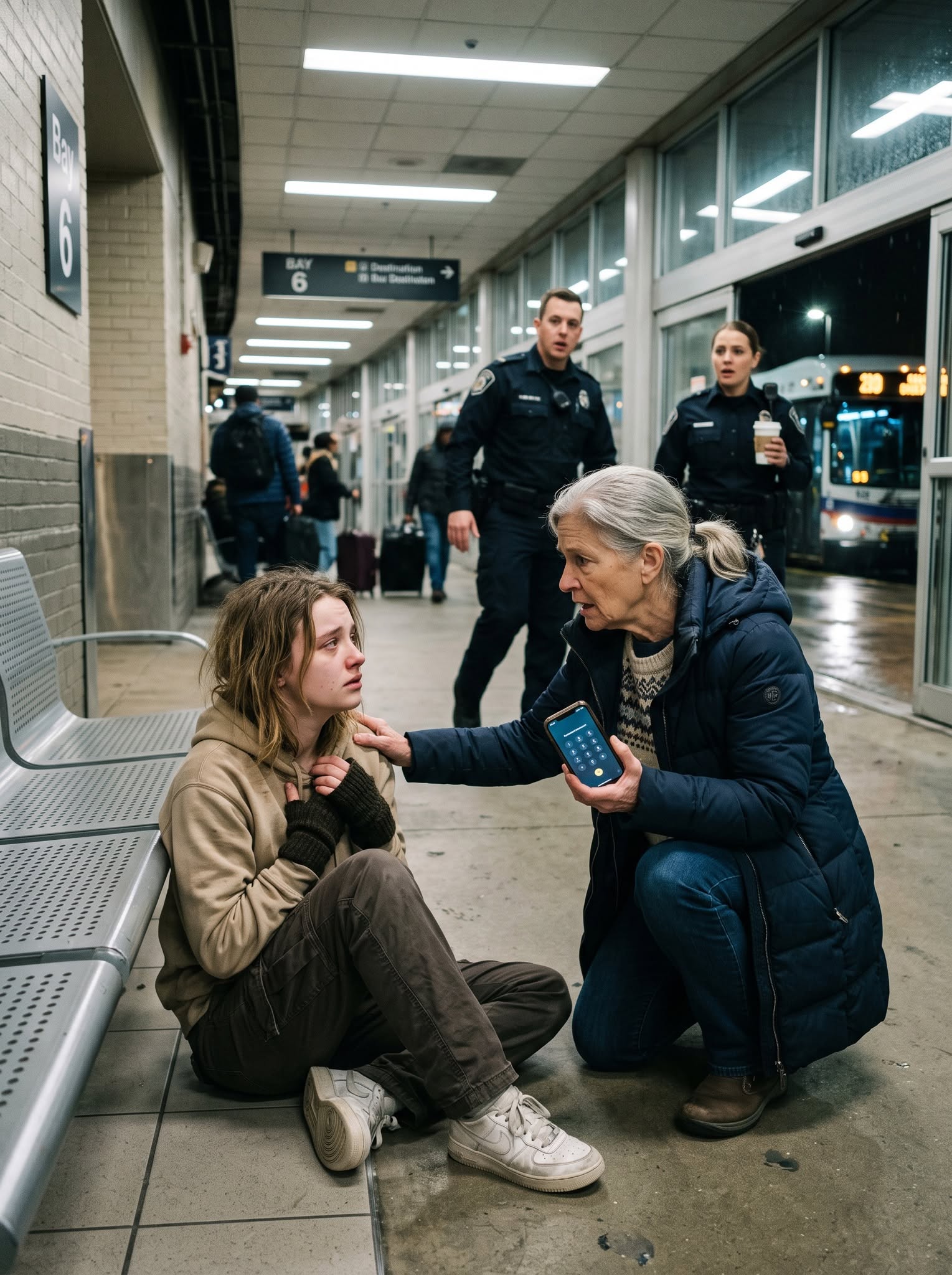
My arrogant son-in-law had no idea I was a retired federal prosecutor. So when he called at 5:00 AM on Thanksgiving telling me to collect my daughter from the bus station, he thought he’d gotten away with it. I found her freezing on a bench, barely able to whisper that they’d hurt her just to put his mistress at the holiday table. While they sat down to host their grand dinner, I unlocked my old badge and made the single phone call that was about to shatter their entire world.
Part 1: The Call at 5:02
At 5:02 on Thanksgiving morning, my son-in-law called me and told me to pick up my “garbage.”
My kitchen still smelled like pumpkin pie, black coffee, and spilled cinnamon. Ice tapped against the windows, and the small flag on my porch snapped in the wind. Then my phone rang.
Ryan.
He never called unless he wanted something moved, signed, hidden, or forgiven. His mother, Diane, was worse. She could turn any kindness into an obligation.
To them, I was just Margaret Hayes—a quiet widow with an old SUV, grocery coupons in my purse, and birthday cards with cash tucked inside. They had never once asked what I had retired from.
I answered.
“Come pick up your garbage,” Ryan said.
My hand tightened around the counter.
“Where is Emily?”
“Downtown bus terminal. Your daughter decided last night was the perfect time for a breakdown. I’m hosting my CEO for Thanksgiving dinner, and I don’t have time for drama in my house.”
Emily was twenty-eight, an engineer, and one of the calmest people I knew. She made spreadsheets for camping trips and labeled moving boxes by room and weight.
Emily did not have breakdowns.
Diane laughed somewhere behind him.
“Tell her to take that pathetic girl back where she came from. And tell her I expect payment for my five-thousand-dollar rug.”
“Go get her, Margaret,” Ryan snapped. “The caterers arrive in four hours. Do not bring her back.”
The call ended.
For three years, I had swallowed things I should have challenged. I wanted to call back and remind him that the harmless old woman he dismissed had spent years in federal courtrooms facing men with powerful lawyers and louder egos.
I didn’t.
Anger mattered later.
Facts mattered now.
I grabbed my coat and keys, then opened the hallway closet and took down a small lockbox I had not touched in years.
By 5:43, I was at the terminal.
I found Emily outside Bay 6, curled on a metal bench beneath a broken streetlight with no coat and only one shoe. She was shaking so hard she could barely say my name.
“Mom,” she whispered.
I dropped to my knees.
“Baby, look at me. Stay with me.”
Her hand gripped my coat weakly.
“They hurt me,” she said. “Ryan and Diane.”
Then her eyes rolled back, and she went limp against me.
At 5:47, I called 911.

Part 2: The Badge Ryan Never Knew About
“I need Advanced Life Support at the downtown bus terminal, Bay 6,” I told the dispatcher. “Adult female, unconscious after being left in freezing temperatures. She may be seriously injured. Send police too. I need to report a domestic incident.”
The dispatcher asked if I was safe.
“Not relevant yet,” I said.
The security guard behind the glass stood up. A bus driver froze with his coffee halfway to his mouth.
I opened the lockbox.
Inside was the badge Ryan had never known existed.
“My name is Margaret Hayes,” I told the dispatcher. “I’m a retired federal prosecutor.”
The dispatcher’s voice changed immediately.
But the badge was not a magic solution.
It did not give me authority over the scene.
It only reminded me of what I already knew: the first record matters. The first words matter. The first version of the truth can disappear fast when calmer, wealthier, better-dressed people start explaining things.
So I spoke carefully.
“Please put this in the call notes exactly. The victim reported a domestic incident. She says the people involved cleaned the residence afterward. There may be evidence at risk. Responding officers need to know that before anyone contacts the house.”
The dispatcher repeated it back.
That mattered.
Then I gave her Ryan’s address and closed the lockbox.

Part 3: Chloe’s First Words
A security guard came outside with a blanket while I kept one hand on Emily’s shoulder. Her breathing was shallow, but it was there.
Every instinct in me wanted to drive straight to Ryan’s house.
I could picture it clearly: Diane arranging the dining room, Ryan rehearsing his version of the night, guests arriving later to a perfect table where my daughter’s seat had already been given to someone else.
But Emily needed her mother more than Ryan needed an opponent.
So when the responders arrived, I made my first decision.
I went with my daughter.
The police could go to the house.
For the first time that morning, Ryan would have to explain himself without me standing there for him to blame.
Before they loaded Emily into the ambulance, she woke enough to whisper fragments of what had happened.
Ryan had someone else.
Diane said Emily had to leave before Thanksgiving dinner because the other woman would be at the table.
They cornered her.
Then they left her at the bus terminal and cleaned the house.
“They said no one would believe me,” Emily whispered. “They said you were just an old woman.”
I held her hand.
“They were wrong.”

Part 4: The Quiet Woman They Underestimated
For years, I had lived simply.
I drove an old SUV, carried coupons, and sent birthday cards with folded cash inside. I preferred being known as a mother and grandmother, not by the job I once held.
Ryan and Diane mistook that for weakness.
They never wondered why I stayed calm when conversations turned cruel. They never asked why I noticed details other people missed.
They never understood that I had spent years watching powerful people behave exactly like them—confident that money, status, and a polished story could protect them from consequences.
Ryan thought he could remove Emily from his life before guests arrived.
He thought Thanksgiving dinner would still happen.
He thought his successful image, his mother’s confidence, and a cleaned house would be enough.
But stories built on control have one weakness.
They collapse when someone else finally speaks.
Emily had already done the hardest thing.
She told the truth.
I did not promise her a perfect ending.
I promised something simpler.
“I’m here,” I told her. “I’m not leaving.”
And while the ambulance pulled away from Bay 6, officers were already on their way to Ryan’s house with the note I had made sure was entered before anyone there could rewrite the morning.
Part 5: Thanksgiving Changed Direction
The holiday table Ryan wanted to protect was no longer the center of the story.
The center was Emily, shaking in the cold.
The center was the call he thought would make me clean up his problem.
The center was the record he never expected me to create.
He had mistaken patience for permission.
He had mistaken kindness for weakness.
He had mistaken my quiet life for ignorance.
But by the time his caterers were supposed to arrive, Thanksgiving had already changed direction.
There would be no easy performance.
No clean version.
No simple explanation about an emotional wife ruining a holiday.
There would be medical records.
A 911 call.
A witness statement.
Police notes.
And a mother who knew exactly how quickly truth can be buried when powerful people reach it first.
Ryan believed he had called an old woman to collect her daughter.
What he actually did was call the one person who knew how to make sure the truth had a timestamp.