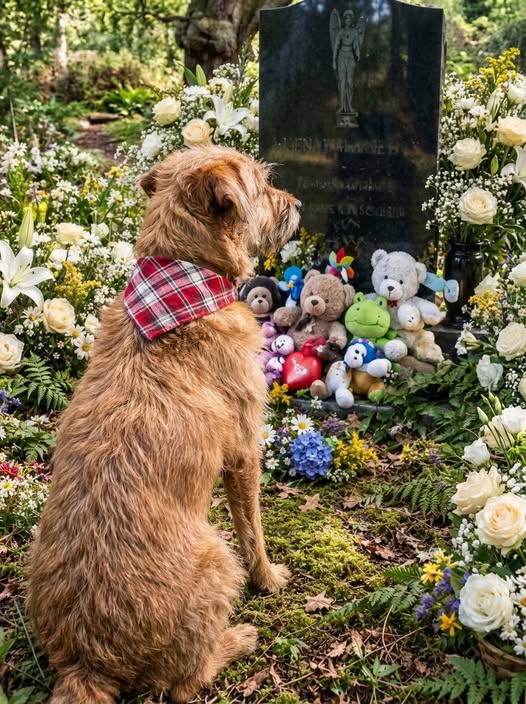
PART 2 : A Strange Dog Sat At My Son’s Grave Every Day
Emma’s hands began to shake before she had even finished unfolding the paper. I watched her eyes move across the first line.
Then the second. By the third, every trace of color had drained from her face. What does it say?”
I asked. She didn’t answer. “Emma.” Her fingers tightened around the note.
Behind us, Noah had crouched beside the scruffy dog, rubbing both hands through its tangled fur as if nothing in the room had changed.
But everything had changed.
Three years of my life had just split open.
I had walked into this house believing the greatest secret waiting for me was the grandson I never knew existed.
Now Emma was looking at a message written by my dead son as though Caleb had reached through the grave and grabbed her by the wrist.
“Please,” I whispered. “Read it.”
Emma swallowed.
Then she handed the note to me.
The handwriting hit me harder than the words.
Caleb had always written too quickly, his letters leaning forward as though even his pen was impatient.
I knew every crooked line.
Mom,
If you ever find this, something probably happened before I could tell you myself.
I need you to know I didn’t fall asleep driving.
I wasn’t drinking.
And I wasn’t speeding.
Someone followed me from Miller Road.
I know who it was.
My hands stopped moving.
The next line had been pressed so hard into the paper that the ink had nearly torn through.
If they say it was an accident, don’t believe them.
I lowered the note.
For a second, I heard nothing.
Not the refrigerator humming.
Not Noah whispering to the dog.
Not even Emma crying.
Only the memory of a police officer standing in my kitchen three years earlier, holding his hat against his chest.
Single vehicle collision.
Wet pavement.
Loss of control.
No evidence of another car.
Caleb had died instantly.
That was what I had been told.
That was what I had forced myself to accept.
I looked at Emma.
“What is this?”
She shook her head rapidly.
“I didn’t know that was in there.”
“Where did the wallet come from?”
“The dog brought it.”
“From where?”
“I don’t know.”
“Emma, that was Caleb’s wallet.”
“I know.”
“No.” My voice rose despite myself. “That wallet was never returned to me after the accident.”
She stared at me.
I remembered the inventory from the hospital.
Cell phone, broken.
One sneaker.
Key ring.
Watch.
A silver chain he had worn since middle school.
No wallet.
I had asked about it once.
The police said belongings sometimes disappeared during crashes.
I had been too shattered to argue.
Now it had appeared in a dog’s mouth three years later.
I unfolded the note again.
There was more writing on the back.
My heart began to pound.
Emma leaned closer.
If I don’t make it home, go to the old maintenance shed near Lake Harper.
Locker 17.
The combination is Noah’s birthday.
Emma made a small sound.
I looked at her.
“What?”
She backed away.
“What did he mean by Noah’s birthday?”
The question barely left my mouth before the answer began forming.
Noah had not been born when Caleb died.
Emma gripped the edge of the kitchen table.
“He couldn’t have known.”
“Known what?”
“That I was pregnant.”
The room seemed to contract around us.
“You said you found out two weeks after he died.”
“I did.”
“Then how could Caleb use your son’s birthday as a combination?”
“He couldn’t.”
Noah glanced toward us.
Emma immediately lowered her voice.
“I swear to you, Diane, Caleb never knew.”
I stared at the little boy.
Three years old.
Dark hair.
Caleb’s chin.
Caleb’s eyes.
I wanted to cross the room, gather him into my arms, and make up for every birthday I had missed.
Instead I stood frozen beside a table, holding a message from my dead son that should have been impossible.
“Maybe he meant another Noah,” I said.
Emma’s expression told me she didn’t believe it.
Neither did I.
The dog suddenly lifted its head.
Its ears turned toward the front window.
A low growl rolled through its chest.
Emma stiffened.
“What is it, Scout?”
“Scout?”
“That’s what Noah calls him.”
The dog stood.
I stepped toward the window.
Across the street sat a black pickup truck.
Engine running.
Windows dark.
“Do you know that truck?”
Emma came beside me.
Her breath caught.
“No.”
But she answered too quickly.
“You’ve seen it before.”
She didn’t respond.
“Emma.”
“It’s been outside twice this week.”
Cold moved down my spine.
“Did you call the police?”
“And tell them what? That someone parked on a public street?”
The truck pulled away.
Slowly.
Almost deliberately.
Scout continued growling until it disappeared around the corner.
I turned back to Emma.
“You’re coming with me.”
“Where?”
“Lake Harper.”
Her eyes widened.
“No.”
“There’s something Caleb wanted me to find.”
“And there is a child in this house.”
“Then Noah comes too.”
Emma stared at me.
“You think I’m taking my three-year-old to some abandoned shed because of a note that appeared in a dead man’s wallet?”
“My son wrote that note.”
“And my son is alive.”
The words stopped me.
My son.
Her son.
Caleb’s son.
The anger went out of me.
Emma covered her face.
“I’m sorry.”
“No. You’re right.”
She lowered her hands.
“I spent three years believing Caleb lost control of his car,” I said quietly. “If someone did something to him, I have to know.”
Emma’s eyes filled.
“So do I.”
We left fifteen minutes later.
Scout came with us.
There was no discussion about that.
He jumped into the back seat beside Noah before either of us could stop him.
Lake Harper sat eleven miles outside town, surrounded by woods and abandoned industrial properties left over from a paper mill that had closed when Caleb was twelve.
I had not driven that road since his accident.
Neither had Emma.
The rain began halfway there.
Light at first.
Then harder.
The windshield wipers beat back and forth as trees blurred along the road.
Emma sat beside me, gripping Caleb’s wallet.
“How long were you and Caleb together?” I asked.
“Almost two years.”
“I thought you broke up.”
“We told people we did.”
“Why?”
She looked toward Noah.
“My father hated him.”
I remembered Emma’s father.
Richard Walsh.
A businessman who owned three auto dealerships and seemed to know half the county council personally.
He had attended Caleb’s funeral.
He had stood twenty feet away from me.
He had shaken my hand.
“I’m sorry for your loss, Diane.”
That was all he had said.
“Why did Richard hate Caleb?”
“Because Caleb knew things about him.”
My hands tightened around the steering wheel.
“What things?”
Emma was silent.
“Emma.”
“Dad had people bringing stolen vehicles into one of the dealership repair warehouses. They changed VIN numbers and moved the cars across state lines.”
I stared at her.
“How did Caleb know?”
“He worked there one summer.”
I remembered.
Caleb had taken a temporary mechanic job after graduation.
He quit after six weeks.
When I asked why, he said the manager was an idiot.
I had believed him.
“He saw something he wasn’t supposed to see,” Emma continued. “After that, Dad wanted me away from him.”
“Did Caleb report it?”
“I don’t know.”
“You never asked?”
“I was seventeen, Diane.”
Her voice broke.
“I thought we had time.”
That sentence almost destroyed me.
I thought we had time.
Every grieving parent knows those words.
Time for one more conversation.
One more hug.
One more question.
One more chance to notice that your child is carrying something heavier than he should.
The entrance to Lake Harper came into view.
An old chain-link gate hung crooked across the service road.
Someone had cut the lock years earlier.
We drove through.
The maintenance buildings sat beyond the trees, low concrete structures covered in vines and rust.
The rain had become a steady downpour.
I parked near the largest shed.
“We stay together,” Emma said.
I nodded.
Noah wore a yellow raincoat she had pulled from the trunk.
Scout walked ahead of us.
The dog knew the way.
That frightened me more than anything else.
He crossed the cracked parking lot without hesitation and stopped beside the third building.
A faded number remained above the door.
17.
Emma whispered, “Oh my God.”
Inside, rows of metal lockers lined the wall.
Most had been forced open long ago.
But locker 17 remained closed.
I knelt in front of the dial.
“The combination is Noah’s birthday,” Emma said.
“Tell me.”
“May nineteenth.”
I tried 0519.
Nothing.
“Year?”
“He was born three years ago. 2023.”
I tried variations.
51923.
51924.
Nothing.
Emma shook her head.
“He couldn’t have known.”
Then Noah wandered closer.
“Mommy?”
“Yes, baby?”
“My birthday is nineteen.”
I looked at him.
“What did you say?”
He smiled.
“I’m May nineteen.”
The simple way he said it made Emma laugh despite herself.
Then the dog scratched at the bottom of the locker.
I noticed four digits scratched into the paint.
1-9-0-5.
I entered them.
Click.
The locker opened.
Emma gasped.
Inside sat a plastic storage box.
Dry.
Untouched.
I carried it to an old workbench.
Inside were photographs.
License plate numbers.
Printed emails.
Copies of dealership invoices.
A flash drive.
And a small digital recorder.
Emma picked up one photograph.
Her father stood beside two men in a warehouse.
Between them was a silver SUV with its doors removed.
“I know this building,” she whispered.
“Where?”
“Dad’s repair center.”
I turned on the recorder.
Static crackled.
Then Caleb’s voice filled the shed.
For one unbearable second, my legs nearly collapsed.
“Testing.”
A pause.
“If anyone hears this, my name is Caleb Bennett.”
Emma covered her mouth.
Noah looked up.
“Daddy?”
Neither of us spoke.
The recording continued.
“I’ve been documenting vehicles coming through Walsh Automotive for six weeks. I think Richard Walsh is running a theft operation with someone inside the sheriff’s department.”
My blood ran cold.
Caleb named dates.
License plates.
Amounts.
He described seeing deputies escort trucks through checkpoints.
Then his voice changed.
Lower.
Nervous.
“Tonight, Emma told me she thinks she might be pregnant.”
Emma dropped into a chair.
“No.”
The recording continued.
“She hasn’t tested yet. She’s scared. I’m scared too.”
Emma began crying.
Caleb had known.
Not for certain.
But enough.
Enough to imagine.
Enough to hope.
“I told her if it’s true and it’s a boy, I want to name him Noah. She laughed and said absolutely not because Noah sounds like an old farmer.”
Despite everything, Emma laughed through her tears.
“That idiot.”
I closed my eyes.
Caleb’s voice went on.
“But I like it.”
A small laugh.
The same laugh I had not heard in three years.
“If the baby comes in May like I think, I’m betting May nineteenth.”
Emma looked at me.
“How?”
I almost smiled.
“Caleb loved numbers.”
“He guessed a birthday?”
“He guessed everything.”
The recording shifted.
“I’m meeting someone tonight who says he’ll take this evidence to state police.”
My smile disappeared.
“I don’t trust local law enforcement anymore.”
Static.
Then Caleb named the meeting location.
Miller Road.
The road mentioned in the note.
Emma stood abruptly.
“Turn it off.”
“Why?”
“Because I know what happens next.”
“No, you don’t.”
“Yes, I do.”
Her voice cracked.
“Caleb called me from Miller Road that night.”
I stared at her.
“You talked to him?”
“For twenty-two seconds.”
“You never told anyone.”
“My father took my phone.”
The words came out in a rush now, as though a door inside her had finally burst open.
“Caleb called and said someone hadn’t shown up. Then headlights pulled in behind him. He said, ‘Emma, I think they found me.’”
She pressed both hands to her temples.
“Then the call ended.”
I could barely breathe.
“What did your father do?”
“He walked into my room five minutes later.”
“What did he say?”
Emma looked at me.
“He said Caleb and I were finished.”
The recorder crackled again.
Another voice appeared.
Not Caleb.
A man.
“Give me the recorder, kid.”
Emma froze.
I turned up the volume.
Caleb answered.
“You said you were taking this to the state police.”
“I changed my mind.”
Then another voice.
Closer.
Familiar.
I had heard it before.
At the funeral.
At the grocery store.
At town meetings.
Sheriff Thomas Mercer.
“You should’ve stayed out of grown men’s business, Caleb.”
I felt the room sway.
Emma whispered, “Mercer.”
Then came the sound of movement.
Caleb breathing hard.
A car door slamming.
An engine.
The recording became chaotic.
Someone shouted.
Then Caleb’s voice.
“If anything happens to me, there are copies.”
A man laughed.
“Where?”
Caleb said nothing.
The recording ended.
Silence filled the shed.
Rain hammered the metal roof.
I sat down.
For three years, Sheriff Mercer had sent me Christmas cards.
Three years.
He had once hugged me at a memorial fundraiser for road safety.
He had stood beside a photograph of my son and talked about “tragic accidents.”
My stomach turned.
Emma looked terrified.
“We need to leave.”
“We take everything.”
“We take the drive and recorder. Leave the rest.”
“Why?”
“Because if they’re watching us, they’ll know we found this.”
A noise came from outside.
Tires on gravel.
Scout began barking.
Emma grabbed Noah.
I looked through the cracked doorway.
A vehicle rolled into the lot.
Black pickup.
Same truck.
“Back door,” Emma whispered.
We ran.
The rear exit opened into thick woods.
Scout bounded ahead.
Rain soaked us immediately.
I could hear doors slamming behind the shed.
Men’s voices.
One shouted, “Check inside.”
Emma clutched Noah against her chest.
I took her arm.
“Move.”
We followed Scout through the trees.
Branches whipped my face.
Mud pulled at my shoes.
Behind us, someone yelled.
“They went out back!”
Noah started crying.
Emma whispered into his hair.
“It’s okay, baby. Mommy’s here.”
Scout suddenly veered left.
He disappeared behind a fallen tree.
We followed and found a drainage tunnel beneath the old service road.
Barely large enough to crawl through.
Emma stared at it.
“No.”
“We don’t have a choice.”
We went in.
Mud covered my hands and knees.
Noah whimpered.
Scout crawled beside him.
Halfway through, headlights swept over the tunnel entrance behind us.
A man’s silhouette appeared.
I held my breath.
Scout growled.
Then another voice called from farther away.
“They’re heading toward the lake!”
The silhouette disappeared.
We waited.
Thirty seconds.
A minute.
Then crawled out the other side.
My car was useless.
They would be watching it.
Emma pulled out her phone.
“No signal.”
I checked mine.
One bar.
I called 911.
Then stopped before pressing send.
Sheriff Mercer.
Someone inside law enforcement had helped kill Caleb.
Maybe Mercer wasn’t alone.
“Who do we call?” Emma whispered.
I thought of the note.
State police.
I searched for the regional office number.
A woman answered.
I gave my name.
I said the words I never thought I would say.
“My son was murdered three years ago, and I have evidence naming the sheriff.”
We were told to stay hidden.
Troopers were being dispatched from another county.
Twenty-eight minutes later, sirens echoed in the distance.
The black pickup was gone.
My car remained.
The storage box had disappeared.
But I still had the recorder.
Emma had the flash drive.
State investigators separated us.
They listened to the recording.
They photographed the locker.
They took fingerprints.
By sunset, two detectives had arrived.
One of them, Detective Laura Hayes, sat across from me inside a patrol SUV.
“Mrs. Bennett,” she said, “we are reopening your son’s case immediately.”
“Arrest Mercer.”
“We need to proceed carefully.”
“You heard the recording.”
“I did.”
“You heard his voice.”
“I heard a voice.”
“That is Sheriff Mercer.”
She didn’t disagree.
Emma gave them everything she knew.
Her father.
The warehouses.
The cars.
The night Caleb called.
Then one detective asked a question neither of us expected.
“Where did the dog come from?”
We looked at Scout.
He sat beside Noah.
“I don’t know,” Emma said.
“How long has he been coming to your house?”
“About six months.”
“And before that?”
“I’d never seen him.”
The detective crouched beside the dog.
“No collar.”
Scout remained still.
Then Hayes ran a scanner over his shoulders.
It beeped.
“He’s chipped.”
An hour later, the result came back.
Registered owner:
Caleb Bennett.
I stared at the detective.
“That’s impossible.”
She checked again.
“Microchip implanted August 14, 2023.”
Caleb died in June 2023.
Two months earlier.
Emma whispered, “That dog wasn’t even born when Caleb died.”
Scout was estimated to be about three years old.
The chip had been registered after Caleb’s death.
Using Caleb’s name.
And my old home address.
Someone had intentionally connected that dog to my son.
The question was why.
That night, I refused to go home alone.
Emma refused to return to her house.
State police placed us in a motel under temporary protection.
Noah fell asleep beside me while Emma showered.
I sat on the edge of the bed, watching him breathe.
My grandson.
I reached out and gently touched his hair.
Three years of grief shifted inside me.
Caleb was gone.
Nothing would change that.
But part of him had somehow survived.
And for the first time since his funeral, I felt something beside pain.
A future.
Scout lay at the door.
At 11:43 p.m., he suddenly stood.
His ears lifted.
Then came a knock.
Three slow taps.
Emma emerged from the bathroom.
“Who is it?”
No answer.
The police officer assigned outside our room should have responded.
He didn’t.
I called Detective Hayes.
No answer.
The knock came again.
Scout barked.
Then something slid under the door.
A photograph.
Emma picked it up.
It showed Caleb.
Alive.
Standing beside his car.
The photograph had been taken on the night he died.
Behind him stood Sheriff Mercer.
And beside Mercer was Richard Walsh.
Emma’s father.
But there was a third person in the photograph.
My hands went numb.
Because I recognized him too.
A man who had stood beside me at Caleb’s funeral.
A man who had paid for half the burial costs.
A man who had visited me every Sunday for months after Caleb died because he said he couldn’t bear the thought of me grieving alone.
My younger brother.
Michael.
On the back of the photograph, someone had written:
ASK DIANE WHY HER BROTHER WAS ON MILLER ROAD.
Emma looked at me.
“Diane?”
I couldn’t answer.
Then my phone rang.
Unknown number.
I answered without thinking.
For three seconds, there was only breathing.
Then a man spoke.
“Stop digging.”
My heart stopped.
I knew that voice.
“Michael?”
Silence.
Then my brother whispered:
“You were never supposed to find the dog.”
The call ended.
And from somewhere outside our motel room, Scout began growling at someone standing on the other side of the door.
PART 3 — THE MAN OUTSIDE THE MOTEL DOOR KNEW MY SON’S LAST SECRET
Scout’s growl changed.
Until that moment, I had heard him bark, whine, scratch at doors, and make the impatient little huff dogs make when humans are moving too slowly.
I had never heard that sound.
It was low enough to vibrate through the motel floor.
Emma grabbed Noah from the bed.
My phone was still in my hand.
The last words my brother had spoken seemed to hang in the room.
You were never supposed to find the dog.
Someone stood outside.
I could see the shadow beneath the door.
Two shoes.
Motionless.
The state officer assigned to protect us had been sitting in a cruiser fifteen feet away.
I moved toward the window.
The cruiser was empty.
Its driver’s door hung open.
“Diane,” Emma whispered, “don’t.”
Three soft knocks came again.
Then a voice.
“Mrs. Bennett?”
Not Michael.
A woman.
“State police. Detective Hayes sent me.”
Emma looked at me.
“Ask her something.”
I stayed behind the locked door.
“What is Detective Hayes’s first name?”
Silence.
My heart began pounding.
Then the woman answered.
“Laura.”
That proved nothing.
“What color coat was she wearing when she interviewed me?”
Another pause.
Scout’s growl deepened.
“Open the door, Mrs. Bennett.”
Wrong answer.
Hayes had worn no coat.
She had been in shirtsleeves.
I backed away.
“Call 911,” I whispered.
Emma already had.
The doorknob moved.
Once.
Twice.
Then stopped.
Noah buried his face against Emma’s shoulder.
The shadow disappeared.
For a few seconds, there was nothing.
Then footsteps moved rapidly along the concrete walkway.
A car engine roared somewhere behind the motel.
Scout lunged toward the window.
I saw a dark sedan race out of the parking lot without headlights.
Two minutes later, real troopers arrived.
Detective Hayes came seven minutes after that, furious.
The officer assigned to us had been found behind the ice machine, conscious but disoriented after being struck from behind.
He remembered nothing except hearing a woman ask him for directions.
Hayes looked at the photograph that had been pushed beneath our door.
Michael.
Sheriff Mercer.
Richard Walsh.
Caleb.
Four men connected by one night.
One of them my son.
One of them my brother.
Two men I now believed had helped hide the truth about Caleb’s cr/@/sh.
Hayes turned the photograph over.
“You recognize the handwriting?”
“No.”
“Emma?”
She shook her head.
Hayes slipped it into an evidence bag.
“Someone wants you looking at Michael.”
“I don’t need encouragement,” I said. “He called me.”
“That may be exactly why you shouldn’t rush.”
I stared at her.
“My brother just admitted he knew about Scout.”
“He admitted knowing about the dog. That is not the same as admitting involvement in your son’s d/e/@/th.”
“My son wrote that the cr/@/sh wasn’t an accident.”
“I know.”
“And Michael was there.”
“I know that too.”
“Then what are you saying?”
Hayes lowered her voice.
“I’m saying someone secretly preserved Caleb’s wallet for three years, registered a dog under his name after his d/e/@/th, trained that dog to visit the cemetery and Emma’s house, and somehow made sure the wallet reached you on the exact week someone began following Emma.”
She paused.
“That isn’t random.”
I looked at Scout.
He had returned to Noah.
The boy was sitting on the bed now, one small hand buried in Scout’s fur.
Hayes continued.
“Whoever created this trail wanted you to find something.”
“Michael?”
“Maybe.”
“Why?”
“That’s what bothers me.”
She sat across from me.
“If Michael wanted the evidence buried, why keep the dog alive? Why register him to Caleb? Why preserve the wallet? Why not destroy everything?”
Emma looked at me.
A horrible possibility formed.
“What if Michael wasn’t hiding the truth?”
Hayes nodded.
“What if he was protecting it?”
I wanted to reject the idea.
I had heard fear in Michael’s voice.
Stop digging.
You were never supposed to find the dog.
Those sounded like threats.
But Michael had also been the person who remained beside me after Caleb’s funeral when almost everyone else eventually returned to ordinary life.
He repaired my porch.
Changed the oil in my car.
Drove me to grief counseling when I refused to drive past the intersection near Miller Road.
On Caleb’s first birthday after the cr/@/sh, Michael sat on my kitchen floor with me until dawn because I could not stop crying.
Had all of that been guilt?
Or protection?
“I want to talk to him,” I said.
Hayes shook her head.
“Not alone.”
“I know where he’ll be.”
Emma frowned.
“How?”
Michael had one ritual he had never missed.
Every Monday morning, six o’clock, before work, he stopped at our parents’ old farmhouse outside Bell Creek.
Our mother had been gone nine years.
Our father, twelve.
Michael kept the property even though he never lived there.
He said he couldn’t sell the place where we grew up.
At 5:48 the next morning, three unmarked state vehicles rolled onto the road half a mile from the farmhouse.
Hayes rode with me.
Emma and Noah remained at a secure location.
Scout refused to stay behind.
The moment we reached the driveway, he started whining.
Not growling.
Whining.
Then he scratched frantically at the window.
“You’ve brought him here before?” Hayes asked.
“Never.”
Scout knew this place.
My stomach dropped.
We let him out.
He ran.
Not toward the house.
Toward the barn.
“Scout!”
He disappeared through a gap beneath the old door.
Michael’s truck was parked beside the house.
The front door stood unlocked.
The kitchen was empty.
Coffee still steamed in a mug.
Hayes called his name.
No answer.
Then Scout barked from the barn.
Once.
Twice.
Urgently.
We crossed the yard.
The barn smelled like cedar, dust, and old hay.
Scout stood beside the rear wall, pawing at loose boards.
Hayes pulled one aside.
Behind it was a narrow door I had never seen.
Michael was inside.
Alive.
Sitting on the floor.
His wrists were tied.
A bruise marked his cheek.
Tape covered his mouth.
Hayes’s officers rushed forward.
When they freed him, Michael looked at me.
Not with anger.
With relief.
“Diane.”
I could barely speak.
“You called me last night.”
His expression changed.
“No, I didn’t.”
My skin went cold.
“I heard your voice.”
“I never called you.”
“You said I wasn’t supposed to find Scout.”
Michael looked at the dog.
Then closed his eyes.
“Oh, God.”
Hayes knelt.
“Who did this to you?”
Michael hesitated.
Then whispered one name.
“Mercer.”
The sheriff.
Michael reached for me.
“Diane, listen carefully. Caleb trusted the wrong person.”
“Who?”
“Me.”
My heart twisted.
Michael stared at the floor.
“Three years ago, Caleb came to me because he thought Richard Walsh was running stolen vehicles through the dealership. He had photographs. Plate numbers. Payments.”
“You knew?”
“I told him to stop.”
“Why?”
“Because I knew Mercer was involved.”
The barn seemed to darken around me.
“How?”
Michael’s eyes met mine.
“Because I used to work for him.”
I stepped backward.
Michael continued before I could speak.
“Not as a deputy. As an accountant. Mercer had businesses under other people’s names. Storage units. Towing contracts. Auctions. I handled records before I realized what he was doing.”
“What exactly was he doing?”
Michael swallowed.
“Moving stolen cars, laundering money, bribing local officials. Richard Walsh was his largest partner.”
My voice shook.
“And Caleb discovered it.”
“Yes.”
“What happened on Miller Road?”
Michael’s face collapsed.
“I was supposed to meet him.”
I stared at him.
“The person Caleb mentioned on the recorder.”
“That was me.”
“You told him you’d take the evidence to state police.”
“I intended to.”
“But Mercer arrived.”
“He had been following me.”
Michael covered his face.
“I didn’t know.”
“What happened?”
“When Mercer pulled in, I told Caleb to leave. Richard arrived seconds later. Caleb ran for his car.”
“And then?”
Michael looked sick.
“Mercer went after him.”
The words hit me like cold water.
“You watched?”
“I followed.”
“Then why didn’t you save him?”
“I tried.”
“Why didn’t you tell me?”
His voice broke.
“Because after the cr/@/sh, Mercer came to my house.”
My breathing stopped.
“He showed me photographs of you.”
“Me?”
“Your grocery store. Your porch. Your bedroom window.”
I felt something inside me crack.
“He told me Caleb had already cost him one problem. He said if I spoke, you would become the next.”
Michael began crying.
Not quietly.
Not gracefully.
My forty-seven-year-old brother folded forward like a child.
“I was a coward.”
I wanted to hate him.
For three years of silence.
For standing beside Caleb’s grave knowing there was more.
For letting me believe my son had simply lost control of his car.
But then Scout pushed against Michael’s leg.
Michael rested one shaking hand on the dog’s head.
“You raised him,” I said.
Michael nodded.
“He was born behind the barn two weeks after Caleb’s funeral.”
The pieces suddenly shifted.
“The chip.”
“I registered him under Caleb’s name.”
“Why?”
Michael looked at me.
“Because I promised your son that if anything happened, I would find a way to make the truth come back.”
I stared at him.
“You trained Scout to visit the cemetery.”
“Yes.”
“And Emma?”
“No.”
His answer was immediate.
“I never knew where Emma went.”
Hayes looked up.
“Then who trained him to go to her house?”
Michael’s expression emptied.
“I didn’t.”
Silence.
Scout had found Emma by himself.
Or someone else had taught him.
Hayes rose slowly.
“Who else knew about the dog?”
Michael hesitated.
“One person.”
“Who?”
“A veterinarian helped me hide him when Mercer started asking questions.”
“What veterinarian?”
Michael looked directly at me.
“Dr. Samuel Reed.”
The name meant nothing to me.
Until Michael added:
“He was the man who pronounced Caleb d/e/@/d at the roadside.”
And suddenly, the mystery was larger than any of us had imagined.
PART 4 — THE VETERINARIAN WHO KNEW CALEB WASN’T ALONE THAT NIGHT
Dr. Samuel Reed’s clinic stood forty miles north of Bell Creek, tucked behind a feed store and a faded red barn.
He was seventy-one now.
Retired.
Widowed.
According to Hayes, he had volunteered with county emergency services during the year Caleb d/i/ed.
That was why he had been on Miller Road.
At least officially.
Michael sat beside me in the unmarked state SUV.
Neither of us had spoken for twenty minutes.
I still didn’t know what to do with him.
Part of me wanted to reach across the seat and take his hand.
Another part wanted to scream until my throat gave out.
“You should have told me,” I finally said.
“I know.”
“You watched me blame Caleb.”
Michael flinched.
“I never blamed him.”
“I did.”
The confession hurt.
“For months, I kept thinking if he had driven slower, slept more, been more careful—”
“Diane.”
“I blamed my own child because I had no other explanation.”
Michael looked out the window.
“I know.”
“No. You don’t get to say that.”
He nodded once.
“You’re right.”
That almost made me angrier.
Then Scout lifted his head from the back seat and rested his chin on my shoulder.
The dog had become the strangest bridge between everyone Caleb left behind.
Me.
Emma.
Noah.
Michael.
And now Samuel Reed.
Hayes approached Reed carefully.
Two troopers remained outside.
She knocked.
A tall, thin man opened the clinic door.
His hair was completely white.
His expression changed the instant he saw Scout.
Not me.
Scout.
“You found her,” he whispered.
Hayes frowned.
“Her?”
Reed stepped backward.
“Oh.”
Scout wagged his tail.
I stared at him.
“You know this dog?”
Reed crouched.
Scout walked straight into his arms.
Reed buried his face against the dog’s neck.
For several seconds, no one spoke.
Then he looked at Michael.
“You told me she was gone.”
Michael looked confused.
“I thought he was male.”
Reed blinked.
Then laughed once, strangely.
“He is.”
“What did you mean by ‘her’?”
Reed rose.
“Not Scout.”
His eyes turned toward me.
“I meant Emma.”
My heart kicked.
“You know Emma?”
He unlocked the clinic door wider.
“Come inside.”
The examination room had been converted into an office.
Reed pulled an old metal box from beneath a cabinet.
“I’ve been waiting three years for someone to ask me the right question.”
“What question?”
He looked at me.
“Who arrived at the cr/@/sh before the sheriff?”
My pulse accelerated.
“Who?”
“Emma.”
I stared at him.
“No.”
“Yes.”
“She told us she spoke to Caleb by phone.”
“She did.”
“Then what?”
“She came to Miller Road.”
Reed opened the box.
Inside were medical notes, photographs, and a sealed envelope.
“Her father followed her.”
Michael stood.
“Richard?”
“Yes.”
Reed’s face tightened.
“I was driving home from an emergency livestock call. I saw Caleb’s car below the embankment. Richard’s SUV was stopped near the road.”
“What did you see?”
“Emma running down the slope.”
I felt dizzy.
“She reached Caleb before anyone else.”
“Was he…”
I could not finish.
Reed understood.
“He was alive.”
The room stopped.
Michael whispered, “What?”
Reed repeated it.
“When I reached him, Caleb was alive.”
My knees nearly gave out.
Hayes pulled out her notebook.
“How long?”
“Several minutes.”
“What condition?”
“Critical.”
“What did he say?”
Reed looked at me.
“Your son asked me to protect Emma.”
Tears flooded my eyes.
“Why?”
“Because she had something.”
Reed opened the envelope.
Inside was a tiny brass key.
“He gave this to her.”
“What does it open?”
“I don’t know.”
“Where is Emma’s key?”
Reed looked toward Scout.
“She hid it.”
“Where?”
“In the collar of the dog’s mother.”
Everyone froze.
Reed told us what happened.
Michael had rescued a pregnant stray shortly after Caleb’s d/e/@/th.
He brought her to Reed.
Neither man knew that Emma had visited the clinic days earlier.
She had escaped from her father long enough to find Reed because she remembered seeing him at the roadside.
Terrified, pregnant, and certain Richard was watching her, Emma gave Reed Caleb’s key and begged him to hide it somewhere her father would never search.
Reed placed it inside a waterproof capsule sewn into the mother dog’s collar.
Weeks later, she gave birth.
One puppy followed Michael everywhere.
Scout.
Then the mother disappeared.
“Disappeared?” Hayes asked.
Reed’s mouth tightened.
“I assumed she wandered off.”
Scout suddenly whined.
I thought of all those months he had gone to Caleb’s grave.
All those trips to Emma’s house.
Dogs remembered scents.
Places.
People.
“Emma knew Scout’s mother,” I said.
“Yes.”
“So Scout recognized Emma because of her scent.”
“Possibly.”
“But why visit Caleb?”
Michael answered.
“I trained him.”
Two mysteries.
Two separate pieces.
One dog connecting them.
Hayes pointed toward the brass key.
“Why make another copy?”
Reed shook his head.
“This isn’t a copy.”
“What do you mean?”
“The key Emma gave me disappeared with the mother dog.”
I stared at the one in his hand.
“Then where did that come from?”
“Caleb gave it to me before he lost consciousness.”
My breath caught.
“He had two keys.”
“Yes.”
“To what?”
Reed gave me the envelope.
Written across the back in Caleb’s handwriting:
MOM’S BLUE HOUSE.
I knew immediately.
The blue house.
My mother’s lake cottage.
It had been abandoned after she d/i/ed.
Michael and I had argued for years about selling it.
Caleb loved that place as a child.
There was an old boathouse beneath the hill.
We reached it before sunset.
The building smelled like lake water and rotting timber.
The brass key opened a cabinet beneath the workbench.
Inside was not money.
Not documents.
Not a we/@/pon.
It was a video camera.
Old-fashioned.
Battery removed.
Hayes found a charger in the cabinet.
When the screen finally turned on, one file remained.
Date stamped the night Caleb d/i/ed.
The image shook.
Caleb’s face appeared.
He was sitting inside the boathouse.
Alive.
Nervous.
“If you’re watching this, I probably didn’t get the chance to explain.”
My hand covered my mouth.
He looked so young.
Nineteen.
Still wearing the gray hoodie I had washed for him that morning.
“I’m making two copies. One stays here. One goes somewhere nobody will think to search.”
Caleb looked away.
Then smiled.
“Emma thinks she might be pregnant.”
My tears came immediately.
“I’m terrified.”
He laughed softly.
“But I think I’m happy too.”
Then his expression became serious.
“I found something bigger than stolen cars.”
Hayes leaned toward the screen.
Caleb held up documents.
“Richard Walsh and Mercer are moving money through a children’s charity called Bright Tomorrow Foundation.”
I knew the name.
Everyone in the county did.
Bright Tomorrow funded school meals, winter coats, and scholarships.
Sheriff Mercer chaired the board.
Richard Walsh was its largest donor.
Caleb continued.
“They’re using the charity accounts to hide money.”
Michael cursed under his breath.
Then Caleb said something none of us expected.
“But Richard isn’t the person in charge.”
Hayes paused the video.
“Who is?”
We continued.
Caleb looked directly into the camera.
“The person controlling Mercer is Judge Evelyn Cross.”
I stopped breathing.
Judge Cross had overseen Caleb’s official inquest.
She was the person who signed the final ruling confirming accidental d/e/@/th.
She had closed the case.
She had also been my closest friend for twenty-six years.
Evelyn had held my hand at Caleb’s funeral.
She had slept on my couch the night I came home from identifying his body.
She had been Noah’s grandmother in every way except bl/o/od before I even knew Noah existed.
And for the first time, I understood something terrifying.
The people closest to my grief had not merely witnessed it.
Some of them had built it.
PART 5 — MY BEST FRIEND HAD SIGNED THE PAPER THAT BURIED THE TRUTH
I met Evelyn Cross when we were seventeen.
We survived college together.
Bad marriages.
My divorce.
Her husband’s illness.
Our parents’ funerals.
She was in the hospital when Caleb was born.
She brought me soup when I had pneumonia.
When Caleb d/i/ed, Evelyn became the person who answered my phone because I could not bear to repeat the words.
My son is gone.
My son is gone.
My son is gone.
Now I sat inside an unmarked state police office staring at a frozen image of my son accusing her of controlling a financial cr/i/me network.
“No,” I said.
Hayes said nothing.
“No.”
Michael sat across from me.
“Diane—”
“She loved Caleb.”
“I know.”
“She bought him his first bicycle.”
No one answered.
“She taught him to drive.”
My voice broke.
“She sat beside me at the funeral.”
Hayes reached toward the laptop.
“Diane, loving someone does not automatically make them innocent.”
I hated her for saying it.
Because she was right.
The state investigation moved quietly.
Judge Cross could not know we had identified her.
Mercer and Richard were already under surveillance.
Michael was placed into protective custody.
Emma and Noah stayed with me at a safe house outside the county.
For three days, nothing happened.
Then Evelyn called me.
Seeing her name on my phone nearly stopped my heart.
I answered.
“Diane?”
Her voice was warm.
Familiar.
“I heard there was some trouble at the cemetery.”
I looked at Hayes.
She nodded for me to continue.
“I’m fine.”
“You don’t sound fine.”
“I’m tired.”
“You always say that when you’re frightened.”
My eyes filled.
She knew me.
Of course she knew me.
That was the worst part.
“Come stay with me tonight,” Evelyn said.
“I can’t.”
“Why?”
“I’m with Emma.”
Silence.
Barely half a second.
But I heard it.
“Emma Walsh?”
“Yes.”
“How did you find her?”
I looked at Scout.
“He found her.”
“The dog?”
“You know about the dog?”
Another pause.
“I’ve seen him at the cemetery.”
That was plausible.
Too plausible.
Evelyn continued.
“Diane, listen to me carefully. There are people around the Walsh family you should not trust.”
“Who?”
“Michael.”
My heart tightened.
“Why Michael?”
“He has secrets.”
“So do you.”
The sentence escaped before I could stop it.
Silence.
Hayes stared at me.
Then Evelyn laughed softly.
“Everyone does.”
The call ended two minutes later.
She had revealed nothing.
But Hayes looked troubled.
“What?”
“She tried to isolate you.”
“She warned me.”
“Against the one person who can testify about Mercer.”
The next morning, state investigators raided two Walsh warehouses.
They found stolen vehicles.
False VIN plates.
Cash ledgers.
Bright Tomorrow Foundation records.
Richard vanished before agents reached his home.
Mercer did too.
Someone had warned them.
The leak came from inside the investigation.
Hayes was furious.
Only seven people had known the timing.
One was a state prosecutor.
One was Hayes.
Two were troopers.
Three were federal financial investigators.
None had an obvious connection to Evelyn.
Then Michael called from protective custody.
“Diane, I remember something.”
“What?”
“Caleb said the charity wasn’t the real reason he was scared.”
“What was?”
“He found adoption records.”
My skin prickled.
“What kind?”
“Fake ones.”
Emma, sitting beside me, looked up.
Michael continued.
“Children placed through Bright Tomorrow. Some of the names didn’t match state records.”
Hayes went completely still.
“What are you saying?” I asked.
“I don’t know.”
We returned to Caleb’s video.
Near the end, he mentioned a folder labeled BLUEBIRD.
The flash drive Emma had carried from the shed contained no such folder.
But Hayes recovered a deleted partition.
Inside were thirty-seven files.
Birth certificates.
Adoption forms.
Hospital discharge records.
Guardianship orders.
Some twenty years old.
All signed by the same young attorney.
Evelyn Cross.
Emma was reading over my shoulder when she suddenly gasped.
“What?”
She pointed at one file.
WALSH, EMMA.
Her own name.
We opened it.
The document said Emma Walsh had not been born to Richard Walsh’s late wife, Caroline.
She had been adopted privately at six weeks old.
Emma stood up.
“No.”
Her face went white.
“My mother gave birth to me.”
“Maybe she believed she did,” Hayes said carefully.
Emma stared at her.
“That makes no sense.”
The original birth certificate listed another mother.
Rachel Monroe.
No father.
Then I saw the date.
Nineteen years earlier.
And the hospital.
St. Matthew’s.
The same hospital where Evelyn had worked as a legal administrator before becoming a judge.
Emma began shaking.
“Why would my father hide this?”
No one knew.
Then we opened Rachel Monroe’s file.
A photograph loaded.
I screamed.
Not because I recognized Rachel.
Because she looked exactly like Caleb.
Same eyes.
Same jaw.
Same crooked half-smile.
Michael stared at the screen.
“Diane…”
“No.”
He whispered, “She looks like Dad.”
Our father.
Emma looked between us.
“What are you saying?”
I couldn’t breathe.
Rachel Monroe was not a stranger.
She was the daughter my father had before marrying my mother.
A child he had never told us about.
My half sister.
Which meant Emma was Rachel’s daughter.
Emma was my niece.
Caleb and Emma had unknowingly been related.
The room went silent.
Emma collapsed into a chair.
“Noah…”
Hayes spoke immediately.
“Distant genetic relationships are more complicated than labels, and we do not know whether these records are genuine. We verify first.”
But the emotional damage had already landed.
Emma began crying.
“I didn’t know.”
I knelt beside her.
“Neither did Caleb.”
“I didn’t know.”
“I know.”
She grabbed my hands.
“What about Noah?”
“We test everything.”
That night, a rush genetic analysis was requested.
Twenty-four hours later, the results came back.
The records were false.
Emma was not Rachel Monroe’s biological daughter.
The birth certificate had been fabricated.
Someone had deliberately created an adoption trail connecting Emma to my family.
Why?
Hayes stared at the file.
“To scare someone.”
“Who?”
“Maybe Caleb.”
Michael shook his head.
“Caleb never found the connection before he d/i/ed.”
“Then perhaps it was created afterward.”
The file metadata confirmed it.
The digital document had been created eighteen months after Caleb’s d/e/@/th.
Someone had planted it inside the charity archive.
We were not uncovering one old conspiracy.
Someone was still actively shaping the evidence.
And they were doing it now.
At 2:11 a.m., Hayes called.
“We found Richard Walsh.”
“Where?”
“Bus station outside Springfield.”
“Alive?”
“Yes.”
“Did he confess?”
Silence.
“Richard says Mercer did not k/i/ll Caleb.”
“Then who did?”
“He says nobody did.”
I sat up.
“What?”
Hayes’s next sentence changed everything.
“Richard says Caleb survived the cr/@/sh.”
PART 6 — THREE YEARS AFTER I BURIED MY SON, A MAN CLAIMED CALEB WALKED AWAY
There are sentences the human mind refuses to accept.
Caleb survived.
I had buried my son.
I had touched his cold hand at the funeral home.
I had chosen his suit.
I had watched the casket close.
I had stood beside the grave as earth covered him.
“You’re telling me Richard says that wasn’t Caleb?”
“I’m telling you what Richard claims.”
Hayes would not say more over the phone.
We drove to the state facility before sunrise.
Richard Walsh looked ten years older than the last time I had seen him.
His expensive suit was wrinkled.
His face was gray.
He stared at Emma when she entered.
“My baby.”
She stopped.
“Don’t call me that.”
Richard lowered his head.
Emma sat beside me.
Hayes began.
“Tell Mrs. Bennett what you told us.”
Richard looked at me.
“Caleb survived the cr/@/sh.”
My hands clenched.
“I saw his body.”
“No.”
“I buried him.”
“You buried someone.”
My chair scraped backward.
Hayes raised one hand.
“Diane.”
I stayed seated.
Barely.
Richard continued.
“Mercer chased Caleb. I followed. His car went over the embankment.”
“You caused it.”
“No.”
“You were there.”
“Yes.”
“Samuel Reed said Caleb was alive.”
Richard looked surprised.
“Reed talked?”
“Answer me.”
“He was alive.”
“What happened afterward?”
“An ambulance arrived.”
I remembered the report.
County emergency unit 14.
“What happened?”
“Mercer sent Reed away.”
“Why?”
“He told him another medic team was coming.”
Richard swallowed.
“It wasn’t a county team.”
Hayes leaned forward.
“Who were they?”
“Private medical contractors working for Bright Tomorrow.”
My stomach turned.
Richard continued.
“Judge Cross had a plan.”
Evelyn.
“What plan?”
“Caleb had evidence. She wanted to know where the copies were.”
“What did she do to him?”
Richard looked sick.
“They transported him.”
“Where?”
“I don’t know.”
“You expect me to believe that?”
“Mercer handled it.”
“Then whose body did I bury?”
Richard looked toward Hayes.
She placed a photograph on the table.
A young man.
Approximately Caleb’s age.
Similar height.
Similar hair.
His name was Aaron Pike.
A runaway from another county.
Reported missing three days before Caleb’s cr/@/sh.
My vision blurred.
“No.”
Richard said, “Mercer switched the identification.”
“How?”
“The body had severe injuries. Closed-casket was recommended.”
“But I saw his face.”
Richard hesitated.
“They altered what you were allowed to see.”
I stood.
“You liar.”
“Diane—”
“You disgusting liar.”
Emma grabbed my arm.
Richard’s eyes filled with tears.
“I am not innocent.”
“Then tell me where my son is.”
“I don’t know.”
“You expect me to believe Caleb has been alive for three years and never contacted me?”
Richard lowered his head.
“That’s what I don’t understand.”
Neither did I.
Hope is not always beautiful.
Sometimes hope is crueler than grief.
Grief had at least become a shape I knew how to carry.
Hope tore everything open again.
Investigators petitioned to exhume the grave.
Two days later, DNA confirmed the remains were not Caleb.
They belonged to Aaron Pike.
I stood at the cemetery while Hayes told me.
The world disappeared.
Three years.
Three years I had spoken to the wrong grave.
Scout sat beside the headstone.
Then something occurred to me.
Scout had never known Caleb alive.
Michael trained him to visit this grave.
The dog wasn’t mourning Caleb.
He was waiting.
For me.
A signal.
A ritual.
A path.
“He’s alive,” I whispered.
Hayes did not answer.
I turned to her.
“My son is alive.”
“We know the remains aren’t his.”
“My son is alive.”
“We do not know his current condition.”
“He is alive.”
I needed to say it.
Again.
Again.
Again.
Like a prayer strong enough to pull him home.
The investigation exploded.
Federal agencies joined.
Evelyn Cross disappeared.
Mercer remained missing.
Richard accepted a cooperation agreement and began naming shell companies, properties, and bank accounts.
Bright Tomorrow had operated more than financial fraud.
It had financed a private network used to hide witnesses, move vulnerable people, manipulate identities, and control families who could be threatened into silence.
Not every worker knew.
Some believed they were helping domestic v/i/olence survivors.
Some genuinely were.
Others served Mercer and Evelyn.
Caleb had been placed inside that network.
But his file ended seven months after the cr/@/sh.
Last known alias:
Daniel Cole.
Last known location:
Maine.
Hayes found a utility account under that name.
Closed two years earlier.
A motel receipt.
A pharmacy purchase.
Then nothing.
Until Michael remembered the recorder.
“Caleb said there were copies.”
We returned to the blue house.
Scout became frantic near the boathouse.
Behind the old cabinet, Hayes found a second compartment.
Inside was a postcard.
No stamp.
No address.
Only seven words.
THE DOG KNOWS WHERE I LEFT HOME.
On the back:
M.
Michael stared at it.
“I didn’t write this.”
“Then who is M?”
Nobody knew.
Scout scratched at the dock.
Then ran toward the woods.
We followed.
Half a mile uphill stood the ruins of an old hunting cabin Caleb and Michael had used when Caleb was fourteen.
Inside, beneath a loose floorboard, we found a map.
Three states circled.
Maine.
Vermont.
New Hampshire.
And one town underlined twice.
Ashford.
We drove overnight.
Ashford was tiny.
One grocery store.
One diner.
One church.
One veterinary office.
Scout barked the moment we reached Main Street.
He pulled toward the diner.
Inside, the waitress took one look at the photograph of Caleb and froze.
“That’s Daniel.”
My heart stopped.
“You know him?”
“He worked here.”
“When?”
“Two years ago.”
“For how long?”
“About four months.”
“Where did he go?”
She frowned.
“Thought he moved west.”
“Did he ever mention Diane Bennett?”
“No.”
“Emma?”
“No.”
“Caleb?”
She stared at me.
“His name was Daniel.”
Then an elderly man at the counter turned around.
“He wasn’t Daniel.”
Everyone looked at him.
“He told me his real name once.”
I couldn’t breathe.
“What was it?”
The old man studied my face.
“Caleb.”
My knees weakened.
“He said his mother loved blueberry pie.”
I started crying.
Caleb had always teased me because mine was terrible.
Too much lemon.
Not enough sugar.
The old man continued.
“He also said he couldn’t go home.”
“Why?”
“He thought someone was watching his family.”
“Who?”
“He never said.”
“Where did he go?”
The man pointed toward the window.
“There’s a woman named Mara who picked him up the last night.”
“Mara who?”
“Mara Reed.”
Samuel Reed’s daughter.
The veterinarian’s daughter.
Once again, every road led back to the same small circle.
And this time, I knew we were close.
PART 7 — THE WOMAN WHO HID CALEB TOLD ME WHY HE NEVER CAME HOME
Mara Reed lived beside the Canadian border in a white farmhouse surrounded by apple trees.
She opened the door before we knocked.
She was forty.
Dark hair.
Tired eyes.
She looked at Scout.
Then at me.
“I wondered when you would find me.”
I could barely speak.
“Where is my son?”
Mara closed her eyes.
“He’s safe.”
The world tilted.
“Where?”
“Diane—”
“Where is Caleb?”
“He asked me not to tell you.”
I stepped toward her.
“My son has been missing for three years.”
“I know.”
“I buried another mother’s child.”
“I know.”
“I spent more than a thousand mornings waking up wishing I could hear his voice.”
Mara’s eyes filled.
“I know.”
“Then don’t tell me what he asked you three years ago.”
My voice broke.
“Tell me where my boy is.”
Mara sat us around her kitchen table.
Hayes recorded everything.
After the cr/@/sh, Caleb had been taken to a private clinic.
He remained unconscious for almost three weeks.
When he woke, he had memory gaps.
He remembered his name.
Me.
Emma.
But Mercer convinced him that his family was being watched.
Evelyn produced photographs.
My house.
Michael’s truck.
Emma’s school.
“She told him if he contacted you,” Mara said, “you would be harmed.”
I covered my face.
“How did you find him?”
“My father.”
Samuel Reed had never stopped doubting the official story.
Months later, he discovered Caleb’s name hidden in private medical billing records.
He contacted Mara, who worked as a nurse in a neighboring state.
Together, they located Caleb.
They tried to bring him home.
But Caleb refused.
“Why?”
“He thought staying gone protected you.”
“He could have called police.”
“He did.”
Mara looked at Hayes.
“Two officers contacted Mercer afterward.”
My stomach turned.
Caleb learned not to trust badges.
Not judges.
Not charities.
Not even medical workers.
He disappeared into rural towns under assumed names.
Mara became his only stable contact.
“Where is he now?”
She looked at me.
“Before I tell you, there’s something else.”
I almost laughed from frustration.
“There is always something else.”
Mara nodded sadly.
“Caleb came back to Bell Creek eight months ago.”
“What?”
“He wanted to see you.”
My heart broke.
“He was there?”
“Yes.”
“When?”
“Sunday.”
I knew.
The cemetery.
“He watched me visit the grave.”
Mara nodded.
“From the trees.”
I began crying.
“Why didn’t he come to me?”
“He saw someone watching you.”
“Who?”
“Judge Cross.”
Evelyn had followed me to my own son’s grave.
Caleb believed the danger remained.
Then he saw Scout.
Michael’s dog.
He recognized Michael.
Understood at least one person had kept the promise.
“He followed Scout to Emma,” Mara said.
Emma’s hand flew to her mouth.
“He saw me?”
“Yes.”
“And Noah?”
Mara smiled through tears.
“He saw Noah.”
Emma began sobbing.
“He knows?”
“He knows.”
“What did he say?”
Mara’s voice softened.
“He sat in my car afterward and cried for almost an hour.”
Emma covered her face.
“He wanted to meet Noah more than anything.”
“Why didn’t he?”
“Because Mercer was still free.”
I thought I understood.
Then Mara said:
“Caleb was the person who put the wallet in Scout’s mouth.”
Everything stopped.
Not Michael.
Not Reed.
Caleb.
Alive.
Watching.
Guiding me.
“He wanted me to find Emma.”
“Yes.”
“He wanted me to find the note.”
“Yes.”
“The photograph at the motel?”
“No.”
“The phone call?”
“No.”
“Then who?”
“We believe Mercer.”
Hayes nodded.
Mercer had learned Caleb was moving again.
The motel incident was designed to fracture us.
Make Michael look guilty.
Make us distrust one another.
The fake adoption record served the same purpose.
Chaos.
Confusion.
Fear.
Divide everyone before the truth could consolidate.
“Where is Caleb?” I asked.
Mara stood.
“Come with me.”
We drove thirty minutes north.
A narrow road disappeared into pine forest.
At the end stood a small cabin beside a lake.
Smoke rose from the chimney.
My hands shook so badly I could not open the car door.
Scout jumped out.
He ran.
Toward the porch.
A man stepped outside.
For one second, I saw a stranger.
Older than Caleb should have been in my mind.
Beard.
Broad shoulders.
A faint scar along his temple.
Then he looked at me.
Gray-blue eyes.
My eyes.
His eyes.
“Mom?”
My legs gave out.
Caleb ran.
He caught me before I reached the ground.
I touched his face.
His hair.
His shoulders.
His hands.
As though he might vanish if I stopped confirming he was real.
“You’re alive.”
He was crying too.
“I’m sorry.”
“You’re alive.”
“Mom—”
“You’re alive.”
I pulled him against me.
Every funeral.
Every Sunday at the cemetery.
Every birthday spent speaking to a stone.
Every night I had asked the darkness to give him back.
None of it mattered in that moment.
He was warm.
Breathing.
Holding me.
“My boy.”
“I’m sorry.”
I hit his chest once.
Not hard.
Then again.
“You should have called me.”
“I know.”
“I would have come.”
“I know.”
“You let me think—”
“I know.”
Then I held him again.
Emma had remained by the car.
Noah beside her.
Caleb looked over my shoulder.
He froze.
Emma whispered his name.
“Caleb.”
Noah hid behind her leg.
Caleb walked toward them slowly.
He stopped several feet away.
His entire body shook.
“That’s him?”
Emma nodded.
“Noah.”
Caleb laughed and cried at once.
“I guessed right.”
Emma smiled through tears.
“You guessed the date too.”
“I got lucky.”
Noah looked at Scout.
Then at Caleb.
“Do you know my dog?”
Caleb knelt.
Scout pushed against him.
“Yes.”
“How?”
Caleb looked at Emma.
Then at me.
“He helped me find my way home.”
Noah considered this.
Then stepped forward.
“Are you my daddy?”
Caleb’s face collapsed.
Emma nodded once.
Caleb opened his arms.
Noah walked into them.
I turned away because my heart could not contain the sight.
For the first time in three years, something inside our family was not breaking.
It was repairing itself.
But happiness lasted eleven minutes.
Hayes’s phone rang.
Her face changed.
“What?”
She walked away.
Then returned.
“Mercer has been located.”
“Where?”
“Bell Creek.”
My stomach dropped.
“Why would he go back?”
Hayes looked directly at me.
“He’s at the cemetery.”
“What does he want?”
“He left a message.”
“For who?”
“For Caleb.”
Caleb stood.
The softness disappeared from his face.
Hayes continued.
“Mercer says Judge Cross is there too.”
Caleb’s jaw tightened.
“He’s lying.”
“Maybe.”
“What did the message say?”
Hayes hesitated.
Then read it.
BRING THE SECOND KEY, OR THE WOMAN WHO STARTED THIS ENDS IT.
Mara turned pale.
“The second key.”
I remembered.
Caleb had carried two brass keys.
One with Samuel Reed.
One hidden in Scout’s mother’s collar.
But that dog had disappeared three years earlier.
Caleb looked toward Scout.
Then whispered:
“She didn’t disappear.”
Everyone turned.
“What?”
Caleb’s eyes filled with disbelief.
“Scout wasn’t the dog carrying the second key.”
“Then who was?”
Caleb looked at me.
“His mother.”
I stared at him.
“Where is she?”
He swallowed.
“With Evelyn.”
PART 8 — THE WOMAN I TRUSTED MOST WAS WAITING AT MY SON’S GRAVE — AND THE TRUTH CHANGED ALL OF US
Judge Evelyn Cross had kept Scout’s mother for three years.
Her name was Daisy.
Samuel Reed confirmed it.
After Daisy disappeared from his clinic, he assumed someone had stolen her.
He never knew Evelyn had taken her.
Why?
Because Evelyn knew Caleb had hidden evidence inside the dog’s collar.
But she had never found the key.
Daisy’s old collar had been removed.
The capsule was gone.
For three years, Evelyn believed Caleb possessed it.
Caleb believed Daisy still carried it.
Both were wrong.
The answer had been sitting beside Noah.
Scout.
“When Michael brought Scout to me as a puppy,” Caleb explained, “he wore a little red ribbon from his mother’s collar.”
Michael frowned.
“I remember.”
“Did you remove it?”
“Eventually.”
“Where?”
Michael thought.
Then looked toward me.
“Your house.”
My heart stopped.
He had brought Scout to visit me once.
Months after Caleb’s funeral.
I barely remembered.
I had been sitting on my porch.
Scout was still a puppy.
Michael said he was considering keeping him.
The little red ribbon around Scout’s neck kept coming loose.
I removed it.
I had placed it somewhere.
Where?
Memory came slowly.
Kitchen drawer.
No.
Desk.
Then I remembered Caleb’s childhood bedroom.
I had taken the ribbon upstairs because Scout kept chewing it.
I tied it around the handle of Caleb’s old baseball trophy.
Three years later, it might still be there.
Troopers entered my house before we did.
The ribbon remained exactly where I remembered.
Faded.
Dusty.
Stitched inside was a tiny waterproof tube.
The second brass key.
No one knew what it opened.
Except Caleb.
“A bank box.”
“Where?”
“First County Bank.”
The bank had been closed since a merger two years earlier.
Its safe-deposit records had transferred to a regional vault.
Hayes obtained emergency access.
Box 219.
Inside was everything.
Original charity ledgers.
Audio recordings.
Photographs.
Payment schedules.
Court orders.
And one sealed letter.
For Diane Bennett.
My hands shook as I opened it.
The letter was from Evelyn.
Dated three years earlier.
Diane,
If you ever read this, then Caleb was smarter than all of us.
I need you to understand that I did not begin as the person you will think I was.
The letter told a different story.
Evelyn had discovered Mercer’s financial scheme years earlier.
She tried to expose him.
Mercer threatened her husband while he was seriously ill.
He threatened her career.
Then Richard Walsh joined.
Evelyn began signing false orders under pressure.
One compromise became another.
Then another.
Eventually, she stopped being only a victim.
She began benefiting from the system.
Money.
Power.
Influence.
She convinced herself she could control Mercer.
She could not.
Caleb discovered everything.
Evelyn tried to frighten him into silence.
She never ordered his d/e/@/th.
According to the letter, she arranged the identity switch after the cr/@/sh because Mercer planned to finish what he started.
Making Caleb officially d/e/@/d was her desperate attempt to keep him alive.
I read that sentence three times.
Evelyn had helped destroy my life.
And she had also saved my son.
Both things were true.
The world is cruel that way.
People are rarely only one thing.
The cemetery meeting was heavily controlled.
No one wanted Caleb near it.
He insisted.
“I spent three years hiding.”
He looked at me.
“I’m done.”
State tactical officers surrounded the grounds.
Hayes wore a recording device.
I stayed in a vehicle two hundred yards away.
Emma and Noah remained far from Bell Creek.
Caleb walked toward his own grave carrying an empty envelope.
Mercer stood beside the headstone.
Evelyn stood ten feet away.
Daisy, old now, sat beside her.
Scout began barking from inside our vehicle.
Mother and son had not seen each other since Scout was a puppy.
Daisy’s head lifted.
Her tail moved once.
Then again.
Scout whined.
Across the cemetery, Evelyn noticed.
Her face broke.
“Diane brought him.”
Mercer snapped, “Quiet.”
Caleb stopped.
“You wanted the key.”
“Give it to me.”
“It’s gone.”
Mercer’s hand moved beneath his coat.
Officers tensed.
Caleb remained still.
“The box is already open.”
Mercer froze.
Evelyn closed her eyes.
“It’s over, Thomas.”
“Shut up.”
“It was over three years ago.”
“You helped me.”
“Yes.”
“You signed everything.”
“Yes.”
“You’ll go down too.”
Evelyn looked at Caleb.
“I know.”
Mercer laughed.
“You think confession makes you noble?”
“No.”
Her voice was quiet.
“I think telling the truth makes me late.”
Caleb took another step.
“Why did you save me?”
Evelyn began crying.
“Because I loved your mother.”
My chest broke.
Mercer shouted at her.
Evelyn ignored him.
“I loved Diane more than anyone except my own family. And I destroyed her without meaning to. By the time I understood what I had become, I was already trapped.”
Caleb’s voice hardened.
“You could have told the truth.”
“Yes.”
“You could have trusted her.”
“Yes.”
“You watched her bury someone else.”
Evelyn nodded.
“Yes.”
No excuse.
No defense.
Just yes.
Mercer suddenly pulled a g/u/n.
Everything happened at once.
Officers shouted.
Caleb moved behind the headstone.
Evelyn stepped between them.
Mercer grabbed her.
Daisy barked.
Scout erupted beside me.
I reached for the door.
Hayes stopped me.
“No.”
Outside, Evelyn screamed:
“Thomas, it’s finished!”
Mercer dragged her toward the cemetery gate.
Then something astonishing happened.
Daisy bit the leg of his trousers.
Not enough to seriously injure him.
Enough to break his balance.
Mercer stumbled.
The g/u/n fell.
Caleb kicked it away.
Officers swarmed.
Within seconds, Mercer was on the ground in handcuffs.
Alive.
Evelyn sank beside Daisy.
Caleb stood over his own grave, breathing hard.
Then he looked toward my vehicle.
I opened the door.
No one stopped me.
I ran.
Across wet grass.
Past headstones.
Past the place where I had cried every Sunday for three years.
Straight into my son’s arms.
“It’s over,” he whispered.
I held him.
“No.”
He pulled back.
“What?”
I looked at Aaron Pike’s grave marker.
“It isn’t over until his mother knows.”
Aaron’s family had spent three years wondering what happened to him.
Just as I had.
The next week, I met his mother.
Her name was Teresa.
She was fifty-four.
Small.
Quiet.
She touched the casket with both hands when Aaron was finally returned to her.
“I thought nobody cared where he went,” she whispered.
“I’m sorry.”
She looked at me.
“You didn’t do this.”
“No.”
“But I benefited from the lie.”
She shook her head.
“You lost your son too.”
Then she said something I will never forget.
“Grief doesn’t need someone to blame. It needs someone willing to stay.”
So I stayed.
Months passed.
Mercer pleaded guilty to multiple federal cr/i/mes rather than face a public trial.
Richard cooperated and received a reduced sentence but lost his businesses, fortune, and reputation.
Evelyn resigned from the bench.
She admitted her role in falsifying documents and obstructing investigations.
She accepted responsibility.
I visited her once before sentencing.
She sat across from me behind glass.
Older.
Smaller.
Human.
“I don’t expect forgiveness,” she said.
“You shouldn’t.”
She nodded.
“I saved Caleb.”
“Yes.”
“And I hurt you.”
“Yes.”
“I loved you.”
That was the hardest one.
“I know.”
She began crying.
“So what does that make me?”
I thought for a long time.
Then answered.
“A person who made terrible choices after being frightened, then kept choosing them long after fear stopped being the only reason.”
She lowered her head.
“I’m sorry.”
“I believe you.”
Her eyes lifted.
“That isn’t forgiveness.”
“No.”
But it was something.
Maybe one day forgiveness would come.
Maybe not.
Caleb came home gradually.
He could not simply walk back into the life he had left.
He needed therapy.
Sleep.
Time.
He hated crowds.
Checked rearview mirrors constantly.
Sometimes he woke from nightmares convinced Mercer had found us.
Emma never rushed him.
Neither did Noah.
The first time Noah called him Daddy without asking, Caleb went outside and cried behind the garage.
I found him there.
“Too much?” I asked.
He laughed through tears.
“Everything is too much.”
I sat beside him.
“Good too much?”
“The best kind.”
Emma and Caleb did not pretend the missing years had never happened.
They rebuilt.
Slowly.
Honestly.
Some weeks they seemed inseparable.
Other weeks they argued over ordinary things like dishes, schedules, and whether Noah should be allowed another cookie before dinner.
I loved those arguments.
Ordinary problems felt miraculous.
Michael moved back into our parents’ farmhouse.
For months, I did not know whether I could forgive him.
Eventually, I understood that forgiveness did not mean pretending his silence had been harmless.
It meant allowing him to become more than his worst decision.
He planted two apple trees behind the barn.
One for Caleb.
One for Aaron.
Samuel Reed adopted Daisy again.
Scout visited every weekend.
The reunion between the dogs became legendary in our family.
Scout sprinted across Samuel’s yard so quickly he knocked over a lawn chair.
Daisy stared at him for two seconds.
Then mother and son chased each other through the grass like three years had never passed.
Noah laughed until he fell down.
One year after the truth came out, we gathered at Lake Harper.
Caleb repaired the old boathouse.
Emma painted the shutters blue.
Noah insisted on helping and covered one shoe, half his leg, and Scout’s tail in paint.
Michael grilled burgers badly.
Samuel brought Daisy.
Hayes came without a badge for once.
Teresa Pike joined us.
At sunset, Caleb walked onto the dock.
“Mom.”
I joined him.
He held out something.
His old wallet.
The one Scout had carried to Emma’s house.
“You keep it.”
“Why?”
“Because apparently I’m terrible at hanging on to it.”
I laughed.
Then cried.
He hugged me.
Across the yard, Noah shouted:
“Grandma! Scout stole Daddy’s sandwich!”
Caleb turned.
“Again?”
We ran back toward the table.
Scout had the sandwich.
Daisy had the bun.
Noah was laughing.
Emma was pretending to be angry.
Michael was shouting completely useless instructions at both dogs.
For a moment, I stood still.
The scene was messy.
Loud.
Ridiculous.
Perfect.
Three years earlier, I believed my life had ended beside a cemetery plot.
I thought grief was a room I would live inside forever.
But grief had never been the whole story.
There had been a boy walking through forests under another name, trying to stay alive long enough to come home.
There had been a frightened young woman raising his child.
There had been a guilty brother keeping a promise badly but faithfully.
There had been an old veterinarian hiding a key.
There had been two dogs carrying pieces of a mystery none of us understood.
And there had been me.
A mother who kept visiting a grave because love did not know where else to go.
The following Sunday, I returned to the cemetery one final time.
Not alone.
Caleb stood beside me.
Noah held my hand.
Emma held his.
Scout lay in the grass.
The old stone still said:
CALEB BENNETT BELOVED SON 2004–2023
Caleb stared at it.
“That’s weird.”
I laughed.
“You think?”
“What happens to it?”
“We replace it.”
“With what?”
I smiled.
“I have an idea.”
Three weeks later, the old marker was removed.
Aaron Pike’s name was honored properly in his own family cemetery.
And where Caleb’s grave had been, we placed a simple stone bench.
No dates.
No epitaph.
Only one sentence:
SOMETIMES THE PERSON YOU ARE MOURNING IS STILL TRYING TO FIND THE ROAD HOME.
Caleb read it.
Then looked at me.
“That’s dramatic.”
“You’re my son. You know where you got it.”
He smiled.
Noah climbed onto the bench.
Scout jumped beside him.
Emma took a photograph.
And just when I thought every secret had finally been uncovered, Noah reached beneath the bench.
“Grandma?”
“What is it?”
He pulled out a small metal tag.
My heart jumped.
For one terrible second, everyone froze.
Caleb took it.
Then started laughing.
“What?”
He turned it over.
It was an old identification tag from Scout’s first collar.
On the back, Michael had engraved something years earlier.
RETURN TO DIANE.
Caleb handed it to me.
“You were always the destination.”
I looked at Scout.
At my son.
At my grandson.
At the family that had somehow survived secrets, fear, betrayal, and three impossible years.
Then I finally understood why the dog had kept returning to the grave.
Michael had trained Scout to find Caleb’s name.
Caleb had later trained him to find Emma.
But nobody had trained Scout to keep coming back to me.
He had chosen that part himself.
Maybe because dogs understand something humans spend their whole lives learning.
Home is not always a house.
Sometimes home is simply the person who keeps showing up.
That evening, we returned to Lake Harper.
Noah fell asleep on Caleb’s chest beside the fire.
Emma rested her head against Caleb’s shoulder.
Michael argued with Samuel about whether Scout had stolen three sausages or four.
Daisy slept beneath the table.
I stood near the window watching all of them.
Caleb noticed.
“What?”
“Nothing.”
“You’re staring.”
“I’m allowed.”
He smiled.
“You going to do that forever?”
“Yes.”
He laughed.
Then his expression softened.
“Mom?”
“Yes?”
“I’m home.”
Four words.
That was all.
After three years of questions, lies, hidden keys, false graves, and roads that seemed to lead nowhere, the ending came down to four simple words.
I’m home.
And this time, I believed him.