
PART 5: NO CHILD SHOULD EAT CRACKERS ALONE
I stared at the guardianship petition until the words blurred.
NEGLECT.
FINANCIAL INSTABILITY.
FAILURE TO PROVIDE ADEQUATE FOOD.
My mother had stolen Sophie’s lunch money, disabled my notifications, and then used the hunger she created as evidence that I was an unfit parent.
She hadn’t just planned to take my house and my money.
She had planned to take my daughter.
Nathan arrived at my home less than an hour later.
Detective Ramirez came with him.
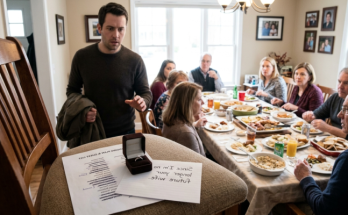
I placed the petition, Michael’s recordings, and the school’s technology report across my dining room table.
Nathan read every page.
Then he looked at me.
“This petition was prepared before Sophie’s cafeteria account became empty.”
“How can you tell?”
“The document metadata shows it was created Saturday night.”
The automatic payment had been removed Sunday.
Mom wrote the accusation before committing the act she intended to accuse me of.
Nathan pointed to another page.
“She claims Sophie confided that you regularly denied her food.”
“That never happened.”
“I know. The principal and school counselor will provide sworn statements. We also have the account records showing your regular deposits for the past three years.”
“What happens now?”
“I’m requesting an emergency hearing first thing tomorrow morning. We’ll ask the judge to dismiss the petition and issue a protective order preventing your mother from contacting Sophie.”
Detective Ramirez picked up the old phone Michael had provided.
“And this recording establishes motive.”
Mom’s voice played again.
“Then we prove she cannot take care of Sophie.”
Hearing those words a second time didn’t hurt less.
“What was she going to do if she got temporary guardianship?” I asked.
Nathan’s expression darkened.
“She could have tried to control Sophie’s finances, restrict your access to her, and use custody as leverage to make you withdraw the criminal complaint.”
“But she had already emptied Sophie’s college account.”
“She may have believed that having Sophie in her home would make the withdrawal appear legitimate.”
Detective Ramirez shook her head.
“Or she wanted a frightened mother willing to trade everything for her child.”
That was exactly what Mom expected.
She believed I would surrender the house.
Drop the fraud report.
Restore her allowance.
And remain silent about the stolen money if she placed Sophie between us.
She was right about one thing.
I would do anything to protect my daughter.
But she was wrong about what protection looked like.
Protection didn’t mean surrendering.
It meant making sure Mom could never hurt Sophie again.
That night, I sat on the edge of Sophie’s bed.
“Grandma asked a judge to let her take care of you temporarily,” I said.
Her eyes widened.
“Do I have to go with her?”
“No.”
“You promise?”
“I promise.”
“What if the judge believes her?”
“The judge will see the truth.”
Sophie pulled the blanket to her chin.
“Grandma made my lunch account empty, didn’t she?”
“Yes.”
“Did she want me to be hungry?”
The question was almost too painful to answer.
“She wanted to create proof that I wasn’t taking care of you.”
“So I was just evidence?”
I took her hand.
“To Grandma, maybe. But never to me.”
A tear slid down her cheek.
“I thought she loved me.”
“She may love you in the only way she understands. But love without kindness, honesty, or safety is not enough.”
“Will I have to speak in court?”
“Only if you want to. Nathan is asking the judge to speak with you privately so Grandma won’t be in the room.”
Sophie thought for a moment.
“I want the judge to know I didn’t tell Grandma you starved me.”
“Then you can tell the truth.”
The following morning, Mom entered the courtroom wearing the same black dress she had worn to the property hearing.
She carried a photograph of Sophie in a silver frame.
Another performance.
Another costume.
Another attempt to appear like the loving grandmother she had never chosen to be when Sophie actually needed her.
Her attorney began by describing Mom as a concerned widow who had noticed signs of neglect.
He presented the cafeteria records.
Five days without purchased lunches.
A negative account balance.
He argued that immediate intervention was necessary.
Then Nathan stood.
“The petitioner did not discover the food deprivation,” he said. “She manufactured it.”
He presented three years of cafeteria payments showing that I had consistently funded Sophie’s account.
Next came the district audit.
The login from Mom’s tablet.
The removed payment method.
The disabled notifications.
The recovery number changed to Mom’s phone.
Then Nathan showed the court the date the guardianship petition was created.
Saturday.
One day before Mom entered the account.
Two days before Sophie missed her first lunch.
The judge looked directly at my mother.
“Mrs. Bennett, did you access this child’s cafeteria account?”
“No.”
Nathan played Michael’s recording.
Mom’s own voice filled the courtroom.
“Then we prove she cannot take care of Sophie.”
Her attorney closed his eyes.
The judge asked again.
“Did you access the account?”
Mom pointed at me.
“My daughter is vindictive. She twisted everything because I asked for financial security.”
“You are not being asked about financial security.”
“I devoted my life to my children.”
“Did you deliberately remove the payment method from your granddaughter’s lunch account?”
Mom’s expression changed.
The trembling widow disappeared.
“She could have taken food from home.”
The courtroom became completely silent.
The judge leaned forward.
“That is not an answer.”
“She was never in danger.”
“She was an eleven-year-old child who went five school days without lunch.”
“Children survive discomfort.”
Nathan placed the box of crackers Mom had brought to the school on the evidence table.
“Is this what you believed she deserved?”
Mom looked at the box but said nothing.
The judge reviewed the forged power of attorney, the emptied college account, and the pending criminal investigation.
Then she dismissed the guardianship petition with prejudice.
She issued a protective order forbidding Mom from contacting Sophie, visiting her school, approaching our home, or communicating through another relative.
Before leaving the bench, the judge looked at Mom.
“You created a child’s suffering and then asked this court to reward you for discovering it. This court will not be used as a weapon against that child or her mother.”
Mom stood as the bailiff approached.
She looked at me.
“You did this.”
“No,” I said. “You did.”
Detective Ramirez waited outside the courtroom.
Mom was arrested for identity theft, forgery, grand theft, and attempting to fraudulently transfer property.
She didn’t cry when the handcuffs closed around her wrists.
She didn’t apologize.
She turned toward me and shouted:
“After everything I gave you!”
I looked at the woman I had supported for six years.
The woman who had received a free house, paid utilities, expensive food, wine, flowers, and more than $320,000 of my money.
“You gave Sophie five days of hunger,” I said. “And you gave me the truth.”
The elevator doors closed between us.
Michael surrendered later that afternoon.
He provided every message, recording, bank form, and document he possessed.
His cooperation didn’t erase what he had done.
But it prevented Mom from claiming she had acted alone without witnesses.
Linda Carver lost her notary commission and was charged for notarizing documents without my presence.
Her messages proved she knew the transaction was improper.
She had risked my house, my daughter’s future, and her own freedom for grocery gift cards and the promise of $10,000.
Within two weeks, the Florida condominium deposit was returned.
The bank released the $5,812 it had frozen.
Holloway Capital initially refused to return the $80,000 used to pay Michael’s debt, but investigators proved the lender had received notice that the funds were disputed before completing the transaction.
A court ordered the money returned.
The remaining cash became part of the restitution order.
After reviewing the fraudulent power of attorney and the proof that I was never present for its signing, the bank restored every dollar to Sophie’s college account and my emergency savings.
The forged deed was formally declared void.
The house belonged to me again.
Mom’s version of events collapsed as quickly as she had created it.
Relatives who accused me of starving an elderly widow began deleting their comments.
My aunt called.
“I didn’t know the whole story.”
“You didn’t ask.”
“Margaret sounded convincing.”
“She showed you an empty refrigerator in her garage.”
My aunt became quiet.
“We’re family, Laura.”
“Then you should have treated me like family before publicly calling me cruel.”
I didn’t need apologies from people who had condemned me without one question.
I needed peace.
Seven months later, the criminal cases ended.
Linda pleaded guilty, received probation, paid restitution, and was permanently prohibited from serving as a notary again.
Michael pleaded guilty to conspiracy and receiving stolen funds.
Because he cooperated and helped recover the money, he avoided prison.
He received five years of probation, community service, and a monthly restitution obligation for the grocery money he knowingly accepted.
He lost his business.
He moved into a small apartment.
For the first time in his adult life, Mom wasn’t available to rescue him.
A week after sentencing, he asked to meet me.
“I know saying sorry isn’t enough,” he said.
“It isn’t.”
“I should have called you the moment Mom mentioned the house.”
“Yes.”
“I kept telling myself I believed her because I needed the money.”
“You believed what benefited you.”
He nodded.
“Can you ever forgive me?”
“Maybe.”
His eyes lifted.
“But forgiveness doesn’t mean trusting you again.”
“I understand.”
“No, Michael. Understanding means accepting that Sophie may never want you in her life. It means repaying what you took without expecting access to us as a reward.”
He wiped his eyes.
“I’ll do it.”
Over time, he did.
He never missed a restitution payment.
He stopped sending emotional messages through relatives.
He wrote Sophie one apology and allowed her to decide whether to answer.
She didn’t.
Not then.
Mom refused every plea agreement requiring her to admit she had intentionally harmed Sophie.
She continued insisting that the house should have belonged to her.
She claimed the college money was a temporary loan.
She said the lunch account had been part of a necessary lesson.
At trial, the jury heard the recordings.
They saw the forged documents.
They saw the bank transfers.
They saw the guardianship petition created before Sophie’s first missed lunch.
It took them less than three hours to find her guilty.
At sentencing, I stood before the judge.
Mom stared straight ahead as I read my statement.
“For six years, I believed supporting my mother was an expression of love. I paid for her home, food, comfort, and every emergency she placed in front of me. When my daughter experienced one real emergency, Mom called her hunger insignificant. Then I learned it wasn’t indifference. It was a plan. She made an eleven-year-old child go without food so she could manufacture evidence, steal property, and control our family.”
My voice shook, but I continued.
“My daughter asked if she was only evidence to her grandmother. No child should ever have to ask that question.”
For the first time, Mom looked at me.
“I am not asking the court for revenge,” I said. “I am asking for consequences strong enough to make sure she can never use love, money, or hunger as a weapon again.”
Mom received a prison sentence followed by supervised probation.
The protective order remained in place.
As deputies led her away, she finally spoke to me.
“I was afraid you would stop taking care of me.”
I looked at her.
“So you tried to destroy the person I had to take care of first.”
“You chose Sophie over your own mother.”
“No. You forced me to choose between protecting my daughter and enabling you.”
I stepped closer.
“And I will choose Sophie every time.”
That was the last conversation we had for nearly two years.
After the trial, I returned to the four-bedroom house where Mom had lived.
The refrigerator I bought was still full.
Steaks.
Salmon.
Imported cheese.
Fresh berries.
Wine.
More food than Sophie could have eaten in a month.
On the counter was the box of crackers Mom had replaced after I threw the first one away.
Beside it sat a handwritten list of everything she believed I owed her.
I turned the paper over and wrote one sentence:
“Love is not a debt you collect from your children.”
Then I left it on the counter.
I sold the house three months later.
I didn’t want Sophie’s future tied to a building that had become a symbol of manipulation.
After taxes and legal expenses, I placed part of the money into a protected trust for Sophie.
No power of attorney could access it.
No relative could borrow from it.
The rest went toward something Sophie helped me create.
It began with one question.
“How many other kids sit at lunch pretending they aren’t hungry?”
The principal told us that dozens of students carried unpaid cafeteria balances.
Some skipped meals because they were embarrassed.
Others avoided the lunch line because they didn’t want classmates to see their accounts declined.
I remembered Sophie eating cold pasta over the kitchen counter.
I remembered how quickly she ate.
I remembered the shame in her voice when she said:
“My account was empty.”
The first month after I canceled Mom’s allowance, I donated exactly $2,800 to clear student lunch debts.
The same amount Mom once spent on wine, flowers, and premium steaks paid for hundreds of hot meals.
Then Sophie and I created the Full Plate Promise.
Part of the house-sale money funded it.
Local businesses joined.
Parents donated.
The school district changed its policy so no child would be denied a standard lunch because of an unpaid balance.
One year later, the Full Plate Promise had provided more than eleven thousand meals.
Sophie designed the logo herself.
A simple blue plate surrounded by the words:
“No Empty Trays. No Ashamed Children.”
Two years after Mom’s conviction, I received a letter from her.
For the first time, it didn’t contain blame.
“I spent my life measuring love by what people gave me,” she wrote. “When you stopped giving, I believed you had stopped loving me. I understand now that I had confused comfort with love and control with family. I cannot return the week I stole from Sophie, but I am sorry she ever believed she deserved so little.”
I didn’t show Sophie the letter immediately.
The apology belonged to her, but so did the choice to read it.
When I finally told her, she asked:
“Do I have to forgive Grandma?”
“No.”
“Do you?”
“Not yet.”
Sophie nodded.
“Maybe someday.”
“Maybe.”
Forgiveness would come on our timetable.
Not Mom’s.
Consequences did not disappear because someone finally found the right words.
Years passed.
On the morning Sophie left for college, I found her standing at the kitchen counter.
For one terrifying second, the memory of that Friday afternoon returned.
Then she turned around holding a piece of toast.
Her college fund had covered her tuition.
She planned to study public policy and expand the Full Plate Promise statewide.
As we carried boxes into her dorm room, Sophie placed a package of crackers inside her desk.
She saw me looking at it and smiled.
“They’re a snack, Mom.”
“I know.”
“Not a meal.”
“Never again.”
Before I left, she hugged me.
“Thank you for choosing me.”
I held her tighter.
“There was never a choice.”
My mother once said children survive.
She was right.
Sophie survived hunger.
She survived betrayal.
She survived being treated like evidence in someone else’s scheme.
But survival was never the most a child deserved.
A child deserved a full plate.
A safe home.
A future no one could steal.
And at least one person willing to stand between her and anyone who tried.
My mother lost a house because she believed she was entitled to everything inside it.
I nearly lost myself because I mistook endless sacrifice for love.
But Sophie taught me the difference.
Love doesn’t tell a hungry child to take crackers.
Love notices the empty tray.
Love fills it.
And love never asks a child to earn her place at the table.
THE END



One Comment on “FINAL PART5: My daughter went hungry at school for an entire week. When I told my mom, she brushed it off and said, “She can take crackers.””