Part 1: The Boy Behind My Ex-Wife’s Door
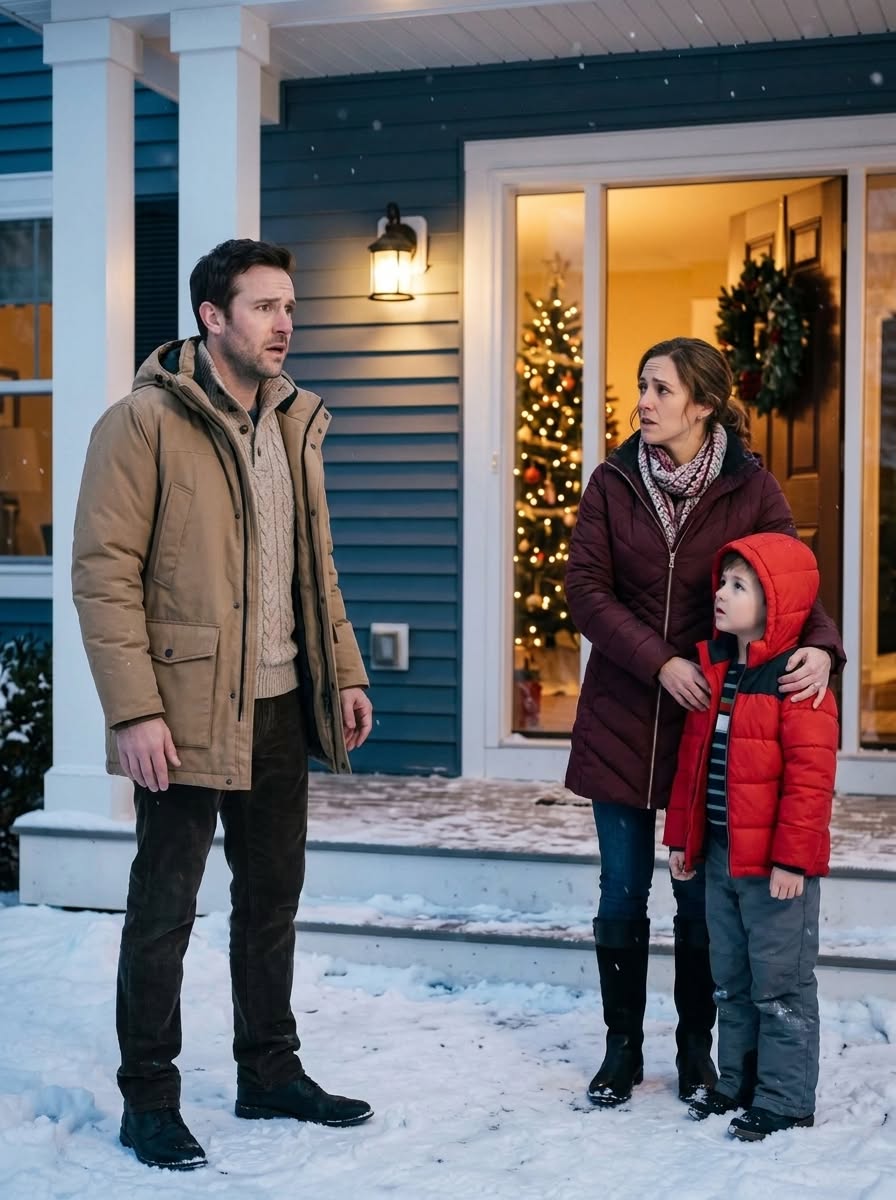
Seven years after my divorce, I stood on my ex-wife’s porch on Christmas Eve with snow melting across the shoulders of my old Army coat.
I had come to apologize for believing a lie that destroyed our marriage, but the moment Emily opened the door, a little boy ran up behind her wearing red Christmas socks and looked at me with my own blue-gray eyes.
“Mom, the star fell off again,” he said, holding a crooked cardboard ornament. Then he noticed me and tilted his head in the same suspicious way I had done in every childhood photograph.
Emily’s face lost its color. She placed one hand on the boy’s shoulder and asked him to return to the living room, but he remained beside her, studying the stranger who had appeared on their porch with a wrapped wooden ornament.
“Who are you?” he asked.
“My name is Anthony,” I answered. “I used to know your mother.”
The explanation was true, but painfully incomplete. I had once known how Emily took her coffee, what song she hummed while cooking and why she always left one lamp burning when I was away on deployment.
The boy glanced at the Army patch sewn onto my coat. He asked whether I had been a soldier, and when I said yes, his expression brightened with the curiosity of a child who had a hundred questions waiting behind the first one.
Emily gently interrupted him and sent him to check the cookies. He obeyed reluctantly, looking back at me twice before disappearing into the kitchen.
“How old is he?” I asked after we were alone.
Emily folded her arms tightly. “Anthony, don’t do this on the porch.”
“How old is he?”
“Seven.”
The answer left me gripping the small package in my hand. Our divorce had been finalized seven years earlier, three weeks before my unit departed for an overseas assignment that kept me away for almost fourteen months.
I looked through the doorway at the construction-paper decorations covering Emily’s modest living room. A child’s school photograph stood on a shelf beside a model rocket, and the smile in that picture resembled my father’s smile before age and disappointment hardened it.
“Is he mine?” I asked.
Emily did not deny it. Instead, she stepped outside, pulled the door almost closed behind her and told me I had no right to arrive without warning and ask questions that could change her son’s life.
“Your son?” I said quietly.
“His name is Noah, and he doesn’t know who you are.”
I wanted to demand an explanation, but seven years earlier I had already made the mistake of treating anger as proof that I deserved an immediate answer. I forced myself to lower my voice and asked whether Emily had ever tried to contact me.
Pain crossed her expression before she looked toward the snow-covered street. She reminded me that I changed my phone number after the divorce, blocked her personal email and instructed my mother to handle anything connected to our former home while I was overseas.
I remembered doing all three. At the time, I called it a clean break because admitting I was running from grief would have required more honesty than I possessed.
“I wrote to you twice,” Emily said. “One letter came back. The other disappeared after reaching your mother’s house.”
My chest tightened. My mother, Margaret, had always believed Emily was too ordinary for the life she imagined I deserved, but I never thought she would hide news about a child.
Before I could respond, the door opened again. Noah stood there holding a tray with three misshapen cookies and announced that two adults having a private conversation on Christmas Eve probably needed emergency gingerbread.
Emily closed her eyes as though asking for patience. Noah offered me the cookie with the most frosting, then pointed toward the package in my hand and asked whether it was for him.
“No,” I said. “It belongs to your mother.”
I had found the wooden ornament while clearing boxes from the house my mother was preparing to sell. It was a replacement for the star Emily and I had bought during our first Christmas together, before deployments, suspicion and pride turned our home into a place where neither of us felt heard.
Emily unwrapped it slowly. When she saw the hand-painted star, her eyes filled with tears, but she immediately looked away so Noah would not notice.
“I came because I learned the truth about Jonathan,” I explained. “He showed me the records last month. You weren’t having an affair with him.”
Jonathan had been our financial adviser. Emily met him privately because she was building an emergency fund she hoped would allow me to leave active service after my next deployment, but my mother photographed them together and told me Emily was preparing to run away with him.
I had believed her because distrust required less courage than asking my wife why she was afraid. During our last argument, I accused Emily of betrayal, refused to examine the documents she tried to show me and signed the divorce papers before returning to my unit.
“I should have listened,” I said. “I should have asked you instead of believing everyone else.”
Emily looked toward Noah, who had carried the ornament to the tree and was trying to hang it beneath his crooked cardboard star. Her expression softened for him but remained guarded when she turned back to me.
“An apology doesn’t make you his father,” she said. “He has a school, friends and a life that doesn’t belong to your guilt.”
She was right. I had come hoping to repair the past with one honest conversation, but the child beside the Christmas tree was not a missing possession I could claim after discovering the truth.
I told Emily I would leave if that was what she wanted. Before she could answer, Noah asked whether I could help fix the tree because the top branch leaned too far for him to reach.
Emily hesitated and then allowed me ten minutes. Noah climbed onto a chair while I steadied it, talking about gravity, reindeer and the telescope he hoped Santa might bring.
When the star was secure, he smiled at me with an openness I had not earned. I stepped away before the resemblance between us made me forget the boundaries Emily had just given me.
As I reached for my coat, Emily disappeared into the hallway and returned carrying a small wooden box. Inside were Noah’s hospital bracelet, a lock of dark baby hair and an envelope yellowed around the edges.
My name was written across the front in Emily’s handwriting. The letter remained sealed, and a postal stamp showed that it had been returned to her seven years earlier.
“I kept it because I knew Noah might someday ask whether I tried to tell you,” she said.
I asked for permission before opening it. Emily nodded, and the first line confirmed that she had written the letter only days after learning she was pregnant.
At the bottom, she had added one desperate request: “Please come yourself, Anthony. Do not let your mother answer for you.”
I turned the envelope over and noticed something Emily had never seen. Beneath the return stamp was a short message written in my mother’s unmistakable handwriting.
“He has chosen the Army and wants nothing to do with this child.”
Part 2: The Woman Who Answered for Me
I read my mother’s sentence until the words blurred together. She had not merely failed to forward Emily’s letter; she had answered on my behalf and made a decision about my child while I was thousands of miles away.
“I never said this,” I told Emily. “I didn’t even know the letter existed.”
“I believe you didn’t write it,” she replied. “That doesn’t mean I knew what you would have chosen.”
Her answer was painful because I had given her no reason to trust me. During our divorce, I had refused every attempt she made to explain the photograph with Jonathan, then changed my contact information and left my mother in control of the mail arriving at my house.
Noah was still standing near the Christmas tree, examining the wooden star. He could not hear our quiet conversation, but Emily closed the box and asked me to leave before he noticed how upset we were.
I wanted to stay and learn everything I had missed. Instead, I thanked Noah for the gingerbread cookie, promised nothing I had not received permission to promise and walked back into the snow.
At the hotel, I placed Emily’s returned letter on the desk beside my phone. Calling my mother immediately would have satisfied my anger, but it would not have changed what Emily and Noah needed from me.
I waited until Christmas morning. Margaret answered cheerfully and began telling me about the brunch she had planned, apparently assuming I was still in Virginia and knew nothing about the house I had visited.
“I met Noah last night,” I said.
The silence that followed told me more than denial could have. My mother finally asked what Emily had told me, framing the question as though the danger was not what she had done but how much of it I had discovered.
“She showed me the letter you returned.”
Margaret exhaled. “Anthony, you were deployed and already under enough pressure. Emily was trying to drag you back into a marriage that had failed.”
“She was carrying my child.”
“She claimed she was carrying your child.”
I closed my eyes. Even after seven years, my mother could transform cruelty into concern by changing a few words.
Margaret reminded me that Emily had secretly met Jonathan and opened an account without my knowledge. When I explained that Jonathan had shown me the records and proved the money was intended to help me leave active service, she dismissed him as a man trying to repair his reputation.
“You took one photograph and built an affair around it,” I said. “Then you let me believe my wife had betrayed me.”
“I protected you from a woman who wanted you to abandon your career.”
“My career was never yours to protect.”
Margaret’s voice hardened. She said the Army had given me discipline, status and a future, while Emily wanted me to return home and become an ordinary husband with an ordinary job.
For the first time, I understood that my mother had never hated Emily because she thought Emily would ruin my life. She hated the version of my life that Emily represented, one in which I might choose a small home and a present fatherhood over the ambitions Margaret had selected for me.
I asked whether she had known Noah’s name. Margaret hesitated before admitting that she had searched for Emily online over the years and had seen photographs of him.
“You watched him grow up?” I asked.
“I made sure he was healthy.”
“You watched my son grow up and never told me he existed.”
Margaret insisted she could not be certain Noah was mine. Then she revealed something Emily had never mentioned: she had visited Emily after receiving the second letter.
According to Margaret, she offered to pay Emily’s medical expenses if she signed a statement agreeing never to contact me again. When Emily refused, my mother warned that the military, my family’s money and my legal resources could be used to take the baby from her.
“You threatened a pregnant woman who had no family in Boston,” I said.
“I told her what could happen if she tried to trap you.”
My hand tightened around the phone. I remembered how easily I used to accept Margaret’s version of people, especially when her conclusions matched the fears I already carried.
I ended the call before anger made me say something that would turn the conversation into a distraction. Then I photographed the writing on the envelope and sent the image to Margaret with a single message stating that she was not to contact Emily or Noah.
Emily agreed to meet me that afternoon at a café near her house. I told her what Margaret had admitted without defending myself or asking why she had not tried harder to reach me.
“She came when I was eleven weeks pregnant,” Emily said. “She brought a check and a lawyer’s business card.”
Emily had torn up the check, but Margaret’s warning stayed with her. She knew I was overseas, surrounded by people loyal to my family and still furious enough to believe the worst about her.
“I thought if I told you after you returned, you might take him,” she admitted. “By then, Noah was the only stable thing left in my life.”
I assured her I would not pursue custody or appear at Noah’s school. Then I said the one thing I knew could hurt her even though avoiding it would leave uncertainty hanging over all three of us.
“We should confirm that I’m his father.”
Emily’s expression closed immediately. I explained that I believed her, but Noah deserved a truth no relative could later challenge or manipulate.
She considered the request for several minutes before agreeing to a private paternity test. We decided not to tell Noah until the result arrived and until a child counselor helped us explain the situation without making him responsible for the adults’ mistakes.
Three days later, I returned to the café with the unopened result. Emily sat across from me as I read the confirmation that there was no reasonable doubt about my relationship to Noah.
I expected relief, but grief arrived first. Every first step, birthday and sleepless night I had missed suddenly belonged to a real child whose photographs I had never seen.
Emily slid a napkin toward me but did not offer forgiveness. She said the result answered a biological question, while the question of whether I could become part of Noah’s life remained entirely different.
Before we left, she placed one condition on the table. I would receive a single supervised hour with Noah the following Saturday, and he would still know me only as Anthony.
“If you use that hour to tell him the truth, buy his affection or make promises you cannot keep, there will not be a second visit,” she said.
I agreed without negotiating. Then Emily gave me a warning that made me understand the test result was only the beginning.
“Noah has spent seven years wondering why his father didn’t want him,” she said. “When he learns who you are, the first question he asks may be the one you are least prepared to answer.”
Part 3: The Question My Son Had Waited to Ask
I arrived at Emily’s house the following Saturday at exactly two o’clock. A new telescope sat in the trunk of my car, but I left it there after remembering her warning that I could not buy my way into Noah’s life.
Emily opened the door and checked the street behind me, perhaps expecting a driver, attorney or member of my family. I had come alone with a paper bag containing three cookies from the bakery near Noah’s school.
“You’re on time,” she said.
“I waited around the corner for five minutes because I didn’t want arriving early to feel like pressure.”
A reluctant smile touched her face before she stepped aside. Noah was lying beneath the Christmas tree trying to repair the wooden train track, and his excitement when he saw me created a warmth I had no right to claim yet.
“You came back,” he said.
“I said I would.”
“Adults say lots of things.”
The observation was delivered casually, but I heard the experience behind it. I sat on the floor instead of defending adults and told him he was right to judge promises by what happened afterward.
For the next hour, Noah directed the repair while explaining that several pieces had been damaged when he was five. I wanted to replace the entire train, but he insisted the older pieces were important because Emily had bought them during a Christmas when they could not afford a real tree.
I began to understand that my instinct to replace imperfect things could erase the history that made them valuable. When the hour ended, I stood even though Noah asked me to stay.
“You could ask Mom for another hour,” he suggested.
“I could, but she trusted me with this one.”
Noah looked disappointed, yet Emily’s posture relaxed. She agreed that I could return the following Saturday for two hours, provided I continued respecting the same rules.
Those visits became the most ordinary and important appointments on my calendar. Noah taught me that he disliked tomato skins, loved astronomy and believed every cardboard box could become part of a spacecraft if an adult supplied enough tape.
I told him carefully chosen stories about the Army, avoiding anything frightening or inappropriate. He was fascinated by field kitchens and portable bridges but disappointed to learn that most military logistics involved lists rather than helicopters.
During our fourth visit, Noah found the small scar near my left eyebrow. He had one in almost the same place from falling against a coffee table when he was three.
“That’s weird,” he said, moving closer to examine mine. “We have matching faces.”
Emily, who had been sorting mail at the kitchen counter, stopped moving. I answered that people sometimes resembled one another, but Noah continued studying my eyes and eyebrows.
He asked again whether I had children. I looked toward Emily, and she gave a small nod that permitted honesty without revealing everything.
“I recently learned that I have a seven-year-old son,” I said.
Noah sat straighter. “That’s my age. Does he live near here?”
“He does.”
“Why didn’t you know about him?”
I chose each word carefully. I explained that adults had made serious mistakes, messages had not reached the right person and fear kept people apart longer than it should have.
“Did his mother hide him?” Noah asked.
“No. His mother tried to protect him.”
Emily turned toward the window, but not before I saw tears in her eyes. Noah accepted the answer and returned to his cardboard spacecraft, although I could tell the coincidence had remained in his mind.
After the visit, I asked Emily whether we should tell him soon. She agreed but wanted to speak with his pediatrician and a counselor first so we would not burden him with details about the divorce or my mother.
I accepted the delay, but my patience weakened two weeks later when Noah’s school announced a family astronomy night. He begged me to attend because Emily did not know how to align the community center’s telescopes.
Emily said no. She explained that appearing beside them at a family event before Noah knew the truth could create questions neither of us was ready to answer.
I reminded her that the test had confirmed I was his father. The moment the words left my mouth, I saw her expression change and realized I had turned biology into a weapon.
“You are his biological father,” she said. “You are still learning how to be someone he can depend on.”
My first instinct was to argue that she had already taken seven years from me. I stopped because the missing years were not hers alone to carry, and blaming her would repeat the same pattern that destroyed our marriage.
“You’re right,” I said. “I’m sorry.”
I attended the event only after Emily reconsidered and invited me as a family friend. Noah spent the evening moving excitedly between telescopes, and I resisted the urge to correct every volunteer or take control of the equipment.
On the drive home, Noah asked Emily why I knew his birthday, his favorite planet and the name of his pediatrician. She pulled the car over because she did not want to answer while distracted.
The following afternoon, we sat with him at the kitchen table. There were no gifts, cameras or dramatic announcements, only three mugs of hot chocolate and the crooked cardboard star still hanging above us.
Emily told Noah that I was the father he had asked about over the years. She explained that I had not known he existed, but I wanted the chance to know him now.
Noah looked at me for a long time. He did not smile, cry or reach for my hand, and I realized I had imagined every possible response except silence.
“Do I have to call you Dad?” he finally asked.
“No. You can keep calling me Anthony for as long as you want.”
He asked whether I would take him away from Emily. I promised that I would never try to remove him from his home, school or mother.
Noah’s lower lip trembled as he stared into his untouched hot chocolate. When he finally looked up, his question carried seven years of confusion that no paternity result could repair.
“If you really didn’t know about me,” he whispered, “why did Grandma Margaret send Mom money to make me disappear?”
Part 4: The Difference Between Guilt and Love
Emily closed her eyes when Noah mentioned Margaret’s money. She had kept the check and my mother’s handwritten note inside the wooden family box because she feared she might someday need proof that the visit had happened.
Noah found them months earlier while searching for photographs for a school project. He could read enough of the note to understand that Margaret offered Emily money in exchange for “no future contact regarding the child.”
“I thought she wanted Mom to go somewhere far away,” Noah said. “I thought maybe you told her to do it.”
I moved my chair back slightly so he would not feel surrounded. I told him I had never seen the check, never asked anyone to send it and did not know about him until the night I arrived at their door.
“Then why did your mom do it?” he asked.
“Because she believed she had the right to control my life. She was wrong.”
Noah looked toward Emily before asking whether Margaret was his grandmother. I said she was related to him, but being related did not automatically make someone safe or give that person permission to enter his life.
Emily explained that Noah did not have to meet Margaret or answer questions about her. The adults would decide how to handle the situation, and he was not responsible for protecting anyone’s feelings.
He remained quiet for the rest of the afternoon. When I prepared to leave, he did not hug me or ask when I would return.
For the next three days, I heard nothing from Emily. I told myself that respecting Noah meant allowing him to be angry, but every silent hour tempted me to send another message or appear at the house.
On the fourth morning, Emily called. Noah wanted to continue our Saturday visits, although he had decided that two hours was enough and did not want to discuss Margaret.
I agreed without asking for more. Then I made exactly the kind of mistake I had promised myself I would avoid.
The telescope in my trunk had remained unopened for weeks. I convinced myself it was educational rather than extravagant, and I arrived on Saturday carrying a box large enough to block most of my body.
Noah stared at the picture printed on the side. The telescope was far more advanced than anything a seven-year-old needed, and his excitement gave me several seconds of relief from my guilt.
Emily asked to speak with me in the hallway. She kept her voice low, but disappointment was visible in her face.
“You knew I didn’t want this.”
“He loves astronomy.”
“That isn’t the problem. You frightened him with the truth, and now you’re trying to repair his feelings with something expensive.”
I wanted to argue that buying my son a telescope was not a crime. Instead, I looked through the doorway and saw Noah running his hand across the box as though accepting it might determine whether I stayed.
Emily was right. The gift was not really about astronomy; it was an attempt to make myself feel useful in a relationship I could not repair quickly.
I carried the telescope back to my car. Noah asked whether he had done something wrong, so I admitted that I had ignored a rule his mother and I had agreed upon.
“Adults have rules too?” he asked.
“Especially adults.”
He considered that before returning to our cardboard model of the solar system. We spent the afternoon painting foam planets, and he corrected me when I made Mars too orange.
Over the following months, I stopped trying to create memorable moments. I helped with homework, attended a public observatory event after Emily invited me and learned how to make grilled-cheese sandwiches without setting off the smoke detector.
I also requested a transfer from Virginia to my company’s Boston office. I did not announce that I was moving for Noah or expect Emily to be grateful, because my employment remained my responsibility rather than a sacrifice my son owed me for making.
I rented a small apartment twenty minutes from their house and furnished the second bedroom gradually. It remained a reading room until Emily and Noah decided whether he would ever feel comfortable sleeping there.
Margaret ignored my instruction not to make contact. Shortly before Noah’s eighth birthday, a delivery arrived at Emily’s house containing an expensive telescope, a military-style jacket and a card signed, “With love from the grandmother who has waited too long.”
Noah read the card before Emily could remove it. He asked why Margaret claimed she had been waiting when she was the person who prevented me from finding him.
I called my mother while Emily listened. Margaret insisted a grandmother had rights and accused Emily of teaching Noah to hate her, but I refused to argue about the past.
“You will not contact him again unless Emily and I agree that it is safe,” I said. “Any package you send will be returned.”
Margaret warned that Emily would eventually turn Noah against me too. Years earlier, that accusation would have awakened every suspicion I carried, but I now understood that trust was not built by predicting betrayal.
I returned the package unopened. For Noah’s birthday, I gave him a simple star chart and took him to the public observatory with Emily.
That evening, he asked whether I regretted returning the telescope. I said I regretted ignoring his mother’s boundary more than I regretted losing the gift.
“She didn’t make you send Grandma’s one back,” he observed.
“No. That was my decision.”
Something changed in his expression. Perhaps it was the first time he understood that Emily and I could make separate choices without using him to punish each other.
Two months later, Noah’s school announced a breakfast for students and the adults who cared for them. I assumed Emily would attend and did not ask for an invitation.
The night before the event, Noah called me from her phone. His voice sounded nervous, and he spent nearly a minute discussing the weather before reaching the reason for the call.
“Some kids are bringing their dads,” he said. “You don’t have to come as mine.”
I waited because I sensed he had not finished.
“You could just sit beside me,” he continued. “And if anybody asks who you are, maybe I could tell them.”
“Tell them what?”
Noah became quiet. Then he said the word I had waited eight years to hear, but he phrased it as a question because he still needed to know whether I would stay.
“That you’re my dad?”
Part 5: The Christmas We Started Again
I arrived at Noah’s school ten minutes before the breakfast began and waited outside until Emily and he reached the entrance. I wore an ordinary sweater instead of my old Army coat because I wanted the morning to belong to Noah, not to the uniform or the history he associated with me.
He introduced me to his teacher in a voice barely above a whisper.
“This is my dad, Anthony.”
The word affected me more deeply than any promotion or military ceremony ever had. I thanked his teacher, sat beside Noah and resisted every urge to turn his small decision into a public celebration.
During breakfast, he told his classmates that I had served in the Army and now helped transportation companies prepare for emergencies. He left out the divorce, the hidden letters and the grandmother he had never met because those details belonged to him, not to anyone who happened to ask.
Afterward, Emily found me standing alone near the parking lot. She said Noah had practiced the introduction in his bedroom the previous night but remained afraid I might become uncomfortable and correct him.
“I would never correct him for calling me his father.”
“He doesn’t know that yet,” she said. “He is still learning which promises are safe.”
Her reminder kept me from treating the school breakfast as the end of our difficult work. It was one step, freely offered by a child who still watched closely to see whether I would remain after receiving what I wanted.
Margaret continued sending letters to me, but I did not pass them to Emily or Noah. I told my mother that any future relationship with her grandson would require an honest apology, respect for Emily and the willingness to accept that Noah might never choose to meet her.
She initially refused. Margaret described herself as the person being punished, which showed me that she still measured harm by what she had lost rather than by what her decisions had taken from others.
Several months later, she sent Emily a short apology without excuses or requests. Emily placed it in the family box and said Noah could read it when he was older, but neither of us treated the letter as an obligation to restore contact.
The divorce and my absence had taught us that forgiveness could not be demanded on someone else’s schedule. An apology could open a door, but the person who had been hurt retained the right to decide whether to walk through it.
My relationship with Noah continued growing through ordinary routines. I attended parent-teacher meetings, learned the names of his friends and kept a supply of tomato sauce without visible tomato pieces in my apartment.
When he became frustrated, he sometimes insisted that everything was fine. I recognized the habit because I had spent most of my life using those words to hide disappointment, fear and grief.
Instead of forcing him to talk, I told him he was allowed to feel upset without losing anyone’s respect. Slowly, both of us learned that honesty did not have to end in punishment or abandonment.
Emily and I also began counseling together, not to restore our marriage but to become dependable parents. We discussed school decisions, holidays and what would happen if my work required travel.
Nearly a year after the paternity test, Emily asked whether I wanted my name added to Noah’s birth certificate. I reminded her that the choice belonged to Noah as well, so the three of us discussed it at the kitchen table where he had first learned the truth.
Noah asked whether changing the document would change his last name. When Emily said no, he appeared relieved and declared that one major change per year was enough.
The paperwork itself was simple because Emily and I agreed and the test had already confirmed our relationship. Signing my name did not make me more of a father than I had been the previous day, but it placed the truth where Margaret’s interference could no longer erase it.
That December, Emily invited me to Christmas Eve dinner. She clarified that the invitation came from both her and Noah, then warned me that I was expected to bring rolls because my attempt at baking the previous month had been “structurally concerning.”
I arrived carrying groceries and one modest present. Before I could knock, Noah opened the door wearing the same red Christmas socks he had worn the night we met.
“You’re late,” he announced.
I checked my watch. “By fourteen seconds.”
“I counted.”
Inside, Emily had decorated the tree with the familiar collection of paper ornaments. The wooden star I brought the previous year hung near the center, directly beneath Noah’s crooked cardboard one.
I asked whether he wanted help straightening it. Noah shook his head and said the star had survived an entire year that way, so changing it now might be bad luck.
Dinner included Emily, Noah and my sister Sofia, who had learned about him only after my mother’s interference came to light.
Sofia did not arrive claiming the privileges of an aunt; she let Noah decide what to call her and spent most of the evening losing an argument about whether cardboard could support a model lunar lander.
After dessert, Noah asked me to help attach one final piece to the spacecraft. He called me Dad without pausing or watching my reaction, as though the word had finally become part of an ordinary sentence.
Emily heard it from the kitchen. Our eyes met, but neither of us interrupted him or made the moment heavier than he intended.
Later, while Noah and Sofia tested the lander beside the tree, Emily stood next to me at the kitchen counter. She said she did not know whether she and I would ever become husband and wife again.
“I don’t know either,” I admitted. “I’m not here to demand that answer.”
She looked toward Noah. “Then why are you here?”
“Because I can’t repair the seven years I missed. I can only be present for the next day, and then the one after that.”
Emily smiled with a warmth I had not seen since before our divorce. It was not a promise that the past had been erased, but it suggested that our future no longer had to be controlled by it.
Noah called for me from the living room because the cardboard landing system had collapsed. I crossed the room and sat beside him, examining the damaged pieces instead of immediately replacing them.
Outside, snow covered the quiet Boston street. Inside, the tree leaned slightly to one side, and the star remained crooked above the family we were still learning how to become.
For once, I did not try to make anything perfect. I simply stayed.