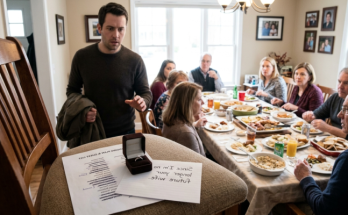
PART 5: THE CHRISTMAS I FINALLY CHOSE MYSELF — FINAL PART
The handwriting belonged to Jennifer.
My oldest child.
The daughter who had cried the hardest in Thomas’s office.
The daughter who had reached for my hand and begged me not to press charges.
The daughter named as my decision-maker on the forged power of attorney.
I sat in silence, listening to the detective explain how they had compared the dosage instructions with Jennifer’s writing in the blue binder.
The shape of her capital letters.
The way she crossed each “t.”
The unusual curl at the bottom of every number seven.
There was no question.
Jennifer had written the instructions.
“I need to hear Ava’s recording,” I said.
“Mrs. Hale, you may want to wait until—”
“I’ve spent my whole life waiting for my children to tell me the truth. Play it.”
Thomas sat beside me as the detective opened the audio file.
At first, I heard glasses touching a table.
Then Michael’s voice.
“Once the deed is filed, we list immediately.”
Lisa answered.
“What if Mom refuses to leave?”
Jennifer spoke next.
“She won’t refuse after Christmas.”
There was a pause.
Then Evelyn’s voice.
“The first dose only caused chest pain because she called the ambulance too quickly. The stronger dose should cause confusion for several hours.”
My stomach turned.
Lisa sounded frightened.
“You said nobody would get hurt.”
“Nobody is getting hurt,” Jennifer replied. “Mom will wake up in the hospital. I’ll show them the power of attorney, tell them she has been confused for months, and request a competency evaluation.”
Michael interrupted.
“Will that be enough to move her?”
“Combined with Evelyn’s statement and Lisa’s recording at the gate, yes.”
A chair scraped across the floor.
Lisa’s voice became louder.
“I’m not doing this.”
Michael laughed.
“You already copied her signature.”
“That was before you started talking about drugging her.”
“It’s a sedative,” Jennifer said. “People take it every day.”
“Not four times the normal amount!”
Jennifer lowered her voice.
“She survived the first dose.”
The recording ended.
I stared at the detective’s phone.
She survived.
That was how my daughter spoke about me.
Not “Mom was terrified.”
Not “Mom could have died.”
She survived.
As though my life were an inconvenience that had delayed their plan.
Thomas reached for my hand.
This time, I let him hold it.
“Did Michael know about the first dose?” I asked.
“We believe Jennifer and Evelyn arranged it privately,” the detective said. “Michael learned about the Christmas plan later. Lisa appears to have objected, but she did not warn you or law enforcement.”
“And Rebecca?”
“We have no evidence she knew about the medication. But she has admitted breaking into your home and stealing the letter, jewelry, and financial documents.”
“Where is Jennifer now?”
“She was arrested at the hotel.”
I closed my eyes.
My first memory of Jennifer was the weight of her sleeping against my chest.
She had been a quiet baby.
When she was five, she refused to attend kindergarten unless I stood at the classroom window until the bell rang.
When she was sixteen and had her heart broken, she crawled into my bed and cried until morning.
When her marriage failed, I opened my home without asking when she would leave.
And now she had measured a dose strong enough to place me in a hospital.
Not because she hated me.
Because she believed my life was worth less than her mortgage.
Jennifer asked to speak with me.
The detective advised against it, but I agreed on one condition.
Thomas would remain beside me, and the conversation would be recorded.
They brought Jennifer into a small interview room.
Her wrists were cuffed in front of her.
The moment she saw me, she began to cry.
“Mom, I never wanted to kill you.”
“You only wanted to make me helpless.”
“I thought you would be safe.”
“In a hospital?”
“Afterward. At Silver Pines.”
“You were going to drug me, take my house, and place me somewhere I repeatedly said I didn’t want to live.”
“You don’t understand the pressure I was under.”
“Then explain it.”
“My mortgage is eight months behind. Paul lost his job. We owe more than sixty thousand dollars.”
“You could have told me.”
“You changed your estate!”
“After you abandoned me.”
“I was scared there would be nothing left.”
“So you decided to take it while I was alive.”
She wiped her face against her shoulder.
“Michael said the house belonged to all of us.”
“Michael says many things when he wants money. You wrote the dosage.”
“Evelyn told me exactly what to write.”
“And you wrote it.”
“I didn’t think she would actually use that much.”
“Did you stop her?”
“No.”
“Did you warn me?”
“No.”
“Did you bring your children to my house on Christmas so they could distract me?”
Jennifer looked down.
“Yes.”
“Did you plan to activate the forged power of attorney while I was confused?”
“Yes.”
“Then look at me.”
Slowly, she raised her head.
“I loved you before you could speak,” I said. “I loved you when you had nothing to give me. I loved you through every mistake you made. And somewhere along the way, you began measuring my value by what you would receive when I died.”
“That isn’t true.”
“You risked my life for three hundred thousand dollars.”
“I’m sorry.”
“I believe you are sorry.”
Hope appeared in her eyes.
Then I continued.
“But being sorry does not erase what you chose.”
“Please don’t do this.”
“I’m not doing this to you, Jennifer. I am finally allowing you to experience the consequences of what you did to me.”
She began sobbing.
“You’re my mother.”
“Yes,” I said. “And I deserved a daughter who cared whether I survived Christmas.”
I stood and walked out.
She called my name three times.
I did not turn around.
On December 26, Thomas and I went to Mountain National Bank.
The police returned Richard’s brass key after photographing it for evidence.
A bank manager led us into a private room and placed the safe-deposit box on the table.
Inside were the original promissory notes from all three children.
There were bank statements, copies of checks, and a written record of every payment Richard had made.
There was also a small velvet box.
I opened it.
Richard’s wedding ring rested inside.
Beneath it was a final note.
Maggie,
If you found this box, then you found the truth.
Do not let what our children became make you question the mother you were.
We gave them love.
What they chose to do with it belongs to them.
My ring belongs to you.
The house belongs to you.
The years you have left belong to you.
Do not spend them proving your love to people who only recognize it when it comes with money.
Live, Maggie.
That will be your answer.
I pressed his ring against my lips.
For thirteen years, I had carried guilt for surviving him.
Now I understood that Richard’s final gift was not the house or the money.
It was the reminder that my life still belonged to me.
The criminal investigation lasted six months.
Evelyn eventually admitted she had approached Michael after learning I planned to change my estate.
She had spent years working in property offices and knew how to prepare deeds, imitate signatures, and exploit weaknesses in verification systems.
She offered to help my children gain control of my property in exchange for fifty thousand dollars and a percentage of the house sale.
But Evelyn had wanted more than money.
Years earlier, Richard had discovered she was stealing from a title company connected to one of his businesses.
He helped have her license revoked.
When she saw his obituary, she attended my grief-support group under her married name and introduced herself to me.
For thirteen years, she waited.
She called occasionally.
Sent birthday cards.
Appeared kind.
Then, when I became vulnerable, she saw an opportunity to take money from Richard’s family and destroy the woman he had protected.
The court found that the first drugging had caused my hospital admission.
The second planned dose could have killed me.
Evelyn pleaded guilty to charges involving fraud, elder abuse, medication tampering, and conspiracy.
She received a lengthy prison sentence.
Jennifer also pleaded guilty.
Her attorney argued that she never intended to kill me.
The prosecutor answered that knowingly gambling with another person’s life for financial gain was not an accident.
She went to prison.
Michael pleaded guilty to fraud, conspiracy, attempted theft, and using forged documents.
Rebecca pleaded guilty to burglary and theft.
Lisa cooperated with investigators.
Her warning in the recording and her decision to provide access to her phone helped the case, but they did not erase her participation.
She received probation, community service, and a court order preventing her from managing my finances or entering my property without permission.
The fraudulent deed was formally canceled.
The house remained inside my trust.
The children’s unpaid loans were legally deducted from any inheritance they might otherwise have received.
After legal fees and penalties, they received nothing.
I did not touch the grandchildren’s education accounts.
Children should not pay for the sins of their parents.
Ava visited me the week after the arrests.
She stood at the gate with a small overnight bag.
Daniel called from the security station.
“Mrs. Hale, Ava is here. She is on the authorized list.”
“Open the gate.”
Ava ran up the driveway and wrapped her arms around me.
“I’m sorry I didn’t tell you sooner.”
“You told me when you understood I was in danger. You were very brave.”
“Mom says you hate her.”
“I don’t hate your mother.”
“Then why won’t you make the charges go away?”
“Because loving someone does not mean protecting them from every consequence.”
Ava looked toward the house.
“Will you ever forgive her?”
“Maybe.”
“Does that mean everything will go back to normal?”
“No.”
She looked confused.
I placed my hands on her shoulders.
“Forgiveness can release anger. It does not have to restore access.”
That was a lesson I had learned too late.
But Ava would learn it at thirteen.
Over the following year, my life changed in ways my children never expected.
I joined the advisory board of a nonprofit that helped older women recognize financial exploitation.
I used part of my investment income to create an emergency fund for widows facing eviction, fraud, or abandonment.
We called it Richard’s Door.
Because Richard had taught me that a closed door could be an act of protection—and an open door should be reserved for people who entered with love.
I kept my house.
I climbed the stairs every morning.
I planted tomatoes in spring.
I repainted the guest rooms.
I traveled to Santa Fe with Thomas’s sister and took a train to California with three women from my support group.
I bought myself a red coat Richard would have called too expensive.
Then I wore it everywhere.
Lisa began writing letters.
The first three were full of explanations.
I returned them unopened.
The fourth contained only four sentences.
Mom,
I knew it was wrong.
I stayed silent because I wanted the money.
I am sorry.
I do not expect forgiveness.
I kept that one.
Months later, I agreed to meet her in a public café.
She did not ask about the will.
She did not ask when she could return to the house.
She did not blame Michael or Jennifer.
She simply apologized.
I told her trust would have to be rebuilt slowly, with actions rather than tears.
She nodded.
For the first time, she understood that I was no longer afraid of losing her.
Michael sent one letter from prison.
He accused me of destroying his life and demanded that I forgive his debt.
I gave the letter to Thomas.
Jennifer wrote every month.
Some letters blamed Evelyn.
Some blamed Michael.
Some blamed financial pressure.
Then, nearly a year later, one letter finally said:
I kept asking why you would not save me.
Now I understand you already spent my whole life saving me.
I am the one who failed to save you when you needed me.
I read that sentence twice.
Then I placed the letter inside a drawer.
I was not ready to answer.
Maybe one day I would be.
But my healing no longer depended on their apologies.
The following Christmas, cars arrived at my gate again.
This time, I was waiting.
Ava came with her cousins.
Lisa drove separately and stopped at the intercom.
Daniel called me.
“Would you like me to open the gate?”
I looked at the long table inside my house.
My grandchildren had seats waiting.
So did six widows from Richard’s Door.
Thomas was carving the turkey.
Neighbors carried pies into the kitchen.
There was laughter in every room.
Lisa had respected every boundary for a year.
She had attended counseling, completed her community service, and begun repaying part of what she owed.
Her name had returned to the authorized list that morning.
“Yes,” I said. “Open it.”
The gate moved slowly.
Lisa parked near the front steps but did not enter.
She waited outside until I opened the door.
“Merry Christmas, Mom.”
“Merry Christmas, Lisa.”
“May I come in?”
That question meant more to me than every apology she had given.
She finally understood that being my daughter did not grant unlimited access to my home, my money, or my life.
“Yes,” I said. “You may come in.”
Ava placed Richard’s ring on a ribbon and hung it near the top of the Christmas tree.
When dinner was ready, everyone gathered around the table.
There were no blue binders.
No real estate brochures.
No conversations about my future spoken as though I were not part of it.
Before we ate, Ava asked me to say something.
I looked around the room at the people who had come because they wanted to share Christmas with me—not because they wanted to divide what I owned.
“My children once told me to stop calling because they had their own lives,” I said. “So I stopped.”
The room became quiet.
“I thought the silence would break me. Instead, it taught me something. Loneliness is not the absence of people. Loneliness is being surrounded by people who make you beg to matter.”
Lisa lowered her eyes.
“I spent years holding open a door for people who entered only when they needed something. Then one day, I finally closed it.”
I looked toward Richard’s ring on the tree.
“Closing that door did not end my life. It gave me room to build a better one.”
Ava reached for my hand.
I smiled at her.
“My children thought changing the locks was punishment. It wasn’t. It was the first promise I ever made entirely to myself.”
“What promise?” one of the younger grandchildren asked.
I looked at every chair around my table.
“That I would never again abandon myself just to stop someone else from leaving.”
Outside, snow began falling across the driveway.
Beyond the windows stood the gate Michael had tried to climb one year earlier.
The code had changed.
The locks had changed.
My will had changed.
But the most important change could not be written into any legal document.
I had changed.
I was no longer the woman waiting beside a silent phone.
I was no longer the mother apologizing for needing love.
I was no longer an inheritance with a heartbeat.
I was Maggie Hale.
Seventy-three years old.
Still living in my own house.
Still choosing my own future.
And finally surrounded by people who understood that the greatest thing I could leave behind was not my money.
It was the example of a woman who discovered that choosing herself was not selfish.
It was survival.
PART 6: THE PHOTOGRAPH TAKEN OUTSIDE MY WINDOW
Five days after Christmas, an envelope arrived at the office of Richard’s Door.
There was no return address.
No stamp.
Someone had pushed it beneath the door before sunrise.
Our office manager found it at 7:30 a.m. and placed it on my desk.
My name was written across the front in black ink.
MARGARET HALE.
Inside was a photograph.
At first, I thought it was one of the pictures taken during Christmas dinner.
The long table was visible through my dining-room window.
Thomas stood near the turkey.
Lisa was placing a bowl on the table.
The widows from Richard’s Door were laughing.
I was sitting beside Ava.
Then I noticed the angle.
The photograph had not been taken inside my house.
Someone had stood outside in the snow and photographed us through the window.
A red circle had been drawn around Ava’s face.
On the back were nine words:
YOU CHANGED THE GATE CODE.
YOU FORGOT THE GIRL.
My hands began shaking.
There was a second page inside the envelope.
It contained a list of names.
All of them were women.
All of them were over sixty-five.
Beside each name was an address, the estimated value of her home, and a brief description of her family situation.
WIDOWED.
ESTRANGED SON.
NO CHILDREN.
DAUGHTER LIVES OUT OF STATE.
LIMITED MOBILITY.
LARGE INVESTMENT ACCOUNT.
My name appeared halfway down the page.
MARGARET HALE—DENVER—HOUSE: $900,000—ESTATE: $850,000—THREE ADULT CHILDREN—FAMILY CONFLICT CONFIRMED.
A thick black line had been drawn through my information.
Beneath my name, another had been circled in red.
HELEN WARD.
I knew Helen.
She was seventy years old and had joined Richard’s Door two months earlier.
Her husband had died from cancer.
Her only son lived in Germany.
Helen owned a beautiful brick house near Washington Park.
She had attended our Christmas dinner.
She had been sitting two chairs away from me when the photograph was taken.
I immediately called her.
The phone rang until voicemail.
I tried again.
No answer.
Then I called Daniel Ruiz.
He arrived fifteen minutes later with one of his security officers.
Daniel studied the photograph.
“This was taken from the north side of your house,” he said.
“There are cameras on that side.”
“I’ll review the footage.”
“Someone stood close enough to see through my dining-room window.”
“The motion alerts should have caught them.”
“Should have?”
Daniel looked at the photograph again.
“Snow can sometimes interfere with the sensors.”
I wanted to believe him.
Daniel had protected me at the gate.
He had stood beside me during the confrontation with my children.
He had checked every room after Evelyn was arrested.
He had become one of the few people I trusted.
But trust was no longer something I gave without questions.
“Check the footage now,” I said.
Daniel looked surprised.
“I can do it when we return to the house.”
“No. Use the security application on your phone.”
He opened the application.
The recordings from Christmas evening appeared normal until 7:42 p.m.
Then every camera on the north side of the property went black.
The outage lasted fourteen minutes.
The other cameras continued recording.
“How does that happen?” I asked.
Daniel frowned.
“Someone may have interrupted power to that section.”
“Wouldn’t I have received an alert?”
“You should have.”
“But I didn’t.”
“I’ll investigate.”
Before I could respond, my phone rang.
It was the detective who had handled the case against my children and Evelyn.
“Mrs. Hale, we’ve received an urgent communication from Jennifer. She says it concerns your granddaughter.”
“Ava?”
“She has asked to speak with you immediately.”
A correctional-facility employee connected the call.
Jennifer’s voice sounded distant.
“Mom, is Ava with you?”
“No. She returned home after Christmas.”
“She didn’t return home.”
My heart stopped.
“What are you talking about?”
“Paul never came to get her.”
Paul was Jennifer’s husband.
He had been the quietest person at the gate one year earlier.
While Jennifer, Michael, and Lisa argued, Paul had stood near the SUV with his hands in his pockets.
During the investigation, he claimed he knew nothing about the forged deed or medication plan.
The police found no direct evidence connecting him to the crimes.
After Jennifer went to prison, Paul kept custody of Ava.
“Lisa told me Paul picked her up,” I said.
“Lisa dropped her at their house. Paul wasn’t there. He sent Ava a message saying he would be home later.”
“When did you learn this?”
“Ava wrote to me two days ago. The letter arrived this morning.”
“Where is she?”
“I don’t know.”
I stood so quickly that my chair fell backward.
Daniel reached for my arm, but I pulled away.
“What else did Ava write?”
“She said Paul had become strange after Christmas. He kept asking about your security system.”
“Why didn’t you warn me about him before?”
Jennifer began crying.
“Because I was still protecting him.”
“From what?”
“Paul knew Evelyn before the rest of us.”
The room became silent.
“You told me Evelyn contacted Michael.”
“She did. But Paul gave her Michael’s number.”
“How did Paul know her?”
“They worked together.”
“Where?”
“At a medical billing company. Paul wasn’t laid off like I told you. He was fired.”
“For what?”
“Accessing private patient information.”
The list on my desk suddenly felt heavier.
Older women.
Medical conditions.
Family relationships.
Property values.
“Did he give Evelyn names?”
“I think so.”
“You think so?”
“After I was arrested, I began remembering things I had ignored. Paul always knew which patients lived alone. He knew who owned a house and who had relatives nearby. He said it was public information.”
“And you believed him?”
“I needed to.”
“No, Jennifer. You chose to.”
“I know.”
Her voice broke.
“There’s something else. The dosage instructions were in my handwriting, but the amounts came from Paul.”
My knees weakened.
“You said Evelyn told you what to write.”
“She read the instructions to me from a message Paul sent her.”
“Why didn’t you tell the police?”
“Because he promised to take care of Ava while I was in prison.”
“And now Ava is missing.”
“I’m sorry.”
Sorry.
That word had become the sound people made after deciding their fear mattered more than my safety.
“Did Paul know about Richard’s Door?”
“Yes.”
“How much?”
“Everything I knew.”
I looked at the page of names again.
“Helen Ward.”
“What?”
“Do you know that name?”
Jennifer became quiet.
“Mom, listen to me. You need to call the police.”
“I already have.”
“Paul mentioned Helen during our last visit. He said she had no family nearby and that her house was worth more than she realized.”
“Why would he know that?”
“Because she was one of his patients.”
“Helen never mentioned him.”
“He may have used a different name.”
The call ended.
The detective issued a missing-person alert for Ava and began searching for Paul.
Another unit was sent to Helen’s home.
I refused to wait at the office.
“You are not going there,” Daniel said.
“Helen may be in danger.”
“The police can handle it.”
“Richard’s Door exists because too many people assume someone else will help.”
Daniel tried to argue, but I was already reaching for my coat.
He drove me to Helen’s street.
A moving truck was parked outside her house.
Two men were carrying furniture through the front door.
A white sign stood in the yard.
SOLD.
My heart began pounding.
Helen had never mentioned selling.
A man in a gray suit came down the front steps.
“Can I help you?”
“I’m looking for Helen Ward.”
“I’m her nephew.”
“Helen doesn’t have a nephew.”
His expression changed.
“How would you know?”
“I run the organization she joined.”
“She’s relocating to assisted living.”
“Which facility?”
“That’s private family information.”
A police cruiser turned onto the street.
The man looked toward the moving truck.
Then he ran.
One of the officers chased him between the houses.
The other entered Helen’s home with Daniel.
I followed despite being told to remain outside.
We found Helen in an upstairs bedroom.
She was lying beneath a blanket, fully dressed.
An open suitcase rested near the closet.
Her eyes moved slowly when I said her name.
“Maggie?”
“I’m here.”
“What happened?”
“They told me my son sent them.”
“Who?”
“The man downstairs. He said my son arranged everything.”
“Did you speak to your son?”
Helen shook her head.
“He said the time difference made it difficult.”
A paper cup and two prescription bottles stood on the nightstand.
The labels did not contain Helen’s name.
Paramedics arrived.
They determined that she had been given a sedative.
Another hour might have left her too confused to object when the men removed her from the house.
Police found a signed property transfer inside the gray-suited man’s briefcase.
Helen’s signature had been forged.
The buyer was a company called Haven Transition Services.
The same company had rented the moving truck.
The man caught behind the neighboring house refused to identify his employer.
But his phone contained three calls from Paul.
Helen was taken to the hospital.
Her son was contacted in Germany.
The property transfer was stopped before it could be recorded.
We had saved her house.
But Ava was still missing.
At 5:20 p.m., Paul’s SUV was found abandoned near a motel outside Denver.
There was no sign of Paul or Ava.
Inside the vehicle, police found disposable phones, blank power-of-attorney forms, and photocopies of medical records belonging to eight women.
Three were members of Richard’s Door.
Someone had given Paul access to our membership information.
The list in the envelope was not merely a threat.
It was a business plan.
That evening, I gathered the board of Richard’s Door through an emergency video call.
We contacted every woman whose name appeared on the page.
We helped them place fraud alerts on their homes and bank accounts.
Police visited those who could not be reached.
Two women discovered unfamiliar documents in their mail.
One found that a stranger had scheduled an appraisal of her home.
Another had received a call offering a free medical evaluation from a company that did not exist.
Evelyn’s operation had never ended.
It had simply continued without her.
Paul had taken over.
At 8:46 p.m., I returned home.
Daniel searched the property before allowing me inside.
He assigned an officer to the gate and another to the rear entrance.
“You should stay somewhere else tonight,” he said.
“I’m not leaving my home.”
“This isn’t about surrendering. It’s about safety.”
“Then make this home safe.”
He nodded.
“I’ll remain downstairs.”
I went into Richard’s study and closed the door.
The Christmas tree was still visible through the hallway.
Richard’s ring hung from the ribbon Ava had tied near the top.
I called Ava again.
Her phone remained off.
I sent one message.
AVA, I AM NOT ANGRY. I LOVE YOU. CALL ME FROM ANY PHONE.
At 10:03 p.m., the gate alert sounded.
Daniel entered the study.
“Someone is approaching on foot.”
The security monitor showed a figure walking along the road.
A small figure.
A red backpack hung from one shoulder.
“Ava.”
I ran downstairs.
Daniel stopped me from opening the door until the figure reached the gate camera.
Ava lifted her face.
She was crying.
“Grandma, please let me in.”
I pressed the intercom.
“Are you alone?”
“Yes.”
“Where is your father?”
“I don’t know.”
Daniel entered a temporary code.
The pedestrian gate opened.
Ava ran up the driveway.
I met her at the door and pulled her into my arms.
She was cold, exhausted, and terrified.
“I took a bus,” she whispered. “Then I walked.”
“Where were you?”
“At a motel with Dad.”
“Did he hurt you?”
“No. But he took my phone and told me we were leaving Colorado.”
“Why?”
“Because I found this.”
She opened the red backpack.
Inside was a black ledger.
Dozens of women’s names filled its pages.
The entries went back nearly seven years.
Each target had been assigned a number.
There were estimated property values, medication lists, family conflicts, and suggested ways to gain trust.
Some women were marked:
COMPLETED.
Others were marked:
DECEASED BEFORE TRANSFER.
My name was marked:
FAILED—LEGAL STRUCTURE CHANGED.
Helen’s name was marked:
ACTIVE—REMOVAL SCHEDULED.
Ava pulled out a flash drive.
“This was with the book.”
“What’s on it?”
“Videos. Dad recorded meetings because he didn’t trust Evelyn.”
Daniel stood near the doorway.
“Give that to me. I’ll secure it until the police arrive.”
Ava pulled the flash drive against her chest.
“No.”
Daniel’s expression changed.
“Ava, it may contain evidence.”
“I need to show Grandma first.”
“You can show her after detectives examine it.”
“No.”
Ava moved closer to me.
Daniel held out his hand.
“Give me the drive.”
I stepped between them.
“She said no.”
For one second, Daniel looked angry.
Then his familiar calm expression returned.
“Of course. I’m only trying to protect both of you.”
He left to check the front entrance.
Ava waited until his footsteps disappeared.
Then she whispered, “Grandma, lock the door.”
“What?”
“Lock the study door.”
I turned the lock.
Ava opened my computer and inserted the flash drive.
Folders appeared containing hundreds of documents and seven video files.
She selected the most recent recording.
The video showed Paul and Evelyn sitting at a restaurant table.
The date was two weeks before my hospital visit.
Evelyn placed a photograph of my medication bottles between them.
Paul handed her an envelope.
“I want the first dose small,” he said. “We need to know how Maggie reacts.”
Evelyn counted the money.
“And if she calls an ambulance?”
“That helps us. The hospital record establishes a cardiac event.”
“What about the children?”
“Jennifer will cooperate. Michael will do anything for money. Lisa will complain, but she always follows the others.”
Evelyn looked toward someone sitting across from them.
The third person’s back faced the camera.
“What about security?” she asked.
The man answered.
“I’ll handle the cameras, the gate, and the response times.”
I recognized the voice.
My blood turned cold.
Ava gripped my hand.
“Keep watching.”
On the screen, the third man leaned forward.
His face entered the camera’s view.
It was Daniel Ruiz.
My security officer.
The man who had supposedly protected me at the gate.
The man who had searched my home after Rebecca’s burglary.
The man who had been given access to every camera, every alarm, and every room.
That was why the north-side cameras had gone black during Christmas dinner.
That was why Rebecca had reached my second-floor study without triggering an alarm.
That was why someone had known when Helen and the other widows were alone.
Daniel had never been protecting us.
He had been controlling what we could see.
Ava leaned close to my ear.
“Grandma, Dad knows I took the ledger. He said he was going to call Daniel.”
A floorboard creaked outside the study.
We both stopped breathing.
The doorknob slowly turned.
Locked.
Daniel knocked once.
“Maggie?”
I closed the laptop.
“Yes?”
“The police are here.”
Ava shook her head violently.
Through the window, I could see the driveway.
There were no police vehicles.
Daniel tried the doorknob again.
“Ava needs to come downstairs.”
I looked around Richard’s study.
The second-floor window still had a new security lock.
The telephone line had been disconnected during the renovation.
My cellphone showed no signal.
Daniel controlled the house system.
He could block the network.
He could disable the cameras.
And he had helped design every emergency exit.
Ava pointed toward the bottom of the door.
A dark liquid was spreading across the hardwood floor from the hallway.
The smell reached me seconds later.
Gasoline.
Daniel’s voice came through the door one final time.
“You should have given me the flash drive, Maggie.”
Then the lights went out…