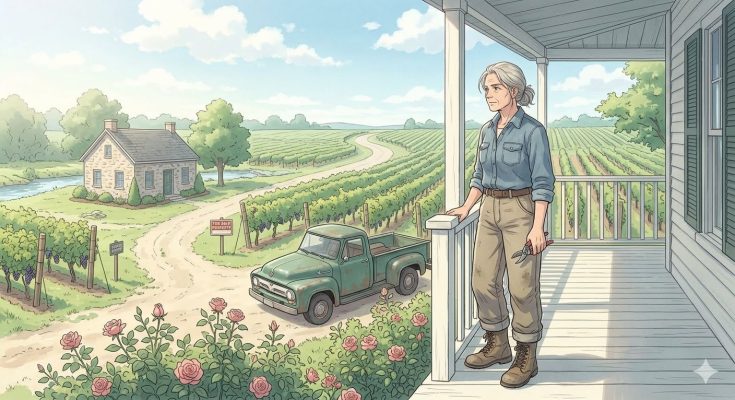
They drank without embracing.
It was not a reunion.
It was the first honest minute they had shared.
Some families require years to reach the second.
PART TWENTY-THREE — ANDREA’S EMPTY CHAIR
I became ill the following winter.
At first, I told no one.
The fatigue seemed ordinary.
At eighty-one, almost every discomfort can disguise itself as age.
Then I collapsed beside the rose garden.
Samantha found me.
The doctors discovered a heart condition that could be treated but not ignored.
For the first time in my life, people began making decisions without waiting for my permission.
Ben removed my work boots from the porch.
Samantha took my truck keys.
Greg installed handrails throughout the farmhouse.
Margaret moved into the guest room for two weeks despite my objections.
“You are enjoying this,” I told her.
“Immensely.”
“You have reorganized my kitchen.”
“It was an emergency.”
“My spices were alphabetical.”
“They were alphabetical by a system known only to you.”
Daniel arrived with medical articles.
Rebecca took them away.
Lily sat beside my bed and read aloud from Richard’s journals.
The entire family crowded into rooms that had once felt too large after his death.
One evening, I woke and heard Samantha crying in the kitchen.
I found her sitting at Richard’s table.
“I’m not dead,” I said.
She wiped her face.
“You could have been.”
“But I am not.”
“You hid it.”
“I did not know.”
“You knew something was wrong.”
“Yes.”
“Then you hid that.”
I sat across from her.
“I did.”
“Why?”
“Because I did not want to become a problem everyone had to manage.”
Her expression sharpened.
“Do you remember what you told Greg?”
“I have told Greg many things.”
“You told him not to call decisions mistakes because they shared one consequence.”
I sighed.
“You are using my own words against me.”
“You raised me properly.”
I reached across the table.
“I am sorry.”
“That is the beginning.”
“Yes.”
“Then here is the work.”
She placed a folder before me.
It contained a schedule for appointments, medication, and reduced responsibilities.
“You planned my life.”
“For three months.”
“I reject it.”
“You can reject Tuesday afternoons.”
“Why Tuesday afternoons?”
“That is when Margaret supervises you.”
“Then I especially reject Tuesday afternoons.”
From the hallway, Margaret called, “Your objection has been recorded and denied.”
Samantha began laughing through her tears.
I laughed with her.
The fear did not disappear.
But it no longer belonged to either of us alone.
PART TWENTY-FOUR — THE FINAL TABLE
I recovered slowly.
By spring, I could walk to the oldest vines with a cane.
Samantha walked beside me without offering her arm unless I asked.
That restraint was another form of love.
At the end of the row, we found a new stone marker.
Greg had placed it there.
The inscription contained a line from Richard’s letter.
DIFFICULT THINGS CAN BE TENDED.
Beneath it were two empty spaces.
“One for Dad,” Samantha said.
“And the other?”
“For you.”
“I am standing here.”
“It can wait.”
“Good.”
We sat beneath the vines.
“What happens when I’m gone?” I asked.
Samantha looked across the vineyard.
“We work.”
“That is not what I mean.”
“I know.”
She thought for a moment.
“Richard House continues.”
“The trust protects the land.”
“Ben retires, although he refuses to admit it.”
“Amara becomes director.”
“Greg keeps building homes.”
“Daniel teaches.”
“Rebecca decides what forgiveness means for her.”
“Lily grows up.”
“And you?”
Samantha rested her head against my shoulder.
“I sit at the kitchen table.”
“With whom?”
“Anyone willing to tell the truth.”
The answer satisfied me.
That summer, we held one final family dinner in the farmhouse.
Not because anyone was leaving.
Not because someone was getting married.
Not because disaster had forced us together.
We gathered because ordinary days deserve witnesses too.
Every chair was occupied.
Ben complained about retirement.
Amara corrected his version of vineyard history.
Margaret wore a blue hat that blocked Charles’s view.
Charles asked her to remove it.
She chose a larger one for dessert.
Daniel washed the dishes.
Rebecca dried them.
Lily secretly fed bread to the dog beneath the table.
Greg and Samantha stood near the window, arguing gently about whether the western vines needed pruning.
I watched all of them.
Years earlier, I had sat at that same table beside a dead phone after fifty-nine missed calls.
I had believed I was witnessing the destruction of my family.
I understand now that a family is not destroyed when its false peace ends.
It is destroyed when people value the appearance of peace more than the truth required to create it.
We had lost a house.
We had lost money.
We had lost years.
We had nearly lost one another.
But the chairs were full.
The doors were open.
No one had been hidden from the photographs.
No one had been asked to become smaller.
And no gift was being used as a chain.
Outside, evening settled across the vineyard.
The old vines stood beside the new ones.
Water moved through the channel we had rebuilt together.
Lights glowed inside Richard House.
The land no longer belonged only to our family.
In the ways that mattered, our family belonged to the land.
Samantha lifted her glass.
She did not make a speech.
She simply looked at me and said, “You’re here.”
I understood everything inside those two words.
“I’m here,” I answered.
For that night, no one needed more.
Not an apology.
Not a promise.
Not another miracle.
Only the table.
Only the truth.
Only the people who had finally learned how to stay.
And beyond the kitchen window, beneath a sky turning slowly gold, the vineyard continued growing toward a future none of us could own, but all of us had helped make possible.
PART TWENTY-FIVE — THE MORNING THE CHAIR WAS EMPTY
The first person to realize I was missing was Margaret.
She entered the kitchen at seven in the morning wearing a dark purple robe and carrying two cups of coffee.
One cup contained cream and sugar.
The other was black.
Mine.
She found the kitchen empty.
The light above the stove was still on.
Richard’s final journal rested open on the table.
My reading glasses lay across the page.
One of my work boots stood beside the back door.
The other was missing.
Margaret placed the coffee down.
“Andrea?”
She checked the study.
She checked the porch.
She climbed the stairs and opened my bedroom door.
The bed had not been slept in.
My cane was gone.
So was the old green coat Samantha kept threatening to throw away.
Margaret called Samantha.
Greg answered.
“What happened?”
“I don’t know yet.”
“What does that mean?”
“Your mother is not in the house.”
There was a brief silence.
Then Samantha’s voice came through the phone.
“What do you mean she isn’t there?”
“I mean her bed is untouched and her coat is gone.”
“Did you call Ben?”
“I’m calling him now.”
“We’re coming.”
Within fifteen minutes, the farmhouse filled with people.
Ben arrived first.
He checked the equipment sheds and the winery.
Greg searched the creek.
Samantha drove along the access roads with the windows lowered, calling my name.
Daniel inspected the water channel.
Amara gathered the apprentices and divided them into search teams.
Margaret stood beside Richard’s table staring at the open journal.
The page contained his original map of the property.
A small circle had been drawn near the northern ridge.
Margaret touched it.
The ink was fresh.
She called Ben.
“What is at the old north boundary?”
“Nothing.”
“Look at Richard’s map.”
Ben entered the kitchen.
His expression changed when he saw the circle.
“That isn’t nothing,” he said.
“What is it?”
“The first cabin.”
“What cabin?”
“Richard and Andrea lived there before the farmhouse was built.”
“Is it still standing?”
“Barely.”
The path to the northern ridge had not been cleared in years.
A fallen oak blocked the old road.
Greg and Daniel climbed over it on foot.
Samantha followed.
The morning fog hung between the trees, swallowing everything beyond twenty feet.
They found one of my footprints beside the dry creek bed.
Then another.
The print from my left boot was clear.
The mark beside it came from my cane.
“She walked all this way?” Samantha whispered.
“She should not have,” Greg said.
“That has never stopped her before,” Ben replied.
The cabin appeared through the fog shortly after eight.
Its roof sagged in the center.
Vines covered one wall.
A narrow line of smoke rose from the chimney.
The door stood partly open.
Samantha entered first.
I was sitting before the small fireplace wrapped in an old wool blanket.
A metal kettle hung above the flames.
One work boot rested on the floor beside me.
My swollen left foot was wrapped in cloth.
“You found me,” I said.
Samantha stared at me.
Fear became anger so quickly that I watched the transformation happen across her face.
“What are you doing?”
“Making tea.”
“You disappeared.”
“I went for a walk.”………….