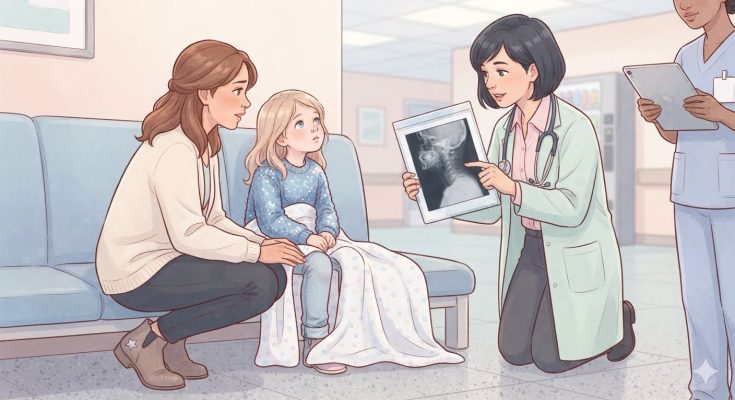
He had just explained that what appeared to be a charcoal-colored streak under her chin was not merely a surface mark. Beneath the skin lay deeper injury. A narrow band of damaged tissue mirrored the line on her neck, and the swelling extended toward the very structures my seven-year-old used to swallow and breathe.
Because Chloe was listening, the doctor chose his words with care. But I heard only one word clearly: compression.
He believed a narrow cord had been pulled tightly against her neck recently.
My mind instinctively resisted the idea. Children trip on playgrounds, catch their clothing on equipment, bump into furniture, or collide during recess—coming home with unexplainable bruises all the time. But this was no random scrape. The doctor was describing a pattern.
Suddenly, every strange detail from that week clicked into place: her refusal to eat, her complaints about swallowing, her lowered chin, her violent flinch when I reached for her hair, and her request to leave the car window open because warm air made breathing feel harder. They had seemed like separate, minor issues only because no one knew what to look for.
Hours earlier, I knew none of this when my phone rang at 12:15 PM on Tuesday. The school nurse reported that Chloe had refused lunch for the third time that week due to throat pain. By 12:27, I was kneeling beside her on the cold tile of the nurse’s office. Wearing her blue sequin sweater, Chloe sat on the exam table with her chin pressed tightly against her chest, refusing to look up.
The nurse, Mrs. Henderson, stood over her holding a cup of water, noting she had checked Chloe’s throat three times—no fever, no redness, no swelling. When I asked Chloe where it hurt, she touched the outside of her neck, saying it hurt when she swallowed or moved it.
Rather than shifting the exam, Mrs. Henderson gently suggested that children sometimes learn which complaints get them sent home early. She never directly called Chloe a liar, but the implication was clear. On the counter, the school’s health log reinforced her theory with neat entries: Monday, 11:58 AM—refused lunch, throat clear; Tuesday, 12:15 PM—repeated complaint, refused food and water. The problem seemed documented and dismissed.
Except Chloe was still in pain.
I asked if anyone had inspected the outside of her neck. Mrs. Henderson pointed to her flashlight, reiterating that her throat was clear. I asked again, emphasizing outside.
When I reached to lift Chloe’s hair, she jerked back violently, tearing the paper under her elbow, and covered her neck with trembling hands. Outside, lockers slammed and footsteps echoed as school life went on normally. That contrast snapped my patience. I locked the office door, placed my phone on the counter with the camera open, and instructed the nurse to move her hair.
Mrs. Henderson set down her cup and lifted the blonde strands under Chloe’s chin. A dark, jagged line traced across her neck above her collar. As Chloe swallowed, the skin around the mark pulled tight. Mrs. Henderson stepped back in shock, accidentally knocking her water cup over the health log, smudging the neat blue ink entries into a blur.
“That isn’t a rash,” the nurse said.
Before anyone could move, I took six clear photographs of the mark on my phone. Mrs. Henderson speculated it might be necklace dye or marker, but when she wiped the edge with wet gauze, nothing came off. The pigment belonged to Chloe’s skin.
When the nurse reached for a standard release form, I pushed the folder shut under her hand and insisted she record a precise description of what she saw. While Mrs. Henderson wrote, Chloe whispered a plea that chilled me: “Please don’t make me go back to lunch.”
I wrapped her coat around her shoulders without forcing her arms into the sleeves. I ignored the nurse’s suggestion to monitor her at home and carried Chloe straight past the main office.
Outside in the biting wind, Chloe asked to keep her window cracked because the heater made breathing difficult. Stopping at a red light, I noticed a silver star sticker stuck to my boot—a mundane detail in an otherwise surreal moment.
At the emergency department, the triage nurse reviewed my six photos before examining Chloe. Within minutes, Chloe was in a wheelchair, ordered not to eat or drink, and scheduled for immediate imaging.
While waiting under a thin blanket, Chloe repeatedly counted the ceiling tiles, stopping at nineteen each time. I kept my voice calm and steady, giving her space when she needed it and avoiding any sudden movements toward her neck.
Later, a radiology technician brought in a second doctor. This doctor lowered himself to Chloe’s eye level and held the scan where she could see it. He asked if anyone had pulled something tightly against her neck. Chloe looked at me without speaking.
Rather than pressing her, the doctor tilted the image toward me. The scan confirmed a narrow compression injury from a cord, suffered recently.
The timeline assembled itself instantly: three refused lunches, throat pain, neck tenderness, a hidden mark under her hair, her fear of the cafeteria, and her need for cold air to breathe. Individually, they seemed minor; together, they pointed to a recent, severe incident.
Looking at the doctor, I realized the scan proved the physical damage, but it couldn’t answer who had put a cord around my daughter’s neck. I didn’t press Chloe for the answer then. Rebuilding her trust and ensuring she felt safe was far more critical than forcing an immediate interrogation.
Chloe leaned closer to me, her fingers gripping my coat sleeve. Hours earlier, she had pulled away from my hand; now, she was choosing to hold on.
The doctor remained patient, letting the silence rest between us without pressure. Every adult in the room was finally listening to what Chloe’s body had been trying to tell us all along.